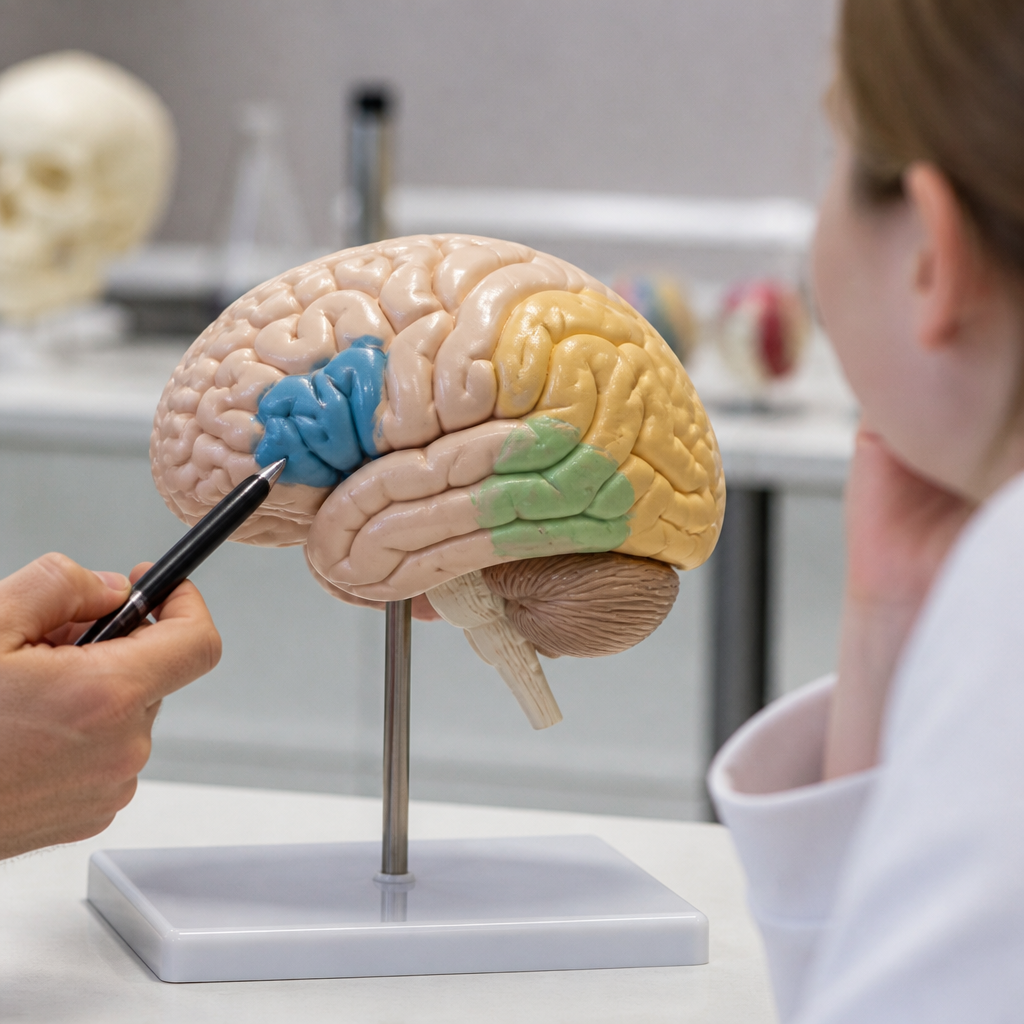
Broca’s area and Wernicke’s area are two of the most important language regions in the brain, and understanding how they differ is central to the biological bases of behavior in AP Psychology. Students often learn them as a simple pair—Broca’s for speech production, Wernicke’s for language comprehension—but that shortcut hides the richer story of how neural circuits support speaking, understanding, reading, writing, and recovering after injury. In practice, I have found that students remember these regions best when they connect anatomy to behavior: what a patient says, how fluent the speech sounds, whether meaning is preserved, and what kind of brain damage explains the pattern.
In neuroscience, a brain area is a region associated with a particular function, though rarely in complete isolation. Language is a clear example. Broca’s area, usually located in the left inferior frontal gyrus, is strongly involved in speech planning, grammatical structuring, and the motor organization of language output. Wernicke’s area, typically in the posterior superior temporal gyrus of the left hemisphere, is crucial for understanding spoken language and linking sounds to meaning. Aphasia is the loss or impairment of language due to brain damage, most often after stroke, traumatic brain injury, tumor, or infection. Different aphasias reveal how the brain normally processes language because specific deficits follow damage to specific networks.
This topic matters far beyond memorizing labels for an exam. It connects localization of function, hemispheric specialization, plasticity, cortical organization, and the methods psychologists and neurologists use to infer brain function from behavior. It also serves as a hub for broader biological bases of behavior content: neurons and neurotransmission, cortical lobes, split-brain research, neuroplasticity, endocrine influences on development, and research methods such as lesion studies, neuroimaging, and stimulation mapping. When students understand Broca’s area versus Wernicke’s area, they gain a framework for explaining why a person can speak without meaning, understand without speaking, read aloud without comprehension, or regain some language through therapy. That makes this comparison one of the most useful entry points into biopsychology.
Where Broca’s Area and Wernicke’s Area Are Located
Broca’s area sits in the frontal lobe, most commonly in Brodmann areas 44 and 45 of the dominant hemisphere, which is the left hemisphere for about 95 percent of right-handed people and a majority of left-handed people as well. Because it is in the inferior frontal gyrus near motor regions controlling the face, tongue, jaw, and larynx, its role in language output makes anatomical sense. Damage here often disrupts the ability to assemble articulate speech, especially when the task requires grammar, sequencing, and effortful verbal production.
Wernicke’s area lies farther back in the temporal lobe, classically in the posterior superior temporal gyrus of the dominant hemisphere, near the primary auditory cortex. That position also fits its function. Spoken language arrives as sound, and the surrounding temporal cortex helps decode phonemes, words, and semantic relationships. In modern neuroscience, language comprehension is understood as more distributed than early maps suggested, extending into the middle temporal gyrus, angular gyrus, supramarginal gyrus, and wider temporal-parietal networks. Still, Wernicke’s area remains the standard reference point because lesions there produce a reliable clinical pattern.
The two areas are connected by white matter pathways, most famously the arcuate fasciculus. This fiber tract allows representations of meaning and sound patterns to interact with systems that plan speech output. In introductory psychology, this connection explains why language is not just stored in one spot. A person may know what they want to say, hear language normally, and still fail to repeat phrases if the pathway linking comprehension and production is disrupted. That syndrome, called conduction aphasia, is a powerful demonstration that behavior depends on networks, not isolated centers.
What Each Area Does in Normal Language Processing
Broca’s area helps transform thoughts into structured utterances. It contributes to syntax, morphosyntax, verbal working memory, and speech motor planning. When I explain this to students, I emphasize that Broca’s area is not simply a mouth-movement center. People with intact oral muscles can still struggle to produce grammatical language if this region is injured. For example, they may omit function words, reduce verb endings, and speak in short bursts such as “walk dog yesterday” instead of “I walked the dog yesterday.” That pattern shows a disruption in linguistic organization, not just muscle control.
Wernicke’s area supports language comprehension by mapping auditory input onto meaningful lexical and semantic representations. It helps listeners distinguish speech sounds, recognize words, access meaning, and monitor whether language makes sense. In normal conversation, this system operates so quickly that comprehension feels effortless. Yet when it fails, the consequences are striking. A person may hear clearly but not understand speech, or may produce streams of words that are fluent in rhythm and intonation yet detached from intended meaning.
Language also depends on neighboring and connected regions. The motor cortex helps execute articulation. The angular gyrus contributes to reading and cross-modal integration. The visual word form area in the occipitotemporal cortex supports rapid word recognition during reading. The supplementary motor area helps initiate speech, and subcortical structures including the basal ganglia and thalamus influence fluency and timing. This broader network is why real patients do not always fit textbook descriptions perfectly. However, Broca’s area and Wernicke’s area remain essential anchors for understanding how complex mental functions emerge from the brain.
Broca’s Aphasia: Nonfluent Speech with Preserved Insight
Broca’s aphasia, sometimes called expressive or nonfluent aphasia, usually follows damage to the left inferior frontal region, often from a middle cerebral artery stroke. The classic presentation includes slow, effortful, halting speech; short phrases; impaired grammar; relatively preserved comprehension for simple sentences; and frustration or awareness of the deficit. Patients may know exactly what they want to say but cannot convert it into fluent spoken language. Writing is often similarly affected because written output also requires linguistic planning and sequencing.
One hallmark is agrammatism, the loss of normal grammatical structure. Instead of saying, “The boy is chasing the dog,” a patient might say, “Boy… chase… dog.” Content words remain, but articles, auxiliaries, and inflections disappear. Repetition is often impaired, naming can be difficult, and complex sentence comprehension may break down, especially when syntax rather than meaning carries the message. For instance, understanding the difference between “The cat was chased by the dog” and “The dog was chased by the cat” may become challenging because passive grammar requires precise syntactic processing.
In clinics, Broca’s aphasia is frequently accompanied by right-sided weakness or paralysis because the lesion may extend into nearby motor cortex. That association helps localize the injury. Yet there is variability. Some patients improve substantially with speech-language therapy, particularly when the lesion is limited and treatment starts early. Recovery often reflects neuroplasticity: surviving left-hemisphere tissue reorganizes, and homologous right-hemisphere regions may support compensatory strategies. Still, gains are usually greatest when therapy is intensive, specific, and focused on functional communication rather than rote drills alone.
Wernicke’s Aphasia: Fluent Speech with Impaired Meaning
Wernicke’s aphasia, often called receptive or fluent aphasia, usually results from damage to the left posterior superior temporal region. Speech remains fluent, with normal or even excessive rate, melody, and articulation, but comprehension is significantly impaired. Patients may produce long sentences filled with paraphasias, circumlocutions, and neologisms. A semantic paraphasia substitutes a related word, such as “chair” for “table.” A phonemic paraphasia changes sounds within a word, such as “tephelone” for “telephone.” Neologisms are entirely novel, meaningless word forms.
A classic bedside feature is reduced awareness of the deficit. Because the motor flow of speech is intact, patients may sound confident even when their language lacks clear meaning. They may answer questions with sentences that are grammatical on the surface but semantically empty, such as “Well this is the sort of thing one knows when one comes around the other way.” Repetition is usually impaired, naming is poor, and reading comprehension often suffers because language meaning is disrupted across modalities.
The distinction between fluency and meaning is the core lesson. In Broca’s aphasia, meaning may be relatively preserved internally, but expression is effortful. In Wernicke’s aphasia, expression sounds easy, but the semantic system is impaired. This contrast gives students a concrete example of dissociation, a major concept in cognitive neuroscience. When one mental ability is impaired and another is spared, researchers can infer that they rely on partly separable neural systems.
Key Differences, Related Syndromes, and How Clinicians Diagnose Them
Neurologists and speech-language pathologists do not diagnose aphasia from a single symptom. They assess spontaneous speech, auditory comprehension, repetition, naming, reading, writing, and pragmatic communication. Standard tools include the Boston Diagnostic Aphasia Examination and the Western Aphasia Battery. Brain imaging, especially MRI and CT, identifies lesion location, while diffusion tensor imaging can reveal white matter damage affecting pathways such as the arcuate fasciculus.
| Feature | Broca’s Aphasia | Wernicke’s Aphasia |
|---|---|---|
| Primary lesion area | Left inferior frontal gyrus | Left posterior superior temporal region |
| Speech fluency | Nonfluent, effortful, halting | Fluent, smooth, often rapid |
| Comprehension | Relatively preserved for simple speech | Markedly impaired |
| Grammar | Agrammatic, telegraphic | Often grammatically formed but semantically disorganized |
| Awareness of deficit | Usually good | Often reduced |
| Repetition | Impaired | Impaired |
Several related syndromes deepen the picture. Conduction aphasia often follows arcuate fasciculus damage and causes relatively fluent speech and fair comprehension but severely impaired repetition. Global aphasia results from large left-hemisphere lesions and disrupts nearly all language functions. Anomic aphasia features relatively fluent speech and good comprehension with major word-finding difficulty. These patterns matter in AP Psychology because they show that language is modular but interconnected. The brain divides labor across regions, yet normal behavior depends on coordinated activity among those regions.
Clinical diagnosis also depends on ruling out related disorders. Dysarthria is a motor speech disorder caused by weakness or incoordination of speech muscles, not a language disorder. Apraxia of speech involves impaired motor planning for speech movements, often overlapping with Broca’s lesions but conceptually distinct from aphasia. Delirium, hearing loss, dementia, and psychiatric conditions can also affect communication. Accurate diagnosis requires careful testing, not guessing based on a few unusual sentences.
Why This Comparison Matters for Biological Bases of Behavior
Broca’s area versus Wernicke’s area is a foundational case study in localization of function, the principle that specific brain regions contribute disproportionately to specific tasks. Paul Broca’s nineteenth-century patient “Tan,” who could understand language better than he could produce it, and Carl Wernicke’s later patients with fluent but nonsensical speech, provided early lesion evidence linking anatomy to behavior. These cases helped establish modern neuropsychology by showing that mental functions can be studied scientifically through brain-behavior relationships.
At the same time, modern evidence corrects oversimplified textbook maps. Functional MRI, cortical stimulation during neurosurgery, lesion-symptom mapping, and magnetoencephalography show that language involves distributed left-lateralized networks with important right-hemisphere contributions to prosody, discourse, and pragmatic meaning. Bilingualism, literacy, age of acquisition, and developmental disorders can alter how these networks are organized. That nuance is important for students because AP Psychology emphasizes both localization and plasticity. Brain systems are specialized, but they are not static.
This language hub also points outward to the rest of biological bases of behavior. Studying aphasia reinforces the role of the cerebral cortex, especially frontal and temporal lobes. It connects to neurotransmission because stroke, hypoxia, and excitotoxic damage affect synaptic signaling. It links to genetics and development because hemispheric specialization emerges over time and varies across individuals. It even relates to consciousness and cognition because inner speech, self-monitoring, and verbal thought depend on these same networks. If you are building a strong AP Psychology foundation, use Broca’s and Wernicke’s areas as organizing landmarks, then connect them to sensation, perception, memory, development, and research methods.
Conclusion
Broca’s area and Wernicke’s area are not just two labels to memorize. They are a practical framework for understanding how the brain turns sound into meaning and meaning into speech. Broca’s area, in the left frontal lobe, is most closely associated with speech production, syntactic planning, and effortful language output. Wernicke’s area, in the left temporal region, is most closely associated with language comprehension and meaningful interpretation of speech. Damage to either system produces aphasia, but the pattern of impairment differs in ways that reveal how language is organized in the brain.
For AP Psychology, this comparison unlocks several core ideas at once: localization of function, hemispheric specialization, neural pathways, lesion methods, and neuroplasticity after injury. It also serves as a reliable hub for the wider biological bases of behavior unit because language engages cortical anatomy, cognition, development, and clinical research. When you can explain why Broca’s aphasia is nonfluent but meaningful, why Wernicke’s aphasia is fluent but often meaningless, and how the arcuate fasciculus links them, you are thinking like a psychologist rather than reciting isolated facts.
Use this page as your anchor for the biological bases of behavior topic, then deepen your understanding by reviewing the lobes of the brain, split-brain studies, neurons and synapses, neuroimaging, and plasticity. Master these connections, and the language chapter becomes one of the clearest examples of how biology shapes behavior.
Frequently Asked Questions
1. What is the difference between Broca’s area and Wernicke’s area?
Broca’s area and Wernicke’s area are both major language-related regions in the brain, but they contribute to language in different ways. Broca’s area, usually located in the left frontal lobe, is most closely associated with speech production. It helps organize the motor patterns needed to turn thoughts into spoken words, and it also plays an important role in grammar, sentence structure, and the planning of expressive language. Wernicke’s area, usually found in the left temporal lobe, is more strongly tied to language comprehension. It helps the brain interpret the meaning of spoken and written language, recognize words, and connect sounds to meaning.
Students often remember this difference with the shorthand “Broca’s speaks, Wernicke’s understands,” and that is a useful starting point. However, the reality is more complex. Broca’s area does not work alone whenever you speak, and Wernicke’s area does not work alone whenever you listen or read. Language depends on a larger network that includes auditory areas, motor cortex, angular gyrus, visual regions, and white matter pathways that connect these systems. In other words, Broca’s area and Wernicke’s area are best understood as key hubs in a language network rather than isolated language switches.
That broader view matters in AP Psychology because it shows how behavior emerges from coordinated brain systems. Speech, comprehension, reading, and writing all require communication across multiple brain regions. Understanding the distinct but connected roles of Broca’s area and Wernicke’s area helps explain why different brain injuries can produce very different language problems, and why language is one of the clearest examples of localization of function in psychology and neuroscience.
2. What happens if Broca’s area is damaged?
Damage to Broca’s area often leads to Broca’s aphasia, sometimes called expressive aphasia or nonfluent aphasia. People with this condition usually know what they want to say, but they have great difficulty producing language smoothly. Their speech may be slow, effortful, and broken into short phrases. They often leave out small connecting words such as “is,” “the,” or “and,” producing what is sometimes called telegraphic speech. For example, instead of saying, “I am going to the store this afternoon,” a person might say, “Go… store… afternoon.”
A key feature of Broca’s aphasia is that comprehension is often relatively better preserved than speech production, especially for simple sentences. Many individuals can understand much of what others are saying, which can make the condition especially frustrating. They may be fully aware that their speech does not match their intended message. This awareness is clinically important because it distinguishes Broca’s aphasia from some other forms of aphasia in which insight is reduced. Writing can also be affected, since written language shares many of the same expressive and grammatical processes as speaking.
That said, Broca’s area is not only about moving the mouth to form words. Damage can also interfere with syntax, sequencing, and the grammatical structure of language. Some patients struggle more with complex sentences than with simple vocabulary. This is one reason modern neuroscience treats Broca’s area as a region involved in organizing language output and structure, not just “speech muscles.” In AP Psychology, this is a great example of how a lesion can reveal the function of a brain region while also showing that even a familiar textbook label often simplifies a richer biological story.
3. What happens if Wernicke’s area is damaged?
Damage to Wernicke’s area typically causes Wernicke’s aphasia, often called receptive aphasia or fluent aphasia. In this condition, speech may remain smooth, well-paced, and grammatically shaped, but the content can become confusing, vague, or nonsensical. A person may produce long streams of words with normal rhythm and intonation, yet the words may not fit the topic or may include made-up terms called neologisms. Because language flow is preserved, people sometimes assume speech is normal at first, but closer listening reveals serious problems with meaning.
The central problem in Wernicke’s aphasia is impaired comprehension. Individuals often have trouble understanding spoken language and may also struggle with reading comprehension. Because they cannot reliably connect words to meaning, they may answer questions in ways that do not match what was asked. For example, if asked where they live, they might respond with a fluent sentence that sounds structurally complete but does not actually provide an answer. Unlike many people with Broca’s aphasia, individuals with Wernicke’s aphasia may have less awareness that their speech is impaired, which can affect communication and treatment.
This condition highlights why language is more than just the ability to make sounds. Someone with Wernicke’s aphasia may speak easily, but communication still breaks down because understanding and meaningful word selection are disrupted. In biological psychology, that distinction is powerful: fluent speech is not the same thing as effective language. Wernicke’s area helps the brain map sounds and words onto meaning, making it essential for comprehension, vocabulary access, and coherent verbal expression. Its role also helps explain why damage can affect both listening and reading, since both rely on understanding symbols as meaningful language.
4. Do Broca’s area and Wernicke’s area work together when we use language?
Yes, absolutely. Although textbooks often introduce Broca’s area and Wernicke’s area as separate functions, real language use depends on constant interaction between them and many other brain regions. When you hear someone speak, auditory areas first process the sound. Wernicke’s area helps identify the words and interpret their meaning. If you then want to respond, information must be coordinated with frontal language and motor planning systems, including Broca’s area, so that you can select words, organize grammar, and produce speech. This is not a step-by-step relay in a simple line; it is a dynamic exchange across a distributed neural network.
One of the classic connections between these regions is the arcuate fasciculus, a bundle of nerve fibers that helps transmit information between posterior and anterior language systems. Damage to this pathway can cause conduction aphasia, in which a person may understand language and speak fairly fluently but has unusual difficulty repeating words or phrases exactly. That finding has been especially important in neuroscience because it shows that not only brain regions but also the connections between them matter. In other words, language problems can arise from broken communication within the network, not just injury to a single “language center.”
This network perspective also explains why speaking, listening, reading, and writing overlap so much. Reading involves visual processing plus language comprehension. Writing involves language planning plus motor output. Even conversation requires memory, attention, social interpretation, and timing. For AP Psychology students, this is a useful reminder that localization of function does not mean one behavior equals one tiny brain spot. Instead, certain regions make especially important contributions, and Broca’s area and Wernicke’s area are two of the clearest examples of specialized but interconnected language processing in the brain.
5. Can people recover language abilities after damage to Broca’s area or Wernicke’s area?
Recovery is often possible, but it varies widely depending on the size and location of the injury, the person’s age and overall health, how quickly treatment begins, and which language abilities were affected. Some people regain substantial function after a stroke or traumatic brain injury, while others continue to experience long-term aphasia. Early improvement may occur as swelling decreases and surviving tissue resumes function. Over time, rehabilitation can help the brain reorganize language processing, a phenomenon related to neuroplasticity. This means that other parts of the brain may partially compensate for damaged language networks, especially with structured therapy and repeated practice.
Speech-language therapy is one of the most important tools in recovery. Treatment often focuses on improving word retrieval, sentence formation, comprehension strategies, reading, writing, and conversational skills. Therapy can be highly individualized. A person with Broca’s aphasia may work on increasing fluency and grammatical completeness, while a person with Wernicke’s aphasia may focus more on comprehension, word meaning, and monitoring whether speech makes sense. Family support also matters because communication improves when loved ones learn strategies such as slowing down, asking clear questions, using gestures, and giving the person time to respond.
From an AP Psychology perspective, recovery from aphasia is a strong example of both localization and plasticity. The initial impairment shows that specific brain regions are crucial for language, but recovery shows that the brain is not fixed or helpless after injury. It can adapt, reroute, and strengthen remaining pathways to improve function. While some deficits may persist, many people make meaningful gains and develop effective ways to communicate. That balance between specialized brain structure and the capacity for reorganization is one of the most important lessons students can take from the study of Broca’s area, Wernicke’s area, and aphasia.