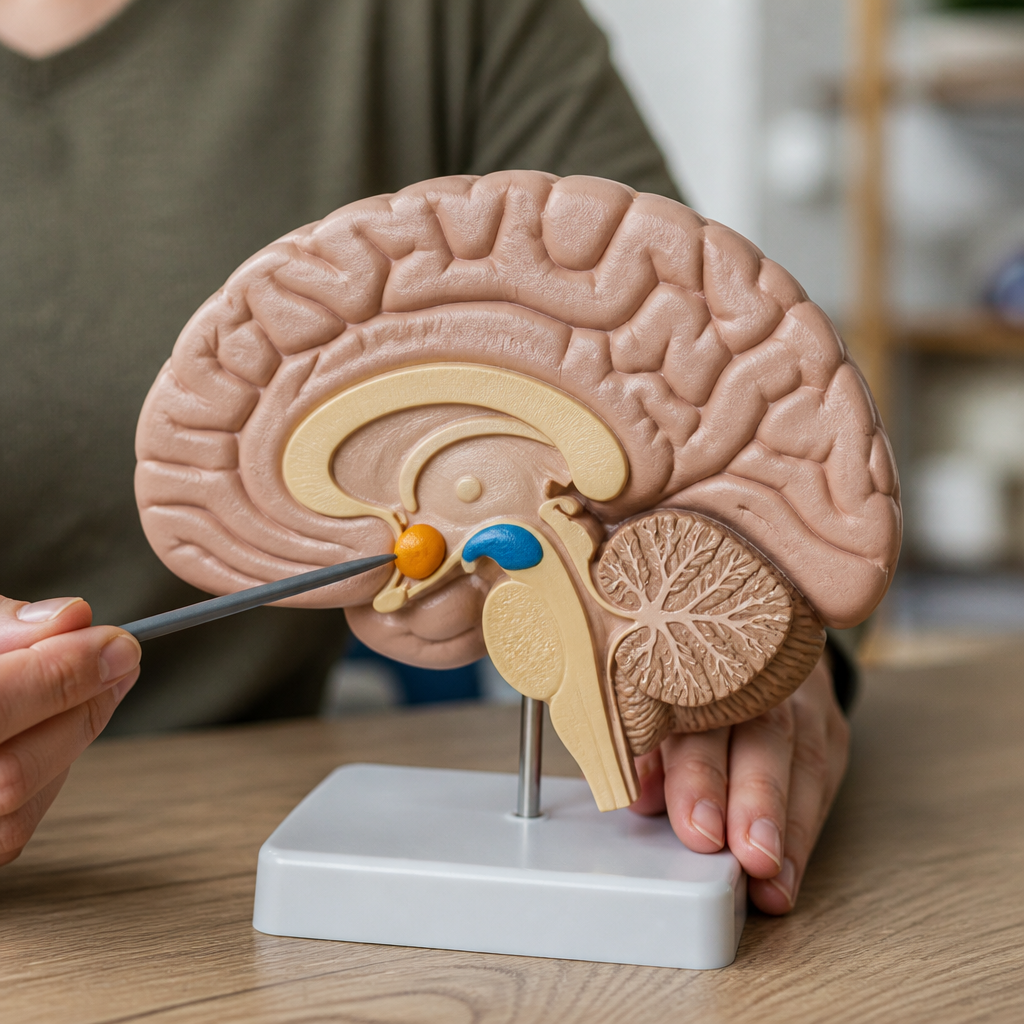
The amygdala and prefrontal cortex are two of the most important brain systems in AP Psychology because they help explain why people react emotionally in the moment, calm themselves later, and sometimes struggle to do either. In the biological bases of behavior unit, students learn that thoughts, feelings, and actions emerge from neural activity, endocrine signaling, brain structures, and experience. Few comparisons make that principle clearer than amygdala vs. prefrontal cortex. The amygdala rapidly detects emotional significance, especially threat, while the prefrontal cortex evaluates context, predicts consequences, and regulates behavior. Together they shape fear, anger, anxiety, decision-making, impulse control, and social judgment.
In practical terms, the amygdala is an almond-shaped set of nuclei deep in the temporal lobes, part of the limbic system, though that label can oversimplify its many connections. The prefrontal cortex sits at the front of the frontal lobes and includes several regions with distinct functions, especially the dorsolateral, ventromedial, and orbitofrontal areas. When teachers describe an “emotional brain” and a “thinking brain,” they are usually summarizing interactions between these systems. That shorthand is useful for beginners, but it can become misleading if it implies that emotion and reasoning are separate. In real brains, they are integrated continuously through neural circuits, neurotransmitters, and feedback loops.
This topic matters because it connects nearly every major idea in biological bases of behavior. It links neurons and neurotransmitters to larger brain networks. It shows how the autonomic nervous system supports fight, flight, or freeze responses. It helps explain stress hormones such as cortisol and adrenaline. It also provides a bridge to learning, memory, development, mental health, and social behavior. In my experience teaching and writing about AP Psychology concepts, students understand the unit much faster when they stop memorizing isolated structures and instead ask a better question: what job is each structure doing in a real emotional event?
Consider a common example. You hear footsteps behind you late at night. Your body tenses before you consciously identify the sound. That fast shift involves the amygdala helping detect possible danger and mobilize a response through connections with the hypothalamus and brainstem. A second later, the prefrontal cortex assesses the situation: the footsteps belong to a neighbor, the street is well lit, and there is no immediate threat. Heart rate falls, muscles relax, and behavior changes. That sequence captures the core of this hub article. To understand emotional responses in AP Psychology, you must understand both rapid detection and top-down regulation, plus the biological systems that support them.
What the amygdala does in emotional responses
The amygdala is best known for fear processing, but its role is broader: it helps assign emotional salience to stimuli, detect biologically relevant cues, support emotional learning, and influence attention and memory. It is especially responsive when something is ambiguous, novel, threatening, or socially significant. Research on fear conditioning shows that the amygdala helps organisms learn associations between neutral cues and aversive outcomes. If a tone repeatedly predicts a shock, the amygdala becomes central to the learned fear response. This is why it is often discussed in classical conditioning, trauma, and phobia formation.
The amygdala does not work alone. It receives sensory input from the thalamus and cortex and sends outputs to the hypothalamus, hippocampus, nucleus accumbens, and brainstem. Those pathways explain why emotional reactions can feel immediate and physical. Through the hypothalamus, the amygdala can trigger autonomic changes such as increased heart rate, sweating, and pupil dilation. Through brainstem circuits, it can alter startle responses and vigilance. Through interactions with the hippocampus, it strengthens memory for emotionally arousing events. Students often remember where they were during a frightening or highly exciting event because amygdala activation can enhance memory consolidation, particularly when stress hormones are elevated.
Importantly, the amygdala responds to positive as well as negative stimuli. It can activate during reward anticipation, emotional facial recognition, and personally meaningful experiences. However, AP Psychology usually emphasizes its role in fear and aggression because those functions are well documented and easy to connect to survival. Damage to the amygdala can reduce fear recognition, impair threat learning, and alter social judgments. The classic patient S.M., who had bilateral amygdala damage, became widely known for unusually low fear responses and difficulty recognizing fear in faces. That case illustrates a major principle: emotional responses depend on specialized neural systems, not just personality or willpower.
What the prefrontal cortex does in judgment and self-control
The prefrontal cortex is the brain’s chief system for planning, inhibition, working memory, flexible thinking, and regulation of emotion. In AP Psychology, it matters because it explains why humans can pause before acting, compare options, follow rules, and override impulses. The prefrontal cortex is not a single switch for rationality. Different subregions contribute in different ways. The dorsolateral prefrontal cortex supports working memory, attention control, and goal-directed problem solving. The ventromedial prefrontal cortex integrates emotion with valuation and decision-making. The orbitofrontal cortex helps evaluate rewards, punishments, and changing contingencies in social and practical situations.
When people say the prefrontal cortex “regulates” the amygdala, they mean that cortical networks can reinterpret stimuli, apply context, and inhibit automatic responses. This top-down control is essential in everyday life. A student who receives critical feedback may feel an immediate surge of embarrassment or anger, but the prefrontal cortex can reframe the event as useful information and prevent an impulsive outburst. In laboratory studies, cognitive reappraisal, a strategy where people change how they interpret a situation, is associated with increased prefrontal activation and reduced amygdala response. That finding helps explain why coping skills can measurably change emotional reactions.
The prefrontal cortex is also sensitive to development, fatigue, substances, and stress. It continues maturing into the mid-twenties, which is one reason adolescents often show stronger sensation seeking and less consistent impulse control than adults. Sleep deprivation weakens prefrontal functioning and makes emotional regulation harder. Alcohol and some drugs impair inhibition and judgment partly by disrupting frontal systems. Acute stress can narrow prefrontal control as the brain shifts toward faster, habitual, and survival-oriented responding. That tradeoff is adaptive in true emergencies but costly during exams, arguments, or workplace decisions where careful reasoning matters more than speed.
How the amygdala and prefrontal cortex work together
The most accurate answer to “amygdala vs. prefrontal cortex” is that emotional responses emerge from interaction, not competition. The amygdala identifies significance quickly; the prefrontal cortex interprets significance in context and shapes the final behavioral response. The hippocampus adds memory and situational detail, the hypothalamus coordinates hormonal and autonomic responses, and the anterior cingulate cortex monitors conflict and errors. Emotional behavior is therefore a network function. Still, the amygdala-prefrontal relationship remains the clearest core comparison for students building a mental map of the biological bases of behavior.
A useful way to understand this interaction is to compare timing and function. The amygdala is optimized for speed and prioritization. The prefrontal cortex is optimized for evaluation and control. If you touch a hot pan, withdraw your hand, and then think about what happened, those stages involve different levels of processing. The same pattern appears in social emotion. An angry facial expression may trigger a rapid amygdala response before you consciously decide whether the person is joking, upset, or reacting to someone else. The prefrontal cortex then updates the interpretation using context, memory, and expectations.
| Brain region | Primary role | Typical emotional effect | AP Psychology connection |
|---|---|---|---|
| Amygdala | Detects salience, especially threat; supports fear learning | Rapid arousal, vigilance, emotional tagging of events | Fear conditioning, aggression, emotional memory |
| Prefrontal cortex | Plans, inhibits, evaluates context, regulates responses | Impulse control, reappraisal, delayed gratification | Executive function, decision-making, adolescence |
| Hippocampus | Forms contextual and episodic memory | Distinguishes safe from unsafe settings | Memory, stress effects, learning |
| Hypothalamus | Coordinates autonomic and endocrine responses | Fight-or-flight activation, hormone release | Homeostasis, stress, endocrine system |
This circuitry also explains why emotional reactions can be both helpful and inaccurate. The amygdala’s bias toward caution can save lives when danger is real, but it can also produce false alarms. The prefrontal cortex can correct those alarms, yet under heavy stress it may have less control. That is why people with anxiety disorders often know their fear is disproportionate and still feel unable to stop it. Their conscious beliefs do not instantly silence deeply learned threat responses. Effective treatment often combines learning-based approaches, such as exposure therapy, with strategies that strengthen regulation and reduce avoidance.
Neurotransmitters, hormones, and stress pathways
To fully cover biological bases of behavior, brain structures must be connected to chemistry. Emotional responses depend on neurotransmitters and hormones that influence amygdala and prefrontal activity. Norepinephrine heightens alertness and attention during arousal. Dopamine contributes to reward learning, motivation, and salience detection. Serotonin is involved in mood regulation and impulse control, though its effects vary across receptor systems and brain regions. Gamma-aminobutyric acid, or GABA, is the major inhibitory neurotransmitter and helps limit excessive neural firing. Glutamate is the major excitatory neurotransmitter and supports learning, including emotional learning.
The endocrine system is equally important. When the amygdala signals threat, the hypothalamus can activate the sympathetic nervous system and the hypothalamic-pituitary-adrenal axis. The adrenal medulla releases adrenaline, also called epinephrine, producing immediate physiological arousal. The adrenal cortex releases cortisol through HPA axis signaling, supporting longer-lasting energy mobilization and stress adaptation. Short-term stress can sharpen memory for central details, but chronic cortisol exposure is associated with impaired prefrontal functioning and can negatively affect the hippocampus. This helps explain why prolonged stress often produces irritability, forgetfulness, reduced concentration, and emotional reactivity.
One of the most useful AP Psychology insights is that biology creates tradeoffs. The same stress system that helps a person slam on the brakes in traffic can undermine thoughtful decision-making during a long period of uncertainty. Students preparing for exams often experience this directly. Moderate arousal may improve focus, but sustained stress, sleep loss, and repeated rumination make prefrontal regulation less efficient. In other words, the body’s emergency tools are powerful, but they are not meant to stay switched on indefinitely.
Development, mental health, and real-world applications
Developmental psychology strengthens this comparison. The amygdala becomes functional early, while prefrontal control develops more gradually. This developmental mismatch helps explain adolescent emotional intensity, sensitivity to peers, and variable judgment. It does not mean teenagers are irrational by default. It means the systems for motivation and emotional salience are highly active at a time when long-range control systems are still maturing. In educational settings, this is why structure, feedback, sleep, and stress management matter so much for performance and behavior.
Mental health conditions often involve disrupted communication between the amygdala and prefrontal cortex. In anxiety disorders and post-traumatic stress disorder, amygdala responses to threat-related cues may become exaggerated, while contextual regulation and extinction learning are less effective. In depression, emotional bias, rumination, reward processing changes, and altered frontal-limbic connectivity can shape mood and cognition. In attention-deficit/hyperactivity disorder, frontal executive networks related to inhibition and sustained attention are especially relevant. In substance use disorders, reward circuits and weakened control systems can combine to make cravings more difficult to resist. These examples show why biological bases of behavior are foundational, not optional background material.
Real-world applications extend beyond diagnosis. Cognitive behavioral therapy often teaches people to identify automatic thoughts and reframe interpretations, engaging prefrontal processes that can reduce amygdala-driven distress over time. Exposure therapy helps the brain learn that a feared cue is not always dangerous, updating associations through new learning rather than simple erasure of old fear memories. Mindfulness training can improve attention regulation and reduce reactive responding in some individuals. Exercise and sleep also matter biologically: both support mood regulation, stress resilience, and executive functioning. None of these tools “turns off” emotion. The goal is more precise regulation, not emotional numbness.
How this hub connects the biological bases of behavior unit
As a hub for biological bases of behavior, this topic connects naturally to articles on neurons, synaptic transmission, neurotransmitters, the nervous system, endocrine glands, split-brain research, hemispheric specialization, sensation and perception links, sleep and circadian rhythms, stress, consciousness, learning, and memory. If a student understands the amygdala-prefrontal relationship, those related topics become easier to organize. Neurons explain signaling. Neurotransmitters explain modulation. The autonomic nervous system explains bodily arousal. The endocrine system explains hormonal stress responses. Memory systems explain why emotional events are learned and retrieved differently from neutral ones.
The clearest takeaway is simple: the amygdala helps the brain react quickly to emotionally important information, and the prefrontal cortex helps the brain interpret, regulate, and act wisely on that information. Emotional responses are not signs that reason has failed; they are biological signals that must be integrated with context. In AP Psychology, that insight helps students move from memorization to explanation. It also helps in everyday life. When a reaction feels immediate and overwhelming, there is often a fast salience system driving it. When a person pauses, labels the feeling, and chooses a better response, frontal regulation is doing its work.
Use this article as your starting map for the biological bases of behavior unit, then build outward to the linked subtopics on neurons, neurotransmitters, stress, brain anatomy, and memory. The more clearly you understand how the amygdala and prefrontal cortex shape emotional responses, the easier it becomes to explain behavior with precision instead of guesswork.
Frequently Asked Questions
What is the difference between the amygdala and the prefrontal cortex in emotional responses?
The amygdala and the prefrontal cortex play very different but closely connected roles in emotion. The amygdala is best understood as a fast-acting emotional alarm system. It helps detect biologically important information, especially potential threats, and can trigger rapid reactions such as fear, anger, vigilance, or stress arousal before a person has fully thought through what is happening. In AP Psychology, this matters because it shows how emotional responses can begin automatically and unconsciously as part of the brain’s survival machinery.
The prefrontal cortex, by contrast, is involved in higher-order thinking, judgment, planning, impulse control, attention, and emotional regulation. Rather than creating the first wave of emotional reactivity, it helps interpret the situation, evaluate whether the threat is real, compare the moment to past experience, and decide what response makes the most sense. If the amygdala says, “React now,” the prefrontal cortex often says, “Pause, think, and choose.” This is why the prefrontal cortex is so important for self-control, delayed gratification, and calming down after an upsetting event.
The key idea is not that one part is “emotional” and the other is “rational” in a simplistic way. Emotional behavior usually emerges from interaction between them. A student startled by a loud noise may feel immediate fear because of amygdala activation, then quickly realize it was only a locker slamming because the prefrontal cortex reinterprets the event. That dynamic relationship helps explain why people sometimes overreact in the moment and then regain control once the thinking parts of the brain catch up.
Why does the amygdala respond faster than the prefrontal cortex?
The amygdala responds faster because the brain is designed to prioritize survival. From an evolutionary perspective, it is safer to react quickly to a possible danger and be wrong than to react too slowly and face a real threat. The amygdala is part of a rapid detection network that can respond to emotionally significant stimuli, especially fear-related cues, before detailed conscious analysis is complete. This speed gives people a survival advantage in situations where hesitation could be costly.
The prefrontal cortex takes longer because its job is more complex. It evaluates context, weighs consequences, considers goals, inhibits impulses, and integrates memory and social rules into behavior. That kind of processing is slower than an immediate alarm response. In practical terms, this is why someone may jump, yell, or tense up before realizing there is no actual danger. The initial reaction is fast and automatic; the later correction is slower and more deliberate.
In AP Psychology, this contrast helps students understand dual aspects of behavior: automatic processing and controlled processing. The amygdala supports fast, reflexive emotional readiness, while the prefrontal cortex supports thoughtful regulation. This timing difference is also one reason stress can make people act impulsively. Under intense pressure, the quick-response emotional system may dominate before the regulatory system has enough time or capacity to step in effectively.
How do the amygdala and prefrontal cortex work together to regulate emotions?
The amygdala and prefrontal cortex are best viewed as partners in an ongoing feedback loop rather than isolated brain regions acting alone. The amygdala detects emotionally relevant information and helps generate bodily and psychological responses, such as increased alertness, fear, or urgency. The prefrontal cortex monitors those responses and can either strengthen them, redirect them, or reduce them depending on the situation. Emotional regulation happens when the prefrontal cortex successfully interprets the meaning of an event and adjusts the amygdala-driven reaction to fit current goals and reality.
For example, imagine a student who receives a text that sounds negative. The amygdala may trigger immediate anxiety or defensiveness. A few moments later, the prefrontal cortex may step in and consider other explanations: maybe the sender was in a hurry, maybe tone was misread, or maybe more information is needed. That top-down regulation can reduce the intensity of the emotional reaction. This is one reason strategies such as cognitive reappraisal, deep breathing, and pausing before responding can be effective: they give the prefrontal cortex more opportunity to guide behavior instead of letting the amygdala run the situation.
This interaction also helps explain individual differences. People with stronger emotion-regulation skills often show better prefrontal control over emotional impulses. When regulation is weaker, the amygdala may exert a stronger influence on behavior, leading to impulsivity, overreaction, or difficulty calming down. In biological psychology, that connection is important because it links neural circuits to real-life behaviors such as conflict management, test anxiety, frustration tolerance, and resilience under stress.
What happens when the amygdala becomes overactive or the prefrontal cortex has trouble regulating emotions?
When the amygdala becomes overactive, a person may become more sensitive to threat, more reactive to stress, and more likely to interpret ambiguous situations as dangerous or upsetting. This can contribute to intense fear responses, chronic anxiety, irritability, emotional outbursts, or hypervigilance. In everyday life, an overactive amygdala might show up as panic during a minor conflict, strong anger over small frustrations, or difficulty feeling safe even when there is no clear threat present.
If the prefrontal cortex has trouble regulating those emotional signals, the person may struggle with impulse control, decision-making, and emotional balance. They may know logically that they should stay calm, but have difficulty actually doing it in the moment. This is especially relevant under stress, fatigue, or strong arousal, because those conditions can reduce prefrontal efficiency and make emotional regulation harder. Adolescents often show this pattern more strongly because the prefrontal cortex continues developing into early adulthood, which is one reason emotional intensity and impulsive behavior can be more common during the teen years.
From an AP Psychology perspective, this is a powerful example of how brain development, neural communication, hormones, and experience shape behavior. It also shows why emotional difficulties are not simply matters of willpower. Brain systems, stress exposure, sleep, learning history, and environmental demands all influence how effectively the prefrontal cortex can regulate amygdala-driven reactions. Understanding that relationship gives students a more accurate and compassionate framework for thinking about anxiety, aggression, emotional dysregulation, and self-control.
Why is the amygdala vs. prefrontal cortex comparison so important in AP Psychology?
This comparison is central in AP Psychology because it brings together many major course themes in one clear example. Students are asked to understand that behavior does not come from a single cause. Instead, thoughts, feelings, and actions emerge from interactions among brain structures, neural pathways, hormones, experience, learning, and context. The amygdala versus prefrontal cortex comparison makes that principle concrete by showing how rapid emotional reactions and deliberate self-regulation come from different but connected parts of the brain.
It also helps students connect biological bases of behavior with topics such as stress, sensation and perception, memory, development, motivation, and abnormal psychology. For instance, the amygdala is involved in emotional salience and fear learning, while the prefrontal cortex contributes to executive functions such as planning and inhibition. Together, they help explain why people can react before thinking, why stress can impair judgment, why coping skills can improve regulation, and why development matters in emotional maturity.
Most importantly, this comparison gives students a practical model for understanding real behavior. It explains why someone may blurt something out in anger and regret it later, why calming techniques can work, why trauma can heighten reactivity, and why good decision-making often depends on strengthening reflective thought before acting. In that sense, the amygdala and prefrontal cortex are not just test concepts. They are foundational to understanding how humans navigate fear, self-control, social conflict, and emotional life itself.