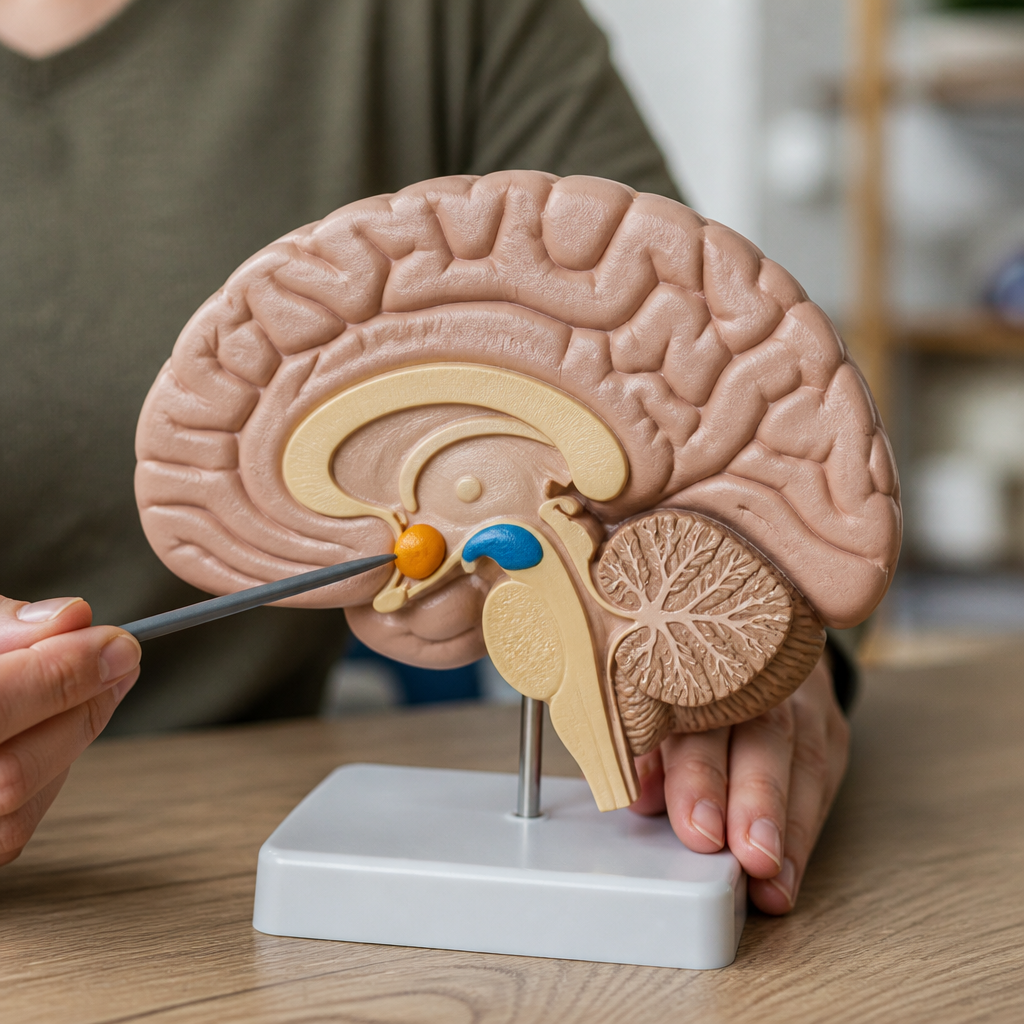
Bottom-up vs. top-down processing explains how the brain turns raw sensory input into meaningful experience, and it sits at the center of sensation and perception in AP Psychology. Sensation refers to the detection of physical stimuli by sensory receptors, such as light hitting the retina or sound waves moving the eardrum. Perception is the brain’s organization and interpretation of that input. In classroom terms, sensation is receiving data and perception is making sense of it. In real life, the two are never far apart. When you smell smoke, recognize a friend in a crowd, or misread a blurry sign, you are relying on both pathways.
Bottom-up processing starts with sensory receptors and builds toward a complete perceptual experience. It is data-driven. The brain begins with basic features such as edges, contrast, pitch, temperature, or texture, then assembles them into patterns, objects, and scenes. Top-down processing works in the opposite direction. It is concept-driven. The brain uses prior knowledge, expectations, goals, language, and context to interpret incoming information quickly. If bottom-up processing is like assembling a puzzle piece by piece, top-down processing is like glancing at the box cover and predicting what the finished image should be.
This distinction matters because it helps explain accuracy, speed, and error in everyday thinking. It clarifies why practice improves reading, why eyewitness memory can be biased, why optical illusions work, and why attention affects what people notice. I have found that students remember the concept best when they stop treating sensation and perception as abstract vocabulary and start seeing them in ordinary events: hearing your name in a noisy room, identifying a song from the first notes, or mistaking a shadow for a person at night. These examples make the unit easier to learn and reveal how the senses and brain cooperate continuously.
As a hub for sensation and perception, this article connects the major ideas AP Psychology students are expected to know: thresholds, sensory transduction, signal detection, selective attention, perceptual set, Gestalt principles, depth cues, constancy, and the role of context in perception. Understanding bottom-up and top-down processing gives structure to all of those topics. It shows where raw input ends and interpretation begins, even though in practice the process is fast, interactive, and overlapping.
What Bottom-Up Processing Looks Like in Everyday Life
Bottom-up processing begins when receptors detect stimulus energy and convert it into neural signals, a process called transduction. In vision, rods and cones in the retina respond to light. In hearing, hair cells in the cochlea bend in response to sound vibrations. In touch, specialized receptors register pressure, pain, warmth, or cold. The brain does not receive a ready-made picture or song. It receives coded information about features, then builds perception from those inputs. This is why bottom-up processing is essential whenever a stimulus is unfamiliar, ambiguous, or too important to guess about.
A simple example is learning to read. Early readers inspect individual letters and letter sounds before identifying a whole word. They move from lines and curves to graphemes, then to pronunciation and meaning. Experienced readers rely more on top-down shortcuts, but the foundation is still bottom-up. Another example is entering a dark room and gradually identifying shapes. At first you detect contrast, movement, and outlines. Only after gathering enough visual detail do you conclude that the “figure” by the chair is a coat on a lamp. Bottom-up processing is slower than expectation-based interpretation, but it is often more reliable when conditions are uncertain.
Face recognition also begins from the bottom up. The visual system detects orientation, spacing, contour, and feature relationships before a face becomes recognizable. This matters when a face is partially hidden, upside down, or seen from an unusual angle. Drivers use bottom-up processing too. In rain or fog, they cannot depend only on expectation. They must track lane markings, brake lights, speed changes, and road texture carefully because sensory conditions are degraded. The more the environment departs from routine, the more people need to lean on incoming data instead of assumptions.
What Top-Down Processing Looks Like in Everyday Life
Top-down processing uses stored knowledge to shape perception from the start. Context, motivation, emotion, and language all influence what a person perceives. If you hear a muffled sentence in a crowded restaurant, your brain fills in likely words based on grammar and topic. If you expect to see your friend at a café, you may briefly think a stranger wearing similar clothes is that person. In each case, the brain is not passively waiting for perfect input. It is actively predicting the most probable meaning.
Reading provides one of the clearest examples. Skilled readers can understand sentences with typos because word shape, syntax, and context guide interpretation. A classic demonstration is that many people overlook repeated words in a familiar phrase because expectation outruns detailed inspection. The same principle appears in medicine, aviation, and sports. A radiologist scans an image with knowledge of normal anatomy and likely abnormalities. A pilot expects instrument patterns that match flight conditions. A baseball hitter anticipates pitch speed and trajectory before the ball reaches the plate. Expertise often strengthens top-down processing, allowing faster performance, but it can also introduce bias if expectations become too rigid.
Perceptual set is a major concept here. It means a mental predisposition to perceive one thing and not another. Mood, culture, motives, and prior experience shape that set. If people are told an ambiguous image is related to animals, they often see an animal; if told it is related to faces, they often report facial features instead. This is not a flaw in the senses. It is evidence that perception is constructive. The brain constantly asks, in effect, “What is this most likely to be?”
How Bottom-Up and Top-Down Processing Work Together
In daily life, perception rarely relies on just one route. The brain combines incoming sensory evidence with prior expectations in a continuous loop. Contemporary neuroscience often describes this as predictive processing: the brain generates expectations about the world and updates them when sensory data does not match. AP Psychology does not require advanced computational models, but the basic idea fits the course well. Perception is efficient because the brain predicts, and accurate because sensory systems can correct those predictions.
Consider walking into your kitchen and spotting your phone on the counter. Bottom-up processing provides edges, color, reflected light, and shape. Top-down processing contributes the expectation that your phone is usually there, your knowledge of its case, and your goal of finding it quickly. If the object has the same size but an unusual color, sensory evidence may force a correction. The interaction is even clearer in hearing. When someone speaks with an accent, listeners use acoustic cues from the speech signal while relying on vocabulary, sentence structure, and topic to understand the message.
| Situation | Bottom-Up Contribution | Top-Down Contribution |
|---|---|---|
| Reading a blurry sign | Detecting letter shapes, contrast, spacing | Using road context and expected words |
| Recognizing a song | Hearing pitch, rhythm, timbre | Recalling stored patterns from memory |
| Finding a friend in a crowd | Scanning facial features and movement | Expecting clothing, height, and location |
| Judging an object in dim light | Using contour and brightness cues | Applying context from the room and past experience |
This interaction explains why perception is both impressive and imperfect. Most of the time, combining the two systems helps people act quickly and accurately. Problems arise when either the sensory data is weak or the expectation is too strong. Many classic demonstrations in psychology are built on that mismatch.
Key Sensation and Perception Topics Connected to This Hub
Several core AP Psychology concepts fit naturally under this bottom-up and top-down framework. Absolute threshold is the minimum stimulation needed to detect a stimulus half the time, while difference threshold, or just noticeable difference, is the smallest detectable change between two stimuli. Weber’s law states that for many stimulus dimensions, the just noticeable difference is a constant proportion rather than a fixed amount. These ideas belong mainly to sensation because they describe detection limits at the receptor and nervous system level.
Signal detection theory adds an important nuance: perception is influenced not only by stimulus intensity but also by decision processes such as expectations, alertness, and consequences of being wrong. A tired student may fail to notice a quiet alarm, while a new parent may awaken at a faint cry. That is where sensation and top-down influence intersect. Selective attention, studied in classic work by researchers such as Donald Broadbent and later Anne Treisman, shows that people process some information deeply while filtering other input. The cocktail party effect demonstrates this well: a person may ignore most conversations in a room yet immediately notice their own name.
Gestalt principles explain how the brain organizes sensory elements into meaningful wholes. Closure, proximity, similarity, continuity, and figure-ground relationships show that perception is not a simple sum of parts. Depth perception uses binocular cues such as retinal disparity and monocular cues such as interposition, linear perspective, texture gradient, and relative height. Perceptual constancy allows objects to appear stable in size, shape, and color despite changes in distance or lighting. Each of these topics helps explain how the brain transforms sensation into coherent perception. Together, they form the backbone of a strong hub page on sensation and perception.
Illusions, Attention, and Common Errors in Perception
Illusions are useful because they reveal the normal rules the brain uses to interpret the world. The Müller-Lyer illusion, in which equal lines appear different in length because of arrowlike ends, shows how context affects size judgments. The Ponzo illusion uses converging lines to suggest depth, making one identical line look longer than another. These effects demonstrate that perception is not a camera recording reality exactly. It is an active system making informed guesses based on cues that usually work outside the lab.
Selective attention creates another source of error. Inattentional blindness occurs when people fail to notice an unexpected but visible object because attention is engaged elsewhere. The famous gorilla experiment by Daniel Simons and Christopher Chabris showed that many viewers counting basketball passes missed a person in a gorilla suit walking through the scene. Change blindness is related: people often miss major visual changes when those changes occur during a brief disruption, such as a cut in a video. These findings matter beyond exams. They affect driving safety, interface design, eyewitness testimony, and workplace error prevention.
Top-down influences can also distort memory and judgment. If someone expects a threatening object, they may misperceive a harmless one under stress. If a witness hears leading questions after an event, recollection may shift. Sensation and perception are therefore deeply relevant to law, education, health care, marketing, and human factors engineering.
How to Study Bottom-Up and Top-Down Processing for AP Psychology
The best way to master this material is to tie every term to a concrete example and ask a simple question: is the brain building up from sensory data, guiding interpretation from expectation, or doing both? Make a two-column study sheet with definitions on one side and original everyday examples on the other. Practice with scenarios rather than isolated vocabulary. If a prompt describes identifying a new smell, start with receptors and transduction. If it describes understanding a partially heard sentence, think about context, language, and prediction.
It also helps to link this hub topic to related pages you may be studying next, such as visual anatomy, hearing, attention, states of consciousness, memory, and cognition. Sensation and perception connect strongly to all of them. When you review, use diagrams of the eye and ear, test yourself on thresholds and Gestalt principles, and explain at least one illusion in your own words. That approach builds durable understanding instead of short-term memorization.
Bottom-up vs. top-down processing is more than a vocabulary pair. It is the organizing idea that makes sensation and perception coherent. Bottom-up processing explains how receptors and feature detection provide the raw materials of experience. Top-down processing explains how knowledge, expectation, and context turn those materials into meaning quickly. Everyday perception depends on both. You read efficiently because expectation supports recognition, but you stay accurate because sensory input can correct you. You navigate crowds, conversations, classrooms, and roads through this constant interaction.
For AP Psychology, this framework also unifies the broader sensation and perception unit. Thresholds show the limits of detection. Signal detection explains why motivation and context influence noticing. Attention determines what information is selected. Gestalt rules organize parts into wholes. Depth cues and constancies stabilize the world you perceive. Illusions reveal the assumptions your brain normally uses to interpret reality. Once you see how these ideas connect, the unit becomes easier to remember and far more useful outside the classroom.
If you are building your understanding of Psychology, start here: learn the difference between sensation and perception, then trace how bottom-up and top-down processing shape every example you encounter. Use that lens when you study vision, hearing, attention, and memory, and the entire subtopic will become clearer, faster, and more intuitive.
Frequently Asked Questions
What is the difference between bottom-up and top-down processing in everyday life?
Bottom-up and top-down processing are two complementary ways the brain makes sense of the world. Bottom-up processing starts with the raw sensory details coming in through the eyes, ears, skin, nose, or tongue. The brain builds perception from the ground up by taking in bits of information such as color, brightness, shape, pitch, texture, or movement and then combining them into a complete experience. For example, if you see an unfamiliar object on a table, your brain may first register its lines, edges, size, and color before recognizing what it is. This is a data-driven process because it begins with the stimulus itself.
Top-down processing works in the opposite direction. Instead of starting only with sensory input, the brain uses prior knowledge, expectations, memories, language, and context to interpret what it senses. If you walk into your kitchen and see a mug-shaped object near the coffee maker, you will probably identify it as a coffee cup almost instantly because your experience helps guide perception. In daily life, people rarely use just one or the other. If you are reading messy handwriting, listening to a muffled sentence, or identifying an object in dim light, top-down processing helps fill in gaps. If you are encountering something new or carefully noticing exact details, bottom-up processing plays a larger role. Together, they explain how sensation becomes perception.
Can you give some simple real-world examples of bottom-up processing?
Yes. Bottom-up processing appears whenever perception depends heavily on incoming sensory details. A common example is hearing a new song for the first time. Your ears detect separate sounds such as rhythm, pitch, tempo, and vocal tone. Your brain then organizes those elements into a melody or identifies the song’s style. Another example is learning to read as a child. At first, a student may have to recognize individual letters, connect those letters to sounds, and then blend the sounds into words. The meaning comes after the sensory information is pieced together.
Visual perception also shows bottom-up processing clearly. Imagine spotting an animal in the distance while hiking. You may first notice motion, then shape, then color, then specific features before deciding whether it is a dog, deer, or coyote. Taste provides another everyday example. If you try a food you have never eaten before, your brain processes the flavor from sensory signals such as sweetness, bitterness, saltiness, texture, and temperature before deciding what it resembles or whether you like it. Bottom-up processing is especially important when sensory information is unfamiliar, when the environment is ambiguous, or when close attention to detail is required. In AP Psychology, these examples help show how raw sensation can gradually be assembled into meaningful perception without relying primarily on expectation.
What are some everyday examples of top-down processing?
Top-down processing happens when your expectations and experience shape how you interpret sensory input. One of the most familiar examples is reading. You can often understand a sentence even when a few letters are missing or words are slightly misspelled because your brain uses context and language knowledge to fill in the blanks. Another example is recognizing a friend in a crowded hallway. You may catch only a brief glimpse of their hairstyle, clothing, or posture, yet identify them immediately because memory helps guide perception.
Top-down processing also explains why context matters so much. If you hear a muffled sound while sitting in a classroom, you may interpret it as a backpack zipper, chair movement, or whispered conversation. The same sound in a kitchen might be interpreted differently. In driving, experienced drivers constantly use top-down processing. They anticipate traffic patterns, recognize signs quickly, and make sense of partial visual information based on what usually happens on the road. Advertisements, optical illusions, and even social situations often rely on top-down influences because the brain is not passively recording reality. It is actively predicting, comparing, and interpreting. This is why two people can experience the same stimulus but perceive it somewhat differently depending on expectations, culture, attention, or prior experience.
How do sensation and perception relate to bottom-up and top-down processing?
Sensation and perception are closely tied to these two processing styles. Sensation is the detection of physical energy by sensory receptors. Light stimulates the retina, sound waves move the eardrum, and pressure activates receptors in the skin. This stage provides the incoming data. Perception is what happens when the brain selects, organizes, and interprets that information so it becomes something meaningful, such as recognizing a face, identifying a song, or noticing the smell of smoke. Bottom-up processing is most closely connected to the flow from sensation into perception because it starts with receptor input and builds upward from the stimulus.
Top-down processing becomes important once the brain begins using what it already knows to interpret the sensory data. In real life, perception is usually a blend of both. For instance, when you smell something baking, sensation begins as odor molecules stimulate receptors in the nose. Bottom-up processing carries that information inward, but top-down processing may help you decide whether it smells like cookies, bread, or a specific recipe you remember from childhood. This combination makes perception efficient, but it can also introduce mistakes. If expectations are strong, people may mishear words, misread expressions, or overlook unusual details. In AP Psychology, understanding this relationship helps students see that the brain is not just receiving information. It is actively constructing experience from both incoming signals and stored knowledge.
Why does understanding bottom-up vs. top-down processing matter in AP Psychology and everyday decision-making?
This distinction matters because it explains both how people understand the world and why perception is sometimes accurate and sometimes flawed. In AP Psychology, bottom-up and top-down processing are core concepts in sensation and perception because they show that the brain does more than simply record information. It interprets, predicts, and sometimes corrects sensory input. Students who understand the difference can better explain phenomena such as illusions, selective attention, ambiguous images, eyewitness errors, and the role of context in perception. These ideas often appear in course discussions because they connect basic brain processes to real behavior.
In everyday life, the concept is useful because it helps explain misunderstandings and improves critical thinking. If you know top-down processing influences perception, you are more likely to recognize how expectations, stereotypes, assumptions, and prior experiences can shape what you think you saw or heard. If you know bottom-up processing is detail-based, you may appreciate why careful observation matters in situations like studying, driving, cooking, sports, or evaluating evidence. For example, a person who expects bad news may interpret a neutral facial expression negatively, while someone relying on more direct cues may reach a different conclusion. Understanding both processes encourages people to slow down when necessary, question snap judgments, and pay attention to the interaction between sensory facts and mental interpretation. That makes the topic highly relevant far beyond the psychology classroom.