
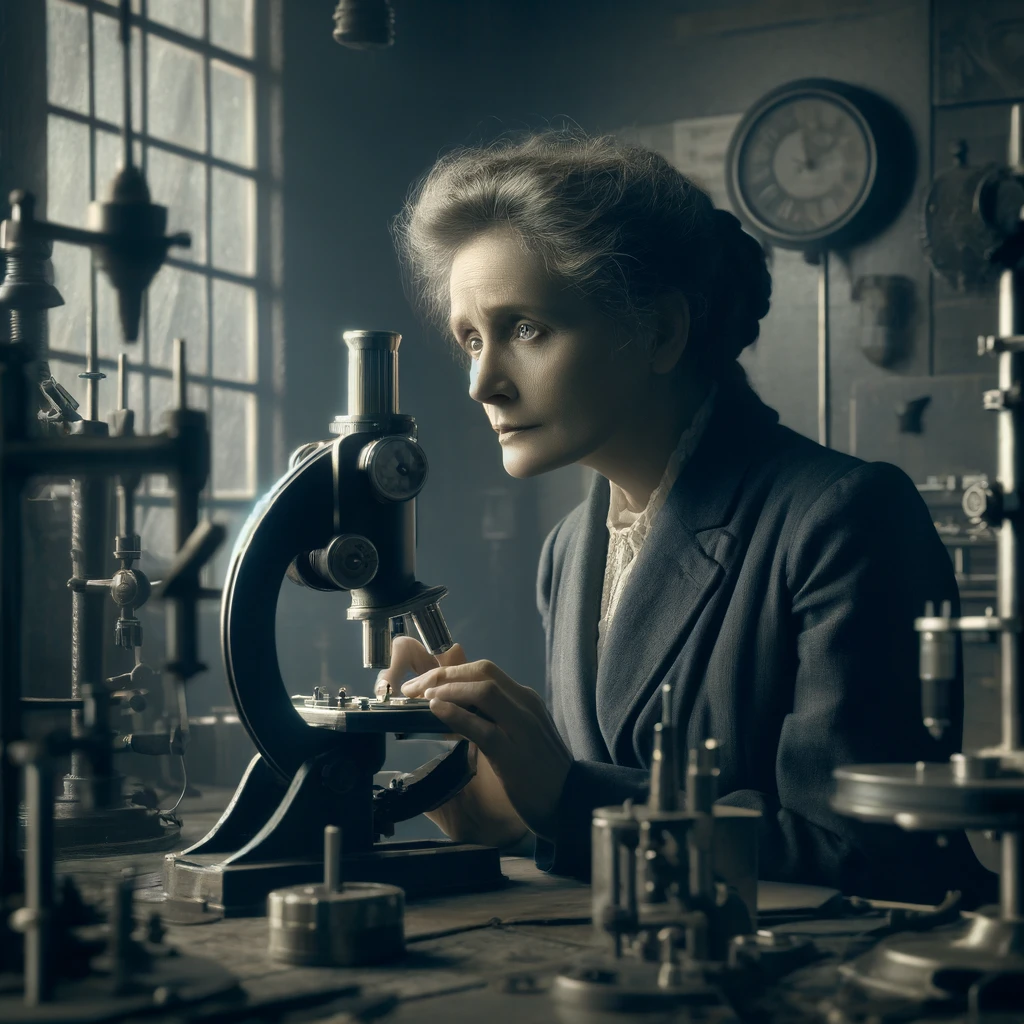
Marie Curie’s name is synonymous with groundbreaking research in radioactivity, a term she coined herself. Her relentless pursuit of knowledge and dedication to science transformed the way we understand the world at an atomic level. This article delves into her life, work, and enduring impact on both science and society.
Early Life and Education
Marie Curie was born Maria Sklodowska in Warsaw, Poland, on November 7, 1867, during a time of political turmoil. Poland was then part of the Russian Empire, where oppression and enforced Russification impacted all walks of life, including education. Despite these challenges, Marie’s parents ensured their children valued and pursued learning. Her father was a teacher of mathematics and physics, which perhaps laid the earliest seeds of scientific curiosity in Marie.
After losing her mother to tuberculosis at a young age, Marie faced further adversity but remained committed to her education. She moved to Paris in 1891 to continue her studies at the Sorbonne, a bold step for a woman at the time, particularly one from a financially struggling background. In Paris, she immersed herself in higher education, battling financial difficulties and health issues due to poor living conditions.
Scientific Partnerships and Discoveries
It was in Paris that Marie met Pierre Curie, a scientist working in the city who would become not only her husband but also her closest collaborator. The couple married in 1895 and soon after began working together on research into the recently discovered rays emitted by uranium. This work was inspired by Henri Becquerel’s discovery of radioactivity in 1896, which intrigued Marie.
Marie and Pierre Curie’s partnership was profoundly productive. They worked on identifying and characterizing radioactive substances, notably discovering two new elements—polonium and radium. Marie named polonium after her homeland of Poland, which was still under foreign domination and lacked recognition as an independent country.
Nobel Prizes and Recognition
Marie Curie’s pioneering research led her to become the first woman to receive a Nobel Prize. In 1903, she, Pierre Curie, and Henri Becquerel were awarded the Nobel Prize in Physics for their combined work on radioactivity. Tragically, Pierre Curie died in 1906, but Marie continued their work, achieving further milestones on her own.
In 1911, she received a second Nobel Prize, this time in Chemistry, for her discoveries of radium and polonium and her investigation into the properties of radium. Her dual Nobel achievements made her the first person ever to win Nobel Prizes in two different scientific fields.
Challenges and Controversies
Despite her monumental contributions to science, Curie faced numerous obstacles. As a woman in a predominantly male-dominated field, she encountered significant sexism. Her academic positions were hard-won, and her nominations for honors like membership in the French Academy of Sciences were initially met with rejection.
Additionally, her affair with a married scientist, Paul Langevin, after her husband’s death caused a scandal that was sensationalized by the press, overshadowing her scientific achievements for a time.
Legacy and Impact
Marie Curie’s work not only advanced scientific understanding but also had practical applications, notably in medicine. During World War I, she developed mobile radiography units, known as “Little Curies,” which were used to perform X-rays on wounded soldiers at the front. This application saved countless lives and established the use of radiological science in medical diagnostics and treatments.
Her legacy extends beyond her discoveries. The Curie Institutes in Paris and Warsaw, which she helped establish, are leading centers for medical research today. Her relentless spirit and dedication to science have inspired generations of scientists, especially women, to pursue careers in the sciences.
Marie Curie remains a towering figure in the history of science. Her intellectual rigor and perseverance through personal and professional adversity left a lasting mark on the world. The first woman to win a Nobel Prize, and still one of the few people to receive it in two different sciences, Curie not only pioneered research in radioactivity but also laid the groundwork for its application in medicine and beyond. Her story is not just about scientific discovery, but also about breaking barriers and setting new standards for what is possible, making her a true giant in both intellect and impact.

Personal Struggles and Perseverance
Despite achieving unparalleled success in her scientific career, Marie Curie’s personal life was filled with hardship. After Pierre’s untimely death, she was left to raise their two daughters, Irène and Ève, alone. Marie’s resilience in the face of personal tragedy underscored her dedication not only to her research but also to her family. She was not just a pioneering scientist but also a devoted mother. Her elder daughter, Irène, followed in her footsteps, eventually winning a Nobel Prize in Chemistry along with her husband, Frédéric Joliot-Curie, for their discovery of artificial radioactivity.
Marie Curie’s personal strength was further tested by the public and press’s reactions to her affair with Paul Langevin. The scandal broke at the peak of her career, immediately after she was awarded her second Nobel Prize. The press vilified her, an unmarried widow involved with a married man, overshadowing her professional achievements with personal judgment. However, Curie’s focus never wavered from her scientific pursuits, showcasing her remarkable ability to separate personal turmoil from her professional goals.
Health Consequences of Radioactivity
Marie Curie’s dedication to her research came at a great personal cost. At the time, the harmful effects of radiation exposure were not well understood, and protective measures were virtually nonexistent. Curie carried test tubes containing radioactive isotopes in her pocket and stored them in her desk drawer, marveling at their faint blue glow in the dark. Her prolonged exposure to high levels of radiation led to health complications, including near-blindness due to cataracts and ultimately aplastic anemia, which caused her death on July 4, 1934.
Curie’s health struggles highlighted the need for safety protocols in handling radioactive materials, a legacy that has shaped modern practices in radiological protection. Her own experience serves as a poignant reminder of the sacrifices often made in the pursuit of scientific advancement.
Educational Contributions and Mentorship
Apart from her research, Marie Curie also made significant contributions to education and mentorship. She championed the development of science education, particularly for women, in a period when they were largely excluded from academic and scientific institutions. Her role as a professor at the Sorbonne was historic; she was the first woman to hold a position there. Curie dedicated herself to training the next generation of scientists, ensuring that her laboratory was a place where young, aspiring scientists could thrive.
Influence and Inspirations
Marie Curie’s influence extends far beyond her scientific achievements. She has become a symbol of perseverance, intelligence, and integrity. Curie’s story has inspired countless books, movies, and plays, highlighting her role as a pioneer not only in science but also in breaking social barriers. The impact of her work is evident in the continued relevance of her research and the ongoing use of her methodologies in scientific exploration today.
Organizations and awards in her name continue to support scientific research and promote women in science, ensuring that her legacy endures. The Marie Curie Alumni Association, for example, supports researchers at all stages of their careers and fosters an active community of scientists worldwide.
Conclusion
Marie Curie’s life story is a powerful testament to the human spirit’s capacity for endurance and the relentless pursuit of knowledge. Her pioneering research in radioactivity has left an indelible mark on the scientific world, providing the foundation for numerous advancements in both theory and practical application. More than just a scientist, Curie was a trailblazer who overcame numerous obstacles to redefine what women could achieve in science and beyond. Her legacy of curiosity, bravery, and undying dedication to science continues to inspire and impact the world, making her truly a giant of intellectual and scientific exploration.


