Albert Einstein, a name synonymous with genius, has left an indelible mark on the field of physics. His theories of relativity have altered the very foundation of how we understand space, time, and gravity. Beyond his iconic equation, E=mc^2, Einstein’s life journey from a curious child to a revered scientist reveals the qualities that make a true intellectual giant. This article explores the pivotal moments and profound insights of Einstein’s career that helped unravel the mysteries of the universe.
Early Life and Education
Albert Einstein was born on March 14, 1879, in Ulm, Germany, to a family of non-observant Ashkenazi Jews. His early academic life was marked by both fascination and frustration with the rigid structures of traditional education. Young Einstein found school to be suffocating, preferring instead the freedom of independent study. At the age of five, his curiosity was sparked by a compass his father showed him, a moment that he later described as profound, revealing an invisible force that acted at a distance.
Einstein’s educational journey took him to Switzerland, where he attended the Swiss Federal Polytechnic School in Zurich. It was here that he began to break away from conventional teaching, immersing himself in the writings of the great scientific thinkers of the past, which shaped his innovative approaches to physics.
Milestone Discoveries
Einstein’s journey into the cosmos began in earnest in 1905, a year often referred to as his annus mirabilis, or “miracle year”. During this single year, while working as a patent clerk in Bern, Switzerland, he published four papers that would revolutionize our understanding of the physical world. These included his paper on the photoelectric effect, which demonstrated that light could be understood as quanta of energy, an insight that would later earn him the Nobel Prize in Physics in 1921.
However, it was his development of the theory of special relativity that truly marked a turning point in modern physics. This theory introduced the famous equation E=mc^2, which states that energy (E) equals mass (m) times the speed of light squared (c^2). This simple yet profound equation showed that mass and energy are interchangeable, laying the groundwork for future advancements in nuclear energy and our understanding of the universe’s structure.
General Relativity and Its Impact
In 1915, Einstein expanded on his ideas from special relativity to formulate the theory of general relativity. This theory proposed that gravity is not a force as Newton had described, but a curvature of spacetime created by mass and energy. The predictions of general relativity were confirmed during a solar eclipse in 1919, when light from stars bending around the sun was observed, just as Einstein had predicted.
The implications of general relativity were monumental. It has provided the theoretical framework for modern cosmology, including the concepts of black holes and the Big Bang, and has been essential in technologies like GPS that we rely on every day.
Political and Personal Life
Einstein’s impact was not confined to the realm of science. With the rise of fascism in Europe, he became an advocate for peace and democracy. After fleeing Nazi Germany, he settled in the United States, where he took a position at the Institute for Advanced Study in Princeton, New Jersey. Throughout his later years, Einstein was a vocal supporter of civil rights and a proponent of socialism, believing in the importance of societal responsibility.
His personal life, however, was marked by tumultuous relationships and personal struggles. His marriages to Mileva Marić and later Elsa Einstein were complicated and fraught with challenges, reflecting the complex nature of his private world.
Lasting Legacy
Albert Einstein passed away on April 17, 1955, in Princeton, but his legacy extends far beyond his mortal life. As a scientist, his theories continue to underpin much of modern physics and astronomy. As a humanist, his advocacy for peace and equality continues to inspire generations.
In unraveling the mysteries of the universe, Einstein taught us not just about the cosmos, but about the potential of the human mind to transcend the apparent limits of our understanding. In his quest for knowledge, he redefined what it means to be an intellectual giant, demonstrating that curiosity, imagination, and perseverance are the ultimate tools for exploring the vast and beautiful universe we inhabit.

Influence on Modern Science
Einstein’s influence extends beyond his direct contributions to theories of relativity. His approach to scientific inquiry—questioning established norms, imagining radical scenarios, and deducing their implications—has become a model for scientific thought. For instance, his consideration of a person traveling alongside a light beam led to the revolutionary concepts underlying special relativity.
Moreover, Einstein’s thought experiments, or “Gedankenexperiments”, have inspired countless physicists to explore the abstract and complex principles that define the laws of physics. His intellectual legacy is not just in the answers he provided, but in the profound questions he posed, which continue to fuel modern scientific research.
Philosophical Contributions
Beyond physics, Einstein’s reflections on philosophy, religion, and ethics have also left a lasting mark. He often engaged with philosophical questions concerning the relationship between science and religion, and the role of the individual in a deterministic universe. Einstein’s assertion that “Science without religion is lame, religion without science is blind” underscores his belief in a harmonious existence between the two realms.
His philosophical musings reveal a thinker deeply concerned with the ethical implications of science and technology, advocating for a balance between scientific progress and moral responsibility. This perspective has become increasingly relevant in today’s technology-driven world, where ethical considerations are critical to scientific advancement.
Educational Impact
Einstein’s life and work also serve as an educational inspiration. His early academic struggles and non-traditional path to success are often highlighted to encourage students who may not thrive under conventional educational systems. His career is a testament to the importance of creativity, critical thinking, and perseverance in education.
Furthermore, Einstein’s role as a professor and mentor at Princeton illustrates his commitment to the next generation of scientists. He believed in fostering a questioning attitude and deep curiosity about the natural world, qualities he considered essential for scientific discovery.
Impact on Culture
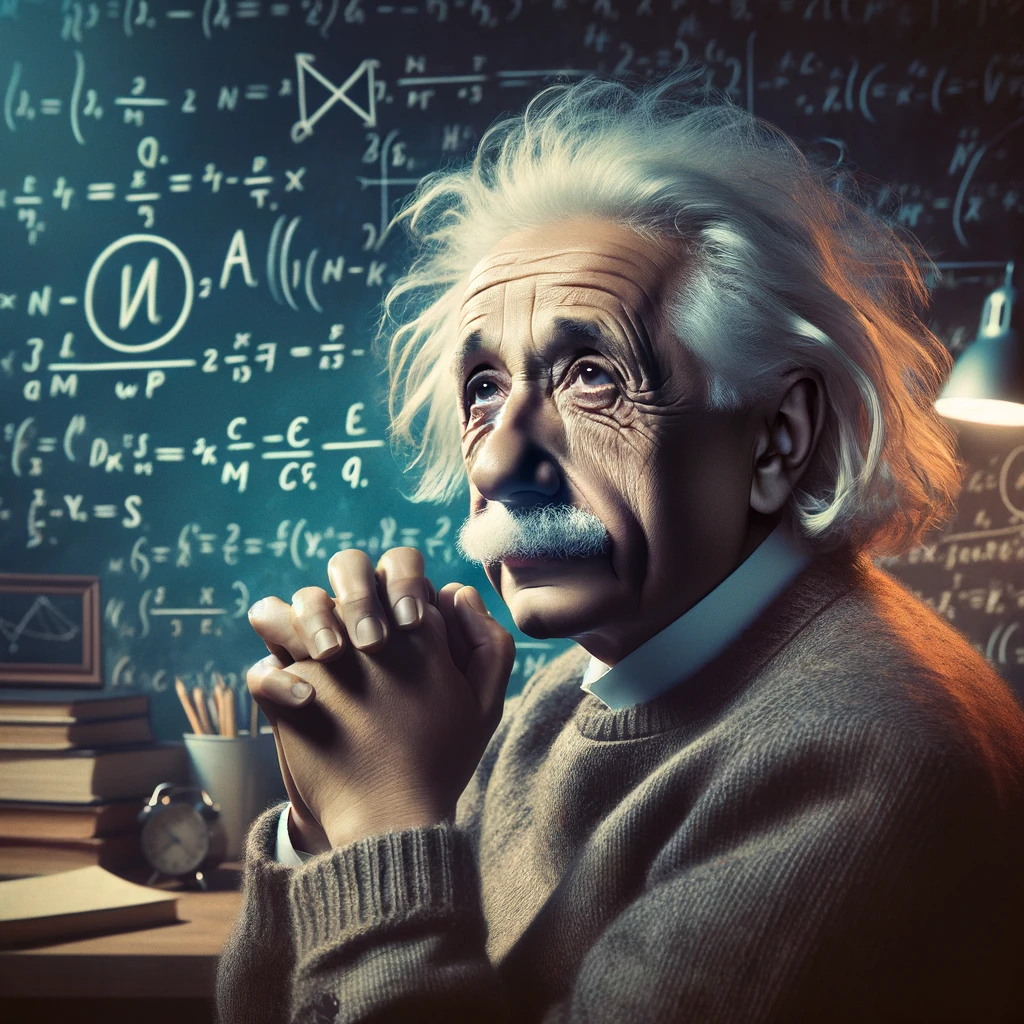
Albert Einstein’s iconic status extends into popular culture, where his image as the quintessential “mad scientist” is both a symbol of intellectual prowess and a beloved figure of human curiosity. His wild hair and thoughtful gaze have made him a recognizable figure across the globe, symbolizing the pursuit of knowledge.
Einstein has also appeared as a character in novels, films, and television shows, often representing wisdom and the ethical use of knowledge. His cultural significance is such that his name has become synonymous with “genius,” used to denote exceptional intellectual ability or creativity.
Conclusion
Albert Einstein’s journey through the mysteries of the universe has left a profound impact on both science and society. His theories of relativity not only transformed our understanding of the cosmos but also challenged our perceptions of reality itself. His relentless curiosity, combined with his philosophical depth, has made him a timeless icon of intellectual exploration.
Einstein’s legacy is not merely in the realm of scientific achievements but also in his approach to life and learning. He demonstrated that at the heart of scientific inquiry is the courage to question the status quo and the vision to see beyond the visible. As we continue to explore the vast unknowns of the universe, Einstein’s life reminds us of the limitless potential of human curiosity and ingenuity.