Europe’s history is intricately woven with the lives of women who, through their various roles, have significantly shaped the continent’s cultural, political, and social landscapes. From the regal halls of queens to the revolutionary fervor of female activists, women have been pivotal in steering the course of European history. This article explores the diverse contributions of these remarkable women, underscoring their enduring impact and legacy.
The Majesty of Queens: Rulers and Diplomats
1. Queen Elizabeth I of England
Queen Elizabeth I, reigning from 1558 to 1603, is one of the most iconic figures in British history. Her era, known as the Elizabethan Age, was marked by significant cultural and political advancements. Elizabeth’s leadership saw England flourish in the arts, epitomized by William Shakespeare’s works, and strengthen its naval power, exemplified by the defeat of the Spanish Armada in 1588. Her diplomatic skills and political acumen enabled her to skillfully navigate the complexities of governing a kingdom in a male-dominated era.
2. Catherine the Great of Russia
Catherine the Great, ruling from 1762 to 1796, transformed Russia into a major European power. Her reign is characterized by territorial expansion, modernization of government, and a flourishing of the arts and sciences. Catherine’s patronage led to the establishment of the Smolny Institute, the first state-financed higher education institution for women in Europe, highlighting her progressive view on women’s education.
The Bravery of Revolutionaries: Catalysts for Change
1. Olympe de Gouges
Olympe de Gouges was a French playwright and political activist whose writings in the 18th century were instrumental in advocating for women’s rights. Her most notable work, “The Declaration of the Rights of Woman and of the Female Citizen” (1791), challenged the male authority and the notion of male-female inequality. De Gouges’ revolutionary ideas were critical in sparking discussions on women’s rights and emancipation during and after the French Revolution.
2. Sophie Scholl
Sophie Scholl was a German student and anti-Nazi political activist during World War II. As a member of the White Rose non-violent resistance group, she and her peers distributed leaflets condemning the Nazi regime and advocating for peace. Scholl’s bravery and commitment to justice, leading to her execution in 1943, remain a powerful symbol of resistance against tyranny and oppression.
The Influence of Intellectuals and Artists
1. Marie Curie
Marie Curie, a Polish-born physicist and chemist, is renowned for her pioneering research on radioactivity. She was the first woman to win a Nobel Prize and remains the only person to win in two different scientific fields—physics and chemistry. Curie’s groundbreaking work not only advanced the scientific community but also paved the way for women in science, challenging gender barriers in a predominantly male field.
2. Virginia Woolf
Virginia Woolf, an English writer, was a central figure in the Bloomsbury Group and is known for her modernist literary style. Her works, including “Mrs. Dalloway” and “To the Lighthouse,” explore the inner consciousness and the complexities of human psychology. Woolf’s essays, notably “A Room of One’s Own,” advocate for both a literal and figurative space for women writers within a literary tradition dominated by men.
Social Reformers and Activists
1. Emmeline Pankhurst
Emmeline Pankhurst was a British political activist and leader of the suffragette movement, which fought for women’s right to vote. Her militant tactics, which included hunger strikes and civil disobedience, brought attention to the suffrage cause. Pankhurst’s perseverance and leadership were crucial in achieving women’s suffrage in the United Kingdom in 1918.
2. Rosa Luxemburg
Rosa Luxemburg was a Polish Marxist theorist, philosopher, and revolutionary socialist. Her work and activism were instrumental in the European socialist and workers’ movements. Despite facing imprisonment for her political activities, Luxemburg continued to write and organize, advocating for socialism and workers’ rights. Her legacy continues to inspire left-wing movements and feminist scholars.
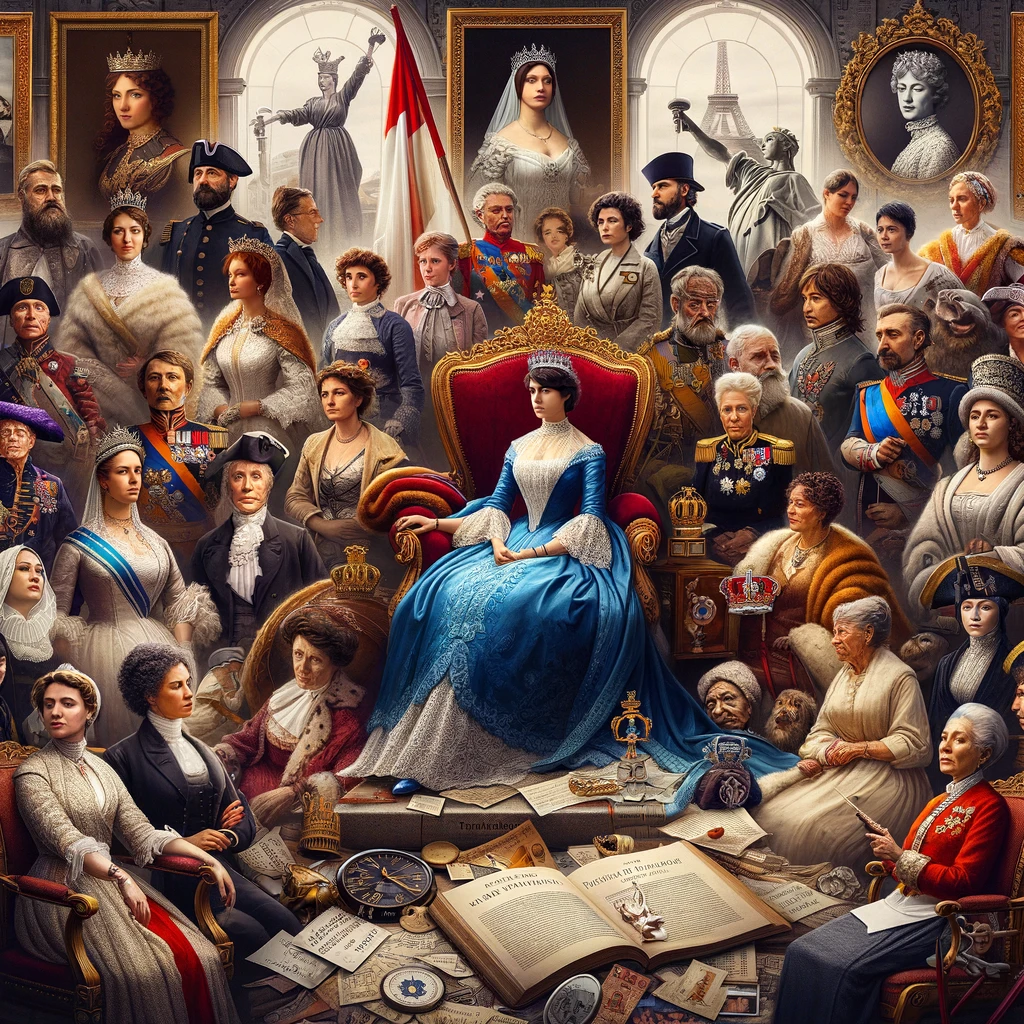
The tapestry of European history is rich with the stories of women who have played integral roles as rulers, revolutionaries, intellectuals, artists, and social reformers. From Queen Elizabeth I’s diplomatic finesse to Sophie Scholl’s courageous resistance, these women’s contributions have left indelible marks on the fabric of European culture and history. Their legacies not only highlight the diverse roles women have played but also serve as a source of inspiration for future generations.
Pioneers in Science and Medicine
1. Ada Lovelace
Ada Lovelace, an English mathematician and writer, is celebrated as one of the first computer programmers. She worked on Charles Babbage’s early mechanical general-purpose computer, the Analytical Engine. Her notes on the engine include what is recognized as the first algorithm intended to be processed by a machine, making her a visionary in the field of computer science.
2. Rosalind Franklin
Rosalind Franklin was an English chemist and X-ray crystallographer whose work was pivotal in understanding the molecular structures of DNA, RNA, viruses, coal, and graphite. Her X-ray diffraction images of DNA, particularly Photo 51, led to the discovery of the DNA double helix. Franklin’s contributions, often overshadowed by her male contemporaries, have gained recognition for their critical role in one of the most important scientific discoveries of the 20th century.
Women in Music and Performance Arts
1. Clara Schumann
Clara Schumann was a German pianist, composer, and piano teacher, considered one of the most distinguished pianists of the Romantic era. Her career spanned over six decades, during which she transformed the piano recital and the role of the concert pianist. Schumann also composed numerous works, including piano pieces, lieder, chamber music, and orchestral works, contributing significantly to the music world.
2. Sarah Bernhardt
Sarah Bernhardt was a French stage actress who starred in some of the most popular French plays of the late 19th and early 20th centuries. Known as “The Divine Sarah,” she is regarded as one of the finest actors of her time, revolutionizing the art of acting and known for her portrayal of dramatic and complex roles. Bernhardt’s influence extended beyond the theatre, making her one of the first global celebrities.
Political Leaders and Peacemakers
1. Margaret Thatcher
Margaret Thatcher, also known as the “Iron Lady,” was the first female Prime Minister of the United Kingdom, serving from 1979 to 1990. A polarizing figure, Thatcher’s economic policies and political ideology, known as Thatcherism, had a significant impact on British politics and the global stage. Her leadership during critical periods, such as the Falklands War and the Cold War, cemented her legacy as a formidable political leader.
2. Bertha von Suttner
Bertha von Suttner, an Austrian-Bohemian pacifist and novelist, was the first woman to be awarded the Nobel Peace Prize in 1905. Her most famous work, “Lay Down Your Arms” (1889), served as a powerful call for peace and influenced the peace movement of the time. Von Suttner played a key role in the formation of the international peace movement and significantly influenced the development of the Nobel Peace Prize.
Conclusion: A Legacy of Resilience and Innovation
The stories of these European women, from queens to revolutionaries, scientists to artists, and political leaders to peacemakers, present a rich tapestry of resilience, innovation, and influence. They broke barriers in their respective fields, challenged societal norms, and paved the way for future generations of women. Their legacies not only provide a window into the past but also continue to inspire and guide us in the present. As we look to the future, the stories of these remarkable women remind us of the importance of courage, determination, and the relentless pursuit of equality and justice.