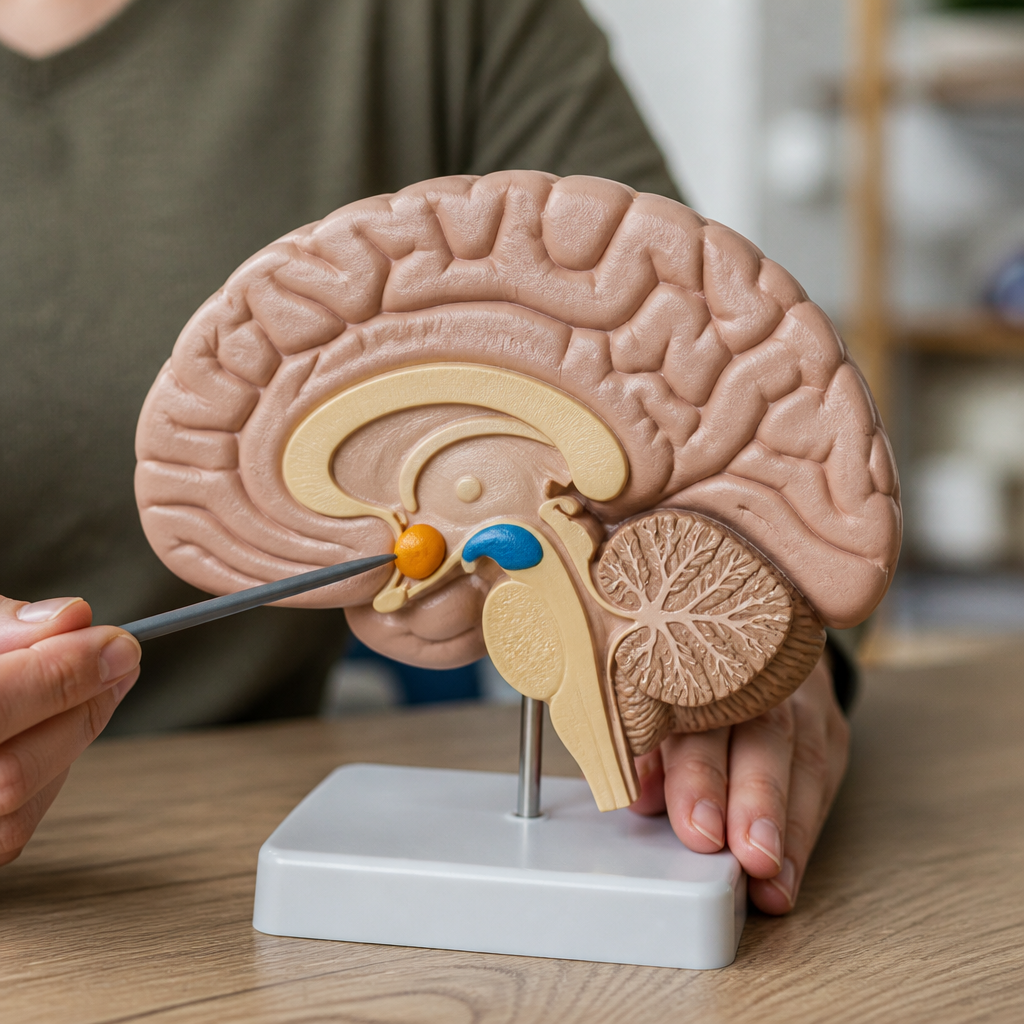
Change blindness and inattentional blindness are two of the most important concepts in sensation and perception because they reveal a basic truth about the mind: seeing is not the same as noticing. In AP Psychology, sensation refers to the process by which sensory receptors and the nervous system receive stimulus energies from the environment, while perception is the brain’s organization and interpretation of that sensory input. Students often assume perception works like a camera that records everything in front of us. In practice, perception is selective, limited, and strongly shaped by attention, expectations, and context.
Understanding change blindness vs. inattentional blindness matters because these topics sit at the center of how psychologists explain awareness. They also connect directly to broader sensation and perception themes, including selective attention, bottom-up and top-down processing, feature detection, perceptual sets, and the role of consciousness in everyday life. I have found that once students grasp the distinction between these two forms of “not seeing,” many other AP Psychology concepts become easier to organize. These phenomena explain eyewitness errors, driving mistakes, medical oversights, design failures, and even why people miss obvious details in films and classrooms.
At a basic level, inattentional blindness happens when a person fails to notice a visible stimulus because attention is focused elsewhere. Change blindness happens when a person fails to notice that something in the environment has changed, especially when the change occurs during a visual disruption such as a blink, eye movement, cut, or brief interruption. Both involve limits of attention, but they are not interchangeable. One is about missing an unexpected object that is present; the other is about missing a difference between two moments. That distinction is the foundation for this sensation and perception hub.
What Is Inattentional Blindness?
Inattentional blindness is the failure to consciously notice a fully visible but unexpected stimulus when attention is engaged on another task. The classic example is the “invisible gorilla” study by Daniel Simons and Christopher Chabris. Participants watched a video of people passing basketballs and were asked to count passes made by one team. While they focused on counting, a person in a gorilla suit walked through the scene, stopped, thumped their chest, and exited. A substantial number of viewers never noticed the gorilla at all. The stimulus reached the eyes, but it did not receive enough attentional processing to become part of conscious awareness.
This phenomenon demonstrates selective attention, the process of focusing conscious awareness on one stimulus while filtering out others. In real life, inattentional blindness happens when a driver looks for traffic signals and fails to notice a pedestrian, when a student copies notes and misses a diagram on the board, or when a clinician fixates on one probable diagnosis and overlooks an unexpected symptom. The key point is that the missed stimulus is not hidden. It is visible, often obvious in hindsight, but outside the current attentional goal.
In AP Psychology terms, inattentional blindness is best understood as a limitation of attentional capacity rather than a defect in eyesight. Vision provides input, but attention determines what is consciously processed. This is why multitasking is often weaker than people believe. When attention is tightly allocated, unexpected information is easy to miss.
What Is Change Blindness?
Change blindness is the failure to detect changes in the visual environment, particularly when those changes coincide with a brief interruption. Researchers study it using flicker tasks, alternating images, film cuts, and real-world interactions. In a typical flicker paradigm, one image and a slightly altered version alternate with a blank screen between them. Even large differences, such as a missing building, a different shirt color, or a moved object, can take surprisingly long to detect. The interruption masks the motion signal that would usually draw attention to the change.
Outside the lab, change blindness appears in continuity errors in movies, unnoticed edits in online meetings, and face-to-face interactions where one conversation partner is replaced during a brief obstruction. A famous field experiment by Daniel Simons and Daniel Levin found that during an interaction on a college campus, pedestrians often failed to notice when the person asking for directions was switched with another individual while a door passed between them. The result was striking because the changed feature was not trivial. It was the identity of the person.
Change blindness shows that people do not build a complete, detailed internal copy of the world. Instead, perception relies on selective sampling, attention, and the assumption that the environment is stable unless something strongly signals otherwise. In sensation and perception, this supports a central idea: conscious visual experience feels rich, but the information actively represented at any moment is much narrower than it seems.
Key Differences Between Change Blindness and Inattentional Blindness
The clearest way to separate these concepts is to ask two questions: Was there an unexpected object present, or did an existing scene change? And was attention occupied, or was the change masked by disruption? In inattentional blindness, the person misses a stimulus that is there right now because attention is elsewhere. In change blindness, the person misses a difference across time, usually because the visual system lacks a salient cue that a change occurred.
| Concept | Definition | Typical Trigger | Classic Example | Main Lesson |
|---|---|---|---|---|
| Inattentional blindness | Failure to notice a visible, unexpected stimulus | Attention focused on another task | Missing the gorilla while counting passes | Attention limits conscious awareness |
| Change blindness | Failure to detect a change in the environment | Brief disruption, distraction, or poor comparison across moments | Not noticing an object disappear between alternating images | Perception does not store every visual detail |
Another useful distinction is expectation. In inattentional blindness, the missed item is often unexpected relative to the task. In change blindness, the observer may expect to see the scene, but not necessarily compare every element moment by moment. That is why students can stare at nearly identical images for several seconds before spotting a changed detail. The problem is not simply distraction; it is the absence of focused comparison and a strong visual transient.
These phenomena can overlap. A person might fail to detect a change partly because attention was elsewhere, and they might miss an unexpected object because the scene shifted rapidly. Still, for AP Psychology, the distinction should remain crisp: inattentional blindness is missing what is present; change blindness is missing what became different.
How These Concepts Fit Into Sensation and Perception
As a hub topic, sensation and perception includes thresholds, transduction, signal detection theory, selective attention, sensory adaptation, perceptual organization, depth cues, constancy, and context effects. Change blindness and inattentional blindness sit closest to selective attention, but they also connect to signal detection theory and top-down processing. Signal detection theory explains that noticing a stimulus depends on both sensory input and decision processes under uncertainty. A faint or unexpected event may be present, yet not reported, because the observer’s criterion and attention are tuned elsewhere.
Top-down processing also matters. Expectations, goals, prior knowledge, and schemas shape what people perceive. When a person counts passes, the task frame narrows awareness to ball movement and team membership. When a driver searches for a street sign, that goal can suppress notice of unrelated but important events. Bottom-up processing, by contrast, relies on raw sensory features. Strong motion, brightness, novelty, or contrast can capture attention automatically, which is why sudden movement often breaks through inattentional limits more effectively than static objects.
These concepts also complement Gestalt principles of organization. The brain groups stimuli into meaningful wholes, but that efficiency comes with tradeoffs. Perception prioritizes structure, relevance, and action over exhaustive detail. The result is adaptive most of the time, yet it leaves predictable blind spots.
Why the Brain Misses What Seems Obvious
Students often ask how anyone could miss a gorilla or fail to notice a major scene change. The answer is that attention is a limited resource. The visual system receives far more information than conscious awareness can process in detail. Through selective attention, the brain filters input according to goals, salience, and relevance. This filtering is efficient, but it means unattended information may never reach awareness.
Eye movements are part of the explanation. During saccades, the rapid movements the eyes make several times each second, visual sensitivity drops, a phenomenon called saccadic suppression. This helps create perceptual stability, but it also contributes to change blindness by reducing awareness of disruptions that occur during eye movement. Blinks and cuts in visual scenes create similar gaps.
Working memory limits matter as well. People cannot hold a perfect snapshot of every object, color, and position in a scene. Instead, they retain selected features and a general layout. If a change affects an unattended or weakly encoded element, it can go unnoticed. In classrooms, I have seen students confidently insist that they would spot any change in a slide deck, then miss alterations in heading color, object placement, or even swapped images when their attention is focused on the lecture point rather than the display.
Real-World Examples in Driving, Medicine, and Media
Driving provides some of the most consequential examples. A driver turning left may look directly toward an oncoming motorcycle yet fail to notice it because attention is allocated to larger vehicles or traffic gaps. Researchers sometimes call this a looked-but-failed-to-see error. It is not proof that the driver had no visual exposure; rather, the critical information did not reach full awareness in time for action.
In medicine, inattentional blindness has been studied in radiology and diagnostic reasoning. When experts search complex images for known targets, unexpected abnormalities can be missed. One well-known demonstration involved inserting an image of a gorilla into a lung scan task; even trained observers sometimes overlooked it while attending to small nodules. Expertise improves detection, but it does not eliminate attentional constraints.
Media editing relies on change blindness constantly. Film cuts, camera angle shifts, and continuity errors often pass unnoticed because viewers track narrative goals, faces, and action rather than every visual detail. Interface designers use this knowledge too. If a software update changes the placement of a critical button without a salient cue, users may struggle because the change does not automatically register. Good design uses contrast, motion, spacing, and predictable layout to support perception rather than fight it.
How to Study These Topics for AP Psychology
For exam success, define each term precisely and tie it to selective attention. A strong short-answer response would say that inattentional blindness is failing to notice a visible, unexpected stimulus because attention is focused elsewhere, whereas change blindness is failing to notice a change in the environment, often after a brief visual disruption. Then add an example and explain the mechanism.
It also helps to connect these ideas to related vocabulary. Link inattentional blindness to selective attention and divided attention. Link change blindness to visual disruption, saccadic suppression, and limited scene representation. Distinguish both from sensory disorders. These are not problems of receptor damage or poor acuity. They are normal cognitive limits in healthy perception.
When building your sensation and perception study map, organize the subtopic from input to interpretation: sensation, transduction, thresholds, attention, organization, interpretation, and context. Change blindness and inattentional blindness belong in the attention-to-awareness stage. From there, branch into perceptual set, context effects, and decision making. That structure makes the entire unit easier to review and remember.
Change blindness and inattentional blindness show that perception is active, selective, and incomplete, not a perfect recording of reality. Inattentional blindness means missing a visible, unexpected stimulus because attention is directed elsewhere. Change blindness means missing a difference between one moment and the next, especially when a disruption hides the change signal. Both are core AP Psychology concepts because they demonstrate how attention shapes awareness and why people can feel certain they saw everything when they did not.
As a sensation and perception hub, this topic links directly to selective attention, top-down processing, signal detection theory, working memory, perceptual organization, and consciousness. It also explains practical issues in driving, medicine, education, and media design. Once you understand these limits, many other psychology ideas become more coherent: the brain is efficient, but efficiency requires filtering, and filtering always creates blind spots.
The main benefit of mastering this distinction is clarity. You will not only answer exam questions more accurately, but also understand how perception works in everyday life. Review the classic experiments, practice defining each term in one sentence, and connect them to the wider sensation and perception unit so the whole subtopic functions as one organized system.
Frequently Asked Questions
What is the difference between change blindness and inattentional blindness?
Change blindness and inattentional blindness are closely related, but they describe two different limits of attention and perception. Change blindness happens when a person fails to notice that something in the environment has changed, especially when that change occurs during a brief visual interruption, distraction, or shift in focus. For example, if two similar images alternate with a blank screen between them, a large difference can go unnoticed for surprisingly long periods of time. The key issue is that a change occurred, but the observer did not detect it.
Inattentional blindness, by contrast, happens when a person fails to notice a visible object or event because their attention is focused elsewhere. In this case, the missed item may be right in front of the observer, but because mental resources are directed toward another task, it does not reach conscious awareness. A classic example is failing to notice an unusual person or object in a scene while concentrating on counting movements or watching for something specific.
The simplest way to separate the two is this: change blindness is missing a difference, while inattentional blindness is missing a presence. Both demonstrate that perception is selective rather than complete. In AP Psychology terms, sensation may allow visual information to enter the system, but perception depends heavily on attention, expectation, and cognitive processing. That is why seeing is not the same as noticing.
Why are change blindness and inattentional blindness important in sensation and perception?
These concepts matter because they challenge the common assumption that perception works like a video camera that continuously records everything in front of us. In reality, sensation and perception are not passive processes. Sensation refers to the reception of stimulus energy by sensory receptors and the nervous system, but perception is the brain’s active organization and interpretation of that information. Change blindness and inattentional blindness show that the brain does not fully process every detail available in the environment.
They are especially important because they reveal how dependent awareness is on selective attention. The visual world feels rich and complete, but conscious perception is actually limited. The brain prioritizes what seems relevant to current goals, expectations, and tasks. As a result, important details can be overlooked even when they are directly visible. This is not necessarily a flaw in the system; it is also what allows people to function efficiently in complex environments without being overwhelmed by every sensory input.
In psychology education, these ideas help students understand the difference between detection and awareness. A stimulus may be present, and the sensory system may register aspects of it, yet the person may still fail to consciously recognize it. That distinction is central to understanding attention, visual processing, memory, and the constructive nature of perception. These concepts also have practical implications in driving, eyewitness testimony, interface design, safety monitoring, and everyday decision-making.
What are some real-world examples of change blindness and inattentional blindness?
Real-world examples make these concepts much easier to understand. Change blindness can occur when a person looks away from a room and fails to notice that an object has been moved, removed, or replaced. It can also happen in conversations if one person is briefly interrupted and does not notice that something in the environment has changed. Drivers may experience change blindness when road conditions shift gradually or when they fail to detect a changed sign, signal, or hazard after their attention has been disrupted.
Inattentional blindness is common whenever people are deeply focused on one task. A driver concentrating on traffic ahead may fail to notice a pedestrian, cyclist, or unexpected object at the side of the road. A student reading intensely may not hear their name called right away or may not notice movement in the room. In sports, an athlete focusing on the ball may miss a player moving into open space. In daily life, people often overlook obvious details when they are texting, multitasking, or searching for something specific.
These examples show that missed information is not always due to poor eyesight or low intelligence. Often, the issue is the limited capacity of attention. The environment contains far more information than the brain can fully process at once, so attention acts like a filter. When that filter is occupied, changes and unexpected objects can be missed. This is one reason these effects are so important in applied settings such as transportation, medicine, aviation, and workplace safety.
How do attention and expectations influence whether we notice something?
Attention and expectations play a major role in determining what reaches conscious awareness. Attention functions as a selection system: it enhances some incoming information while reducing awareness of other details. Because cognitive resources are limited, people cannot give equal processing power to every stimulus around them. When attention is tightly focused on a specific task, unexpected events become easier to miss, which increases the likelihood of inattentional blindness.
Expectations also shape perception by guiding what the brain is prepared to notice. If a person expects to see certain objects, movements, or patterns, they are more likely to detect those features quickly. At the same time, information that does not fit current expectations may be ignored or overlooked. This can contribute to both change blindness and inattentional blindness. A person may fail to notice a change because they assume stability in the environment, or they may miss an unusual object because it is inconsistent with what they are mentally searching for.
This reflects a broader principle in psychology: perception is constructive. The brain does not simply copy sensory input; it interprets it using context, prior knowledge, goals, and assumptions. That interpretive process is usually efficient and adaptive, but it can also create blind spots. Understanding this helps explain why people can be highly confident in what they think they saw, even when important details never entered conscious awareness in the first place.
How can students remember the key differences for AP Psychology exams?
A useful memory strategy is to focus on the core question each term answers. For change blindness, ask: “Did something change that the person failed to notice?” If yes, the concept is likely change blindness. For inattentional blindness, ask: “Was there a visible object or event that the person missed because attention was elsewhere?” If yes, it is probably inattentional blindness. This quick distinction helps students separate the two on multiple-choice and free-response questions.
Another helpful approach is to connect each concept to a simple phrase. Change blindness means missing the difference. Inattentional blindness means missing the unexpected. Students can also remember that change blindness usually involves a before-and-after comparison, while inattentional blindness often involves selective attention to one task at the expense of noticing something else in the moment. These patterns make identification easier under exam pressure.
For stronger retention, students should tie both concepts back to the broader unit on sensation and perception. The big idea is that perception is selective, active, and limited. The senses may receive input, but awareness depends on what the brain attends to and how it interprets the scene. If students remember that “seeing is not the same as noticing,” they will understand why both concepts matter and how they illustrate the limits of conscious perception. That big-picture understanding is often more effective than memorizing isolated definitions.