
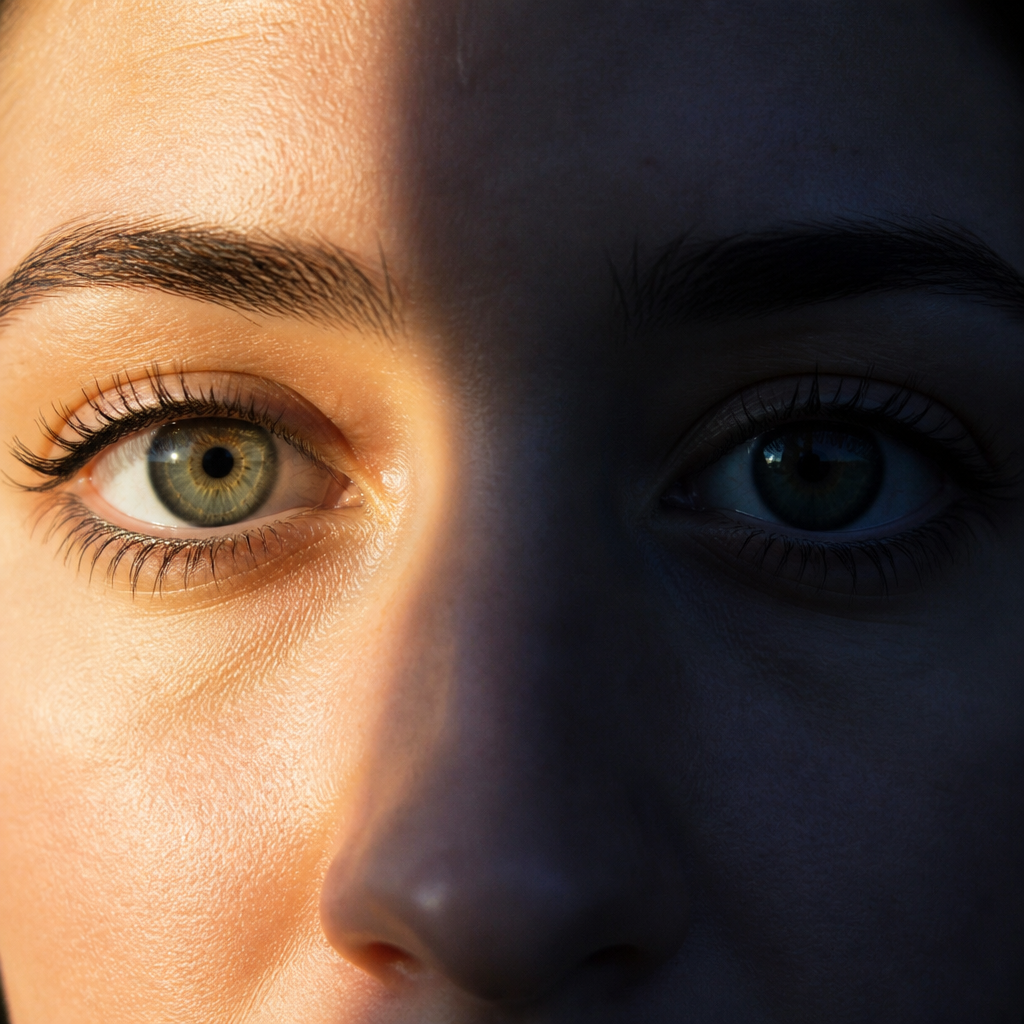
Vision begins when light enters the eye, but what we actually perceive depends on two specialized photoreceptors in the retina: rods and cones. Understanding rods vs. cones is essential to understanding sensation and perception in AP Psychology because these cells explain why colors fade at dusk, why reading in dim light is difficult, and why peripheral motion often grabs attention before detail does. In psychology, sensation refers to the detection of physical energy by sensory receptors, while perception refers to the brain’s organization and interpretation of that sensory input. Rods and cones sit at the center of that process for sight.
Rods are highly sensitive photoreceptors that function best in low light. They do not detect color, but they are excellent at picking up motion, broad shapes, and contrast, especially in peripheral vision. Cones, by contrast, require brighter light and support sharp central vision, fine detail, and color discrimination. Humans typically have about 120 million rods and roughly 6 million cones, a distribution that already hints at their separate jobs. The fovea, the tiny central pit in the retina used for reading and detailed inspection, is densely packed with cones. The outer retina contains far more rods, making the edges of vision more sensitive in darkness.
This matters far beyond basic biology. In AP Psychology, sensation and perception include bottom-up processing, top-down processing, absolute threshold, difference threshold, selective attention, and perceptual organization. Vision provides the clearest way to see those concepts working together. A dim star can vanish when you stare directly at it because the cone-rich fovea is less sensitive in darkness than rod-heavy peripheral areas. A bright red stop sign remains vivid in daylight because cones are active and the visual cortex can rapidly interpret shape, color, and learned meaning. The sensory system is not just receiving light; it is continuously filtering, amplifying, and interpreting it.
I have found that students understand sensation and perception much faster when they connect the vocabulary to ordinary experiences: adjusting to a dark movie theater, losing color accuracy at twilight, or noticing a fast movement out of the corner of the eye before recognizing what it is. These examples show why rods and cones are a practical foundation for the entire unit. Once you understand how retinal receptors respond to light, it becomes easier to grasp transduction, visual pathways, depth cues, color theories, and perceptual constancies. This article serves as a hub for the full Sensation and Perception topic by explaining how the eye converts light into neural signals and how the brain turns those signals into meaningful visual experience.
The Retina: Where Sensation Begins
The retina is a thin layer of neural tissue lining the back of the eye, and it is where light energy is transformed into electrochemical signals the brain can process. This conversion is called transduction, one of the most important terms in AP Psychology. Light passes through the cornea, pupil, and lens before reaching the retina, where rods and cones absorb photons. Those receptors then trigger neural changes that pass through bipolar cells to ganglion cells. The axons of ganglion cells form the optic nerve, which carries information toward the thalamus and then to the occipital lobe.
The arrangement of the retina creates useful strengths and predictable limits. The fovea supports high acuity because it has a dense concentration of cones and relatively direct wiring to ganglion cells. Peripheral regions pool information from many rods onto fewer downstream neurons, which increases sensitivity in dim light but reduces detail. This is why you can detect a faint object off to the side at night but may struggle to identify its exact shape. The optic disc, where the optic nerve exits the eye, contains no photoreceptors and creates the blind spot. Under normal conditions, the brain fills in this missing area automatically.
These features connect directly to broader perception topics. Bottom-up processing begins with receptor activity, but top-down processing influences interpretation almost immediately. If you expect to see your friend in a crowd, ambiguous visual input may be interpreted as that person until closer inspection corrects the guess. Sensation provides raw data; perception gives it meaning. The eye does not function like a camera simply recording reality. It is an active biological system that prioritizes some information, sacrifices other information, and sends the brain an efficient rather than perfect representation of the world.
Rods: Dim-Light Specialists
Rods are built for scotopic vision, the kind of vision used in very low illumination. They are extremely sensitive because their photopigment, rhodopsin, can respond to very small amounts of light. That sensitivity allows people to navigate at night, detect movement in shadow, and notice contrast even when color information disappears. However, rods have low spatial resolution. They are not designed for crisp detail. In practical terms, rods help you see that something is there, but not always exactly what it is.
Rods are concentrated mostly outside the fovea, which is why peripheral vision often works better than central vision in darkness. Astronomers use this fact deliberately through a technique called averted vision: instead of looking directly at a faint star, they look slightly to the side so the image lands on rod-rich retinal areas. The star appears brighter because rods are more sensitive than cones under those conditions. Students often remember this better than any textbook definition because it turns a vocabulary term into a visible demonstration.
Dark adaptation also depends heavily on rods. When you walk from sunlight into a dim room, cones adjust relatively quickly, but rods take longer to fully regain sensitivity because rhodopsin must regenerate after being bleached by bright light. Full dark adaptation can take around 20 to 30 minutes. That is why the environment seems progressively clearer over time. This gradual increase in sensitivity is a classic example of sensory adaptation and threshold change. It also shows that sensation is dynamic, not fixed from moment to moment.
Cones: Color and Fine Detail
Cones support photopic vision, or vision in bright conditions. They are less sensitive to low light than rods, but they provide what rods cannot: high acuity and color perception. Most cones are packed into the fovea, making them essential for reading, recognizing faces, threading a needle, or judging the exact hue of a traffic signal. In classroom terms, if rods answer the question “Is something there?” cones answer “What exactly is it?”
Humans normally have three classes of cones, each most responsive to a different range of wavelengths: short, medium, and long. These are often simplified as blue, green, and red cones, though the actual sensitivity curves overlap substantially. Color perception arises from the relative activation pattern across all three cone types, not from one cone handling one pure color. This is the basis of trichromatic theory, first advanced by Thomas Young and Hermann von Helmholtz. Modern color science, display technology, and color vision testing all rely on this principle.
Cones also explain why visual performance changes across lighting conditions. At dusk, overall illumination drops into a mesopic range where rods and cones both contribute. Colors become muted, blue-green objects may remain visible longer than reds, and detail declines. This shift is linked to the Purkinje effect, in which peak visual sensitivity moves toward shorter wavelengths in dimmer light. If you have ever noticed red flowers looking darker than blue leaves at twilight, you have experienced the effect directly. For AP Psychology, this is a strong example of how receptor properties shape perception.
Comparing Rods and Cones in Everyday Vision
The simplest way to compare rods and cones is to match each receptor type to the visual tasks it performs best. The distinction is not academic; it explains common perceptual experiences, common testing items, and several applied fields, including driving safety, interface design, and vision screening.
| Feature | Rods | Cones |
|---|---|---|
| Best lighting | Dim light | Bright light |
| Color sensitivity | None | High |
| Visual detail | Low acuity | High acuity |
| Main location | Peripheral retina | Fovea and central retina |
| Motion detection | Strong | Weaker than rods |
| Example task | Seeing shapes at night | Reading black text on white paper |
Night driving shows the tradeoff clearly. Rods help detect movement at the roadside, but cones are needed to read signs and distinguish signal colors. That is one reason glare from headlights is so disruptive: intense light can temporarily reduce rod sensitivity and impair recovery. In sports, a baseball player relies on cone-rich central vision to track stitching and spin in daylight, while a goalkeeper may first pick up motion in peripheral vision before shifting gaze for detail. In product design, dashboard displays often use high-contrast layouts because fine discrimination deteriorates quickly as light falls.
These differences also matter for psychological measurement. Visual threshold experiments, attention tasks, and studies of signal detection all depend on receptor limits. A participant may detect a dim flash without identifying its color because rods crossed the threshold while cones did not contribute enough information. That gap between detection and identification is exactly the kind of distinction AP Psychology asks students to analyze.
From Retina to Brain: How Perception Takes Shape
Photoreceptors begin the process, but perception emerges through neural pathways and cortical analysis. Signals from the retina travel through the optic nerve, partially cross at the optic chiasm, relay through the lateral geniculate nucleus of the thalamus, and reach the primary visual cortex in the occipital lobe. From there, processing branches into multiple pathways, including systems specialized for object recognition and spatial location. Vision is therefore distributed, not confined to a single point in the brain.
This pathway helps explain why seeing is not identical to understanding. Feature detectors in the visual cortex respond selectively to edges, angles, orientation, and movement, a finding strongly associated with David Hubel and Torsten Wiesel. Higher cortical areas then combine these features into coherent objects. Gestalt principles such as figure-ground organization, proximity, similarity, closure, and continuity describe how the brain imposes order on sensory input. You do not consciously calculate every contour in a face; perception groups the information into meaningful wholes almost instantly.
Attention further shapes what reaches awareness. Selective attention allows one stimulus to dominate processing while others are filtered out. Inattentional blindness and change blindness show that even visible stimuli can be missed if attention is engaged elsewhere. That does not mean the eyes failed. It means perception depends on both sensory registration and cognitive prioritization. Rods and cones supply the data, but the brain decides what matters enough to interpret, store, and respond to.
Color Vision, Perceptual Theories, and Common Disorders
Color vision in AP Psychology is usually taught through two complementary explanations. Trichromatic theory explains how three cone types encode color at the receptor level. Opponent-process theory, associated with Ewald Hering, explains later neural coding in paired channels such as red versus green, blue versus yellow, and black versus white. Afterimages demonstrate this well. Stare at a green image, then shift to a white surface, and a reddish afterimage often appears because the fatigued channel rebounds in the opposite direction.
Color vision deficiencies illustrate how receptor differences alter experience. The most common forms involve altered long- or medium-wavelength cone function and are often grouped under red-green color blindness, though complete blindness to red or green is uncommon. Because these traits are frequently X-linked, they occur much more often in males. Most affected people still perceive many colors but have trouble distinguishing specific combinations, especially under poor lighting or low contrast. Ishihara plates are a standard screening tool because they reveal these discrimination limits efficiently.
Other visual disorders also connect sensation to perception. Night blindness can result from rod dysfunction or vitamin A deficiency, since retinal chemistry depends on vitamin A derivatives. Macular degeneration harms central vision and therefore cone-heavy tasks such as reading and face recognition. Retinitis pigmentosa often begins with peripheral rod loss, reducing night vision first. These conditions remind students that visual experience depends on receptor health, retinal structure, and intact neural pathways, not just open eyes.
Why Rods and Cones Matter Across Sensation and Perception
Rods vs. cones is more than a chapter subsection; it is the gateway to the full Sensation and Perception unit in AP Psychology. Once you understand that different receptors detect different kinds of visual information under different conditions, larger concepts become easier to organize. Thresholds make sense because sensitivity varies by receptor and context. Adaptation makes sense because photopigments recover at different rates. Perceptual set makes sense because ambiguous input must be interpreted by a brain that uses expectation, memory, and attention to fill gaps.
The key takeaway is straightforward. Rods support dim-light, peripheral, motion-sensitive vision without color. Cones support bright-light, central, detailed, color vision. Together they allow the retina to operate across an enormous range of environments, from starlight to midday sun. Every later stage of visual perception depends on the quality and type of information these receptors deliver. If you are studying AP Psychology, master this distinction first, then connect it to visual pathways, color theories, attention, and perceptual organization. Use this article as your hub, and then move deeper into each linked concept until the whole unit fits together clearly.
Frequently Asked Questions
What is the difference between rods and cones in the human eye?
Rods and cones are the two main types of photoreceptors in the retina, and each is specialized for a different visual job. Rods are extremely sensitive to light, which makes them essential for seeing in dim conditions such as dusk, nighttime, or a dark room. They do not detect color, so rod-based vision is mostly shades of gray. Cones, by contrast, require brighter light to function well, but they provide sharp detail and color vision. This is why reading, recognizing faces, and distinguishing colors work best in daylight or other well-lit settings.
Their location in the retina also helps explain how vision works. Cones are concentrated in the fovea, the central part of the retina responsible for high-acuity vision. Rods are more common in the peripheral retina, where they help detect movement and broad shapes outside the direct line of sight. In AP Psychology, this distinction matters because it connects the biology of sensation to real-world perception: rods help detect faint light and motion, while cones support detailed, color-rich visual experiences.
Why do colors seem to fade or disappear in low light?
Colors fade in low light because cone cells, which are responsible for color vision, do not work efficiently when illumination drops. In bright environments, cones are active and allow the brain to compare signals across different wavelengths of light, creating the experience of color. But as the environment gets darker, cone activity decreases and rods begin to dominate visual processing. Since rods are highly sensitive to light but do not code for color, the world starts to look muted, grayish, or washed out.
This is a classic example of how sensation affects perception. The physical stimulus may still be present, but the sensory receptors available under those conditions change what the brain can interpret. That is why a red flower that looks vivid in sunlight may appear dull or almost colorless at dusk. In psychology terms, the shift from cone-dominant to rod-dominant vision shows how the visual system adapts to environmental conditions and why perception depends on both the stimulus and the capabilities of the receptors detecting it.
Why is reading in dim light so difficult?
Reading in dim light is difficult because reading depends heavily on cone vision. To read clearly, the eye must detect fine detail, contrast, and the precise shapes of letters. Cones are designed for this kind of visual acuity, especially those packed into the fovea, where central vision is sharpest. However, cones need relatively bright light to function effectively. When lighting is poor, cone performance drops, and the visual system relies more on rods.
Rods are excellent at detecting faint light, but they are not built for fine detail. They provide lower spatial resolution and are more useful for noticing general forms and movement than for distinguishing small printed letters. That is why text may look blurry, strained, or harder to focus on in a dim room, even if it is still technically visible. In AP Psychology, this helps illustrate the difference between simply detecting a stimulus and accurately perceiving it. Sensation may still occur in low light, but perception of detailed visual information becomes less efficient because the receptor system best suited for the task is underperforming.
Why does peripheral motion often catch your attention before visual detail does?
Peripheral motion often grabs attention first because the peripheral retina contains many more rods than cones, and rods are especially sensitive to changes in light and movement. From an adaptive perspective, this makes sense: noticing motion quickly in the environment could help an organism respond to threats or opportunities. When something moves off to the side, rod-rich peripheral vision is often the first part of the visual system to register that change, even before the brain has enough detailed information to identify exactly what the object is.
Detailed recognition usually requires shifting the eyes so that the image falls on the fovea, where cone density is highest. That is when the brain can analyze color, shape, and fine features more accurately. This is why you may instantly notice “something moving” in the corner of your eye but need to look directly at it to tell whether it is a person, an animal, or just a shadow. In psychological terms, this shows how sensation and attention are linked: the sensory design of the retina influences what captures awareness first, and rod-based peripheral sensitivity plays a major role in alerting us to motion before cone-based detail fills in the rest.
How do rods and cones relate to sensation and perception in AP Psychology?
Rods and cones are a foundational example of the difference between sensation and perception. Sensation refers to the detection of physical energy from the environment, in this case light, by sensory receptors. Rods and cones perform that first step. They convert light into neural signals through a process called transduction, allowing the nervous system to begin processing visual information. Without these photoreceptors, there would be no raw visual input for the brain to work with.
Perception happens next, when the brain organizes and interprets that sensory information into meaningful experiences such as color, brightness, shape, motion, and depth. The specific qualities of rods and cones directly shape what can be perceived. Because rods are sensitive in low light but weak in detail and color, nighttime perception is less vivid and less precise. Because cones excel in bright light and color discrimination, daytime perception is richer and sharper. In AP Psychology, understanding rods vs. cones helps students see that perception is not just about what is “out there” in the world; it is also about how the body’s sensory systems gather information under different conditions. This makes rods and cones an essential biological basis for understanding visual experience.


