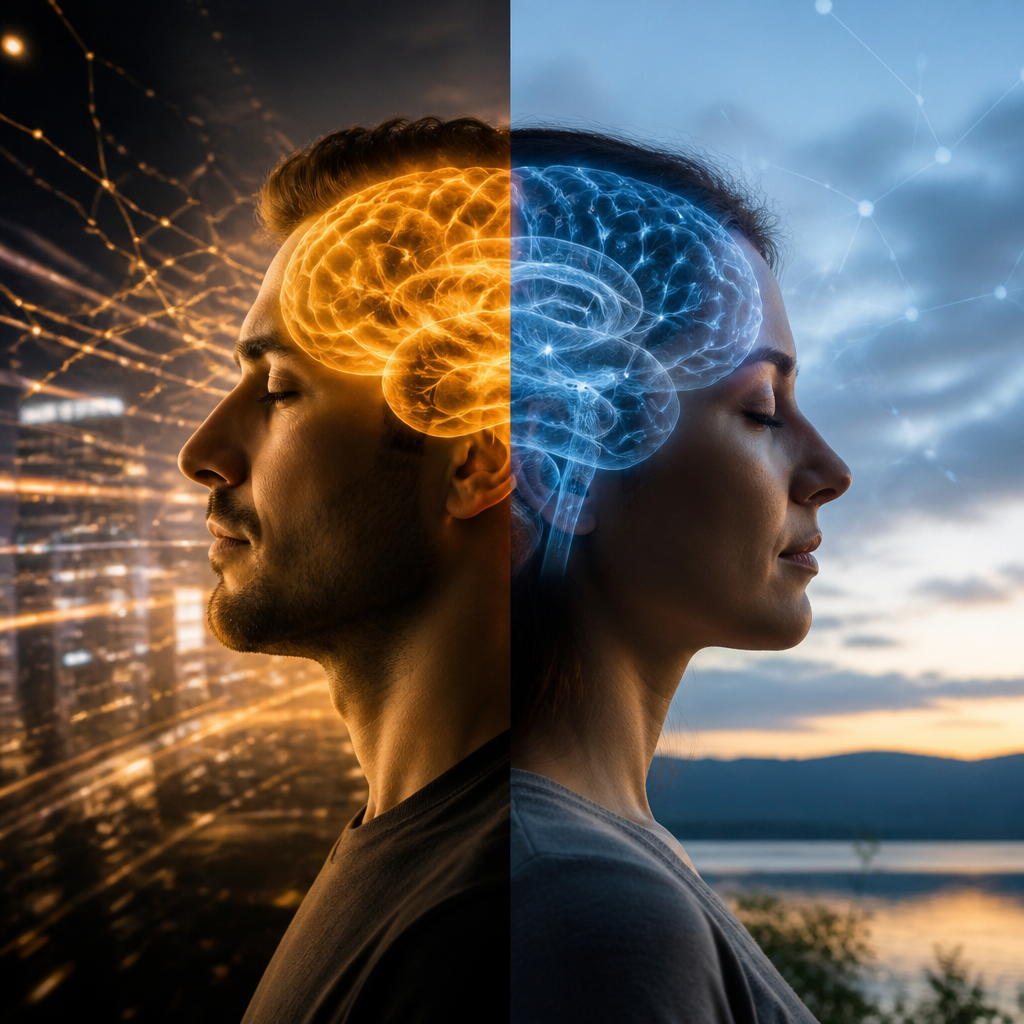
Dopamine and serotonin are two neurotransmitters that appear constantly in psychology classes, health articles, and everyday conversation, yet they are often reduced to misleading labels like the “reward chemical” and the “happiness chemical.” In AP Psychology, especially within Biological Bases of Behavior, those shortcuts are not enough. To understand how the brain guides motivation, mood, movement, learning, sleep, and decision-making, students need a more accurate comparison of dopamine vs. serotonin and the larger biological systems in which they operate.
A neurotransmitter is a chemical messenger released by neurons at the synapse, the small gap between communicating nerve cells. After an electrical impulse travels down the axon, neurotransmitters are released from vesicles, cross the synaptic cleft, and bind to receptors on the next neuron. Their effects depend on receptor type, brain region, firing pattern, and whether the signal is later cleared by reuptake transporters or broken down by enzymes. In practice, that means neither dopamine nor serotonin has one single psychological function. Each influences multiple processes, and each can support healthy behavior in one context while contributing to dysfunction in another.
This topic matters because it sits at the center of Biological Bases of Behavior. It connects neuron structure, synaptic transmission, the endocrine system, brain anatomy, sensation, emotion, motivation, sleep, learning, and mental disorders. When I have helped students build study maps for this unit, the best results came from treating dopamine and serotonin as hubs rather than isolated definitions. Dopamine links strongly to reward prediction, reinforcement, movement, and attention. Serotonin links strongly to mood regulation, appetite, sleep, pain processing, and impulse control. Both interact with other systems, including norepinephrine, glutamate, GABA, and key hormones such as cortisol and melatonin.
For exam preparation and real understanding, the goal is not memorizing slogans. It is learning how these neurotransmitters work across neural pathways, what brain structures they influence, how drugs alter signaling, and why psychologists and neuroscientists interpret behavior through biological mechanisms. This article serves as a hub for Biological Bases of Behavior by comparing dopamine and serotonin clearly, placing them in broader brain systems, and showing how neurotransmission helps explain normal behavior, psychological disorders, and treatment.
Dopamine: motivation, reward learning, movement, and attention
Dopamine is produced primarily in several brain areas, especially the substantia nigra and the ventral tegmental area. From there, dopaminergic pathways project to other regions with distinct functions. The nigrostriatal pathway is crucial for movement. The mesolimbic pathway is heavily involved in reward, incentive salience, and reinforcement learning. The mesocortical pathway influences attention, planning, and executive functioning. A fourth major route, the tuberoinfundibular pathway, helps regulate prolactin through hypothalamic control of the pituitary gland.
The most important psychological point is that dopamine does not simply create pleasure. Research strongly supports its role in wanting, anticipation, effort allocation, and reward prediction error. Reward prediction error means the brain compares expected outcomes with actual outcomes. If an outcome is better than expected, dopaminergic firing increases; if it is worse, firing decreases. This mechanism helps organisms learn which cues predict valuable outcomes. In plain terms, dopamine helps stamp in learning about what is worth pursuing.
That is why dopamine is central to operant conditioning. Behaviors followed by rewarding outcomes become more likely in the future partly because dopaminergic systems strengthen learning about cues, actions, and results. In classrooms, this appears when praise, grades, or social approval reinforce studying. In daily life, it explains why notifications, gambling, and variable-ratio reward schedules can be so compelling. Slot machines are a classic example because unpredictable rewards produce strong behavioral persistence, a principle AP Psychology students also see in learning theory.
Dopamine also matters for movement. In Parkinson’s disease, degeneration of dopamine-producing neurons in the substantia nigra reduces signaling in motor circuits, leading to tremor, rigidity, bradykinesia, and postural instability. This is one of the clearest demonstrations that neurotransmitters have measurable psychological and behavioral effects. It also shows why biological explanations are not abstract. When a neurotransmitter system changes, behavior changes in observable ways.
In cognition, dopamine contributes to working memory, cognitive flexibility, sustained effort, and goal-directed action. Too little or too much can impair performance, which is why psychologists often describe an optimal range rather than a simple more-is-better rule. This nuance matters in conditions such as ADHD, where dopamine and norepinephrine signaling in frontostriatal networks are implicated. Stimulant medications such as methylphenidate can increase catecholamine availability, improving attention and self-regulation for many patients.
Serotonin: mood regulation, sleep, appetite, and behavioral control
Serotonin, also called 5-hydroxytryptamine or 5-HT, is synthesized largely in the raphe nuclei of the brainstem and sent widely throughout the brain and body. Although popular writing often treats serotonin as the chemical of happiness, its actual functions are broader and more complex. Serotonin helps regulate mood, anxiety, appetite, sleep-wake cycles, pain sensitivity, sexual behavior, gastrointestinal activity, and forms of impulse control. Because its projections are so widespread and its receptor families are diverse, serotonin influences many systems at once.
In psychology, serotonin is especially important for emotional regulation. Lower serotonergic function has been associated with depression in some contexts, but the story is not as simple as a single deficit causing a disorder. Major depressive disorder involves multiple mechanisms, including stress pathways, cognitive patterns, inflammation, genetics, and changes in neural plasticity. Selective serotonin reuptake inhibitors, or SSRIs, can reduce symptoms for many people by increasing serotonin availability at the synapse, yet they do not work for everyone, and improvement often takes weeks. That timeline suggests downstream adaptations, not just immediate chemical elevation, are part of treatment.
Serotonin is also relevant to anxiety and inhibition. From a behavioral perspective, it often supports the capacity to pause, evaluate, and modulate responses. That is one reason serotonin has been linked to aggression, impulsivity, and emotional reactivity. Students should remember, however, that these associations are probabilistic, not deterministic. Human behavior emerges from neural circuits, developmental history, context, and cognition, not one molecule acting alone.
Sleep is another major area. Serotonin participates in circadian regulation and interacts with melatonin pathways. It also influences appetite and satiety, which is why serotonergic drugs may affect eating behavior. Much of the body’s serotonin is located outside the brain, especially in the gastrointestinal system, an important reminder that biological bases of behavior extend beyond the cerebral cortex alone.
Dopamine vs. serotonin: the clearest psychological differences
Students often ask for the simplest accurate comparison. The shortest useful answer is this: dopamine is more strongly tied to motivation, reinforcement, reward prediction, and movement, while serotonin is more strongly tied to mood regulation, satiety, sleep, and impulse modulation. That comparison is directionally correct, but it should never be treated as a rigid division. Both neurotransmitters affect emotion. Both affect learning. Both affect decision-making. The difference lies in dominant roles within larger circuits.
| Feature | Dopamine | Serotonin |
|---|---|---|
| Main psychological emphasis | Motivation, reinforcement, reward learning | Mood regulation, inhibition, emotional balance |
| Major brain sources | Substantia nigra, ventral tegmental area | Raphe nuclei |
| Classic AP Psychology link | Parkinson’s disease, schizophrenia, addiction | Depression, anxiety, sleep, eating behavior |
| Behavioral example | Pursuing a reward after learning a cue predicts it | Stabilizing mood and reducing impulsive reactions |
A practical example makes the distinction clearer. Imagine a student studying for an exam. Dopamine helps energize the pursuit of the goal, especially when the student expects a valued outcome such as a high grade or praise. Serotonin helps regulate mood during stress, support sleep needed for memory consolidation, and curb emotionally driven distractions. Success depends on both systems working within broader networks.
How these neurotransmitters fit into Biological Bases of Behavior
Biological Bases of Behavior is wider than neurotransmitter definitions. It includes neurons, the central and peripheral nervous systems, the autonomic nervous system, endocrine signaling, brain imaging, hemispheric specialization, and plasticity. Dopamine and serotonin are entry points into all of these topics. At the neuronal level, they illustrate synaptic transmission, receptor binding, agonists and antagonists, reuptake, and enzymatic breakdown. At the systems level, they show how specific pathways connect brain structures to behavior.
Consider the limbic system and frontal lobes. Dopamine activity in mesolimbic circuits involving the nucleus accumbens supports reward learning and cue-driven motivation, while mesocortical projections to the prefrontal cortex influence planning and cognitive control. Serotonin reaches the amygdala, hippocampus, cortex, and hypothalamus, helping shape emotional reactivity, memory processes, and homeostatic behaviors such as sleep and appetite. These are standard examples of how brain anatomy and chemistry work together.
The endocrine system also matters. Chronic stress activates the hypothalamic-pituitary-adrenal axis and elevates cortisol. Over time, that can alter mood, motivation, and even hippocampal functioning. In real clinical settings, I have found students grasp neurotransmitters faster when they stop imagining the brain as separate boxes and start seeing feedback loops: stress hormones influence brain function, neurotransmitters influence behavior, behavior influences environment, and environment reshapes the brain through plasticity.
Disorders, drugs, and why balance matters more than simple labels
Psychological disorders provide some of the clearest evidence for the roles of dopamine and serotonin, but they also expose the danger of oversimplification. Schizophrenia has long been linked to dopamine dysregulation, particularly excessive dopaminergic activity in some pathways contributing to positive symptoms such as hallucinations and delusions. Yet negative symptoms and cognitive impairments involve more complicated circuitry, including glutamate and cortical dysfunction. Antipsychotic medications often block dopamine receptors, which can reduce psychosis, but they can also produce side effects such as motor changes or metabolic problems.
Addiction is another dopamine-rich topic. Drugs such as cocaine and amphetamines increase dopamine signaling, especially in reward pathways. Repeated exposure can sensitize cue-driven wanting while reducing the impact of natural rewards, making compulsive use more likely. Importantly, addiction is not a moral failure. It is a disorder involving learning, reinforcement, stress, environment, and neuroadaptation.
On the serotonin side, depressive and anxiety disorders are common examples, but no serious psychologist now treats them as mere serotonin shortages. SSRIs, serotonin-norepinephrine reuptake inhibitors, psychotherapy, sleep regulation, exercise, and social support can all matter. The larger lesson for AP Psychology is that biological explanations are powerful but incomplete unless paired with cognitive, behavioral, and social perspectives.
Study takeaways for AP Psychology students
For exam success, remember three ideas. First, neurotransmitters work through pathways and receptors, not one universal effect. Second, dopamine is best associated with motivation, reinforcement, movement, and reward prediction, while serotonin is best associated with mood regulation, sleep, appetite, and impulse control. Third, behavior reflects interaction among brain structures, neurotransmitters, hormones, experience, and environment. If you build your notes around those principles, the entire Biological Bases of Behavior unit becomes easier to organize.
Dopamine vs. serotonin is not a battle between pleasure and happiness. It is a comparison between two multifaceted signaling systems that help explain why people pursue goals, regulate emotions, move, sleep, learn, and sometimes develop disorders. Understanding that comparison gives students a strong foundation for the rest of psychology, from learning and cognition to health and abnormal behavior. Review the pathways, connect them to disorders and treatments, and use this article as your hub as you study Biological Bases of Behavior in greater depth.
Frequently Asked Questions
1. What is the main psychological difference between dopamine and serotonin?
The clearest psychological difference is that dopamine is more strongly associated with motivation, reinforcement, reward prediction, goal-directed behavior, and movement, while serotonin is more strongly associated with mood regulation, emotional stability, impulse control, sleep, appetite, and broader behavioral balance. That does not mean dopamine only handles reward or serotonin only controls happiness. In reality, both neurotransmitters influence many overlapping processes, but they do so in different ways.
In psychology, dopamine is especially important when discussing why people pursue goals, repeat behaviors, and learn from consequences. It helps the brain mark what is important, energize action, and update expectations based on outcomes. Serotonin, by contrast, is often discussed in relation to emotional regulation and behavioral restraint. It helps shape how stable or reactive a person feels, how the body regulates sleep and appetite, and how the brain modulates stress and social behavior.
For AP Psychology students, a useful comparison is this: dopamine often helps answer, “What should I move toward, work for, or learn from?” while serotonin often helps answer, “How regulated, steady, and behaviorally controlled am I?” That summary is still simplified, but it is much more accurate than calling dopamine the reward chemical and serotonin the happiness chemical. Both are part of complex neural systems that interact constantly with other neurotransmitters, hormones, brain regions, and environmental experiences.
2. Why is it misleading to call dopamine the “reward chemical” and serotonin the “happiness chemical”?
Those labels are popular because they are memorable, but they leave out most of what these neurotransmitters actually do. Dopamine is not simply the chemical of pleasure. In many cases, it is more accurate to say dopamine is involved in reward prediction, motivation, reinforcement learning, attention to significant stimuli, and initiating action. A person can have strong dopamine activity not only when enjoying something, but also when anticipating a result, working toward a goal, or learning from an unexpected outcome.
Serotonin is also far more complicated than a happiness chemical. It contributes to mood regulation, but it also plays major roles in sleep, appetite, digestion, arousal, emotional resilience, aggression, and impulse control. Someone cannot reduce serotonin to a single feeling state any more than they can reduce dopamine to simple pleasure. In fact, many emotional and behavioral experiences involve both neurotransmitters at the same time, along with norepinephrine, GABA, glutamate, and many other biological systems.
These labels are especially misleading in education because they encourage students to memorize oversimplified catchphrases instead of understanding mechanism and function. In a more accurate psychological framework, dopamine helps the brain learn what matters and motivates future behavior, while serotonin helps regulate mood and maintain behavioral and physiological stability. The brain is not driven by one chemical per emotion. It is a networked system in which neurotransmitters act across circuits, receptors, and brain regions to shape thought, feeling, and action.
3. How do dopamine and serotonin affect learning, decision-making, and behavior?
Dopamine plays a major role in reinforcement learning, which is the process of strengthening behaviors based on outcomes. When an outcome is better than expected, dopamine signaling can help the brain encode that information and increase the likelihood of repeating the behavior. This is one reason dopamine is linked to habit formation, reward-based learning, and motivation. It does not just make experiences feel good; it helps the brain update predictions and allocate effort toward goals that seem valuable or relevant.
In decision-making, dopamine can influence how strongly a person pursues rewards, how much effort they are willing to invest, and how sensitive they are to incentives. This is why dopamine is often discussed in relation to approach behavior, novelty seeking, and the drive to act. It is also why disruptions in dopamine systems can affect disorders involving motivation, movement, or reinforcement, such as addiction or Parkinson’s disease.
Serotonin contributes to behavior in a different but equally important way. It is often involved in regulating impulses, tolerating frustration, moderating emotional reactions, and supporting more measured responses. In decision-making, serotonin may help reduce impulsivity and support patience, self-control, and adaptation to changing social or emotional contexts. It is also relevant to mood disorders because emotional stability affects how people interpret events, respond to stress, and make choices over time.
Together, these neurotransmitters help shape a balance between activation and regulation. Dopamine can push behavior forward by supporting pursuit and reinforcement, while serotonin can help modulate intensity, maintain stability, and reduce dysregulated responding. In psychological terms, behavior is often not the result of one neurotransmitter being “high” or “low,” but the result of multiple systems interacting to influence attention, motivation, emotion, and self-control.
4. What brain functions are dopamine and serotonin each most closely tied to in AP Psychology?
In AP Psychology, dopamine is most commonly tied to reward, motivation, reinforcement, attention to important stimuli, voluntary movement, and learning from consequences. It is especially relevant when students study the brain’s reward pathways, addiction, and movement disorders. For example, dopamine dysfunction is strongly associated with Parkinson’s disease, where reduced dopamine activity affects motor control, and with schizophrenia, where certain dopamine pathways have been linked to symptoms in more complex ways.
Serotonin is most commonly tied to mood, sleep, appetite, arousal, and emotional regulation. It is often discussed when students study depression, anxiety-related functioning, aggression, and the biological factors involved in psychological disorders. Serotonin is also important because many antidepressant medications, such as selective serotonin reuptake inhibitors, are designed to affect serotonin signaling, which is one reason it receives significant attention in psychology and health education.
It is important, however, not to think of these as isolated categories. Dopamine also affects cognition and attention, not just reward. Serotonin also affects behavior and decision-making, not just mood. AP Psychology increasingly rewards students who can move beyond simple one-to-one definitions and explain how neurotransmitters operate in networks. A strong answer on an exam would show that dopamine and serotonin each have broad effects and that their functions depend on which neural pathways, receptors, and brain systems are involved.
5. How do dopamine and serotonin work together rather than against each other?
Dopamine and serotonin are often presented as if they are opposites, but that framing is too simplistic. In the brain, they work in interconnected systems that help coordinate motivation, mood, self-control, learning, and daily regulation. Dopamine may increase the salience of a goal, support effort, and reinforce learning from outcomes, while serotonin may help regulate emotional tone, moderate impulsive responses, and stabilize behavior across changing situations. These functions are complementary, not mutually exclusive.
For example, pursuing a long-term goal such as studying for an exam may involve dopamine-based motivation and reinforcement, but it also requires serotonin-related regulation of mood, sleep, stress response, and impulse control. A student may need dopamine to stay engaged by progress and achievement, and serotonin to maintain emotional balance, tolerate frustration, and avoid acting on every distraction. Healthy behavior usually depends on coordinated activity across both systems rather than dominance of one alone.
This is one reason modern psychology avoids “one neurotransmitter, one emotion” explanations. Real mental life involves interacting circuits. Motivation without regulation can become impulsive or unstable. Regulation without motivation can become flat or disengaged. By understanding dopamine and serotonin as part of a larger biological system, students gain a more accurate picture of how the brain supports movement, emotion, learning, rest, and decision-making. That deeper comparison is exactly what makes the topic so important in Biological Bases of Behavior.