Skip to content

SOCIALSTUDIESHELP.COM

Learn Social Studies and American History

  • American History Lessons
  • American History Topics
  • AP Government and Politics
  • Economics
  • Resources
    • Blog
    • Practice Exams
    • AP Psychology
    • World History
    • Geography and Human Geography
    • Comparative Government & International Relations
    • Most Popular Searches
  • Toggle search form

Sacred Rivers in Global Religions: A Cultural Insight

Posted on By admin

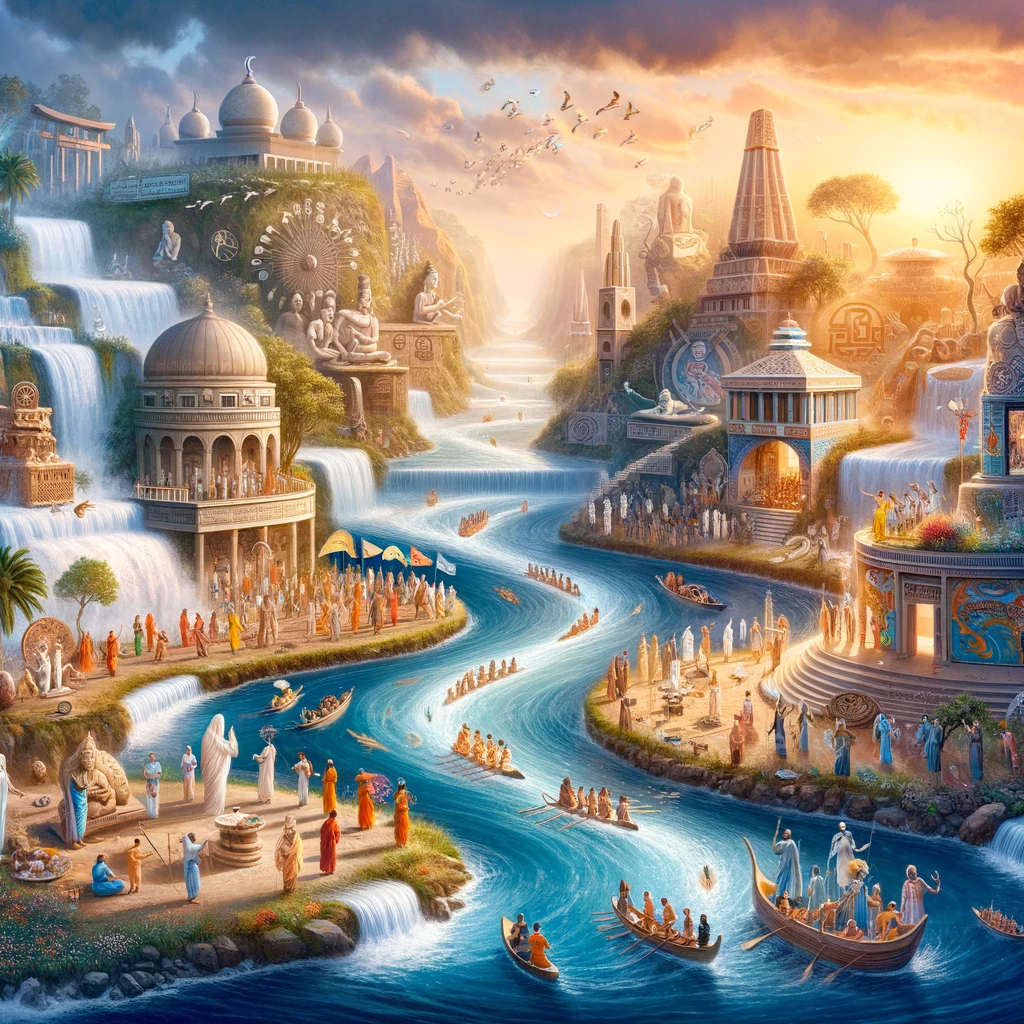
Rivers have been venerated across various cultures and religions throughout history, often seen as symbols of life, purity, and spiritual rejuvenation. This article delves into the significance of sacred rivers in different world religions and cultures, exploring how these natural water bodies have shaped beliefs, practices, and community life.

Hinduism and the Ganges

The Ganges: A Divine Entity

In Hinduism, rivers are not merely physical entities but are imbued with divine qualities. The Ganges, known as “Ganga” in Sanskrit, is perhaps the most sacred river in Hinduism. It is personified as a goddess, Ganga Ma, and is revered as a purifier of sins and a granter of salvation. The significance of the Ganges is evident in various Hindu rituals, including the scattering of ashes in the river, symbolizing the cycle of life and death.

Festivals and Rituals

The river is central to numerous festivals and rituals, most notably the Kumbh Mela. Held every three years in four different locations along the river, this festival draws millions of pilgrims who bathe in the Ganges to cleanse themselves of sins. The Ganges also plays a crucial role in daily rituals like ‘Aarti’ where lamps are floated on the river, creating a mesmerizing sight of devotion.

Buddhism and the Mekong River

The Mekong: A Path to Enlightenment

In Buddhism, rivers are seen as metaphors for the path to enlightenment. The Mekong River, flowing through multiple Southeast Asian countries, has a special place in Buddhist culture. It is seen as a source of life and a path that connects various Buddhist communities.

Water Festivals and Community

The Mekong is central to many Buddhist water festivals, which combine religious ceremonies with community celebrations. For example, in Laos and Thailand, the Loy Krathong festival involves floating decorated baskets on the river, symbolizing the release of anger, grudges, and negative thoughts.

Christianity and the Jordan River

The Jordan River: A Symbol of Baptism

In Christianity, the Jordan River holds immense significance, primarily as the site of Jesus Christ’s baptism by John the Baptist. This event marks the Jordan as a symbol of spiritual cleansing and renewal. The river, thus, becomes a pilgrimage site for Christians seeking to reaffirm their faith through baptismal rites.

Pilgrimages and Spiritual Reflection

Christian pilgrimages to the Jordan River often involve baptism or reenactments of the baptism of Jesus. These acts are seen as a means of spiritual reflection and a recommitment to Christian faith and values.

Islam and the Tigris and Euphrates

Tigris and Euphrates: Rivers of Paradise

In Islamic tradition, the Tigris and Euphrates rivers are often associated with the rivers of Paradise mentioned in the Quran. They symbolize the bounty and sustenance provided by Allah and are integral to the historical and cultural landscape of Islamic civilizations.

Cultural and Historical Significance

These rivers have played a vital role in the development of early Islamic civilizations, especially in the Mesopotamian region. The Tigris and Euphrates are not just physical entities but are interwoven with the cultural, economic, and spiritual life of the people in the region.
Indigenous Beliefs and the Amazon River

The Amazon: A Lifeline of Indigenous Cultures

In the belief systems of many indigenous cultures in South America, the Amazon River is not just a water body but a living entity with a spirit. It is revered as the lifeline of the ecosystem and the source of spiritual and physical sustenance for the indigenous tribes.

Rituals and Environmental Stewardship

Indigenous rituals often revolve around the Amazon, emphasizing a deep connection with nature and the need for environmental stewardship. The river is central to their cosmology, featuring in creation myths and legends that guide their lifestyle and practices.

Judaism and the Jordan River

The Jordan River: A Historical and Spiritual Landmark

In Judaism, the Jordan River holds historical and religious significance. It is mentioned in the Old Testament as the boundary of the Promised Land and the site where the Israelites crossed into Canaan. The river symbolizes freedom and redemption in Jewish history.

Ceremonies and Symbolism

While not central to Jewish rituals like in Christianity, the Jordan River remains a powerful symbol in Jewish culture, representing new beginnings and spiritual liberation.

African Traditional Religions and the Nile River

The Nile: A Source of Life and Mythology

In various African traditional religions, the Nile River is revered as a god or a gift from the gods. It is seen as the source of life, fertility, and prosperity. The river features prominently in Egyptian mythology, with gods like Hapi, the god of the Nile, symbolizing its life-giving properties.

Festivals and Agricultural Practices

The Nile’s flooding cycle is central to agricultural rituals and festivals in these cultures. These events often include prayers and offerings to the river gods, asking for bountiful harvests and protection from floods.

Shintoism and the Kamo River

The Kamo River: A Sacred Shinto Site

In Shinto, the native religion of Japan, rivers are seen as home to ‘Kami’ or spirits. The Kamo River in Kyoto is particularly significant in Shinto practice. It is considered pure and cleansing, hosting several purification rituals and festivals.

Matsuri and Purification Rites

Matsuri, or Shinto festivals, often take place near the Kamo River, involving rituals of purification and offerings to the Kami. The famous Aoi Matsuri, one of Kyoto’s three main festivals, includes a procession to the Kamo River to pray for peace and good harvests.

Conclusion

The reverence for rivers in various world religions and cultures underscores the deep connection between humanity and the natural world. These sacred rivers are not just physical bodies of water; they embody the spiritual, cultural, and ecological values of the societies that hold them dear. Understanding the significance of these rivers offers insight into the diverse ways humans find meaning and connection in the natural world.
Environmental Practices, Religion and Spirituality, World Cultures

Post navigation

Previous Post: Indigenous Farming Techniques: Harmonizing with Nature
Next Post: Eco-Villages: Bridging Ancient Traditions with Modern Sustainability

Related Posts

African Diaspora: Cultural Impact Globally African Cultures
Exploring the Rich Indigenous Cultures of the Andes South American Cultures
Exploring Persian Culture: Influence Beyond Iran Middle Eastern Cultures
Indigenous Farming Techniques: Harmonizing with Nature Environmental Practices
Exploring the Maasai Culture: East Africa’s Heritage of Resilience African Cultures
Irish Diaspora: Shaping US and Australia Historical Migrations and Their Cultural Impact
  • World History
  • Timeline of US History: Major Events from 1492 to Present
  • Glossary of Government Terms: 50 AP Gov Concepts Explained in Plain English
  • Top 10 Most Common Social Studies Exam Terms (and What They Mean)
  • Research Paper Outline Example (Template for High School & AP Research)

Navigation

  • Economics
    • Agricultural Price Supports
    • Agriculture in the United States
    • Bank Deregulation and the S&L Crisis
    • Banking and the Federal Reserve System
    • Basic Economic Concepts
    • Budgeting
    • Business Cycle
    • Business Organizations
    • Perspectives on Business Structures
    • Circular Flow Model
    • Collective Bargaining
    • Comparative Economic Systems
    • Different Types of Banks
    • Economic Growth
    • Economic Indicators
    • Economics Final Exam Review
    • Economics Links
    • Elasticity
    • Federal and State Budgeting
    • Federal Spending and National Debt
    • Free Enterprise
    • Governments Role in the Economy
    • History of Labor Unions
    • Government Protection of the Consumer
    • Income Inequality
    • Inflation
  • History Topics
    • “Robber Barons” or “Captains of Industry”
    • The 18th & 19th Amendments: Prohibition & Women’s Suffrage Explored
    • 19th Amendment – Womens Suffrrage
    • African American Reformers
    • African American Reform in the Progressive Era
    • America – Divided at Birth
    • America’s Role in WWII: Decisive Influence in War’s Outcome
    • Spanish American War: How it Forged America’s Global Dominance
    • Andrew Carnegie – Gospel of Wealth
    • Effectiveness of U.S. Antitrust Laws in Protecting Competition
    • Articles of Confederation
    • Justifications & Impacts: Policies Toward Native Americans
    • Understanding the Bill of Rights’ Protections
    • US Campaigns and Elections: Democracy’s Backbone
    • Causes of the Great Depression
    • Opposition & Responses to the New Deal: Roosevelt’s Strategy
    • Checks and Balances
    • Effectiveness of the Civil Rights Movement in U.S. Social Change
    • What Caused the Beginning of the Civil War?
    • Colonization and Mercantilism
    • Constitutional Convention
    • Constitutional Flexibility
    • Containment Policy: America’s Tactics Against Communism
    • Cooling the Cold War: From Peaceful Coexistence to Detente
    • Cooling Off: Peaceful Coexistence to Detente
    • Declaration of Independence
    • Democracy in the colonies
    • Dropping of the Atomic Bomb
    • Early Domestic Policies
    • Washington & Jefferson’s Impactful Foreign Policies
    • Reconstruction’s Impact on Freedmen’s Lives
    • Effect of Lincoln’ Death on Reconstruction
    • Effects of the Great Depression
    • Electoral College
    • Enlightenment Thinkers
    • Events Leading Up To The Revolution
    • French and Indian War
    • Government Relationship with Unions
    • How a bill becomes a law.
    • Immigration – Why they came
    • Improvement in the cities – Progressive Era
    • American Influence in Asia during the 1800s
    • John Quincy Adams and Andrew Jackson
  • History Lessons
    • Cold War Genesis: A Detailed Analysis
    • The End of the Cold War
    • FDR’s New Deal
    • Foundation of Democracy
    • The Presidency of Andrew Jackson
    • JFK versus LBJ
    • The Presidency of John Adams
    • Judicial Branch
    • Immigration in the U.S
    • Legislative Branch
    • Madison – War of 1812
    • Monopolies & Trusts: Exploring American Businesses’ Quest to Curb Competition
    • The Presidency of James Monroe
    • Judicial Review and Supreme Court Cases
    • Justification for Imperialism
    • Korematsu V. United States
    • Origins of Legalized Segregation in the South
    • Management vs Unions: Responses to Unionization in the Industrial Revolution
    • Westward Expansion: Manifest Destiny’s Impact
    • McCarthyism Explained: Politics, Fear, and Cold War Context
    • The New Deal’s Impact on Minorities in 1930s America
    • Monopolies
    • Monroe Presidency
    • New Technologies – Industrialization
    • WWI and Civil Liberties: Striking the Balance in Wartime
  • Gov & Politics
    • Elections and Campaigns – Week 9 Notes
    • Interest Groups in American Politics: A Historical Review
    • Interest Groups – Text Notes – Week Seven
    • Lecture Notes – American Political System
    • Lecture Notes – Congress – Week 11
    • Lecture Notes – Economic Policy
    • Lecture Notes – Federalism
    • Lecture Notes – The Judiciary – Week 13
    • Notes – The Bureaucracy
    • Lecture Notes – Political Culture in America
    • Political Participation
    • Political Participation – Text Notes – Week Six
    • Political Parties – Week 8 – Text Notes
  • World Cultures
    • Asian Cultures
    • African Cultures
    • European Cultures
    • Middle Eastern Cultures
    • North American Cultures
    • Oceania and Pacific Cultures
    • South American Cultures
  • Global Trends
  • Important Events
  • Social Studies Weekly
  • Cultural Celebrations
    • Ancient Civilizations
    • Architectural Wonders
    • Celebrating Hispanic Heritage
    • Celebrating Women
    • Celebrating World Heritage Sites
    • Clothing and Fashion
    • Culinary Traditions
    • Cultural Impact of Language
    • Environmental Practices
    • Festivals
    • Global Art and Artists
    • Global Music and Dance
  • Economics
    • Behavioral Economics
    • Development Economics
    • Econometrics and Quantitative Methods
    • Economic Development
    • Economic Geography
    • Economic History
    • Economic Policy
    • Economic Sociology
    • Economics of Education
    • Environmental Economics
    • Financial Economics
    • Health Economics
    • History of Economic Thought
    • International Economics
    • Labor Economics
    • Macroeconomics
    • Microeconomics
  • Important Figures in History
    • Artists and Writers
    • Cultural Icons
    • Groundbreaking Scientists
    • Human Rights Champions
    • Intellectual Giants
    • Leaders in Social Change
    • Mythology and Legends
    • Political and Military Strategists
    • Political Pioneers
    • Revolutionary Leaders
    • Scientific Trailblazers
    • Explorers and Innovators
  • Global Events and Trends
  • Regional and National Events
  • World Cultures
    • Asian Cultures
    • African Cultures
    • European Cultures
    • Middle Eastern Cultures
    • North American Cultures
    • Oceania and Pacific Cultures
    • South American Cultures
  • Privacy Policy

Copyright © 2025 SOCIALSTUDIESHELP.COM. Powered by AI Writer DIYSEO.AI. Download on WordPress.

Powered by PressBook Grid Blogs theme