
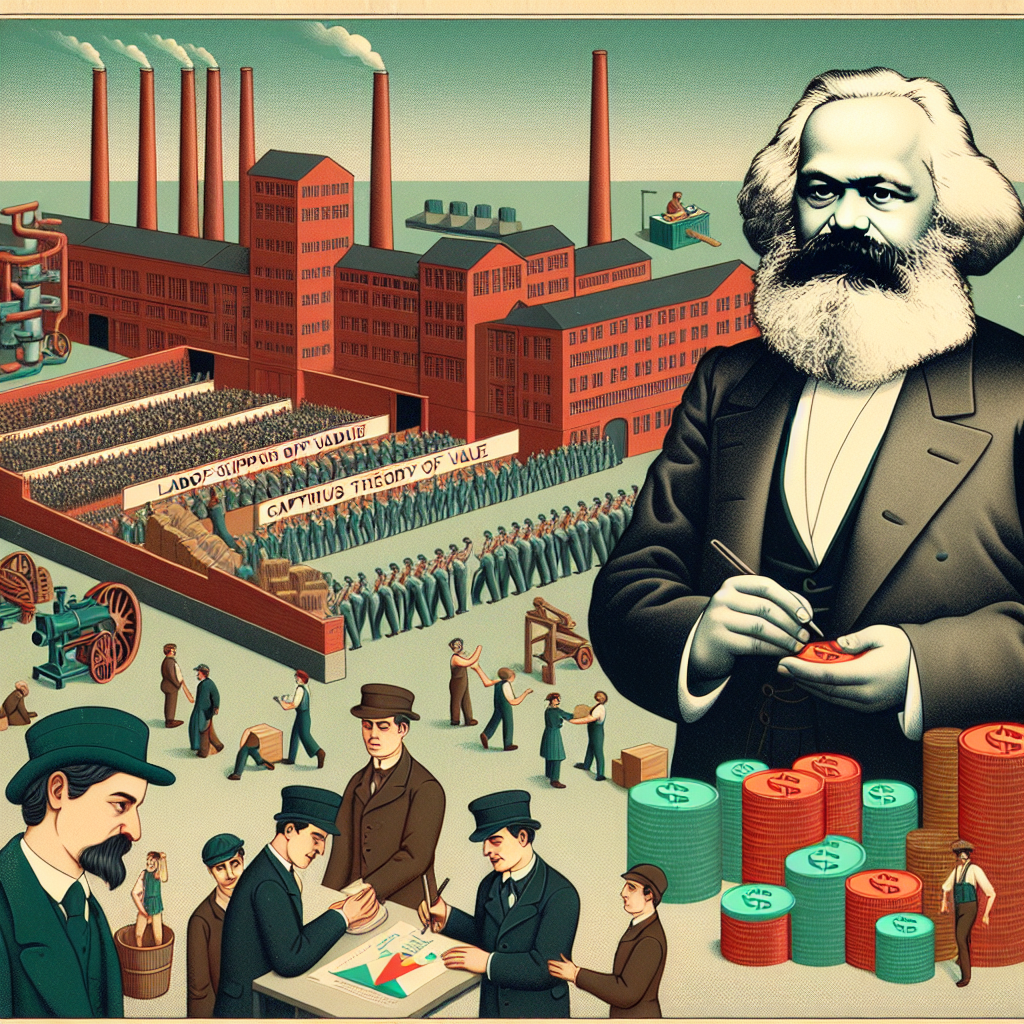
Marxist economics, rooted in the works of Karl Marx and Friedrich Engels, presents a compelling critique of capitalist society. At its core lies the theory of surplus value, which underscores the inherent exploitation within capitalism. Marx posited that capitalism systematically deprives workers of the value they produce, leading to class struggles and economic inequalities. To understand Marxist economics comprehensively, it’s essential to dive into the intricacies of the theory of surplus value and the broader critique of capitalism.
The theory of surplus value is pivotal in Marxist thought. It addresses the value generated by labor and how it is appropriated by capitalists, thus elucidating the foundations of profit in a capitalist economy. According to Marx, the value of a product is derived from the labor invested in its production. Despite this, workers receive wages that equate to only a fraction of the value they create. The remaining portion, or the surplus value, is appropriated by capitalists, leading to their accumulation of wealth at the expense of laborers.
Moreover, Marxist economics critiques capitalism by highlighting its propensity for crises, inherent contradictions, and the social ramifications of unchecked capital accumulation. Marx argued that capitalism is inherently unstable, plagued by cycles of booms and busts, which are consequences of overproduction and underconsumption. This instability not only disrupts economic life but also exacerbates social inequalities, making capitalism inherently unsustainable in the long run.
In this article, we will delve into the fundamental aspects of Marxist economics, particularly focusing on the theory of surplus value and the broader critique of capitalist society. We will explore how these concepts help us comprehend the dynamics of economic exploitation and the root causes of societal disparities under capitalism.
The Theory of Surplus Value
The theory of surplus value is a cornerstone of Marxist economics. It explains how value is created and distributed within a capitalist economy, shedding light on the exploitation embedded in such systems. According to Marx, the value of any commodity is determined by the amount of socially necessary labor time required for its production. This notion stands in stark contrast to classical economists’ focus on supply and demand or utility.
Surplus value arises because wages paid to workers, which reflect the value of their labor power, are less than the value of the goods or services they produce. The difference constitutes surplus value, which is appropriated by the capitalist employer. In practical terms, if a worker is paid for eight hours of labor but produces value equivalent to ten hours, the extra two hours of labor constitute surplus value, thus maximizing the capitalist’s profit.
Marx elaborated on this concept further through the distinction between necessary labor time and surplus labor time. Necessary labor time is the duration workers need to work to produce value equivalent to their wages, covering their subsistence and the reproduction of their labor power. Any additional labor time beyond this is surplus labor time, generating surplus value for the capitalist.
This exploitation, Marx argued, is systematic and intrinsic to capitalist economies. It underscores the antagonistic relationship between labor and capital, with workers continuously striving for better wages and conditions while capitalists seek to maximize surplus value and, consequently, profits. This tension lies at the heart of class struggles within capitalist societies.
The Process of Capital Accumulation
Capital accumulation, described by Marx as the process by which capitalists reinvest surplus value to generate more capital, is a fundamental aspect of his critique of capitalism. This process perpetuates the cycle of exploitation, as surplus value extracted from laborers is reinvested in new means of production, leading to more extensive and intense exploitation in subsequent production cycles.
Marx identified two primary forms of capital accumulation: the accumulation of absolute surplus value and the accumulation of relative surplus value. The accumulation of absolute surplus value involves extending the working day or increasing the intensity of labor to extract more value from workers. In contrast, the accumulation of relative surplus value focuses on enhancing productivity through technological advancements, which reduce the necessary labor time, thereby increasing surplus labor time without extending the working day.
This relentless drive for capital accumulation fuels economic growth under capitalism but also contributes to numerous contradictions and crises. Marx highlighted the tendency of the rate of profit to fall, stemming from increasing investments in machinery and technology, which reduce the proportion of living labor relative to capital. As the source of surplus value is labor, this shift results in diminishing returns on capital investments, contributing to economic instability.
Moreover, capital accumulation intensifies the concentration and centralization of capital. Large firms continuously outcompete and absorb smaller ones, leading to monopolistic structures that further exacerbate economic disparities. This concentration of economic power in the hands of a few capitalists undermines competition and democratic processes, fostering social and economic inequalities.
Contradictions of Capitalism
Marx’s critique of capitalism extends beyond the theory of surplus value to identify various contradictions inherent in the capitalist mode of production. These contradictions emerge from the dynamics of capital accumulation and manifest in periodic economic crises, social discontent, and environmental degradation.
One of the fundamental contradictions identified by Marx is the overproduction crisis. Capitalists, driven by the pursuit of surplus value, continually increase production beyond the consumption capacity of the market. This results in a surplus of goods, which cannot be sold at profitable prices, leading to economic downturns, unemployment, and wasted resources. Overproduction, therefore, stands in stark contrast to the underconsumption faced by workers, who often lack sufficient income to afford basic necessities.
Another significant contradiction is the alienation of labor. Under capitalism, the labor process becomes increasingly fragmented and specialized, reducing workers to mere cogs in the production machine. This alienation from the products of their labor, their work, and their fellow workers leads to a profound sense of disconnection and dissatisfaction among the workforce. Marx contended that this alienation is a symptomatic expression of the exploitative nature of capitalist production.
Environmental degradation is yet another contradiction of capitalist economies. The relentless pursuit of profit drives capitalists to exploit natural resources unsustainably, leading to ecological crises such as deforestation, pollution, and climate change. These environmental consequences not only endanger ecosystems but also disproportionately affect marginalized communities, exacerbating social inequalities.
Marxists argue that these contradictions are integral to capitalism and cannot be resolved within its framework. They point to the necessity of a revolutionary transformation towards a socialist society, where production is organized for the common good rather than profit, as a solution to these systemic issues.
Critique of Exploitation and Class Struggle
Marx’s analysis of surplus value and capital accumulation lays the groundwork for his broader critique of exploitation and class struggle within capitalist societies. He argued that the capitalist mode of production perpetuates a class structure characterized by the bourgeoisie (capital owners) and the proletariat (working class), whose interests are fundamentally opposed.
The extraction of surplus value epitomizes the exploitative relationship between capitalists and workers. Capitalists, driven by the profit motive, seek to maximize surplus value by minimizing wages and intensifying labor exploitation. This exploitation is systemic, as wages rarely reflect the true value created by workers, leading to economic inequalities and social disenfranchisement.
Moreover, Marx posited that capitalism inherently generates class struggle, as the working class resists exploitation and strives for better wages, working conditions, and social rights. This struggle is not confined to economic demands but extends to political and ideological realms, challenging the legitimacy of capitalist rule. Across history, labor movements, strikes, and revolutions have been manifestations of this class struggle, highlighting the antagonistic relationship between labor and capital.
Marx also emphasized the role of ideology in perpetuating exploitation and class domination. Capitalist societies, he argued, propagate ideologies that legitimize and naturalize the capitalist mode of production, masking the underlying exploitation. Institutions such as the state, education system, and media play crucial roles in sustaining this ideological hegemony. However, Marxists contend that through class consciousness and collective action, the working class can challenge and overturn this ideological domination, paving the way for a socialist transformation.
Potential for Revolutionary Change
Integral to Marxist economics is the notion that capitalism, due to its inherent contradictions and exploitative dynamics, cannot sustain itself indefinitely. Marx envisaged a revolutionary transformation where the working class would overthrow the capitalist system and establish a socialist society based on collective ownership and democratic control over the means of production.
This revolutionary change, Marx argued, would address the root causes of exploitation and social inequality by abolishing private property and the profit motive. In socialism, production would be aimed at satisfying human needs rather than generating profits, fostering a more egalitarian and just society. The surplus value created by labor would no longer be appropriated by a minority of capitalists but would be distributed collectively to ensure the well-being and development of all members of society.
Furthermore, Marx believed that socialism would overcome the contradictions of capitalism, such as economic crises and environmental degradation, by planning and coordinating production rationally and sustainably. In a socialist economy, decisions about production and distribution would be made democratically, taking into account social and environmental considerations rather than profit maximization.
Marxists argue that the historical development of capitalism, marked by increasing concentration of capital, social inequalities, and recurring crises, creates the conditions for revolutionary change. They contend that the working class, through collective action and solidarity, possesses the potential to challenge capitalist domination and build a socialist society. The experience of previous socialist movements and revolutions provides valuable lessons for contemporary struggles against capitalism and for the construction of an alternative, socialist future.
Conclusion
Marxist economics, with its theory of surplus value and critique of capitalism, provides a profound analysis of the dynamics of exploitation, inequality, and class struggle within capitalist societies. By uncovering the mechanisms through which capital appropriates surplus value created by labor, Marxist economics reveals the inherent injustices and contradictions of the capitalist system.
The theory of surplus value underscores the exploitative relationship between capitalists and workers, highlighting the systematic extraction of surplus labor and the resulting accumulation of capital. This exploitation is not only economic but also social, manifesting in alienation, economic disparities, and environmental degradation. Marxist economics thus offers a powerful critique of the capitalist mode of production, emphasizing its unsustainability and the necessity of revolutionary change.
Furthermore, Marx’s analysis of capital accumulation, contradictions, and class struggle illuminates the inherent instability and conflict within capitalism. The recurrent crises of overproduction, the alienation of labor, and the environmental degradation under capitalism underscore the need for a transformative alternative. Marxist economics advocates for a socialist society that prioritizes collective ownership, democratic control, and the satisfaction of human needs over profit, envisioning a more just, equitable, and sustainable mode of production.
In conclusion, the Marxist critique of capitalism, centered on the theory of surplus value, offers invaluable insights into the workings of capitalist exploitation and the potential for revolutionary change. By understanding and addressing the root causes of economic injustice and social inequality, Marxist economics provides a framework for envisioning and realizing a socialist future that transcends the limitations and contradictions of capitalism.