
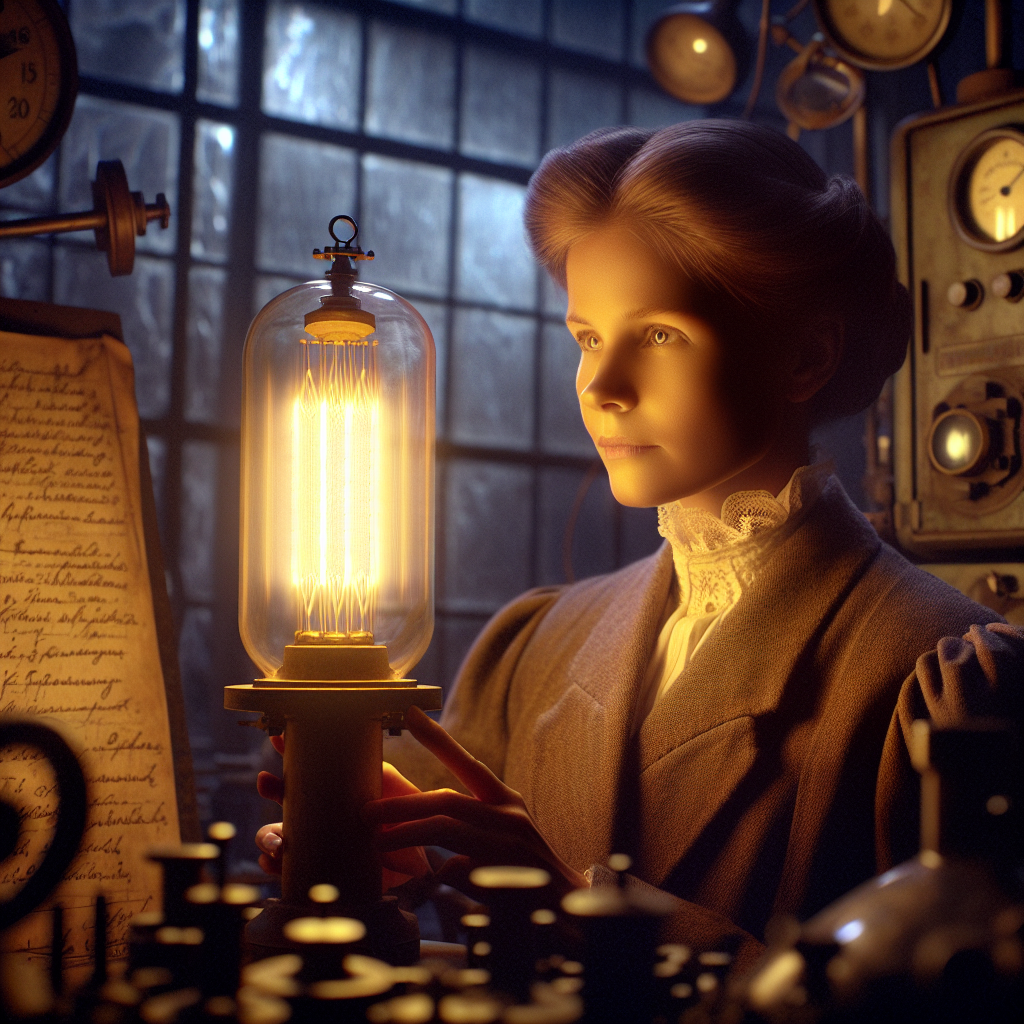
Marie Curie was a pioneer of science whose groundbreaking research and discoveries shaped the modern world. Born Maria Skłodowska on November 7, 1867, in Warsaw, Poland, Curie’s early life was marked by her voracious appetite for learning and her resilience in the face of adversity. Despite the limited opportunities for women in her homeland, she pursued her passion for science, which led her to move to Paris for further education. There, she would not only find the resources to nurture her scientific pursuits but also meet her future husband and collaborator, Pierre Curie.
Curie’s journey from a driven student to a Nobel laureate is a testament to her extraordinary talent, determination, and profound curiosity. She is best known for her work on radioactivity, a term she coined, which revolutionized the fields of physics and chemistry. Her discovery of the elements polonium and radium, along with her meticulous research on radioactive substances, paved the way for significant advancements in medical treatments and nuclear physics.
This article delves into the life and achievements of Marie Curie, exploring her motivations, challenges, and the indelible mark she left on the scientific community and beyond. By understanding her contributions and the context in which she made them, we gain insight into the profound impact one dedicated individual can have on human knowledge and societal progress.
Early Life and Education
Growing up in a family that deeply valued education, Marie Curie was encouraged to pursue knowledge from a young age. Her father, a mathematics and physics teacher, provided her with scientific equipment, fostering her interest in the sciences. Despite the struggles of her family after the death of her mother and the loss of her father’s job, Curie’s determination never wavered.
Curie became involved in the clandestine “Flying University,” a Polish institution that defied the oppressive regulations imposed by the Russian Empire by providing higher education to women. She excelled in her studies, but the political climate in Poland severely restricted her academic aspirations. Determined to overcome these barriers, Curie moved to Paris in 1891 to attend the University of Paris (Sorbonne), where she earned degrees in physics and mathematics.
During her time at the Sorbonne, Curie faced numerous challenges, including language barriers and financial difficulties. She often lived in near poverty while dedicating herself fully to her studies. Her remarkable perseverance and academic prowess soon paid off, and she began her journey into the field of scientific research.
Partnership with Pierre Curie
In 1894, Marie met Pierre Curie, a highly respected physicist, and her intellectual equal. Their mutual admiration for science quickly blossomed into a partnership, both personally and professionally. The couple married in 1895 and combined their scientific efforts, fostering a collaborative environment that was rare for the time.
Pierre’s expertise in crystallography and electromagnetism complemented Marie’s burgeoning research on radioactivity. Together, they embarked on a quest to understand the mysterious radiation discovered by Henri Becquerel. Through meticulous experimentation and analysis, the Curies discovered two new elements: polonium, named after Marie’s homeland, and radium.
Their collaborative work led to significant advancements in the understanding of atomic structure and radioactivity. Despite the modest conditions of their laboratory, their discoveries earned them international recognition. The couple’s groundbreaking research culminated in the award of the 1903 Nobel Prize in Physics, which they shared with Becquerel. As the first woman to receive a Nobel Prize, Marie Curie had already begun to break down gender barriers in the scientific community.

Solo Pursuits and Further Discoveries
Following Pierre’s tragic death in a street accident in 1906, Marie Curie continued their research with unrelenting determination. She took over Pierre’s teaching position at the Sorbonne, becoming the first woman to teach there. This role not only highlighted her academic prowess but also signified her breaking new ground for women in science.
Curie’s work continued to garner recognition, and in 1911, she was awarded the Nobel Prize in Chemistry for her discovery of radium and polonium, and her investigation into the nature of radium and its compounds. She remains the only person to have won Nobel Prizes in two different scientific fields. Her extensive research on radioactive substances laid the foundation for the development of X-ray machines and furthered the understanding of atomic physics.
Throughout her career, Curie faced criticism and prejudice, yet her unwavering dedication to science remained unshaken. She paved the way for future generations of women scientists, showing that passion and perseverance could transcend societal limitations.
Impact on Medicine
One of Curie’s most profound contributions to science was her work’s effect on medical practices. During World War I, Curie recognized the potential of X-rays in diagnosing injuries. She developed mobile radiography units, known as “Little Curies,” which could be used on battlefields to assist surgeons in locating shrapnel and broken bones in wounded soldiers.
Curie personally spent years traveling with these mobile units and training other doctors and technicians in their use, significantly advancing battlefield medicine. Her pioneering efforts in radiology led to the establishment of new medical techniques that have saved countless lives.
Beyond her immediate medical innovations, Curie’s research on radioactivity has had lasting impacts on cancer treatment. The development of radium therapy (now known as radiation therapy) directly resulted from her findings, revolutionizing the treatment of various cancers and other illnesses.
Legacy and Influence
Marie Curie’s legacy extends far beyond her research and Nobel Prizes. She established the Radium Institute in Paris in 1914, dedicated to studying radioactivity and its applications. This institute became a hub for scientific research and produced several Nobel laureates in the following decades.
Curie’s influence also extends into the realm of education and advocacy. She was a staunch advocate for women in science, often speaking out against the gender biases that hindered their progress. Her life inspired generations of women to pursue careers in STEM fields and showed that gender does not dictate scientific ability.
The Curie family continued her scientific legacy, with her daughter Irène Joliot-Curie also winning a Nobel Prize for chemistry. The impact of Marie Curie’s life’s work is seen in the continuous advancements in medical science, physics, and chemistry. Her indomitable spirit and contributions to humanity remain a powerful example of what unwavering dedication to knowledge and discovery can achieve.
Conclusion
Marie Curie’s story is a remarkable journey of triumph over adversity, a relentless pursuit of knowledge, and a passion for scientific discovery. Her work not only revolutionized our understanding of radioactivity but also led to practical applications that have profoundly impacted medicine and technology.
Her legacy is a beacon of inspiration, demonstrating that groundbreaking discoveries often come from those who are willing to challenge conventional wisdom and embrace curiosity. Curie’s determination and resilience in the face of societal and personal challenges highlight the importance of perseverance in achieving great things.
As we reflect on the life and contributions of Marie Curie, we are reminded of the potential of science to change the world. Her advancements continue to benefit humanity, proving that dedication to research and a commitment to progress are invaluable assets to society. Curie’s life illuminated by radioactivity continues to shine brightly, guiding future generations of scientists towards new horizons of knowledge and discovery.


