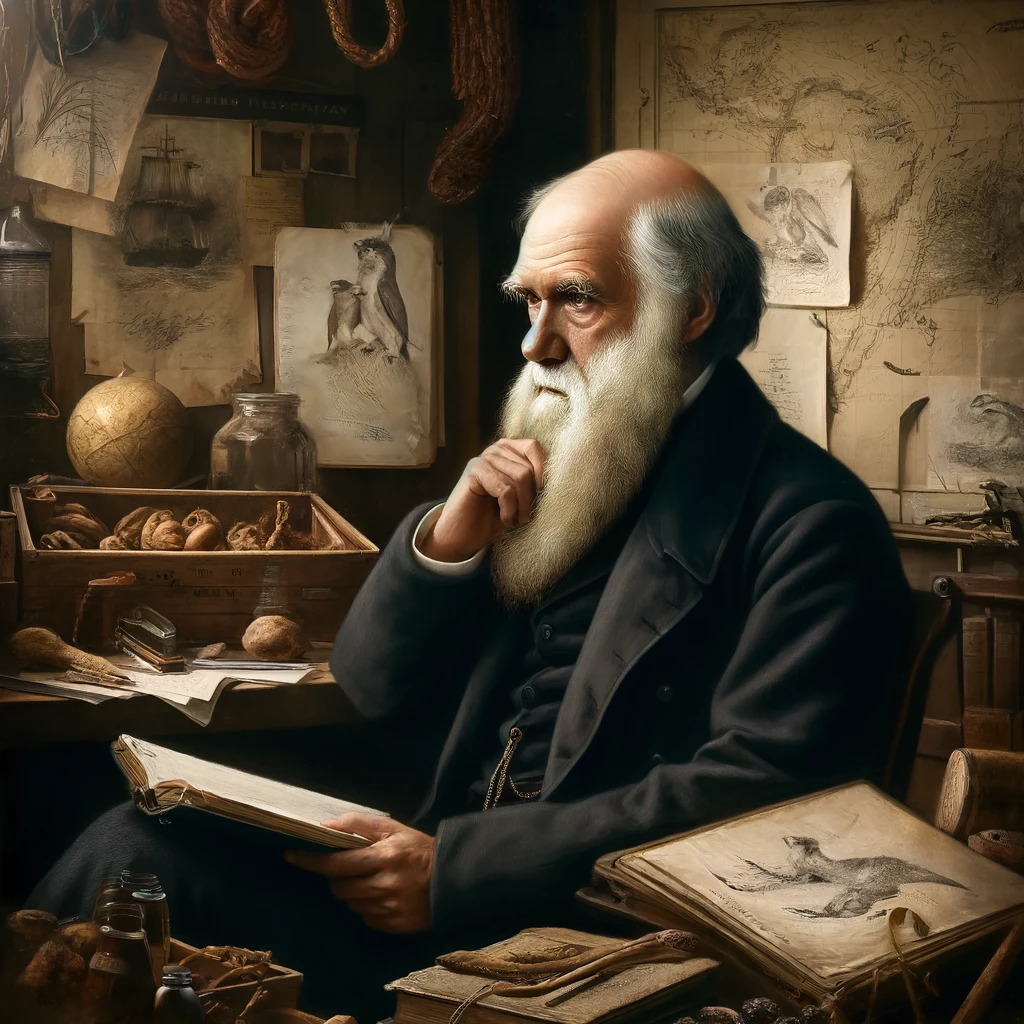
Charles Darwin, a name synonymous with the theory of evolution, revolutionized our understanding of the natural world. His observations and insights laid the foundation for evolutionary biology, challenging existing views on species origin and development. This article explores Darwin’s life, the formulation of his groundbreaking theory, and its profound impact on science and society.
Early Life and Influences
Born on February 12, 1809, in Shrewsbury, England, Charles Darwin was the fifth of six children in a wealthy and well-connected family. His father, Robert Darwin, was a successful physician, and his grandfather, Erasmus Darwin, was a noted intellectual who had hinted at evolutionary ideas himself. Despite this rich intellectual heritage, Charles did not initially show a strong interest in academics, often preferring the natural world.
Darwin enrolled at Edinburgh University to study medicine but soon found he could not stomach the brutality of surgery at the time. This aversion led him to Cambridge University, where he intended to become a clergyman. However, it was at Cambridge that Darwin’s true passion for natural science began to flourish. He was profoundly influenced by botany professor John Stevens Henslow and geologist Adam Sedgwick, who exposed him to contemporary scientific thought and field research.
The Voyage of the Beagle
Darwin’s life changed dramatically in 1831 when he was invited to join the HMS Beagle as a naturalist on a five-year voyage around the world. This journey would provide him with unique opportunities to observe natural phenomena. From the volcanic archipelagos of the Galapagos to the coral reefs of Australia, Darwin collected a plethora of natural specimens, including fossils, birds, animals, and plants.
Throughout his travels, Darwin observed variations that species exhibited across different geographical areas, particularly noting how island species appeared to have diverged from mainland species. The pivotal moment came in the Galapagos Islands, where Darwin noticed that the finches on each island differed mainly in beak shape, tailored to their specific dietary needs.
Development of Evolutionary Theory
After returning to England in 1836, Darwin began to synthesize his observations into a coherent theory of how species evolve. Influenced by Thomas Malthus’s essay on population growth, Darwin proposed that species evolve through a process he called natural selection. He suggested that individuals with traits that enhance their ability to adapt to their environment are more likely to survive and reproduce. Over generations, these traits become more common in the population, leading to evolutionary changes.
Darwin worked on his theory for over 20 years, collecting extensive evidence and cautiously refining his arguments. He corresponded with numerous scientists and conducted breeding experiments, particularly with pigeons, to understand more about inheritance and variation.
Publication and Reaction
The publication of Darwin’s “On the Origin of Species by Means of Natural Selection” in 1859 marked a turning point in biological science and public discourse. The book argued convincingly for the evolution of species by natural processes, challenging the prevailing belief of special creation that was widely held at the time.
The reaction to Darwin’s ideas was mixed. The scientific community was initially skeptical but gradually came to accept the evidence. The broader public reaction included both interest and outrage, particularly from religious groups who saw Darwin’s ideas as conflicting with the literal interpretation of the creation stories in the Bible.
Legacy and Continuing Impact
Darwin’s theory of evolution by natural selection became a fundamental concept in biology, influencing a wide range of scientific disciplines. His ideas paved the way for the modern understanding of genetic inheritance, species diversification, and ecological interactions. Today, evolutionary biology not only helps us understand the history of life on Earth but also provides essential insights into conservation, agriculture, and medicine.
Despite controversies and challenges over the years, the core of Darwinian evolutionary theory remains robust, supported by discoveries in genetics, paleontology, and molecular biology. The ongoing research in evolutionary biology continually reaffirms and refines Darwin’s initial insights.
Charles Darwin’s development of evolutionary theory represents one of the most significant achievements in scientific history. His work transformed how we comprehend the biological world, emphasizing the dynamic and interconnected nature of life. Darwin’s legacy continues to influence both scientific thought and cultural perspectives on human existence and the natural environment, underscoring the power of observation, evidence-based thinking, and the courage to challenge conventional wisdom.

The Broader Implications of Darwin’s Work
Beyond biology, Darwin’s theory of evolution had broad implications across multiple fields, including psychology, sociology, and ethics, challenging and enriching our understanding of human behavior and social structures. It influenced thinkers like Herbert Spencer, who coined the term “survival of the fittest,” mistakenly extending Darwinian ideas into social and economic realms, a concept now known as social Darwinism.
Evolutionary Theory in Modern Science
Today, evolutionary theory continues to be a cornerstone of modern biology. It provides the framework for understanding the complex relationships between all living things, from the smallest bacteria to the largest mammals, including humans. It helps scientists understand the spread of diseases, the development of antibiotic resistance, and the principles behind biological diversity.
The field of genetics, in particular, has expanded our understanding of evolution. The discovery of DNA and the mechanisms of genetic inheritance have provided detailed evidence supporting and expanding Darwinian theory. This molecular perspective confirms the connections among species that Darwin inferred from morphology and biogeography.
The Evolution of Evolutionary Thought
Darwin’s initial ideas have also evolved. While natural selection remains central, other mechanisms such as genetic drift, gene flow, and mutation are now known to play significant roles in the evolution of species. Modern synthesis, a 20th-century development that integrates Darwin’s theory with genetic principles, has further solidified and expanded the theoretical framework of evolution, confirming its status as one of the most robust theories in science.
Darwin’s Cultural and Social Impact
Culturally, Darwin’s work has continued to provoke thought, debate, and reflection on human origins, our place in the natural world, and the ethics of how we relate to other living beings. These discussions have permeated various aspects of culture and society, from education and politics to religion and philosophy.
In education, Darwin’s theories are now fundamental components of biology curricula across the world, although they continue to face opposition in some regions for religious and ideological reasons. Politically and ethically, the implications of Darwin’s work have sparked debates on topics ranging from conservation policies to bioethical considerations in genetics and medicine.
Challenges and Controversies
Despite its scientific acceptance, evolutionary theory has faced and continues to face significant challenges. Some of these challenges come from within the scientific community itself, where new evidence can lead to adjustments and refinements of the theory. Others come from outside the scientific realm, particularly from ideological viewpoints that oppose the idea of evolution on religious or moral grounds.
Public misconceptions about what evolution is and what it implies are also widespread, often fueled by misunderstandings about the nature of scientific theories and evidence. This has led to ongoing public debates, particularly in the context of educational curricula and scientific literacy.
Looking Forward
As we look to the future, the principles of evolutionary biology will remain crucial as we tackle new challenges from environmental changes and shifts in global biodiversity to advances in genetic engineering and biotechnology. Understanding evolution helps predict changes in ecosystems and assists in managing everything from endangered species to pest resistances.
Conclusion
The evolution of evolutionary theory, pioneered by Charles Darwin, remains a testament to the power of scientific inquiry and evidence-based understanding. Darwin’s legacy is not merely in the specifics of his findings but also in his methodological approach and his unwavering commitment to a rational explanation for natural phenomena. As we continue to explore the biological sciences, the principles he established serve as guideposts for ongoing discoveries and remind us of our interconnectedness with the natural world.


