
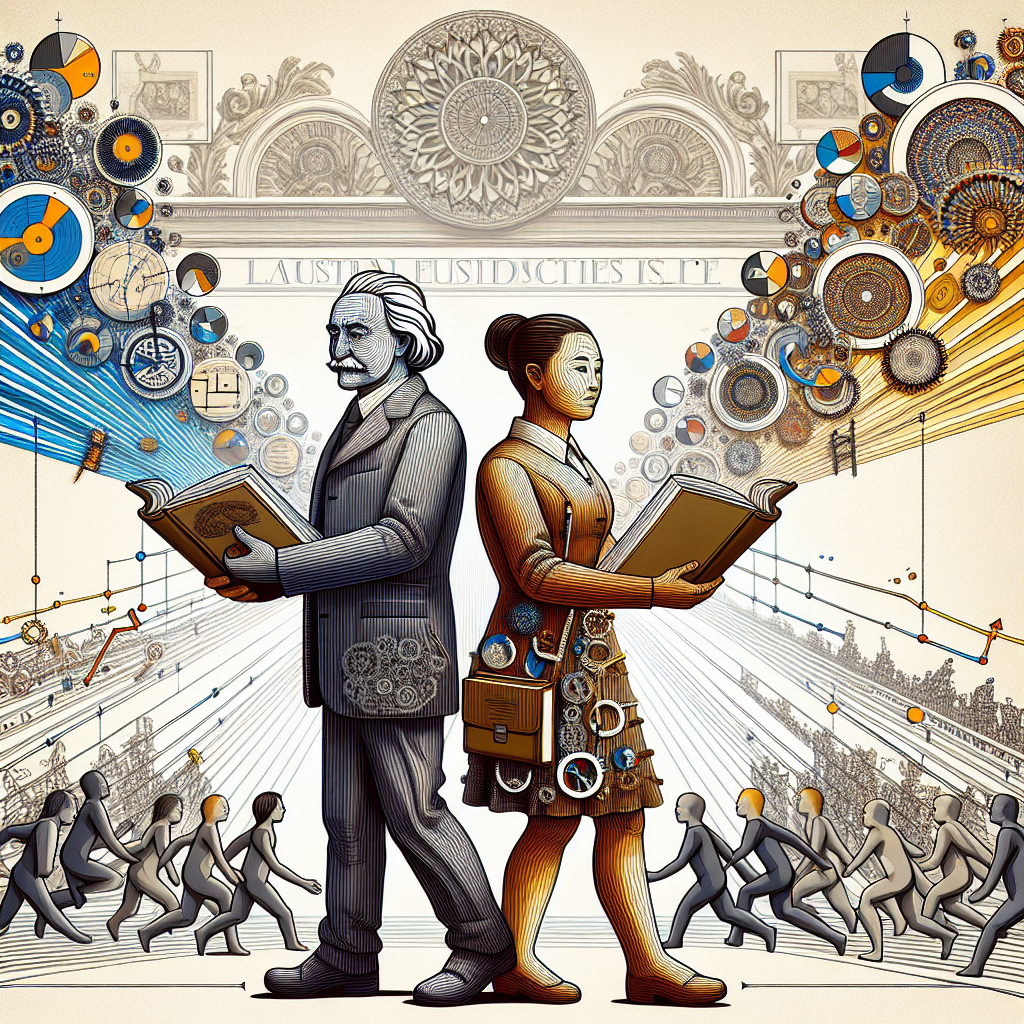
The Austrian School of Economics is one of the most influential and distinct traditions in economic thought. Emerging in the late 19th and early 20th centuries, it emphasizes individualism, subjective value, and the inefficacy of central planning. Two towering figures associated with the Austrian School are Ludwig von Mises and Friedrich Hayek. Their intellectual contributions have significantly shaped modern economic theory and policy discussions.
The Austrian School’s insights on market processes, entrepreneurship, and the limitations of government intervention remain highly relevant in today’s economy. Ludwig von Mises, in particular, is celebrated for his work on praxeology, the study of human action, and his critiques of socialism. Friedrich Hayek, a Nobel laureate, extended Mises’ work by exploring the spontaneous order and the decentralization of knowledge, which he argued were crucial for economic coordination and development.
In this article, we will delve into the historical context and foundational principles of the Austrian School of Economics, focusing particularly on the pivotal contributions of Mises and Hayek. By understanding their ideas, we can gain a clearer perspective on contemporary economic debates and the enduring relevance of classical liberal thought.
Historical Context of the Austrian School
The Austrian School of Economics was founded by Carl Menger in the late 19th century. Menger’s seminal work, “Principles of Economics” (1871), laid the groundwork for the school’s methodologies and theoretical insights. Menger’s emphasis on the subjective theory of value—that the value of a good is determined by the preferences of individuals rather than inherent properties—was revolutionary.
In the wake of Menger, a second generation of economists including Eugen Böhm von Bawerk and Friedrich von Wieser expanded on these ideas, further developing concepts like capital theory and opportunity cost. This rich intellectual tradition set the stage for Mises and Hayek to advance Austrian thought in groundbreaking ways.
The early 20th century witnessed considerable debate between the Austrian School and other economic traditions, particularly the German Historical School and later Keynesian economics. Amidst these debates, the Austrian perspective distinguished itself by advocating for methodological individualism—the notion that social phenomena result from the actions and interactions of individuals, not abstract entities or classes.
Ludwig von Mises and Praxeology
Ludwig von Mises was one of the most prominent figures of the Austrian School. His magnum opus, “Human Action,” introduced the concept of praxeology—the study of purposeful human behavior. Mises argued that economics should be grounded in deductive reasoning, starting from the axiomatic premise that human beings act to achieve desired ends.
Mises’ praxeological approach contrasts sharply with empirical and statistical methods commonly used in other economic schools. He argued that economic laws are immutable and universally valid, akin to the laws of logic and mathematics. This focus on deductive logic positioned Mises at odds with both the German Historical School and the emerging Keynesian approach that emphasized empirical data and aggregate analysis.
Another critical contribution by Mises was his critique of socialism. In his 1922 book “Socialism,” Mises contended that central planning was inherently flawed because it could not solve the economic calculation problem. He argued that without a price mechanism generated by free markets, planners have no way to efficiently allocate resources among competing uses. This critique had a profound impact on the intellectual discourse surrounding economic systems and the viability of socialism.

Friedrich Hayek and the Decentralization of Knowledge
Friedrich August von Hayek was another towering figure in the Austrian School. Hayek’s contributions extended many of Mises’ core ideas and introduced new dimensions to the discussion on economic coordination and the role of information in markets.
One of Hayek’s most influential works, “The Use of Knowledge in Society” (1945), elaborated on the concept of decentralized knowledge. Hayek argued that information is dispersed among individual actors in the economy, and no single planner or central authority can aggregate this knowledge efficiently. This principle underpins the importance of market signals—namely prices—as a means of coordinating economic activity.
Hayek’s exploration of spontaneous order—the idea that complex systems can emerge from the interplay of simple rules and individual actions without central direction—also left an indelible mark on economic thought. This insight was crucial in understanding the dynamic and adaptive nature of markets, contrasting sharply with the static models of central planning and state control.
Additionally, Hayek’s contributions to political philosophy, particularly in “The Road to Serfdom” (1944), highlighted the dangers of excessive government intervention. He warned that centralization and social engineering could erode individual liberties and lead to totalitarian outcomes, a cautionary perspective that resonated during and after World War II.
The Legacy of Austrian Economics
The legacy of the Austrian School, particularly through the works of Mises and Hayek, continues to influence contemporary economic thought and policy. Their emphasis on the limits of central planning, the role of individual choice, and the importance of market mechanisms remains pertinent in debates over economic policy and the role of government.
Many economic think tanks, academic institutions, and policy advocacy groups draw upon Austrian ideas to champion free-market principles and advocate for limited government. The Mises Institute, for instance, focuses on research and education to further the understanding of Austrian economics and classical liberalism.
The resurgence of interest in the Austrian School during periods of economic crisis, such as the 2008 financial meltdown, reflects the enduring relevance of its core principles. Critics of interventionist policies often cite Austrian insights to argue for more sustainable and decentralized economic approaches.
Critiques and Counterarguments
Despite its many contributions, the Austrian School has not been without its critiques. Scholars from other economic traditions have raised questions about the empirical basis of Austrian theories, particularly the praxeological method’s reliance on deductive reasoning.
Critics argue that the Austrian School’s rejection of empirical and statistical methods limits its explanatory power and applicability to real-world scenarios. They contend that a robust economic theory should incorporate empirical validation to ensure its predictions and prescriptions are grounded in observable phenomena.
Furthermore, some have criticized the Austrian School’s focus on individualism, suggesting that it overlooks important collective dynamics and structural factors that shape economic outcomes. The debate between Austrian economists and adherents of other schools continues to enrich the broader discourse, generating diverse perspectives on economic theory and policy.
Austrian Economics in Modern Policy Debates
Today, Austrian economics plays a vital role in shaping discussions on a range of policy issues, from monetary policy and fiscal responsibility to regulation and entrepreneurship. Policymakers and economists who draw on Austrian principles often advocate for sound money policies, highlighting the risks of inflation and the importance of maintaining the purchasing power of currency.
Austrian scholars also emphasize the importance of entrepreneurial discovery in driving economic progress. They argue that regulatory and bureaucratic hurdles hinder innovation and market dynamism. By promoting a legal and institutional framework that nurtures entrepreneurship, Austrian economists believe that societies can harness the creative potential of individuals.
Furthermore, the Austrian School’s skepticism of government intervention adds a crucial dimension to debates on public policy. Whether discussing healthcare, education, or environmental regulation, Austrian insights compel policymakers to consider the unintended consequences and inefficiencies that may arise from central planning and state control.
Conclusion
The Austrian School of Economics, with its rich intellectual heritage and foundational principles, offers enduring lessons for understanding economic phenomena and informing policy decisions. Ludwig von Mises and Friedrich Hayek, two of its most influential figures, provided profound insights into the nature of human action, the limitations of central planning, and the role of decentralized knowledge in economic coordination.
As we navigate increasingly complex and interconnected global economies, the Austrian emphasis on individualism, market processes, and the spontaneous order continues to resonate. The ideas put forth by Mises and Hayek compel us to question assumptions, challenge centralized approaches, and embrace the dynamism and ingenuity that arise from free markets and entrepreneurial activity.
By revisiting and engaging with the contributions of the Austrian School, scholars, policymakers, and citizens alike can better appreciate the intricate tapestry of economic thought and its practical implications for fostering prosperity and freedom. The legacy of Mises and Hayek endures, reminding us that in the realm of economics, as in life, the actions and choices of individuals are paramount.