
Aung San Suu Kyi is a name that resonates powerfully in the global discourse on democracy and human rights. Born on June 19, 1945, in Yangon, Myanmar, Suu Kyi has become one of the most renowned symbols of peaceful resistance and the struggle for democracy. Her father, General Aung San, is recognized as the founding father of modern Myanmar, which ingrained in her a profound sense of duty and commitment to her country from a young age.
Educated at institutions like the University of Delhi and the University of Oxford, Suu Kyi was exposed to diverse political ideologies and human rights perspectives, influencing her future activism. Her life took a decisive turn in 1988 when she returned to Myanmar to tend to her ailing mother. This was a tumultuous period marked by nationwide protests against the dictatorial military regime.
Suu Kyi soon emerged as a leading figure in these protests, founding the National League for Democracy (NLD) and advocating for a peaceful transition to democratic governance. Over the years, despite facing multiple house arrests and relentless repression from the authorities, Aung San Suu Kyi’s unwavering commitment to non-violence earned her the prestigious Nobel Peace Prize in 1991.
This article delves into the life and contributions of Aung San Suu Kyi, highlighting her role as a human rights champion and a beacon of hope for democracy in Myanmar. It explores her early influences, political struggles, significant achievements, and the ongoing challenges she faces in her quest to bring enduring democratic reforms and human rights to her homeland.
Early Life and Influences
Aung San Suu Kyi’s journey to becoming a symbol of democracy and human rights started long before her political involvement in Myanmar. The daughter of Aung San, who played a pivotal role in Myanmar’s independence from British rule, and Khin Kyi, a prominent diplomat, Suu Kyi grew up in an environment steeped in political and social consciousness.
Her father was assassinated when she was only two years old, but his legacy continued to influence her deeply. This familial connection to Myanmar’s fight for independence imbued Suu Kyi with a strong sense of national identity and responsibility. Her mother’s subsequent diplomatic career offered her opportunities to live abroad, further broadening her horizons.
Suu Kyi received her education from institutions around the world, including the University of Delhi and the University of Oxford, where she studied Philosophy, Politics, and Economics. Her exposure to different political conditions and cultures helped her form a holistic view of democracy and human rights. During her time at Oxford, she met and later married Michael Aris, a British scholar.
Her academic pursuits and personal experiences combined to shape her political ethos. The global perspective she acquired enabled her to understand the complexities of implementing democratic principles in a diverse and multifaceted society like Myanmar. Hence, when she returned to Myanmar in 1988, she was not only equipped with the ideals of democracy and human rights but also with the practical knowledge and diplomatic finesse to advocate for change.
Founding the National League for Democracy
Aung San Suu Kyi’s return to Myanmar in 1988 coincided with a period of national unrest and calls for democracy. Inspired by her father’s legacy and driven by the urgent need for political change, Suu Kyi actively participated in the pro-democracy movement. Her eloquence, conviction, and commitment to peaceful protest quickly made her a central figure in the movement.
In September 1988, she co-founded the National League for Democracy (NLD), a political party dedicated to achieving democracy in Myanmar through non-violent means. As the General Secretary of the NLD, Suu Kyi traveled extensively across the country, delivering speeches and galvanizing support for the cause of democracy.
Her message, echoing the philosophies of Mahatma Gandhi and Martin Luther King Jr., emphasized the power of peaceful resistance and moral courage. Despite facing significant threats from the ruling military junta, Suu Kyi urged her supporters to remain non-violent, reinforcing the principle that the pursuit of justice and democratic governance should be rooted in peace and ethical consistency.
The establishment of the NLD marked a significant milestone in Myanmar’s political landscape. It provided a structured, organized platform for advocating democratic reforms and articulating the people’s aspirations. Under Suu Kyi’s leadership, the NLD rapidly gained popularity, culminating in a decisive victory in the 1990 general elections. However, the refusal of the military junta to recognize the election results plunged the country into another long period of political repression.
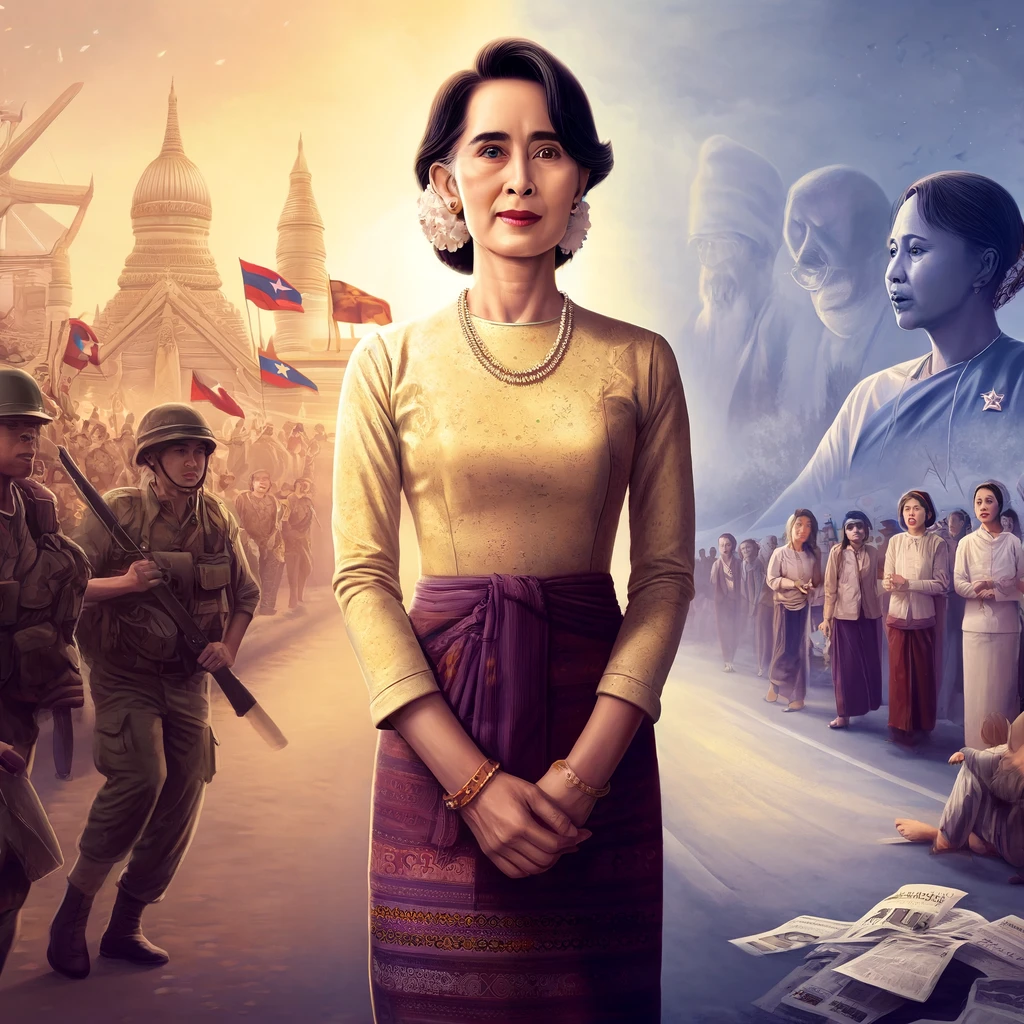
House Arrest and International Recognition
The 1990 victory of the NLD was both a triumph and a prelude to greater struggles. The military junta’s refusal to hand over power led to Aung San Suu Kyi’s first house arrest, only a year after winning the elections. Over the next two decades, she spent nearly 15 years under house arrest, enduring isolation and restrictions but never wavering in her commitment to democracy and human rights.
During her periods of confinement, the international community continuously rallied for her release. Suu Kyi became a global symbol of resistance against tyranny and the fight for human rights. In 1990, she was awarded the Sakharov Prize for Freedom of Thought, and in 1991, she received the Nobel Peace Prize.
The Nobel Committee highlighted her “non-violent struggle for democracy and human rights,” a testament to her enduring spirit and moral fortitude. Although she could not attend the Nobel ceremony in person, her acceptance speech, delivered by her sons, resonated with messages of hope, resilience, and the inexorable march towards freedom.
International accolades and persistent advocacy helped maintain global attention on Myanmar’s political situation, putting pressure on the ruling junta. Meanwhile, Suu Kyi’s writings and speeches smuggled out of Myanmar continued to inspire movements for democracy worldwide. Her perseverance and the global solidarity that her plight inspired played a crucial role in advancing the cause of human rights and democratic governance.
Transition to Civil Government and Challenges
In 2010, Aung San Suu Kyi was finally released from house arrest amid a series of political reforms initiated by the military government. Her release was a significant step towards transitioning Myanmar from a military dictatorship to a civil government. The NLD boycotted the 2010 elections, citing unfair voting practices, but soon began to participate in the political process again.
In the 2012 by-elections, the NLD secured a staggering victory, with Suu Kyi herself winning a parliamentary seat. This electoral success paved the way for the 2015 general elections, where the NLD won a landslide victory, enabling Suu Kyi to assume a key leadership role in the government.
However, the progress toward democracy has been fraught with challenges. The Myanmar military retained significant power and influence, complicating the new government’s efforts to implement reforms. Moreover, Suu Kyi’s leadership has faced international scrutiny and criticism, particularly regarding the handling of the Rohingya crisis. Accusations of ethnic cleansing and human rights violations against the Rohingya minority have severely tarnished her and the NLD’s international reputation.
Despite these controversies, Aung San Suu Kyi’s contribution to Myanmar’s democratic journey remains indelible. Her role in guiding the country through its nascent stages of democracy, balancing internal and external pressures, and striving for long-term political reforms continues to be a focal point of her political career. Understanding these complexities highlights the multifaceted nature of her leadership and the challenges inherent in democratic transitions amidst longstanding authoritarian rule.
The Complex Legacy of Aung San Suu Kyi
Aung San Suu Kyi’s legacy is a tapestry of resilience, idealism, and complexity. She remains a pivotal figure in Myanmar’s contemporary history, symbolizing the ongoing struggle for democracy and human rights. Her journey from a political prisoner to a national leader encapsulates a remarkable story of personal sacrifice and determination.
Her advocacy for democracy, inspired by her father’s legacy and global human rights principles, set the stage for significant political changes in Myanmar. However, her tenure in power underscores the intricacies and limitations of political leadership in transitional societies. The Rohingya crisis, in particular, complicates her legacy as a human rights champion.
Critics argue that her response to the crisis reflects a failure to uphold the very principles she once championed. Defenders, on the other hand, point to the pragmatism required to navigate Myanmar’s deeply rooted ethnic conflicts and military influence. This duality in her legacy continues to spark intense debate among historians, political analysts, and human rights advocates.
Regardless of the controversies, Aung San Suu Kyi’s name remains synonymous with the pursuit of democratic ideals. Her life’s work offers valuable insights into the global struggle for human rights and the complexities of political transitions. For many, she embodies the enduring hope for a better future, where the principles of democracy and human dignity prevail.
Conclusion
In conclusion, Aung San Suu Kyi’s life and political career are emblematic of the enduring struggle for democracy and human rights. From her early influences and education to her pivotal role in founding the National League for Democracy, her journey is marked by an unwavering commitment to non-violent resistance and democratic principles.
Her long periods of house arrest and international recognition, including the Nobel Peace Prize, highlight the global impact of her struggle and the inspiration it has provided to many worldwide. Despite the significant challenges and controversies during her time in government, particularly concerning the Rohingya crisis, Suu Kyi’s role in advancing Myanmar’s democratic process remains significant.
Aung San Suu Kyi’s complex legacy underscores the difficulties of political leadership in environments transitioning from authoritarian rule to democracy. It serves as a reminder of the intricate balance required to navigate national politics, human rights, and international relations.
Her story continues to resonate as a powerful example of the human spirit’s resilience in the face of adversity and the ongoing global struggle for democratic governance and human rights. As Myanmar continues its journey towards full democratic establishment, Suu Kyi’s contributions and the lessons derived from her experiences will remain pivotal to understanding the broader quest for democracy and human rights worldwide.


