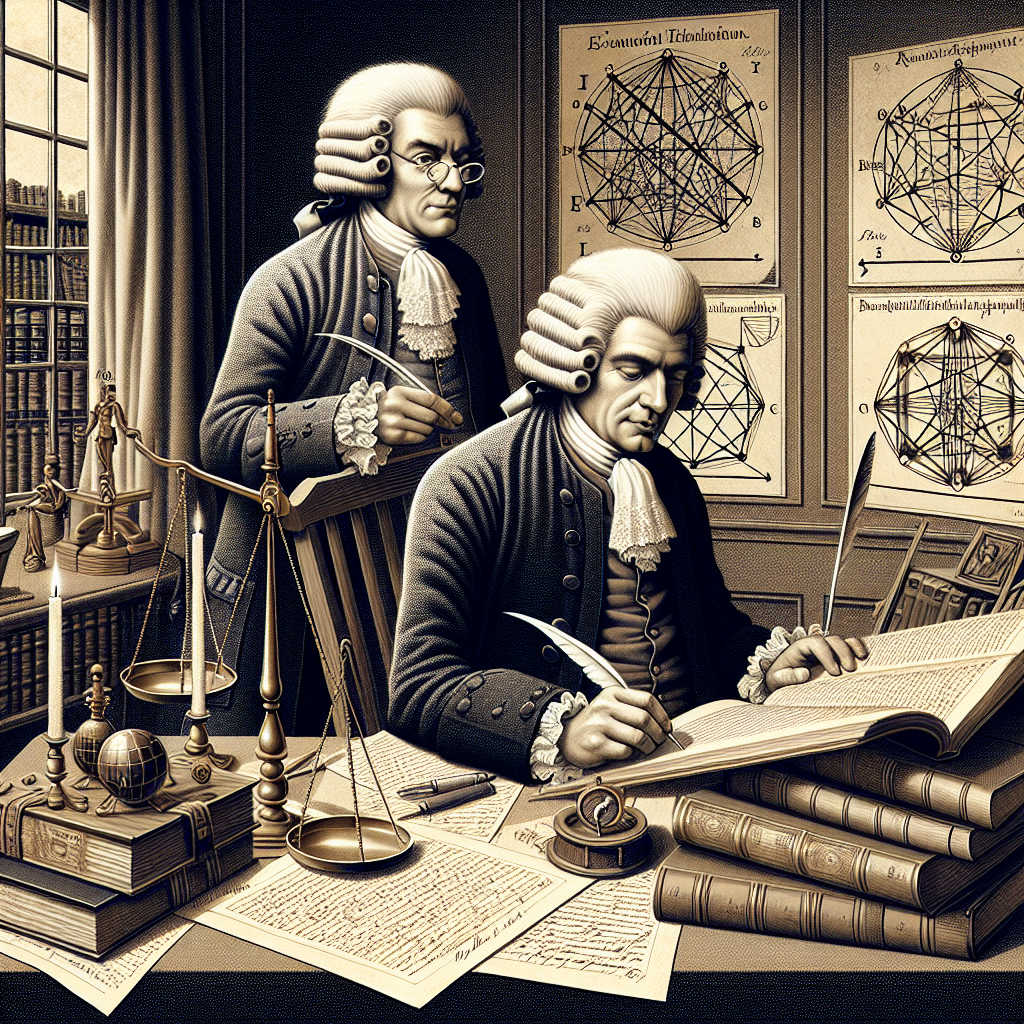
The history of economic thought is a fascinating journey through the ideas and theories that have shaped our understanding of markets, trade, and finance. Classical economics, a school of thought that emerged in the late 18th and early 19th centuries, laid the foundations for modern economic theory. Pioneers like Adam Smith and David Ricardo introduced groundbreaking concepts that continue to influence economists and policymakers to this day.
This article delves into classical economics, focusing on the contributions of Adam Smith and David Ricardo. Understanding their ideas helps us appreciate the evolution of economic thought and its impact on contemporary economic practices. We’ll start by exploring the fundamental principles of classical economics before diving into the specific contributions of Smith and Ricardo.
Classical economics primarily revolves around the ideas of self-regulating markets, the importance of free trade, and the role of competition in driving economic growth. These principles were groundbreaking during their time and challenged the mercantilist views that dominated economic thought. Smith and Ricardo, through their theories and publications, provided a systematic approach to studying economics, which helped transition it from a fragmented discipline into a coherent field of study.
Adam Smith and the Wealth of Nations
Adam Smith, often regarded as the father of modern economics, made significant contributions that have deeply influenced economic theory. His seminal work, “The Wealth of Nations,” published in 1776, is a cornerstone in the field of economics. Smith introduced the concept of the “invisible hand,” which describes how individuals pursuing their self-interest unintentionally contribute to economic prosperity.
Smith’s idea of the invisible hand suggests that when individuals act in their own self-interest, they inadvertently promote the collective good of society. This concept laid the groundwork for the laissez-faire approach to economics, which advocates minimal government intervention in markets. By emphasizing the role of self-regulation in markets, Smith argued that competitive forces naturally lead to efficient resource allocation.
Another critical contribution of Smith is his analysis of the division of labor. He observed that specialization and the division of labor lead to increased productivity and economic growth. In a famous example, Smith described how dividing the production of pins into distinct tasks allowed workers to produce many more pins compared to when each worker undertook the entire process independently.
Smith’s work also highlighted the importance of free trade. He critiqued mercantilist policies that restricted trade and promoted tariffs, arguing instead that free trade allows nations to specialize in producing goods where they have a comparative advantage. This specialization, in turn, leads to mutual benefits and higher overall economic efficiency.
David Ricardo and Comparative Advantage
David Ricardo, another influential classical economist, expanded on Adam Smith’s ideas and introduced the theory of comparative advantage. Ricardo’s work, “Principles of Political Economy and Taxation,” published in 1817, provided a more precise framework for understanding the benefits of international trade.
The theory of comparative advantage posits that even if a country is less efficient at producing all goods compared to another country, there are still gains to be made from trade. Ricardo demonstrated this using a hypothetical example of two countries producing two goods. He showed that if each country specializes in producing the good for which it has a lower opportunity cost, both countries can benefit from trade.
Ricardo’s theory was revolutionary because it provided a solid justification for free trade, highlighting how countries could achieve mutual gains through specialization and exchange. It challenged the prevailing mercantilist belief that trade was a zero-sum game, where one nation’s gain was another’s loss. Instead, Ricardo showed that trade could be a positive-sum game, where all parties involved could improve their welfare.
In addition to comparative advantage, Ricardo also studied the distribution of income within an economy. He developed the labor theory of value, which posits that the value of a good is determined by the amount of labor required to produce it. Ricardo further explored rent theory, examining how income is distributed between landowners, capitalists, and workers. His insights into income distribution have had a lasting impact on economic analysis and policy discussions.
The Influence and Legacy of Classical Economics
Classical economics, as developed by Adam Smith, David Ricardo, and their contemporaries, laid the intellectual foundation for many key concepts in modern economics. The ideas of self-regulating markets, free trade, and the division of labor continue to be central to economic thought and policy.
One of the enduring legacies of classical economics is its emphasis on the role of competition in fostering economic growth and innovation. Classical economists argued that competition drives efficiency, incentivizes innovation, and leads to better products and services for consumers. This perspective has influenced modern economic policies that promote market competition and limit monopolistic practices.
Moreover, the classical economists’ advocacy for free trade has had a profound impact on global economic policies. Their arguments for the benefits of free trade and the idea of comparative advantage have been instrumental in shaping international trade agreements and reducing trade barriers. The principles of classical economics have helped pave the way for the globalization of trade and the integration of economies worldwide.
The work of Smith and Ricardo also set the stage for subsequent developments in economic theory, including the marginalist revolution and the emergence of neoclassical economics. Their focus on systematic analysis and theoretical rigor provided a framework that later economists built upon, leading to more sophisticated models and tools for analyzing economic phenomena.
Criticisms and Limitations
Despite their significant contributions, the ideas of Smith, Ricardo, and classical economics have faced various criticisms and limitations. One of the main criticisms is the assumption of rational behavior and perfect competition. Critics argue that these assumptions do not always hold true in real-world markets, where irrational behavior, information asymmetry, and imperfect competition are common.
Additionally, the classical economists’ focus on self-regulating markets has been challenged by those who advocate for a more active role for government intervention. Critics point to instances of market failures, such as monopolies, externalities, and public goods, where government intervention is necessary to achieve efficient outcomes.
Moreover, classical economics has been critiqued for its limited consideration of social and environmental factors. The focus on economic growth and efficiency often overlooks issues related to income inequality, environmental sustainability, and social welfare. Critics argue that a more holistic approach to economics should consider these broader societal impacts.
Despite these criticisms, the contributions of Smith, Ricardo, and classical economics cannot be understated. Their ideas continue to be relevant and influential, providing a foundation for ongoing debates and discussions in economic theory and policy. The evolution of economic thought since the classical period has built upon their insights, addressing some of the limitations and incorporating new perspectives to better understand complex economic phenomena.
Modern Applications of Classical Economics
The principles of classical economics remain highly relevant in contemporary economic policy and practice. Many modern economic models and theories build upon the foundations laid by Smith and Ricardo, adapting their ideas to address current challenges and complexities.
For instance, the concept of the invisible hand and the benefits of competition are fundamental to modern antitrust laws and regulations. Policymakers use these principles to promote competitive markets, prevent monopolistic behavior, and protect consumer interests. The emphasis on the efficiency of free markets continues to guide economic policies aimed at fostering innovation and economic growth.
The theory of comparative advantage is also pivotal in shaping international trade policies. Governments and international organizations use this theory to negotiate trade agreements and advocate for open markets. The benefits of specialization and trade, as articulated by Ricardo, are central to the arguments for reducing trade barriers and fostering economic cooperation between nations.
Additionally, the classical focus on productivity and the division of labor is evident in contemporary approaches to business organization and management. Companies strive to enhance productivity through specialization, efficient resource allocation, and innovation, reflecting the enduring influence of classical economic principles.
Conclusion
The contributions of Adam Smith, David Ricardo, and classical economics have left an indelible mark on the field of economic thought. Their pioneering ideas on self-regulating markets, free trade, competition, and the division of labor have shaped the way we understand and analyze economic phenomena. These concepts continue to influence economic policies and practices, underscoring the lasting relevance of classical economics.
While classical economics has faced criticisms and evolved over time, the foundational principles established by Smith and Ricardo remain central to economic theory. Their insights into the functioning of markets, the benefits of trade, and the drivers of economic growth provide a valuable framework for addressing contemporary economic challenges.
As we continue to navigate the complexities of the global economy, the ideas of classical economists serve as a guiding light, reminding us of the importance of competition, innovation, and the benefits of open markets. By building on their legacy and incorporating new perspectives, we can develop more effective economic policies that promote prosperity and well-being for all.
In summary, the history of economic thought is enriched by the contributions of Adam Smith, David Ricardo, and classical economics. Their work has not only advanced our understanding of economic principles but also influenced the development of modern economic systems. As we reflect on their contributions, we recognize the enduring impact of classical economics on our world today.