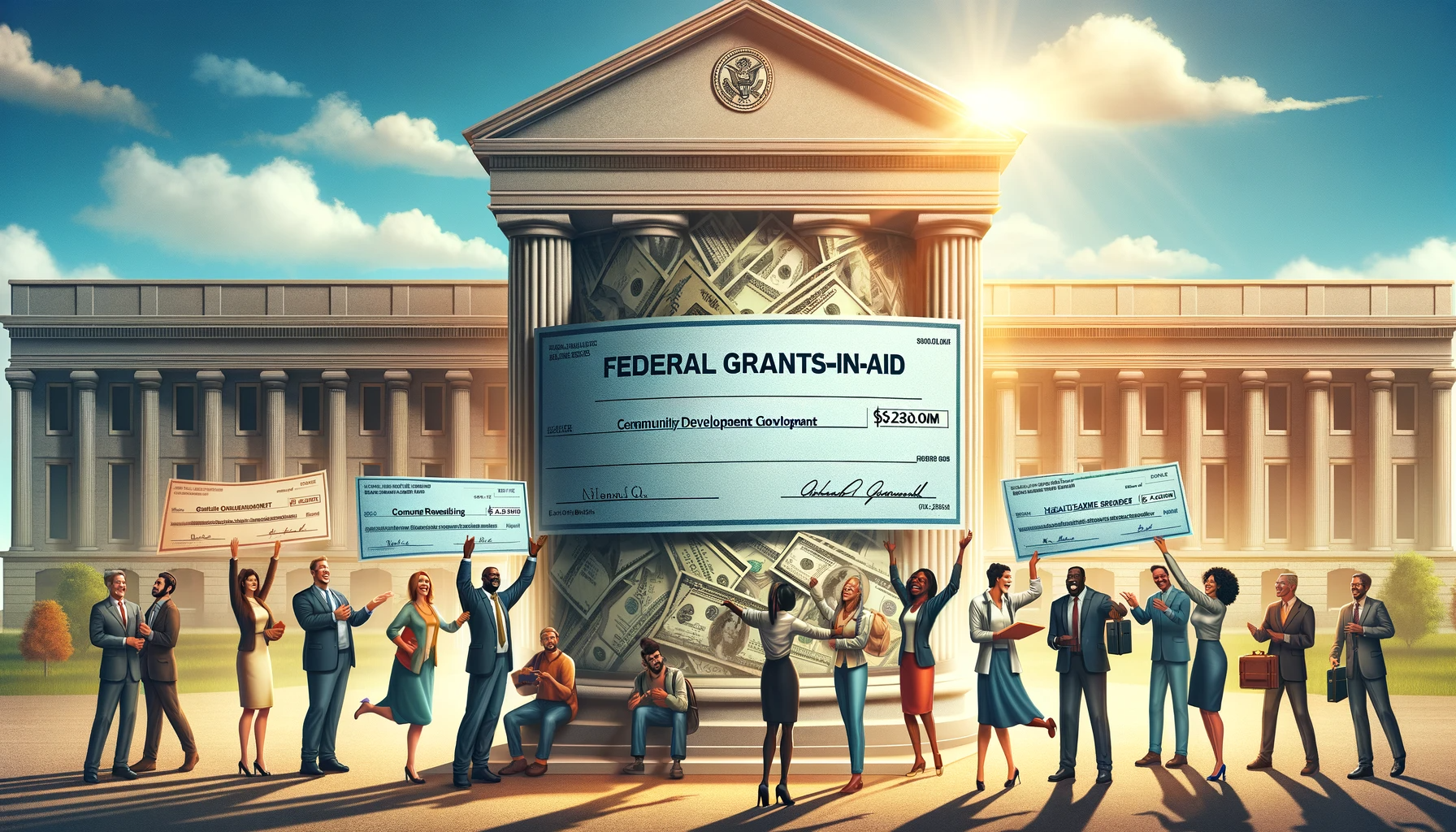
Federal grants-in-aid are sums of money given by the federal government to state governments for specific purposes. These grants have been a fundamental aspect of American federalism, playing a critical role in shaping the relationship between the national and state governments. The popularity of these grants, along with their inherent pitfalls, provides a complex picture of federal-state interactions.
Read our comprehensive look at Federalism.
Reasons for Political Popularity
- Addressing National Priorities: Federal grants-in-aid allow the national government to address widespread concerns that transcend state boundaries. Issues like healthcare, education, and transportation require a coordinated approach, and these grants ensure that states have the necessary funding to tackle these national priorities.
- Economic Stability and Support: During economic downturns, federal grants serve as a crucial support mechanism for states. They help maintain essential services and stimulate economic activity, offering a lifeline to states struggling with budget constraints.
- Political Leverage: For federal politicians, these grants are a way to gain political leverage and influence state policies. By attaching specific conditions to the funds, the federal government can steer states towards certain policy goals, aligning them with national objectives.
- Resource Redistribution: Grants-in-aid facilitate the redistribution of resources from wealthier to poorer states, ensuring a more equitable allocation of national wealth. This redistribution supports states with limited fiscal capacities to meet the needs of their citizens.
- Innovation and Experimentation: States often serve as “laboratories of democracy.” Federal grants give states the flexibility to experiment with different approaches to common problems, fostering innovation in public policy.
Pitfalls of Federal Grants-in-Aid
Despite their popularity, federal grants-in-aid are not without criticism and have several pitfalls:
- Complex Administration: The administration of these grants is often complex and bureaucratic, requiring states to navigate a maze of regulations and compliance requirements. This complexity can lead to inefficiencies and delays in the implementation of funded programs.
- Conditional Funding: The conditions attached to grants can lead to a loss of state autonomy. States may feel compelled to alter their policies and priorities to align with federal stipulations, which can undermine the principle of federalism.
- Dependency and Fiscal Illusion: Reliance on federal funds can create a sense of fiscal illusion among states, as they may underestimate the true cost of programs funded primarily through federal grants. This dependency can also lead to budgetary imbalances when federal funding is reduced or withdrawn.
- Inequitable Distribution: Although intended to redistribute resources, the actual distribution of grants can sometimes be inequitable. Political considerations and lobbying efforts can influence the allocation process, leading to disparities among states.
- Short-Term Focus: Federal grants are often geared towards immediate needs or specific projects, leading to a short-term focus in state planning. This can divert attention from long-term strategic planning and investment.
Categorical Grants vs. Block Grants and General Revenue Sharing
Understanding the differences between categorical grants, block grants, and general revenue sharing is crucial in comprehending the nuances of federal grants-in-aid.
Categorical Grants: These are grants issued by the United States Congress which may be spent only for narrowly defined purposes. Categorical grants are intended for specific projects or initiatives, such as building a specific highway or funding medical research. They come with stringent requirements and often require a “matching” component from the state, meaning the state must provide a certain amount of funds to receive the federal grant.
Block Grants: In contrast, block grants are large sums of money granted by the federal government to state and local authorities to be used for general purposes. These grants provide greater flexibility compared to categorical grants, allowing states to use the funds within broader areas, such as healthcare, social services, or community development. Block grants typically have fewer strings attached, offering states more autonomy in how they use the funds.
General Revenue Sharing: This concept refers to the distribution of a portion of federal tax revenues to state and local governments with minimal restrictions on how the funds can be used. General revenue sharing grants are the most flexible, allowing states to allocate the funds according to their own priorities and needs. This approach was more common in the 1970s and has since been largely replaced by more targeted forms of grants.
Impact on Federal-State Relations
The nature of federal grants-in-aid has significant implications for federal-state relations:
- Cooperative Federalism: These grants exemplify the concept of cooperative federalism, where national and state governments work together to solve common problems. However, this cooperation is sometimes more coercive than collaborative, with the federal government dictating terms.
- Shift in Power Dynamics: The allocation of federal funds can shift power dynamics between the national and state governments. States often find themselves in a position where refusing federal funds could mean forgoing critical resources, thereby inadvertently increasing federal influence over state affairs.
- Political Tensions: The conditions attached to federal grants can lead to political tensions between states and the federal government, especially when these conditions are perceived as federal overreach into state sovereignty.
- Uneven Influence: Larger or more populous states may have more influence in the allocation of federal grants, leading to an uneven playing field. This can exacerbate regional disparities and fuel inter-state competition.
Evaluating the Effectiveness of Federal Grants
The effectiveness of federal grants-in-aid is a subject of ongoing debate:
- Achievement of National Goals: Federal grants have been instrumental in achieving national goals, such as improving healthcare access, enhancing education quality, and developing infrastructure. However, the effectiveness varies significantly across different programs and states.
- Efficiency and Accountability: The efficiency and accountability of grant-funded programs are often questioned. The layering of federal, state, and local bureaucracies can lead to duplication of efforts and mismanagement of funds.
- Adaptability and Responsiveness: While block grants and general revenue sharing provide states with greater adaptability and responsiveness to local needs, categorical grants are criticized for their rigidity and one-size-fits-all approach.
Moving Forward: Balancing Flexibility and Accountability
The future of federal grants-in-aid lies in finding a balance between flexibility for states and accountability for the use of federal funds. This involves:
- Streamlining Administration: Simplifying the administrative process and reducing bureaucratic hurdles can make it easier for states to access and utilize funds effectively.
- Enhancing Local Input: Involving state and local governments in the decision-making process can ensure that federal funds are aligned with local needs and priorities.
- Fostering Transparency: Increasing transparency in the allocation and use of federal funds can enhance accountability and public trust in government programs.
- Evaluating Outcomes: Regular evaluation of grant-funded programs is essential to assess their impact and make necessary adjustments. This can help in ensuring that federal funds are achieving their intended outcomes.
Conclusion
Federal grants-in-aid represent a complex interplay of political, economic, and social factors within the framework of American federalism. While they have been politically popular for addressing key national issues and supporting state initiatives, their pitfalls cannot be overlooked. The challenges of conditional funding, administrative complexity, and potential inequities raise important questions about the balance of power between national and state governments. Understanding the differences between categorical grants, block grants, and general revenue sharing is essential in appreciating the nuances of this federal-state relationship. As the United States continues to evolve, so too will the nature of federal grants-in-aid, requiring ongoing dialogue and adaptation to ensure they serve the best interests of both the federal and state governments, as well as the citizens they represent.


