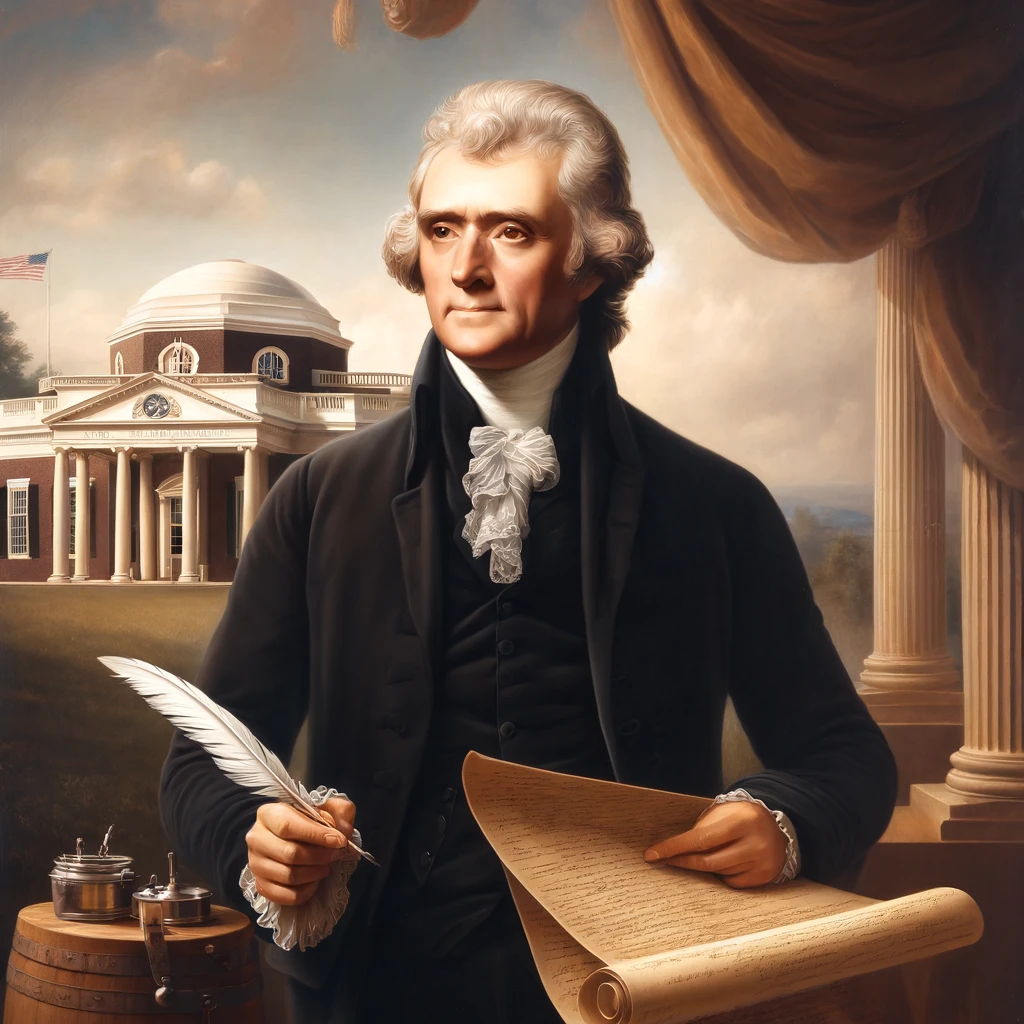
Thomas Jefferson stands as a colossal figure in the annals of American history, known primarily for his role as the principal author of the Declaration of Independence and as the third President of the United States. His contributions, however, extend much further, deeply embedding the principles of democracy into the American political landscape. This article explores Jefferson’s life, his political philosophy, and his enduring influence on the fabric of American governance.
See also our comprehensive article entitled, “The Presidency of Thomas Jefferson.”
Early Life and Education
Thomas Jefferson was born on April 13, 1743, in Shadwell, Virginia. Raised in a prosperous family, he inherited a keen interest in learning from his father, Peter Jefferson, a successful planter and surveyor. Jefferson’s formative years were spent in the rural landscape of Virginia, but he soon pursued broader horizons at the College of William & Mary, where he studied mathematics, metaphysics, and philosophy under Professor William Small, whose liberal views deeply influenced Jefferson.
Political Beginnings
Jefferson’s entry into politics began in 1769 as a member of the Virginia House of Burgesses. He quickly distinguished himself with his articulate stance on issues of freedom and governance. By the time the American colonies were set on the path of conflict with Britain, Jefferson had already crystallized his views on individual liberties and self-governance, which would later be pivotal in his writings.
The Declaration of Independence
In June 1776, Jefferson was appointed to a five-man committee tasked with drafting the Declaration of Independence. At just 33 years old, his pen gave voice to the colonies’ collective cry for independence, articulating the fundamental principles that would underpin the new nation: equality, rights, and self-governance. The document was not only a call for independence from British rule but also a blueprint for future American democratic governance.
Jeffersonian Democracy
Jefferson’s vision of America was one of agrarian simplicity powered by an educated citizenry. He believed deeply in the virtues of rural life and the dangers of concentrated power, whether in the hands of monarchs or urban elites. His ideas were further manifested when he founded the University of Virginia, envisioning it as a crucible for future democratic leaders who were versed in the values of personal liberty and scientific inquiry.
Presidency and Policies
Jefferson assumed the presidency in 1801 after one of the most contentious elections in American history. His administration was marked by significant achievements such as the Louisiana Purchase, which doubled the size of the United States, and the Lewis and Clark Expedition, which expanded the nation’s knowledge of its vast new territories. However, his presidency was also characterized by challenges, including tensions with Britain and France, and domestic political rivalries.
Personal Controversies
Jefferson’s life and legacy are not without controversy. His ownership of slaves and his relationship with Sally Hemings, a woman enslaved in his household, contrast sharply with his writings on liberty and equality. These contradictions reflect the complexities of his character and the times in which he lived, posing challenging questions for historians and moral philosophers.
Enduring Influence
Jefferson’s influence on American democracy is profound and enduring. His articulations of democratic ideals in the Declaration of Independence and his advocacy for public education and civic responsibility have shaped American cultural and political thought. His vision of a decentralized, agrarian democracy continues to influence political debates and policies.
Thomas Jefferson’s role as an architect of American democracy is indelible. His intellectual contributions and political actions laid a foundation for the United States that continues to influence the nation’s ideals and controversies. As we reflect on his legacy, we confront the complexities of his human flaws and his visionary ideals, reminding us that the journey of democracy is a perpetual work in progress, always aspiring to the principles upon which it was founded.

The Philosopher President
Jefferson’s presidency was as much a reflection of his philosophical ideals as it was a test of them. His belief in minimal government interference and the maximization of individual freedom influenced many of his policies. He was particularly skeptical about the power of banks and opposed to the creation of a centralized financial system, which he feared might lead to a new form of aristocracy—an antithesis to his democratic ideals.
Jefferson and Education
Jefferson was a staunch advocate for public education, believing it essential for a republic’s survival. He argued that a government reliant on the voice of the people must ensure its citizenry is well-informed. His establishment of the University of Virginia was a testament to his commitment to education, designed to produce citizens who could actively participate in and sustain the democratic process.
Religious Freedom
Another cornerstone of Jefferson’s philosophy was religious freedom, believing that no single religious doctrine should dominate government policy or public life. His Virginia Statute for Religious Freedom, enacted in 1786, was a pioneering document that disestablished the Church of England in Virginia and guaranteed freedom of religion to people of all religious faiths.
Jefferson’s Monticello
Jefferson’s home, Monticello, serves as a physical embodiment of his varied interests and intellectual pursuits. The estate was not only his home but also a laboratory where he experimented with architectural and agricultural innovations. Monticello reflects Jefferson’s curiosity and his dedication to improvement and innovation, aspects that also permeated his political life.
Legacy and Modern Relevance
Jefferson’s legacy is a complex tapestry reflecting bold ideals and stark contradictions. Today, he is both celebrated as a champion of democracy and critiqued for his slaveholding and the policies that supported systemic racism. Modern America continues to grapple with his dual legacy, reflecting on the ideals he espoused against the realities of his actions and their consequences.
His vision for America as a bastion of liberty and democracy continues to be a reference point for democratic discourse globally. Jefferson’s writings and actions have inspired countless leaders and democratic movements around the world. His belief in the importance of education in democracy has fueled educational reforms in various nations, emphasizing the role of informed citizenry in governance.
Conclusion
Thomas Jefferson’s contributions to American democracy are monumental, shaping the political, cultural, and philosophical foundations of the nation. Despite his personal and political contradictions, his vision of a democratic society where liberty and education prevail has left a lasting imprint on the United States. As we assess his legacy, we find a figure emblematic of the ongoing American struggle to reconcile ideals with reality, embodying the perpetual effort to perfect a union that remains a work in progress.
References
- Malone, Dumas. Jefferson and His Time. Little, Brown and Company, 1948–1981.
- Wills, Garry. Inventing America: Jefferson’s Declaration of Independence. Houghton Mifflin, 1978.
- Ellis, Joseph J. American Sphinx: The Character of Thomas Jefferson. Alfred A. Knopf, 1997.
- Peterson, Merrill D. Thomas Jefferson and the New Nation: A Biography. Oxford University Press, 1970.
This detailed exploration captures Jefferson’s broad impact on American democracy, acknowledging both the revolutionary and the controversial aspects of his life. His enduring influence reminds us of the complexity of historical figures and challenges us to continually strive towards the democratic ideals he helped to establish.