In the realm of global education systems, few approaches have transcended borders and cultures as profoundly as the Montessori Method. Originating from Italy in the early 20th century, this educational framework has not only revolutionized how children learn and grow but also how educators around the world approach teaching. The Montessori Method emphasizes independence, freedom within limits, and respect for a child’s natural psychological development. As we explore its origins, principles, and global impact, we’ll see why this method has been adopted in schools across continents and continues to thrive more than a century after its inception.
Origins and Development
The Montessori Method was developed by Dr. Maria Montessori, the first woman in Italy to earn a medical degree. Her scientific background influenced her educational approach, which she formulated through meticulous observation of children from diverse socioeconomic backgrounds. Starting with children who were deemed uneducable at the time, Montessori designed materials and techniques that significantly improved their ability to learn and interact with the environment.
Her first school, Casa dei Bambini or Children’s House, opened in 1907 in a poor inner-city district of Rome. The success of her school and methods led to the opening of more schools and eventually caught international attention. By the 1910s, Montessori schools had started to appear all over the world, from the United States to India, making it one of the first educational approaches to gain such widespread global acceptance.
Core Principles of the Montessori Method
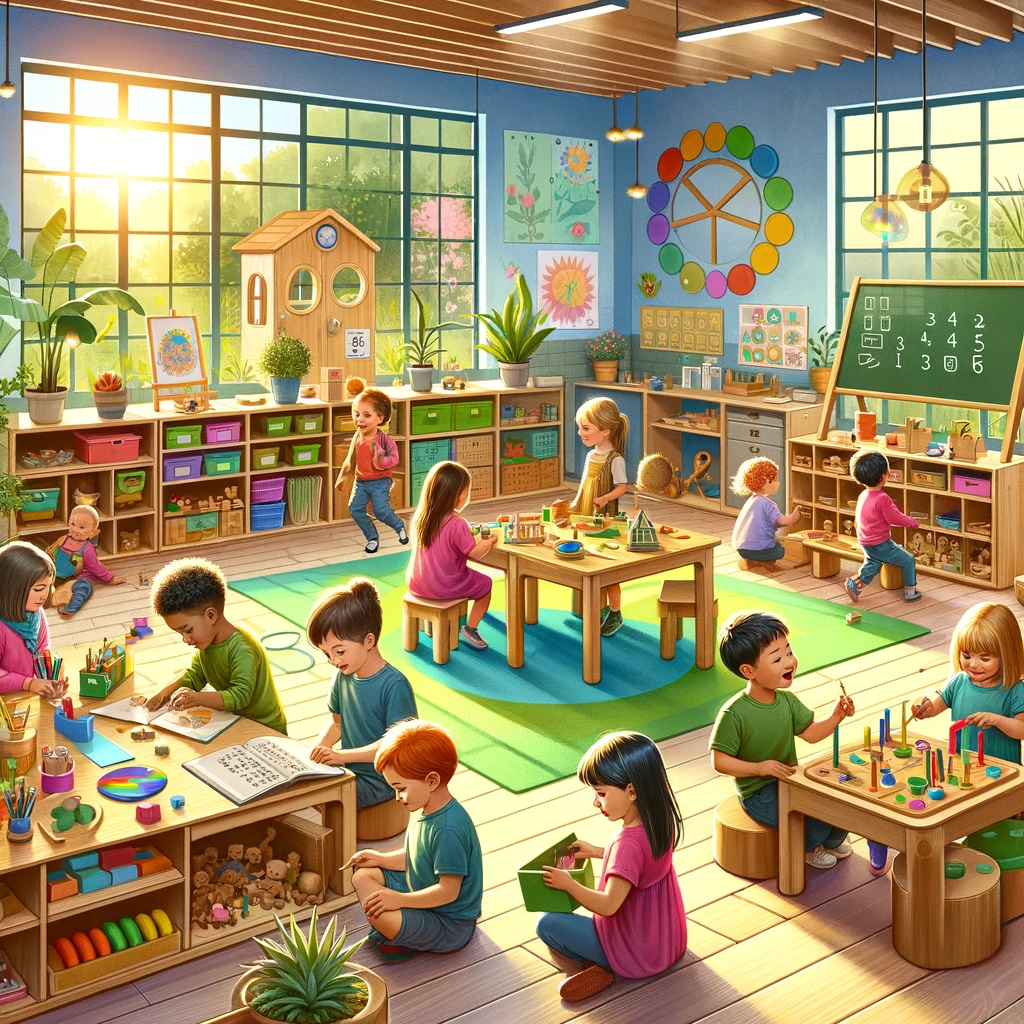
1. Child-Centered Learning: The Montessori classroom is meticulously designed to cater to the child’s learning needs. It is set up with specific areas for each part of the curriculum, such as language arts, mathematics, sensory activities, and practical life skills. Each material within the classroom is designed to be self-corrective, which means children can learn through their own errors without direct intervention from a teacher.
2. Prepared Environment: Montessori environments are prepared in advance based on observations of the children’s needs. They are aesthetically pleasing and orderly, designed to encourage independence and freedom within safe boundaries. This environment helps children develop a sense of discipline and responsibility.
3. Educator as Guide: In Montessori schools, teachers act more as guides than traditional instructors. They facilitate the learning process by linking children with appropriate activities rather than dictating what children should do. This role supports the development of independence and initiative.
4. Respect for Developmental Phases: Montessori education is structured around several developmental phases, each with distinct needs, behaviors, and learning modes. These phases cover specific age groups: 0-3 years, 3-6 years, 6-12 years, and 12-18 years. Recognizing and respecting these phases allows educators to provide age-appropriate learning experiences that resonate with and engage children at different stages of their development.
Global Spread and Adaptation
The adaptability of the Montessori Method to various cultural and educational contexts has been key to its global reach. In countries like the United States, Montessori schools have flourished by integrating the method’s core principles with local educational standards and cultural expectations. Similarly, in places like Kenya and India, Montessori schools have been tailored to meet the local community’s needs while maintaining the integrity of the Montessori philosophy.
In addition to private schools, Montessori principles have also been integrated into public and charter school programs in various countries, making it accessible to a broader range of socioeconomic groups. This adaptability not only speaks to the universality of Montessori’s approach to child development but also its potential to improve educational practices worldwide.
Challenges and Opportunities
Despite its widespread popularity, the Montessori Method faces challenges such as the cost of implementation and the need for specialized training for educators. However, the growing interest in alternative education models and the increasing global focus on early childhood education present significant opportunities for the expansion of Montessori-based education. Moreover, the positive outcomes associated with Montessori education, such as improved academic performance, enhanced social skills, and greater creativity, continue to drive its adoption in new regions and cultures.
The Montessori Method, with its emphasis on individual growth and learning through exploration, has proven to be a dynamic and influential educational approach. From its humble beginnings in a small classroom in Italy to its presence in schools around the globe, it is a testament to the enduring power of an idea that respects the innate potential of every child. As education continues to evolve, the principles of the Montessori Method offer valuable insights into how we can nurture not just better learners, but better people.

Influence on Modern Educational Practices
The Montessori Method’s influence extends beyond its own schools and into the broader educational landscape. Many contemporary educational practices have been inspired by Montessori principles, such as personalized learning, student-centered environments, and inquiry-based approaches. Educators and researchers alike recognize the value in allowing students to explore and learn at their own pace, a cornerstone of Montessori education.
Integration with Technology
In the 21st century, the integration of technology in education has been inevitable and substantial. Montessori schools have navigated these waters by integrating digital tools that complement traditional Montessori materials rather than replace them. For instance, interactive learning apps are used to enhance the sensory learning experience without detracting from the hands-on learning approach that is vital to Montessori education. This thoughtful incorporation of technology helps maintain the integrity of Montessori’s vision while also preparing students for the digital age.
Social and Emotional Learning
Another significant aspect of the Montessori Method is its focus on social and emotional learning (SEL). The environment and culture within Montessori schools promote skills like empathy, self-regulation, and cooperation. These skills are now recognized as crucial by educators around the world for holistic child development. Montessori’s emphasis on SEL has inspired many educational institutions to incorporate these elements into their curriculums, recognizing that the well-being of the student is as important as academic achievements.
Sustainability and Environmental Education
Montessori education also places a strong emphasis on the natural world and teaches children about sustainability from an early age. This is particularly relevant in today’s context, where environmental education has become critical to global education curricula. Montessori classrooms often include elements like gardening, recycling, and the use of natural materials, which instill a sense of responsibility and connection to the earth. These practices encourage children to become conscientious global citizens who are aware of their impact on the environment.
The Montessori Method in Public Education
While traditionally associated with private schooling, there is a growing movement to introduce Montessori principles into public education systems. Several public schools in the United States and Europe have begun to adopt Montessori techniques, often funded by governmental grants and private donations. These initiatives aim to make Montessori education accessible to a broader demographic, democratizing the benefits of a Montessori education and proving its adaptability and effectiveness across different economic backgrounds.
Teacher Training and Certification
The expansion of Montessori education globally has increased the demand for well-trained Montessori teachers. Montessori teacher training is rigorous and detailed, ensuring that educators are not only familiar with Montessori materials and curriculum but also with the philosophy and psychological theories underlying the practices. This training is crucial because the role of the teacher in the Montessori setting is fundamentally different from that in traditional education systems. The growing number of Montessori teacher training centers around the world is a testament to the method’s enduring relevance and appeal.
Challenges in Global Adaptation
Despite its numerous successes, adapting the Montessori Method to different cultural contexts can be challenging. Educational norms, parental expectations, and societal values differ greatly around the world, and Montessori schools sometimes struggle with maintaining the purity of Montessori principles while adapting to local expectations. Furthermore, the cost associated with Montessori materials and teacher training can be prohibitive, making it difficult for the model to reach lower-income populations without substantial financial support.
Conclusion
As the Montessori Method continues to spread across the globe, its impact on children’s education is undeniable. With a focus on nurturing independent, thoughtful, and creative individuals, Montessori schools offer a compelling alternative to traditional education methods. The global education community continues to watch and learn from this Italian innovation that has grown to have a profound and enduring influence on how education can be envisioned and implemented across different cultures and communities.
References
- Lillard, A. (2005). Montessori: The Science behind the Genius. Oxford University Press.
- Kramer, R. (1976). Maria Montessori: A Biography. Putnam.
- Montessori, M. (1949). The Absorbent Mind. Clio Press.
- Montessori, M. (1967). The Discovery of the Child. Ballantine Books.
- Standing, E.M. (1957). Maria Montessori: Her Life and Work. Plume.


