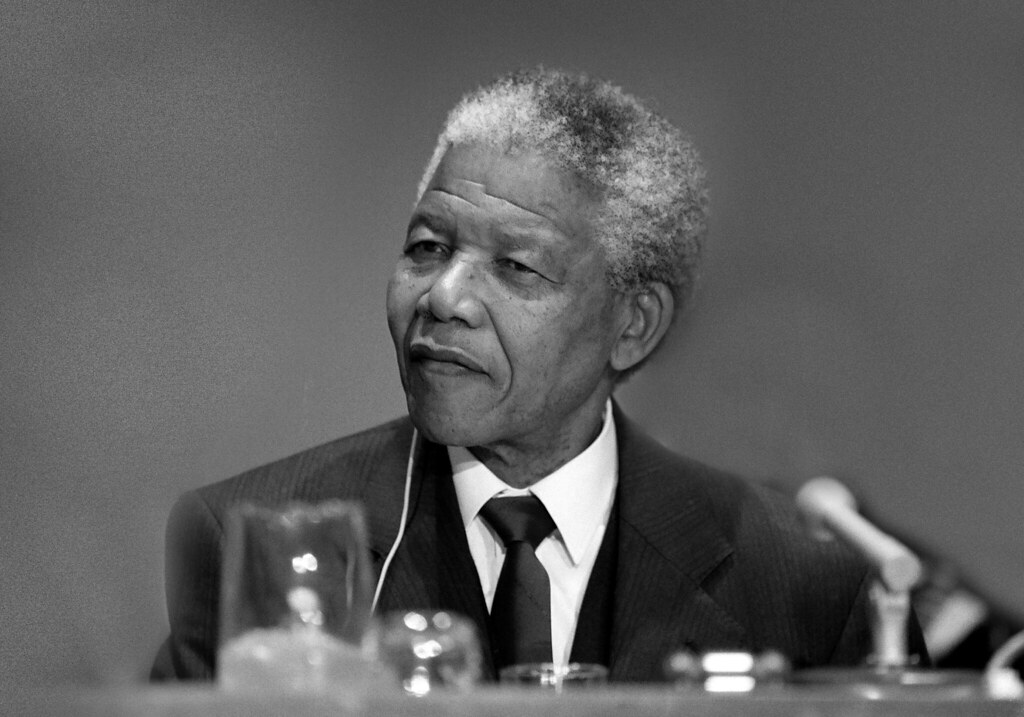
Nelson Mandela, whose name resonates with the essence of human rights and equality, stands as a colossus in the annals of modern history. His inspiring journey from a small village in South Africa to becoming a globally revered leader symbolizes hope, strength, and resilience. Mandela’s life is a testament to the power of an unyielding spirit that dares to dream of justice and equity in the face of oppression and adversity.
Born on July 18, 1918, in the village of Mvezo in Umtata, Mandela’s early years were shaped by traditional African values. Despite the segregation and systemic injustices that were rampant in South Africa due to apartheid, Mandela pursued an education—a journey that would lay the groundwork for his future as a fierce advocate for racial equality. His commitment to the liberation of his people saw him endure 27 years of imprisonment, but this period of hardship only fortified his resolve.
The story of Nelson Mandela is more than just a narrative of one man’s fight against apartheid. It is a vivid chronicle of a movement fueled by the collective yearning of a marginalized population for dignity and freedom. His charismatic leadership, uncompromising stance against racism, and unparalleled capacity for forgiveness have left an indelible mark on the world. This article seeks to delve deep into the life and legacy of Nelson Mandela, tracing his journey from a rural upbringing to his pivotal role in the dismantling of apartheid and the establishment of democracy in South Africa.
Early Life and Education
Mandela’s formative years were spent in rural South Africa, where he was exposed to the Xhosa culture and traditions. He was christened Rolihlahla, a name that intriguingly means “troublemaker,” a foreshadowing of his future role as a revolutionary. His father, a local chief and advisor to the Thembu royal family, imbued him with a sense of duty and leadership.
In 1939, Mandela began his higher education at the University College of Fort Hare, a premier institution for black Africans. However, his time there was cut short when he became involved in a student protest, leading to his expulsion. Undeterred, Mandela moved to Johannesburg, where his resolve to fight against racial oppression took root. While working as a law clerk, he completed his law degree through the University of South Africa.
Mandela’s involvement with the African National Congress (ANC) marked the beginning of his political journey. The ANC, established in 1912, was dedicated to ending apartheid and ensuring equal rights for all South Africans. Mandela’s legal expertise and eloquence made him a vital asset to the movement. He co-founded the ANC Youth League (ANCYL) in 1944, which played a crucial role in revitalizing the ANC with a more militant stance against apartheid.
The early phase of Mandela’s life exemplifies his commitment to education as a tool for empowerment and his natural propensity for leadership. These years laid the foundation for his larger-than-life role in the struggle against apartheid, wherein he would become both a beacon of hope and a symbol of resistance to tyranny.
Rising Tide of Activism
The 1950s marked a significant escalation in Mandela’s political activism. Alongside his ANCYL colleagues, Mandela was instrumental in initiating the Defiance Campaign in 1952, a non-violent resistance against apartheid laws. The campaign galvanized thousands of South Africans to defy unjust laws, striking a chord with the oppressed populace and drawing international attention to their plight.
Mandela’s legal acumen was further put to test when he co-founded the first black law firm in South Africa, Mandela & Tambo, with his friend Oliver Tambo. This firm provided affordable legal counsel to black South Africans grappling with the brutalities of apartheid, thus empowering them to pursue justice through legal avenues.
In 1956, Mandela faced his first major legal battle when he was arrested, along with 155 other activists, and charged with treason for their role in the Freedom Charter—a manifesto calling for a non-racial South Africa. This trial, which lasted four years, played a significant part in solidifying Mandela’s reputation as a steadfast leader and an eloquent orator who could rally people around the cause of equality and justice.
The Sharpeville Massacre of 1960, where police killed 69 unarmed protesters, marked a turning point in Mandela’s approach to resistance. Recognizing that peaceful protests were met with brutal force, Mandela and his ANC colleagues decided to form Umkhonto we Sizwe (Spear of the Nation), an armed wing aimed at sabotaging government installations. This pivot to armed resistance underscored the gravity of the struggle and the lengths to which Mandela and his comrades were willing to go to end apartheid.
Imprisonment and International Solidarity
In 1962, Mandela was captured and sentenced to five years in prison for inciting workers’ strikes and leaving the country without permission. While serving this sentence, he and other top ANC leaders were tried again in the infamous Rivonia Trial, named after the suburb of Johannesburg where key ANC leaders were arrested. Mandela used the dock as a platform to deliver a stirring speech, famously stating that he was prepared to die for an ideal of a democratic and free society.
In 1964, Mandela, along with other leaders, was sentenced to life imprisonment. His incarceration on Robben Island became an emblem of apartheid’s oppression. Despite the harsh conditions, Mandela remained resolute, transforming the prison into a focal point of resistance and a site for political education.
Internationally, Mandela’s imprisonment galvanized global solidarity movements. Anti-apartheid activists across continents echoed the call for his release. Campaigns, boycotts, and international sanctions against the South African government increased, putting immense pressure on the apartheid regime. Mandela’s name became synonymous with the struggle for freedom, making him a global icon.
The relentless pressure from the international community, coupled with internal resistance, forced the apartheid regime to reconsider its stance. Mandela’s imprisonment had not quashed the fight; instead, it amplified his message, turning him into a symbol that inspired a generation of activists worldwide. His name became a rallying cry, a testament to the power of unity in the face of injustice.
Negotiations and the Path to Democracy
The 1980s marked the beginning of significant political changes in South Africa. Under increasing internal and external pressure, the apartheid regime began to acknowledge the inevitability of reform. Mandela, despite being in prison, played a crucial role in these transformative discussions.
In 1985, South African President P.W. Botha offered Mandela conditional release, which Mandela rejected, stating that freedom without the liberation of his people was no freedom at all. This principled stand reinforced his image as a steadfast leader dedicated to the cause of equality. It also underscored the sincerity and resolve that Mandela brought to the negotiating table.
When F.W. de Klerk succeeded Botha in 1989, there was a marked shift in government policy. De Klerk recognized the need to dismantle apartheid and initiated dialogues with Mandela and other imprisoned leaders. The negotiations were fraught with challenges, but Mandela’s strategic acumen and his ability to foster dialogue played a pivotal role in steering these talks towards fruition.
On February 11, 1990, after 27 years of imprisonment, Nelson Mandela walked out of Victor Verster Prison, holding his wife Winnie’s hand, symbolizing the dawn of a new era for South Africa. His release marked the beginning of the end for apartheid. Over the next few years, Mandela tirelessly engaged in negotiations, advocating for a peaceful transition to a multi-racial democracy. His ability to navigate the complex political landscape with grace and determination was instrumental in forging a new South African constitution that enshrined equal rights for all.
Presidency and Post-Presidency Contributions
In 1994, South Africa held its first democratic elections. Nelson Mandela was elected as the first black president of the nation in a momentous occasion that was celebrated worldwide. His presidency, from 1994 to 1999, was characterized by efforts to reconcile a racially divided country and lay the foundation for a democratic society.
Mandela’s administration prioritized national healing through initiatives like the Truth and Reconciliation Commission (TRC), which aimed to address the atrocities of apartheid by fostering an environment of understanding and forgiveness. Under Mandela’s leadership, South Africa began to rebuild its national identity, one that embraced diversity and sought to rectify the inequities of the past.
Mandela’s presidency also focused on economic restructuring. He worked on policies geared towards poverty alleviation, education reform, and healthcare improvement. While his government faced numerous challenges, Mandela’s vision and policies set the stage for future governance that would continue to grapple with South Africa’s socio-economic complexities.
After stepping down from the presidency, Mandela did not retreat from public life. Instead, he continued his advocacy through the Nelson Mandela Foundation, focusing on issues like HIV/AIDS awareness, peace, and justice. He remained a global statesman, leveraging his moral authority to influence international peace efforts.
Mandela’s influence extended beyond his lifetime. His enduring legacy of compassion, forgiveness, and dedication to human rights continues to inspire individuals and movements around the globe. He remains a perennial symbol of the power of resilience and the enduring quest for justice.
Conclusion
Nelson Mandela’s journey from the rural hinterlands of South Africa to becoming an emblem of human rights activism is a narrative replete with lessons in courage, resilience, and unwavering integrity. His life’s work continues to resonate as a timeless testament to the capacity of one individual to effect profound change.
Mandela’s relentless pursuit of justice, even under the most trying conditions, exemplifies the quintessential spirit of human rights advocacy. His willingness to sacrifice his freedom and endure hardships for the liberation of his people has cemented his place in history as a beacon of hope and a paragon of virtue.
The impact of Mandela’s legacy is evident in the numerous global movements that draw inspiration from his philosophical underpinnings and practical approaches to resistance and reconciliation. He demonstrated that true leadership is not about dominion but about serving the greater good and empowering the oppressed.
As we reflect on Nelson Mandela’s life, it is imperative to recognize that the struggle for human rights and equality is an ongoing process. Mandela’s story serves as a reminder that the fight against injustice requires continuous effort, collective action, and unwavering dedication. His “long walk to freedom” beckons us to persist in our endeavors to build a world where liberty and justice are the cornerstones of our collective humanity.