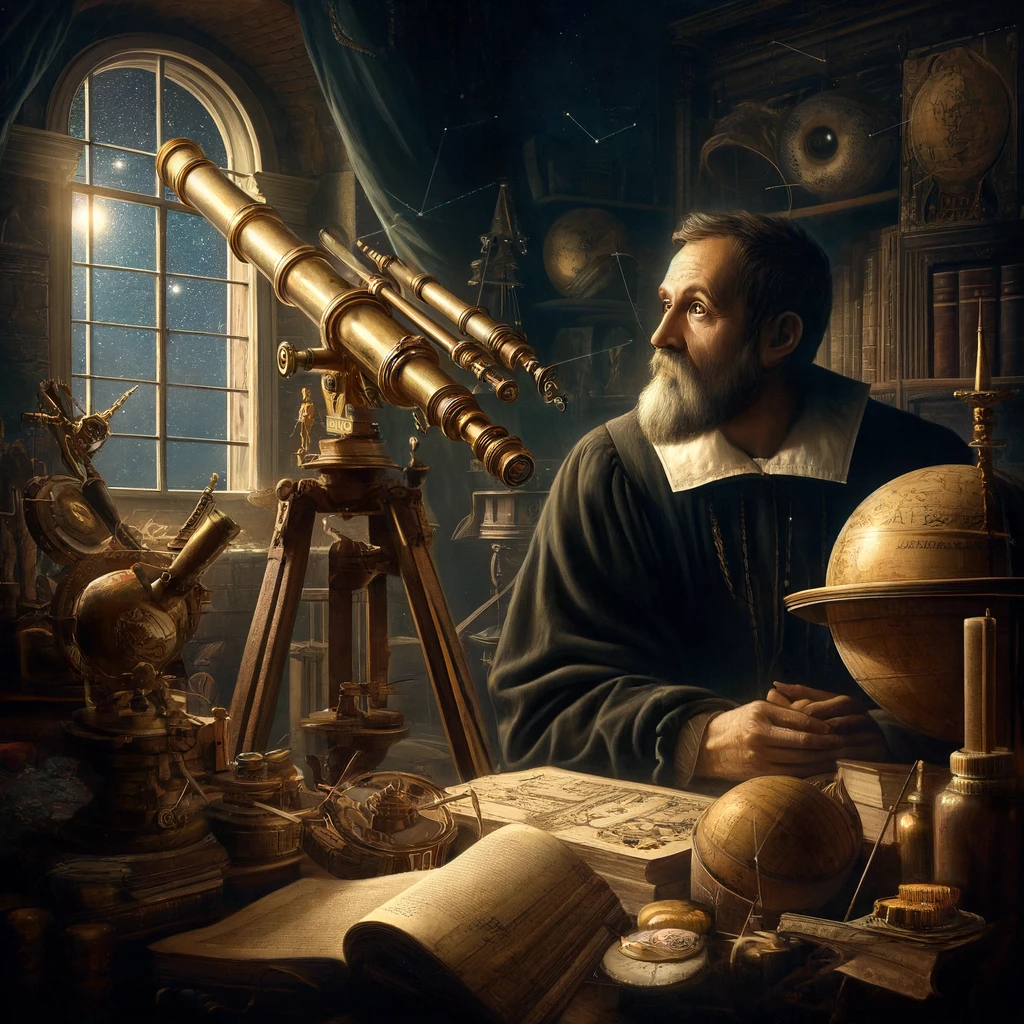
Isaac Newton, a name synonymous with apples and gravity, is one of the most influential figures in the history of science. Born on January 4, 1643, in Woolsthorpe, England, Newton’s contributions span the realms of physics, mathematics, astronomy, and beyond, laying the groundwork for modern engineering and technology. This article delves into his life, discoveries, and the lasting impact of his work on our understanding of the universe.
Early Life and Education
Isaac Newton’s journey began in a small English village, where he was born prematurely and not expected to survive. His early years were marked by academic curiosity and an innate knack for inventing, allowing him to stand out among his peers. Newton’s mother, determined to see him succeed, sent him to the King’s School in Grantham, where he became absorbed in the world of books.
At the age of eighteen, Newton enrolled at Trinity College, Cambridge. Here, he was introduced to the works of the leading scientists of his day, including René Descartes and Galileo Galilei. However, it was the great plague of 1665 that, ironically, gave Newton the solitude needed to develop his most revolutionary ideas. With Cambridge closed, Newton returned to Woolsthorpe for two years of intense intellectual production, which would later be referred to as his “annus mirabilis” or “year of wonders.”
The Birth of the Principia
During his time at Woolsthorpe, Newton made groundbreaking advances in mathematics, optics, physics, and astronomy. His most renowned achievement was formulating the law of universal gravitation, inspired by the fall of an apple from a tree. This law posited that every particle of matter in the universe attracts every other particle with a force that is proportional to the product of their masses and inversely proportional to the square of the distance between their centers.
In 1687, with the support of astronomer Edmond Halley, Newton published his seminal work, Philosophiæ Naturalis Principia Mathematica (Mathematical Principles of Natural Philosophy), commonly known as the Principia. In this work, he laid out the three laws of motion, which together laid the foundation for classical mechanics.
Newton’s Laws of Motion
Newton’s three laws of motion can be summarized as follows:
- An object will remain at rest or in uniform motion in a straight line unless acted upon by an external force.
- The force acting on an object is equal to the mass of that object multiplied by its acceleration.
- For every action, there is an equal and opposite reaction.
These laws helped explain not only the motion of celestial bodies but also the everyday movements of objects on Earth and remain integral to physics education around the world.
Contributions to Optics and Mathematics
Beyond his work in physics, Newton made significant contributions to optics. He constructed the first practical reflecting telescope, now known as the Newtonian telescope, which allowed him to observe the moons of Jupiter and the rings of Saturn more clearly than ever before. In optics, he also studied light and color, discovering that white light is composed of multiple colors, which can be separated into a spectrum via a prism.
In mathematics, Newton was a pioneer in developing calculus, a branch of mathematics that became crucial for describing changes in motion and shapes of curves. Although German mathematician Gottfried Wilhelm Leibniz developed calculus independently, Newton’s formulation of fluxions, as he called them, was instrumental in advancing mathematical studies.
Legacy and Later Life
Newton’s influence extended beyond his own lifetime. His principles and methods remained unchallenged until the early 20th century, when physicists like Albert Einstein began to explore the limitations of Newtonian mechanics, giving rise to modern physics. Nevertheless, Newton’s work remains foundational, and his methods continue to be a staple in scientific research and educational curricula worldwide.
In his later years, Newton held several influential positions, including Professor of Mathematics at Cambridge and Warden, and later Master, of the Royal Mint. He was knighted by Queen Anne in 1705, becoming Sir Isaac Newton. He spent his final years in London, where he died on March 31, 1727, and was buried in Westminster Abbey, an honor reserved for distinguished individuals.
Sir Isaac Newton’s legacy is not just in the realm of academic theory but in the everyday applications of his discoveries. The modern world, with its satellites orbiting in principles derived from his laws, to the technologies that underpin current engineering practices, owes much to Newton’s work. His curiosity, rigor, and methodological approach to understanding the natural world have made him a titan of science, rightly called the father of modern physics, whose contributions continue to influence our understanding of the world and our place within it.

Newton’s impact extends beyond the tangible and into the philosophical and methodological frameworks of science. His approach, which seamlessly combined experimentation with mathematical rigor, set a new standard for scientific inquiry and established a model that is still followed today. This integration of different disciplines underlined his belief in a universe governed by natural laws, which could be understood through reason and observation.
Newton’s Methodological Influence
Newton’s insistence on empirical data coupled with mathematical description revolutionized the way scientists approached natural phenomena. Before Newton, science was more speculative, often mixed with alchemical, mystical, and philosophical ideas that lacked empirical verification. Newton’s approach demystified the universe, showing that the same physical laws applied everywhere and to everything, from the motion of planets to the falling of an apple. This was a radical departure from earlier theories which often viewed celestial and terrestrial phenomena as governed by different principles.
Religious and Philosophical Views
Newton was deeply religious and his theological beliefs influenced his scientific methodology. He viewed the universe as a creation of a rational designer, a belief that framed his scientific work and his motivation to discover the laws of nature. Newton’s God was a master mathematician and engineer whose existence could be inferred from the order and beauty of the universe.
Despite his profound contributions to science, Newton’s religious studies were equally extensive, though much of this work was published posthumously. He spent a significant amount of time studying biblical texts and writing about prophecy, which he saw as further evidence of a universe governed by order and law.
Newton and Alchemy
Another less often celebrated aspect of Newton’s intellectual pursuit was his work in alchemy. He wrote extensively, albeit secretly, about alchemical traditions. Many of his manuscripts on alchemy were only discovered after his death. Newton believed that alchemy provided insights into the hidden forces of nature and the transformation of elements. While today we might separate his scientific achievements from his alchemical pursuits, for Newton, all were part of a unified quest to understand the natural world.
Impact on Economics and the Royal Mint
Newton’s role as the Warden and later the Master of the Royal Mint was not merely an honorary position; he took an active part in reforming the currency and combating counterfeiting. His methodical approach helped to standardize the British currency system and secure the nation’s economy. This aspect of his work demonstrates how his rigorous approach to science could be applied effectively to practical problems in administration and economics.
Newton’s Personality and Disputes
Despite his towering intellect, Newton was known to be a complex character, often embroiled in disputes with other scientists. One of the most famous of these was with Leibniz over the invention of calculus. Both men arrived at similar conclusions independently, yet the priority dispute became bitter and protracted, influencing the European scientific community deeply.
Newton’s rivalry with Robert Hooke, another giant of British science, over the nature of light and color further illustrates his sometimes confrontational nature. Yet, these disputes also highlight the competitive and collaborative nature of scientific progress during the Enlightenment.
Educational Legacy
Today, Newton’s work remains a fundamental part of science education. His laws of motion and universal gravitation are taught in classrooms around the world, and his method of posing hypotheses, conducting experiments, and applying mathematical principles to formulate laws is the cornerstone of scientific education.
Final Thoughts
Isaac Newton transformed our understanding of the universe. His work laid down the foundation for much of modern physics and astronomy. More than three centuries later, his ideas about light, motion, and gravity still enlighten scientific thought. His influence extends beyond science, into economics, religion, and philosophy, painting a picture of a man who sought to understand the universe in its entirety. Newton’s story is one of relentless curiosity and profound brilliance, embodying the very essence of scientific inquiry and intellectual exploration. His legacy is not only in the answers he provided but in the method of questioning and understanding the world, which continues to inspire curiosity and drive scientific advancement today.