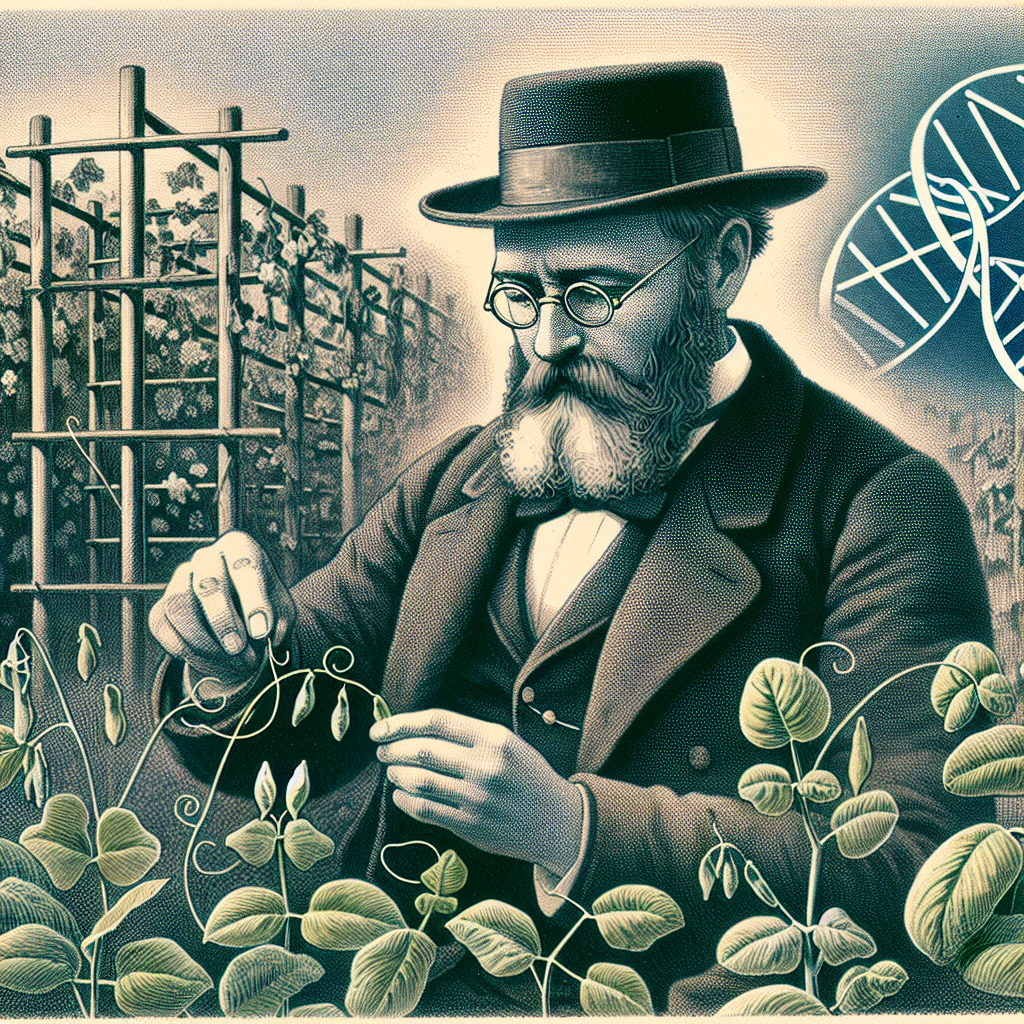
In the grand tapestry of scientific history, certain individuals stand out for their groundbreaking contributions that have fundamentally shaped humanity’s understanding of the natural world. Gregor Mendel, often hailed as the Father of Genetics, is one such luminary whose meticulous experiments with pea plants laid the foundational principles of heredity. Born on July 20, 1822, in Heinzendorf, Austria (now the Czech Republic), Mendel’s work was not fully recognized during his lifetime. However, his pioneering research, conducted in a modest monastery garden, eventually revolutionized biology and genetics, carving his name permanently into the annals of scientific history.
Most of Mendel’s significant discoveries came from his daring approach to studying pea plants. By focusing on specific traits and nurturing his plants with an unwavering precision, Mendel uncovered the mechanisms that govern gene inheritance. His techniques and findings were detailed in a paper he presented in 1865, which today is regarded as a monumental piece of scientific literature. Despite initial disinterest, his discoveries were pivotal in launching the field of genetics, influencing later scientific inquiries and technological advancements.
This article delves into Gregor Mendel’s life, his groundbreaking work, and the profound impact he has had on the field of genetics and beyond. By exploring his journey, the methodology behind his experiments, and the subsequent influence of his discoveries, we aim to provide a comprehensive understanding of why Mendel is celebrated as a cornerstone in the field of biology and genetics.
Mendel’s Early Life and Education
Born Johann Mendel, he later adopted the name Gregor upon entering the St. Thomas Monastery in Brno. His early years set the stage for a life dedicated to scientific inquiry. Growing up on a family farm, Mendel was naturally inclined towards agriculture, an interest that was further nurtured by his schooling. His academic journey began with an education in a piarist school and continued at the Philosophical Institute at Olomouc, where he developed a keen interest in physics and mathematics.
Mendel’s entry into the Augustinian convent marked a significant shift in his life. While the monastery duties kept him busy, it was also a center of intellectual pursuit, offering him access to a wealth of academic resources. His superiors quickly recognized his potential, dispatching him to the University of Vienna in 1851 to further his education. There, under the guidance of some of the era’s leading scientists, Mendel absorbed influential teachings that encompassed both biological and mathematical sciences.
Vienna’s academic environment was crucial in honing Mendel’s analytical skills, equipping him with the intellectual tools required for his later experiments. Studying under notable figures such as Christian Doppler, Mendel gained a comprehensive understanding of scientific methodology, which facilitated the structured approach he would employ in his genetic studies. This academic grounding, combined with Mendel’s innate curiosity and precision, set the stage for his pioneering research.
The Pea Plant Experiments
Mendel’s choice of the garden pea (Pisum sativum) for his experiments was both strategic and insightful. The plant’s various traits, such as seed shape and flower color, exhibited distinct variations, making it an ideal subject for studying inheritance. Over eight years, from 1856 to 1863, Mendel conducted thousands of cross-pollination experiments, systematically tracking how traits were passed from one generation to the next.
The meticulous nature of his work cannot be overstated. Mendel cultivated and tested around 28,000 pea plants, meticulously documenting their growth and trait variations. By analyzing the offspring from cross-breeding plants with different traits, Mendel observed consistent patterns of inheritance. For instance, breeding a pea plant with green seeds with another carrying yellow seeds yielded predictable ratios of green to yellow seed plants in subsequent generations.
Through his experiments, Mendel proposed three key principles that form the bedrock of classical genetics: the Principle of Segregation, the Principle of Independent Assortment, and the Principle of Dominance. He identified that traits are inherited as discrete units (now known as genes), which do not blend but segregate independently during gamete formation, thereby resulting in different gene combinations in offspring. These revolutionary insights were published in Mendel’s seminal paper, “Experiments on Plant Hybridization,” in 1865.

Post-Research Life and Rediscovery
Despite the revolutionary nature of his findings, Mendel’s work received scant attention during his lifetime. It was overshadowed by prevailing scientific theories and lacked the immediate recognition it deserved. Mendel continued his duties at the monastery, and eventually, his research took a backseat as he assumed administrative responsibilities. In 1868, Mendel became the abbot of the monastery, a position that demanded much of his time and energy.
Mendel’s groundbreaking work languished in obscurity for several decades until it was rediscovered independently by three scientists – Hugo de Vries, Carl Correns, and Erich von Tschermak – at the turn of the 20th century. As they conducted their own genetic studies, they stumbled upon Mendel’s work and recognized its significance. The resurrection of Mendel’s principles catalyzed the development of the modern field of genetics, solidifying his status as a scientific pioneer.
The acknowledgment of Mendel’s work posthumously awarded him the recognition he had missed during his lifetime. His findings were integrated into the growing body of genetic research, influencing numerous fields from agriculture to medicine. Mendel’s principles laid the groundwork for understanding genetic diseases, hereditary traits, and the fundamental mechanics of DNA, contributing immeasurably to the scientific advancements that followed.
Impact on Modern Genetics and Beyond
Mendel’s work has left an indelible mark on numerous fields of science beyond genetics. His principles have been fundamental in understanding genetic disorders, aiding in diagnosing, managing, and in some cases, curing conditions with a genetic basis. The advent of biotechnology and genetic engineering owes much to Mendelian genetics, providing a framework that allows scientists to manipulate genes for improvements in medicine, agriculture, and other fields.
Agricultural sciences, for instance, have significantly benefitted from Mendelian principles. The ability to understand and predict plant traits has enabled the creation of superior crop varieties with desirable characteristics such as disease resistance and enhanced nutritional content. Similarly, animal breeding programs have utilized these principles to breed livestock with preferred traits, directly impacting food production and security.
Furthermore, Mendel’s influence extends into evolutionary biology. His work bridged the gap between Darwinian evolution and the genetic inheritance, providing the missing explanation for how traits are passed down and how variation arises. This fusion of concepts culminated in the development of the modern synthesis of evolutionary biology in the mid-20th century.
Mendel’s Legacy and Ongoing Research
The ongoing research and developments in genetics continue to build upon the foundation Mendel established. The discovery of DNA and the molecular mechanisms of gene function have expanded the understanding of genetics exponentially. Modern technologies such as genome sequencing, CRISPR, and gene therapy trace their conceptual origins to Mendelian genetics.
Gene editing technologies, like CRISPR-Cas9, exemplify how genetic principles identified by Mendel are applied to contemporary scientific challenges. These advancements offer the potential to correct genetic errors, treat hereditary diseases, and address complex genetic conditions that Mendel’s early work hinted at but couldn’t fully elucidate due to the technological limitations of his time.
Moreover, Mendel’s approach to scientific research has had a lasting impact on scientific methodology. His insistence on quantifiable, repeatable experimentation set a standard for rigorous scientific inquiry, influencing research methodologies across a wide array of scientific disciplines. Scientists today still rely on Mendel’s methodological clarity, where hypothesis-driven research and statistical validation are pivotal in scientific discovery.
Conclusion
Gregor Mendel’s life and work epitomize the profound impact a single scientist can have on the trajectory of human understanding. His meticulous experimentation and groundbreaking discoveries in the realm of genetics not only unlocked the secrets of heredity but also set a precedent for scientific methods that resonate across all fields of research today. Despite the initial oversight of his work, the eventual recognition and validation of Mendel’s principles have established him as a cornerstone in the scientific community.
His contributions have transcended his humble beginnings in a monastery garden to influence various facets of modern science. From agriculture to medicine, and from understanding the fundamentals of genetic inheritance to applying these principles in cutting-edge technological advancements, Mendel’s legacy is both vast and enduring. As we look to the future of genetics and biotechnology, the foundations laid by Gregor Mendel continue to support and inspire new generations of scientists, paving the way for future discoveries.
As we commemorate Mendel’s contributions, it is essential to continue fostering curiosity and rigorous scientific exploration, ensuring that the spirit of inquiry that Mendel embodied remains alive. His work serves as a testament to the notion that diligent observation, precise methodology, and an unyielding quest for knowledge can unlock the deepest mysteries of nature, ultimately benefiting all of humanity.


