Galileo Galilei, often hailed as the father of modern observational astronomy, the father of modern physics, and the father of science, is a pivotal figure in the history of the world’s intellectual development. His life’s work laid the groundwork for the scientific revolution and changed our understanding of the universe forever.
Early Life and Education
Born in Pisa, Italy, on February 15, 1564, Galileo was the eldest of six children in a well-educated, but not affluent, family. His father, Vincenzo Galilei, a famous lutenist and music theorist, instilled in him a deep appreciation for both the arts and the sciences. Galileo initially enrolled at the University of Pisa to study medicine but soon found his true calling in mathematics and natural philosophy, which led him to abandon his medical studies.
Contributions to Science
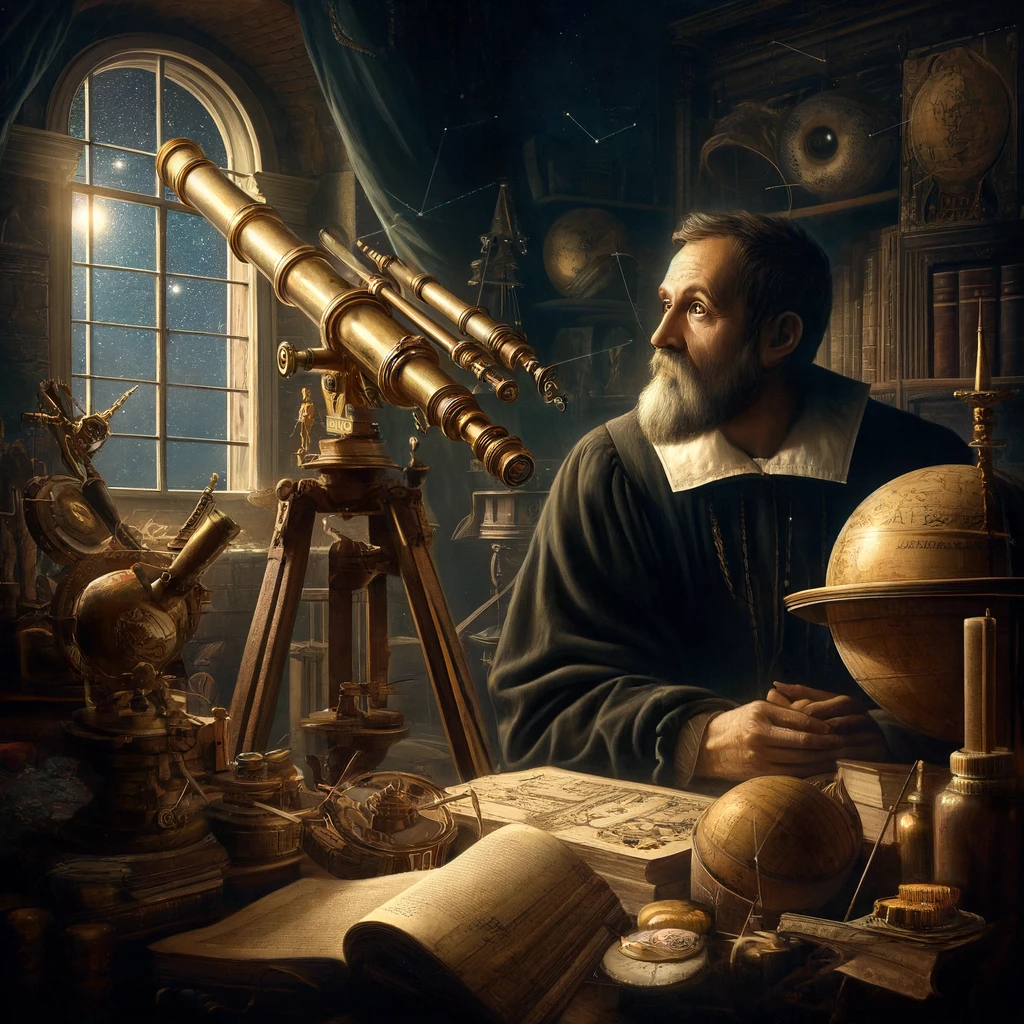
Galileo’s scientific achievements are vast and varied. In 1609, inspired by reports of a spyglass created by Dutch eyeglass makers, he designed his own telescope. With it, he made a series of astronomical observations that would dramatically alter humanity’s view of the universe.
Telescopic Discoveries
Galileo’s homemade telescopes, which magnified objects up to 20 times, allowed him to observe mountains and craters on the moon, contradicting the Aristotelian belief in celestial perfection. He discovered the phases of Venus, which provided evidence for Copernican heliocentrism over Ptolemaic geocentrism. Perhaps most famously, he discovered four moons orbiting Jupiter. These celestial bodies, later named the Galilean moons in his honor, were the first objects observed to orbit a body other than Earth, providing further evidence against geocentrism.
Dynamics and Kinematics
Galileo’s contributions weren’t limited to astronomy. His investigations into the laws of motion laid the groundwork for Newton’s later work. He challenged Aristotle’s teachings that heavier objects fall faster than lighter ones by famously dropping two spheres of different masses from the Tower of Pisa, demonstrating that their time of descent was the same. His work Dialogues Concerning Two New Sciences laid the foundations for classical mechanics by introducing the concepts of inertia and kinematics.
Conflict with the Church
Galileo’s advocacy for Copernicanism, the heliocentric model proposed by Copernicus that placed the Sun at the center of the universe rather than the Earth, eventually led to conflict with the Roman Catholic Church. In 1616, the Church decreed heliocentrism to be formally heretical since it contradicted the Scriptures. Galileo was warned to abandon his support for this theory, which he more or less did for a while.
However, in 1632, Galileo published his Dialogue Concerning the Two Chief World Systems, which ostensibly presented arguments for both heliocentrism and geocentrism but clearly favored the former. As a result, he was tried by the Inquisition, found “vehemently suspect of heresy,” forced to recant, and spent the rest of his life under house arrest.
Last Years and Legacy
Despite his persecution, Galileo continued to work while under house arrest. During this time, he produced one of his finest works, Discourses and Mathematical Demonstrations Relating to Two New Sciences. This book, which summarized his studies of motion and strength of materials, was smuggled out of Italy and published in the Netherlands.
Galileo’s health deteriorated in the late 1630s, and he became blind in 1638. He died on January 8, 1642. Galileo’s legacy is immense. His method of systematic observation, experimentation, and the use of mathematics to prove his theories set the standard for scientific inquiry. He is regarded as a major figure in the transition from natural philosophy to modern science.
Galileo Galilei, through his relentless pursuit of the truths of the universe, embodies the spirit of inquiry and perseverance. His intellectual bravery not only revolutionized astronomy and physics but also established methodologies that became the bedrock of the scientific method. Despite facing great opposition, his work has endured, his discoveries continue to inspire, and his methodologies still underpin the scientific pursuits of today. Galileo truly was a starry messenger, bearing revelations that brightened the darkened landscapes of his time and illuminated paths for future generations.

Despite the challenges he faced, including opposition from the church and his eventual house arrest, Galileo’s contributions to science and our understanding of the universe remain undiminished. His intellectual legacy is characterized by his rigorous methodological approach and his dedication to empirical evidence.
The Scientific Method
One of Galileo’s most enduring contributions is his refinement of the scientific method. He emphasized the importance of observation and experimentation in yielding reliable and replicable results. By systematically observing celestial bodies through his telescope and documenting their movements, Galileo set new standards for scientific accuracy and objectivity. His insistence on verifying theoretical assumptions through direct experimentation laid the foundations for modern scientific inquiry.
Impact on Astronomy
Galileo’s astronomical discoveries were profound. His observations of the Milky Way, which he correctly described as being composed of a vast number of stars, expanded our understanding of the breadth of the universe. His discovery of sunspots challenged the prevailing notion of the incorruptibility of heavenly bodies and suggested that the sun, an integral part of the solar system, was dynamic and ever-changing.
His work also sparked a broader scientific debate that eventually led to the general acceptance of the heliocentric model of the solar system. This paradigm shift was not just a change in astronomical models but also a significant philosophical shift that altered how humanity perceived itself in the universe.
Influence on Physics
Galileo’s studies in physics, particularly his work on the motion of objects, introduced concepts that were revolutionary at the time. His formulation of the laws of acceleration and his insights into the parabolic trajectory of projectiles would influence generations of scientists, including Isaac Newton, who built upon Galileo’s ideas to develop the law of universal gravitation.
Challenges to Traditional Views
Galileo’s challenges to traditional Aristotelian cosmology were not just scientific but also philosophical. By disputing the geocentric view of the universe, Galileo challenged the way people understood their place in the cosmos. His defense of Copernican heliocentrism was seen as controversial because it opposed centuries of doctrinal teaching that placed Earth at the center of the universe, a position that was intertwined with theological beliefs.
The implications of Galileo’s scientific discoveries extended beyond the realm of science into the broader cultural and philosophical domains, influencing literature, religion, and philosophy. His willingness to question accepted truths and his commitment to empirical evidence encouraged others to also question and explore, which was instrumental in the development of modern science.
Educational Influence
Galileo was also an esteemed educator who believed in the power of knowledge and the importance of accessible education. His teaching methods emphasized critical thinking and encouraged students to question accepted knowledge and to verify facts through their own observations. This educational philosophy contributed to a more informed and skeptical scientific community that was more resistant to dogmatism.
Conclusion
Galileo Galilei remains a towering figure in the history of human thought. His ability to merge theoretical physics with experimental data paved the way for modern science. His work represents a crucial point in the history of science, marking the transition from classical antiquity’s speculative reasoning to a more rigorous, observational, and mathematical framework.
His story is a poignant reminder of the complex interplay between science and society, and his legacy teaches us about the courage to explore and to understand the world. Galileo was not just a starry messenger who brought new truths to light; he was a beacon of change that altered the course of human understanding forever. His contributions continue to inspire curiosity and drive scientific exploration, making his life and work a fundamental chapter in the story of human progress.