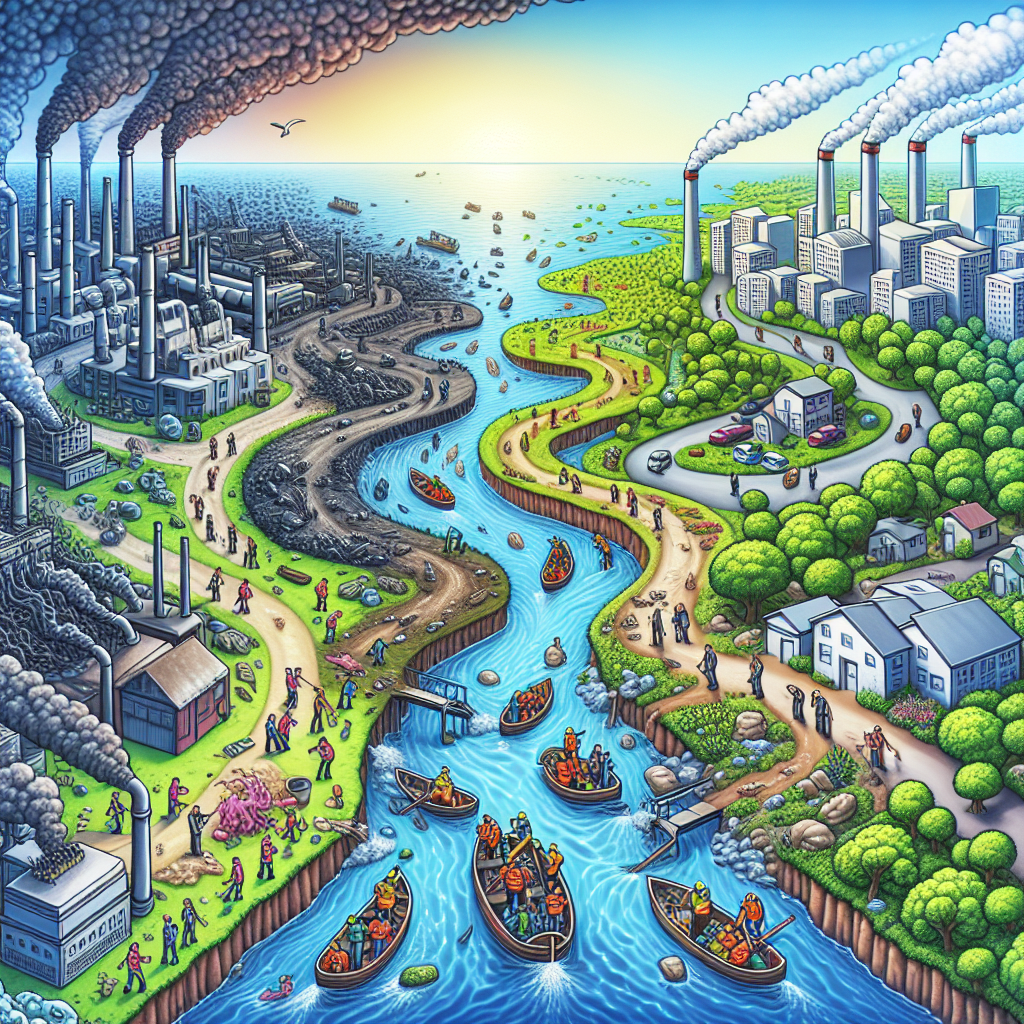
In the complex web of modern economic systems, environmental economics plays an essential role in ensuring sustainable development and conservation of our natural resources. One of the key concepts within this field is the study of externalities and their impact on the environment. Externalities are essentially the unintended side effects of economic activities, which can be either positive or negative. In the context of environmental economics, these external effects often lead to market failures, where the full social costs or benefits of production and consumption are not reflected in market prices.
In this article, we will delve into the fascinating realm of externalities, uncovering the various types of environmental externalities and exploring how they contribute to market failures. We will also discuss potential remedies and policy interventions that aim to correct these market failures and promote environmental sustainability. By the end of this comprehensive guide, you will have a deeper understanding of the intricate relationship between economic activities, externalities, and environmental health.
Understanding Externalities
Externalities can be broadly classified into two categories: positive externalities and negative externalities. Positive externalities occur when the actions of individuals or firms have beneficial effects on third parties. For example, a beekeeper’s bees pollinating nearby crops can enhance agricultural productivity, providing benefits to farmers. On the other hand, negative externalities arise when economic activities impose costs on others that are not accounted for by the market. Pollution from industrial plants, for instance, can harm public health and the environment, affecting individuals who are not directly involved in the production or consumption process.
The existence of externalities leads to market inefficiencies because private actors lack the incentive to consider the full social costs or benefits of their actions. In the presence of negative externalities, such as pollution, firms may produce more than the socially optimal level, leading to overconsumption of resources and environmental degradation. Conversely, in the case of positive externalities, valuable goods or services may be under-provided because the producers do not receive compensation for the external benefits they generate.
Environmental Market Failures
Market failure occurs when the allocation of goods and services by a market is not efficient. In the context of environmental economics, market failures often arise due to the presence of externalities. One prominent example of an environmental market failure is the tragedy of the commons, a situation where individuals, acting in their self-interest, overuse and deplete shared resources, such as fisheries, forests, and air quality.
Public goods also contribute to environmental market failures. Public goods are non-excludable and non-rivalrous, meaning that individuals cannot be excluded from their use, and one person’s use does not reduce their availability to others. Clean air and water are examples of public goods. However, because these goods are not confined within market transactions, it is challenging to assign property rights and incentivize individuals or firms to take responsibility for their preservation.
The combination of externalities and the unique characteristics of certain environmental goods can complicate the efficient functioning of markets. As a result, government intervention often becomes necessary to address market failures and protect environmental resources.
Regulatory Approaches
One of the primary means by which governments address environmental market failures is through regulatory measures. Environmental regulations set standards and limits on pollution emissions, resource use, and other activities that may harm the environment. These regulations aim to internalize the external costs of pollution by making it more costly for firms and individuals to engage in harmful activities.
Command-and-control regulations, for instance, specify exact limits on emissions or mandate the use of certain technologies to reduce harmful outputs. While effective in many cases, such regulations can be inflexible and may not always encourage the most cost-effective solutions. More flexible regulatory approaches include market-based instruments, such as pollution taxes and tradable permits. Pollution taxes impose a fee on each unit of pollution emitted, providing an economic incentive for firms to reduce their emissions. Tradable permits, also known as cap-and-trade systems, set a total allowable level of pollution and allocate permits to firms. Firms can trade these permits, promoting cost-effective pollution reduction.
Market-Based Solutions
Market-based solutions for environmental externalities harness the power of market forces to promote efficient and sustainable outcomes. One such approach is the use of Pigovian taxes, named after economist Arthur Pigou, who first proposed the idea. Pigovian taxes seek to correct negative externalities by imposing a tax equal to the marginal external cost of the harmful activity. This tax aligns private costs with social costs, encouraging firms and individuals to reduce environmentally damaging behavior.
Another market-based approach is the creation of property rights or tradable permits for environmental resources. This method is exemplified by the cap-and-trade systems used to regulate greenhouse gas emissions. By setting a cap on total emissions and allowing firms to trade permits, the system creates a market for pollution rights, incentivizing firms to innovate and reduce emissions cost-effectively.
Payments for ecosystem services (PES) are another market-based solution that compensates individuals or communities for managing their land or resources in ways that provide ecological benefits. For instance, farmers might receive payments for adopting sustainable agricultural practices that preserve biodiversity, water quality, or carbon sequestration. PES programs create a direct financial incentive for environmental stewardship and conservation.
Behavioral Insights and Nudges
Traditional economic models assume that individuals and firms act rationally and respond to financial incentives. However, behavioral economics recognizes that human behavior is often influenced by cognitive biases, social norms, and other non-economic factors. As a result, policymakers have increasingly turned to behavioral insights and “nudges” to address environmental externalities.
Nudges are subtle interventions that alter people’s behavior in predictable ways without restricting their freedom of choice. For example, policymakers might encourage energy conservation by providing consumers with feedback on their energy usage compared to their neighbors. Studies have shown that such comparative information can motivate individuals to reduce their energy consumption. Another example is the use of default options, such as enrolling employees in green energy programs by default while still allowing them to opt out. The default option exploits the inertia and status quo bias that often influence decision-making, leading to higher participation rates in environmentally friendly programs.
By leveraging insights from behavioral economics, policymakers can design more effective interventions that account for the complexity of human behavior and promote environmentally sustainable choices.
International Cooperation and Agreements
Environmental issues, such as climate change and biodiversity loss, are global in nature and require coordinated efforts across borders. International cooperation and agreements play a crucial role in addressing environmental externalities that transcend national boundaries.
One notable example is the Paris Agreement, an international treaty that aims to limit global warming to well below 2 degrees Celsius above pre-industrial levels. Countries that are parties to the agreement commit to reducing their greenhouse gas emissions and implementing adaptation measures. The agreement also includes mechanisms for financial support, technology transfer, and capacity building to help developing countries meet their climate goals.
Another example is the Convention on Biological Diversity (CBD), which aims to conserve biodiversity, promote sustainable use of natural resources, and ensure the fair and equitable sharing of benefits arising from the use of genetic resources. The CBD encourages countries to develop national biodiversity strategies and action plans, as well as to collaborate on regional and global initiatives.
International agreements provide a framework for countries to work together, share knowledge and resources, and hold each other accountable in the pursuit of common environmental goals.
Conclusion
The intricate relationship between economic activities, externalities, and environmental health underscores the importance of environmental economics in addressing market failures and promoting sustainability. By understanding the nature of externalities and their impact on market efficiencies, we can develop and implement policies that internalize environmental costs and benefits, rectify market failures, and safeguard our natural resources.
Regulatory approaches, market-based solutions, behavioral insights, and international cooperation all offer valuable tools to manage and mitigate environmental externalities. As we move forward, it is essential to adopt a multidisciplinary approach that leverages economic theory, behavioral science, and global collaboration to create innovative and effective solutions for environmental challenges.
Through continued research, policy development, and international cooperation, we can address the root causes of environmental market failures and foster a more sustainable and resilient future for generations to come.