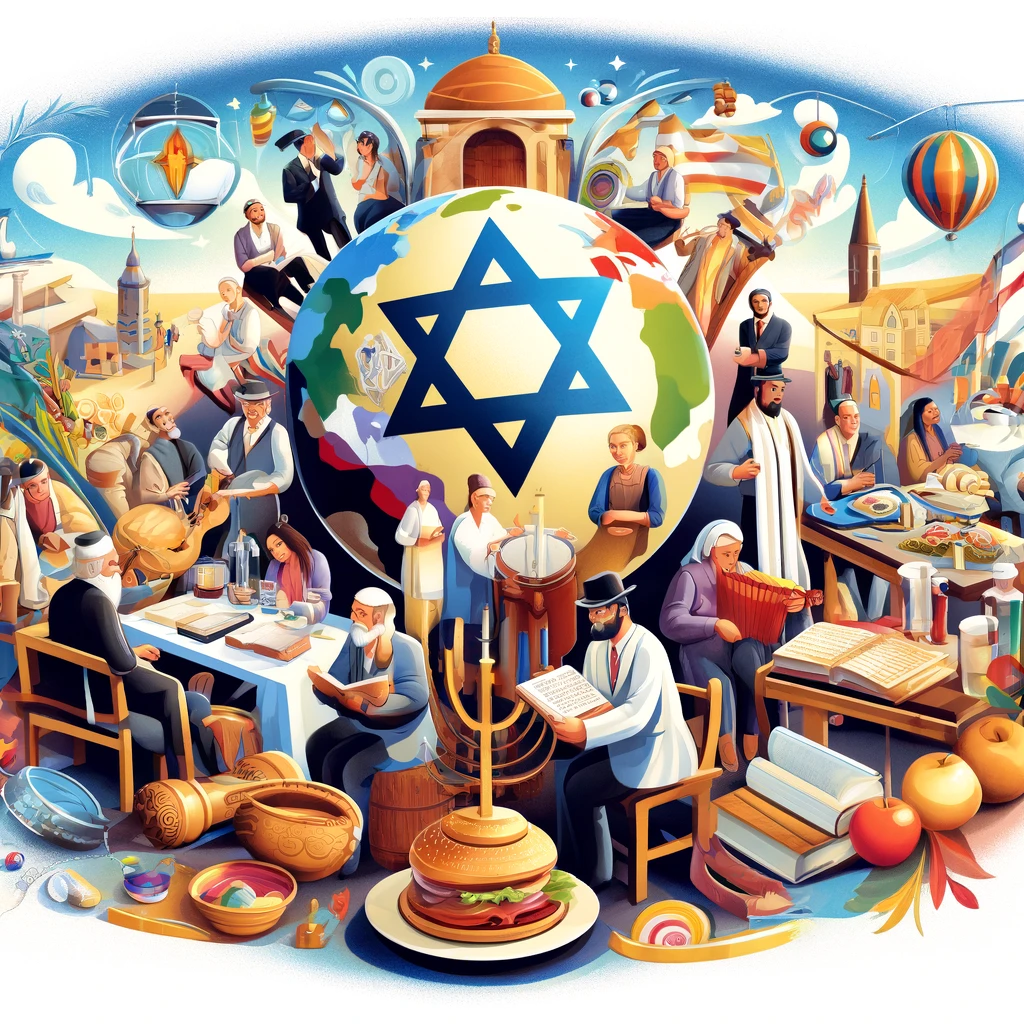
The Jewish Diaspora refers to the scattering of Jewish people outside their ancestral homeland, Israel, and its profound cultural impact throughout history. This migration is not just a story of movement but also of cultural resilience and adaptation. Jews have managed to maintain their cultural identity despite centuries of migration, influenced by, yet distinctly apart from, the cultures of their host countries.
Origins of the Jewish Diaspora
The beginnings of the Jewish Diaspora can be traced back to ancient times. The most significant early dispersal occurred in 586 BCE when the Babylonian conquest of Judah led to the exile of Jewish elites to Babylon. This event marked the first major spread of Jewish people outside their homeland, setting a pattern of migration and settlement that would define Jewish history. The destruction of the Second Temple by the Romans in 70 CE further dispersed Jewish communities throughout the Roman Empire, from North Africa to Europe and the Middle East.
Cultural Preservation through Religion
Religion played a central role in maintaining Jewish cultural identity. Jewish law, traditions, and customs provided a cohesive framework that helped sustain community life. The synagogue, evolving during the Diaspora as a place of worship, study, and social gathering, became a cornerstone of Jewish community life, replacing the Temple as the center of religious practice.
The practice of observing the Sabbath, keeping kosher dietary laws, and celebrating religious festivals such as Passover, Rosh Hashanah, and Yom Kippur helped to strengthen communal bonds and reaffirm Jewish identity. Moreover, the study of the Torah and Talmud enabled a continuation of religious and philosophical education, which has been pivotal in preserving the Jewish heritage.
Language as a Cultural Vessel
Language has been another vital element in the preservation of Jewish culture. Hebrew, the traditional language of the Jewish people, remained a liturgical language used in religious contexts. Yiddish, developed during the Middle Ages in Central Europe, became the everyday language for many Jews and carried with it a rich literary and cultural heritage. It encapsulated Jewish folklore, humor, and ethical teachings, becoming a significant expression of Jewish life in Eastern Europe.
In Sephardic communities, Ladino, a language derived from Old Spanish with influences from Hebrew, Arabic, and Turkish, played a similar role. These languages not only facilitated communication within Jewish communities but also served as a means of transmitting cultural values and traditions across generations.
Contributions to Host Societies
While maintaining their distinct identity, Jewish communities have also contributed significantly to the cultures of their host countries. In medieval Islamic Spain, Jewish scholars played a crucial role in the translation movement that helped preserve the philosophical and scientific knowledge of ancient Greece. In Eastern Europe, Jews contributed to the economic life as traders and artisans. In the United States, Jewish immigrants have had a profound impact on the cultural, scientific, and political fabric of the country.
Challenges and Resilience
The history of the Jewish Diaspora is not without its challenges. Jews have faced persecution and exclusion in many forms, from the Spanish Inquisition to the pogroms in Eastern Europe and the Holocaust. Despite these adversities, the Jewish community’s resilience has been remarkable. The establishment of the State of Israel in 1948 was a monumental moment, offering a homeland and refuge, though the Diaspora continues to thrive globally.
Modern Diaspora and Cultural Fusion
Today, the Jewish Diaspora remains vibrant, with major populations in the United States, France, Canada, and other countries around the world. These communities continue to preserve their heritage while also adapting to and influencing modern societal landscapes. The fusion of Jewish traditions with local customs has led to diverse cultural expressions, from Jewish-American literature to Israeli music that blends Western pop with Middle Eastern melodies.
The Jewish Diaspora exemplifies how a community can maintain its cultural essence while contributing richly to the global tapestry. Through centuries of migration, Jews have preserved their traditions and identity, demonstrating the power of cultural endurance and the importance of community in the face of change and adversity.

Intermarriage and Identity
One of the complex issues facing the Jewish Diaspora in modern times is intermarriage. As Jews have settled in various countries and become part of broader societies, intermarriage rates have increased, especially in places like the United States. This phenomenon has sparked discussions about Jewish identity and continuity. While some view intermarriage as a challenge to cultural preservation, others see it as an opportunity for renewal and growth within the community, promoting a more inclusive understanding of Jewishness.
Technology and Connectivity
In the age of technology, digital tools have played a crucial role in connecting Jewish communities worldwide. Online platforms, virtual synagogues, and educational resources have made it easier for Jews, especially younger generations, to engage with their culture, learn about their history, and connect with others across the Diaspora. This digital connectivity is particularly crucial for smaller communities that might not have access to extensive physical resources or large congregations.
Cultural Renaissance in the Arts
The Jewish Diaspora has also experienced a cultural renaissance in arts and media, with an increasing number of films, books, and music exploring Jewish themes and Diaspora experiences. This cultural output not only enriches the community internally but also serves as a bridge to non-Jewish audiences, promoting understanding and appreciation of Jewish culture and history.
For instance, Jewish film festivals around the world showcase films that explore the Jewish experience, contributing to a broader dialogue about identity, migration, and belonging. Similarly, Jewish literature continues to evolve, with authors drawing on diverse Diaspora experiences to enrich the global literary landscape.
Political Influence and Advocacy
Politically, Jewish communities in the Diaspora have organized to advocate for their rights and interests, both within their host countries and internationally. This includes support for Israel, efforts to combat antisemitism, and initiatives to influence policies that impact their communities. Through such advocacy, the Jewish Diaspora continues to play a significant role in international politics and Jewish communal life worldwide.
Preservation of Minor Jewish Cultures
Among the broader Jewish Diaspora, there are efforts to preserve the cultures of smaller, less well-known Jewish communities, such as the Beta Israel of Ethiopia or the Mountain Jews of the Caucasus. These groups have unique traditions and histories that are integral parts of the Jewish cultural mosaic. Preserving these cultures ensures that the full diversity of the Jewish experience is remembered and celebrated.
The Role of Museums and Cultural Institutions
Museums and cultural institutions also play a pivotal role in preserving and showcasing the history and culture of the Jewish Diaspora. Institutions like the Jewish Museum in Berlin and the Museum of Jewish Heritage in New York offer educational programs and exhibitions that depict the multifaceted nature of Jewish life and history. They serve as important resources for both Jews and non-Jews to learn about the complexities of Jewish migration, adaptation, and contribution to global cultures.
Conclusion
The Jewish Diaspora is a testament to the enduring spirit of a people who, despite countless challenges, have managed to preserve their cultural heritage and influence the world in myriad ways. From maintaining religious traditions to contributing to the arts and sciences, Jews around the world continue to celebrate their identity while adapting to and enriching their host societies. The story of the Jewish Diaspora is not just a historical narrative but a living, evolving dialogue about identity, resilience, and the universal quest for belonging.