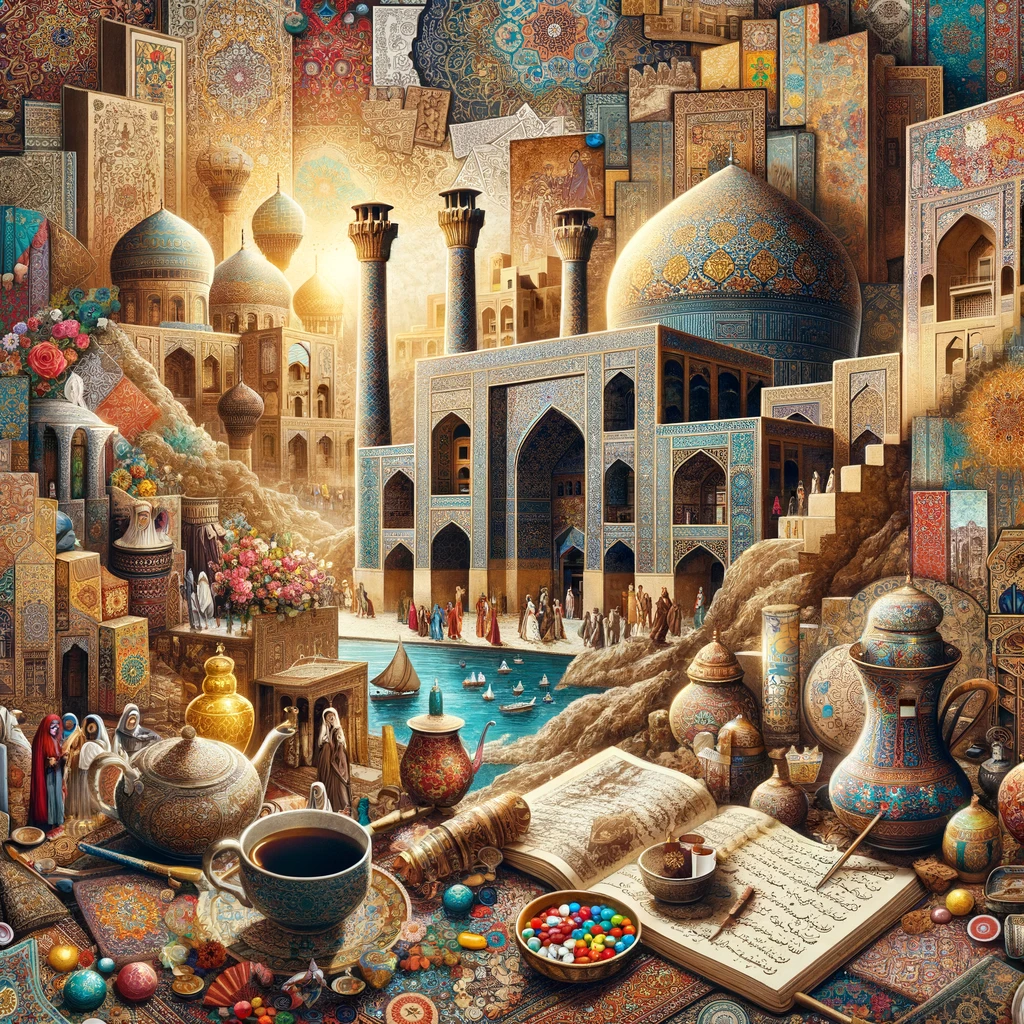
The tapestry of world cultures is vast and varied, with each thread representing the unique traditions, customs, and influences of different civilizations. Among these, Persian culture stands out as one of the most influential and enduring, its threads woven deeply into the fabric of global history. This article aims to explore the extensive reach of Persian culture, moving beyond the borders of modern-day Iran to understand its impact on the world.
The Historical Spread of Persian Culture
The Achaemenid Empire: Seeds of Cultural Exchange
Persian culture began to spread globally during the Achaemenid Empire (550–330 BC), one of the largest empires in ancient history. Under rulers like Cyrus the Great and Darius I, the empire expanded, encompassing parts of Asia, North Africa, and Europe. This expansion facilitated cultural exchange, spreading Persian art, architecture, and customs far and wide. Key aspects such as Zoroastrianism, the Persian language (Old Persian), and administrative practices left lasting impacts on the regions under Persian rule.
The Silk Road: A Conduit for Cultural Interaction
The Silk Road, a network of trade routes connecting East and West, was instrumental in the further dissemination of Persian culture. Persian cities like Ctesiphon and Isfahan became cultural and commercial hubs, where ideas, goods, and traditions were exchanged. Persian rugs, textiles, and crafts were highly sought after, and the Persian language became a lingua franca for traders. The influence of Persian poetry, music, and literature also spread along these routes, impacting neighboring cultures.
Persian Art and Architecture
Influences on Islamic and Western Art
Persian art and architecture have had a profound influence on Islamic art. The use of intricate geometric patterns, calligraphy, and detailed miniature paintings in Islamic art can be traced back to Persian artistic traditions. The iconic Islamic architectural elements like domes, minarets, and decorative tiles were also heavily influenced by Persian styles. In the Western world, Persian motifs and styles were introduced through the Crusades and later through trade, influencing European art, especially during the Renaissance.

The Legacy of Persian Gardens
The concept of the Persian garden, known as ‘Paradise Garden,’ has been a significant cultural export. These gardens, characterized by their quadrilateral design, water features, and lush vegetation, have influenced garden designs across the world, from the Moorish gardens in Spain to the Mughal gardens in India.
The Influence of Persian Literature
The Global Reach of Persian Poetry
Persian literature, especially poetry, has had a global impact. Poets like Rumi, Hafez, and Omar Khayyam are renowned worldwide for their profound and timeless works. Rumi’s mystical poetry, which combines spirituality and philosophical themes, has found a global audience and is especially popular in the Western world. The works of Hafez, with their themes of love, spirituality, and protest against religious hypocrisy, have influenced writers and poets across cultures.
The Epic of Shahnameh
Another monumental work is the Shahnameh (The Book of Kings) by Ferdowsi. This epic poem, which recounts the history of Persia from mythical beginnings to the Islamic conquest, has not only been pivotal in preserving the Persian language and cultural identity but also has influenced storytelling and literary traditions in neighboring regions.
Persian Language and Education
The Role of Persian in the Islamic Golden Age
During the Islamic Golden Age, the Persian language played a crucial role in the preservation and dissemination of knowledge. Many scientific, philosophical, and literary works were written in Persian, which became a language of scholarship and administration throughout the Islamic world. This era saw the translation of Greek and Roman texts into Persian, which later facilitated their transmission to Europe, aiding the Renaissance.
Contemporary Persian Language Influence
Today, the Persian language continues to influence many languages in Central Asia, the Middle East, and South Asia. The modern Persian language, Farsi, is not only spoken in Iran but also in parts of Afghanistan (Dari) and Tajikistan (Tajik), with significant Persian-speaking communities around the world.
Persian Cuisine and Festivals
Culinary Influence
Persian cuisine, known for its rich flavors and diverse dishes, has influenced Middle Eastern, Central Asian, and South Asian cuisines. Ingredients like saffron, pomegranates, and various nuts used in Persian cooking are now staples in many regional cuisines. Dishes such as kebabs, pilafs, and stews have been adopted and adapted across these regions.
Celebrations and Traditions
Persian festivals like Nowruz (the Persian New Year) are celebrated beyond Iran’s borders, in countries with historical Persian influence. Nowruz, marked by the arrival of spring, is recognized by UNESCO as an intangible cultural heritage and is celebrated globally, symbolizing themes of renewal and rejuvenation.
The legacy of Persian culture extends far beyond the geographical boundaries of Iran, influencing art, literature, architecture, language, and more globally. Its rich and diverse history has interwoven with the cultures of many nations, leaving a lasting imprint on the tapestry of human civilization. Understanding the depth and breadth of Persian culture’s influence helps us appreciate the interconnectedness of our global cultural heritage.
The Global Impact of Persian Philosophy and Religion
Zoroastrianism’s Influence
Zoroastrianism, an ancient Persian religion, has significantly influenced other major world religions, including Judaism, Christianity, and Islam. Concepts such as the dualistic nature of good and evil, the final judgment, and the idea of a savior can be traced back to Zoroastrian beliefs. The religion’s emphasis on moral choice and individual responsibility has had a profound philosophical impact, shaping ethical frameworks in various cultures.
Sufism and Persian Mysticism
Persian influence is also evident in the realm of Islamic mysticism or Sufism. Many prominent Sufi saints and poets were of Persian origin, and their teachings blended Islamic concepts with traditional Persian spirituality. This synthesis has contributed to a unique strand of spiritual thought that has attracted followers worldwide, transcending religious and cultural boundaries.
Persian Influence in Science and Technology
Contributions to Medicine, Astronomy, and Mathematics
During the Islamic Golden Age, Persian scholars made significant contributions to science and technology. Figures like Avicenna (Ibn Sina) and Al-Biruni were instrumental in the fields of medicine, astronomy, and mathematics. Avicenna’s ‘Canon of Medicine’ was a standard medical text in Europe for centuries. Persian mathematicians like Khayyam contributed to the development of algebra and also made advancements in calendar calculations.
Architectural Engineering and Innovations
Persian architectural engineering, such as the design of qanats (underground irrigation channels) and wind-catchers for cooling buildings, demonstrate the ingenuity of Persian science. These innovations not only shaped the infrastructure in regions under Persian influence but also informed architectural practices in other parts of the world.
Persian Cultural Resilience and Adaptation
The Role of the Persian Diaspora
The Persian diaspora has played a crucial role in spreading and preserving Persian culture globally. From the early Islamic era to modern times, Persian communities established in various parts of the world have acted as cultural ambassadors, promoting Persian art, music, literature, and culinary traditions. This diaspora has been instrumental in creating cultural dialogues and fostering understanding between different peoples.
Adaptation and Syncretism
One of the remarkable aspects of Persian culture is its ability to adapt and synthesize with other cultures. Throughout history, Persian culture has shown a unique flexibility, absorbing elements from other civilizations and integrating them into its own. This syncretism is evident in Persian art, architecture, and language, reflecting a rich tapestry of diverse influences.
Contemporary Global Presence of Persian Culture
Modern Art and Cinema
In contemporary times, Persian art and cinema have gained international recognition. Iranian filmmakers like Abbas Kiarostami and Asghar Farhadi have received global acclaim, showcasing the richness and complexities of Iranian society and culture. Their work has opened windows into contemporary Persian life, bridging cultural gaps and challenging stereotypes.
Persian Literature and Translation
The translation of Persian literature into various languages has continued to introduce Persian cultural narratives to a global audience. Contemporary Persian writers and poets, both within Iran and in the diaspora, have gained international readerships, reflecting the ongoing vitality and relevance of Persian literary traditions.
Conclusion
The cultural heritage of Persia is not confined to the borders of Iran but is a global legacy. Its rich and varied contributions to art, literature, philosophy, science, and spirituality have shaped and enriched world cultures. Understanding the depth of Persian culture’s influence reminds us of the interconnected nature of human history and the shared cultural foundations upon which our diverse societies are built. As we continue to explore and celebrate this heritage, we contribute to a richer, more inclusive understanding of the world’s cultural tapestry.