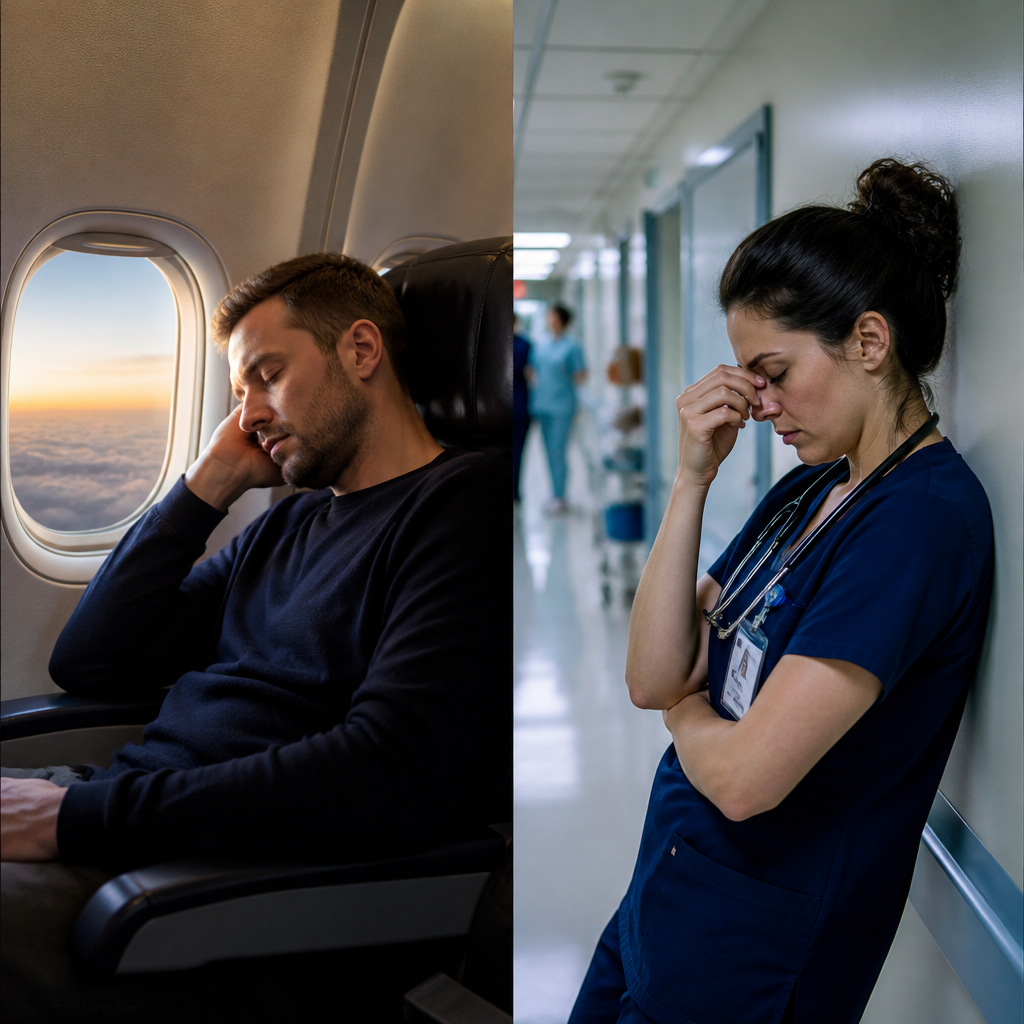
States of consciousness include waking awareness, sleep, dreaming, hypnosis, meditation, psychoactive drug effects, and altered patterns of attention, but one of the most practical ways to understand this AP Psychology topic is to compare two common disruptions of consciousness: jet lag and shift work. Both conditions disturb circadian rhythms, the roughly twenty four hour biological cycles that regulate sleep, body temperature, hormone release, alertness, and appetite. In class, students often hear that circadian disruption makes people tired and unfocused. That is true, but it is incomplete. Jet lag and shift work are not interchangeable problems, and treating them as the same misses important differences in cause, duration, physiology, and psychological impact.
Circadian rhythms are coordinated by the suprachiasmatic nucleus, a cluster of neurons in the hypothalamus that acts as the brain’s master clock. Light detected by the retina helps reset this clock each day, which is why sunlight has such a strong effect on sleep timing and daytime alertness. Sleep itself is controlled by both circadian timing and sleep pressure, the homeostatic drive that builds the longer a person stays awake. When these systems align, consciousness during the day is stable and sleep at night is restorative. When they misalign, people experience insomnia, fatigue, reduced concentration, irritability, slower reaction time, and changes in mood.
This distinction matters well beyond exam definitions. I have seen students, nurses, flight crews, and factory employees use the term “jet lag” for any tiredness tied to unusual hours, yet the biology tells a more precise story. A traveler crossing time zones faces a temporary mismatch between internal time and local clock time. A night shift worker faces a repeated social and occupational demand to stay awake and perform when the circadian system is promoting sleep. In psychology, that difference helps explain why one problem usually resolves in days while the other can persist for years. It also connects this hub topic to sensation and perception, learning, memory, health psychology, and research methods, because circadian disruption affects attention, emotional regulation, and performance in measurable ways.
As a hub for states of consciousness, this article also frames the broader subtopic. Sleep cycles, REM sleep, dreams, insomnia, sleep deprivation, parasomnias, meditation, and psychoactive substances all change subjective awareness and behavior through predictable physiological mechanisms. Jet lag and shift work offer a concrete entry point because they show how consciousness is shaped not just by willpower, but by timing systems in the brain and body. Once students grasp that principle, other altered states become easier to compare and analyze.
What jet lag is and why it happens
Jet lag is a circadian rhythm sleep wake disorder caused by rapid travel across multiple time zones. The body’s internal clock remains partly set to the departure location even after the person arrives somewhere else. A traveler who flies from New York to Paris may reach morning in France while the brain and body are still functioning as if it were the middle of the night in the United States. Common symptoms include difficulty falling asleep at local bedtime, early waking, daytime sleepiness, poor concentration, digestive discomfort, and lowered mood.
The central feature of jet lag is that the environment changes faster than the circadian system can adjust. The body cannot instantly shift melatonin secretion, cortisol timing, core body temperature rhythm, and patterns of alertness. In general, eastward travel is harder than westward travel because advancing the body clock usually requires falling asleep earlier, which is more difficult than delaying sleep. A common rule is that adjustment may take about one day per time zone crossed, though age, light exposure, timing of sleep, and individual chronotype all influence recovery.
Psychologically, jet lag disrupts attention and working memory, but it is usually short term. The person’s internal clock is trying to resynchronize to a stable new local time. Once the brain receives consistent time cues, especially morning or evening light at the correct phase, adaptation occurs. This temporary nature is the key reason jet lag differs from many other states of consciousness disturbances discussed in psychology. It is disruptive, but it is also typically self limiting.
How shift work disrupts consciousness differently
Shift work disorder develops when a person’s job schedule overlaps with the usual biological sleep period, especially in permanent night shifts, rotating shifts, early morning shifts, or unpredictable scheduling. Unlike jet lag, shift work does not require travel at all. The worker remains in one place, but occupational demands force wakefulness and high level performance at times when the circadian system is promoting sleep. Sleep often has to occur during the day, when light, noise, family obligations, and the body’s own alerting signals make restorative rest harder to obtain.
In practice, shift work is more chronic and often more damaging than jet lag. Hospitals, emergency services, aviation, manufacturing, logistics, and food production all rely on nonstandard schedules. Research from organizations such as the Centers for Disease Control and Prevention and the National Sleep Foundation has linked shift work to shortened sleep, increased accident risk, metabolic problems, cardiovascular strain, depressed mood, and impaired cognitive performance. Rotating shifts are especially difficult because the worker may begin to adapt to one schedule only to have it changed again.
The subjective experience also differs. A traveler with jet lag usually expects temporary discomfort. A night worker may function in a state of ongoing circadian misalignment for months or years, sometimes while trying to maintain a daytime social life on days off. That pattern creates what clinicians call social jet lag, a mismatch between biological timing and social schedules. In AP Psychology terms, shift work shows how environmental demands can repeatedly alter arousal, attention, and consciousness in ways that affect health and behavior.
Jet lag vs. shift work: the core differences
The simplest way to compare these conditions is to look at cause, duration, and whether the body has a stable target for adaptation. Jet lag follows rapid travel and usually improves as the internal clock resets to a new time zone. Shift work results from a recurring work schedule that often prevents full adaptation because the person moves between night duty, daylight exposure, and off day routines. Even a permanent night worker may not fully adjust if family life keeps pulling sleep and meals back toward daytime norms.
| Factor | Jet Lag | Shift Work |
|---|---|---|
| Primary cause | Crossing time zones rapidly | Working during the biological night |
| Main pattern | Temporary circadian misalignment | Repeated or chronic circadian misalignment |
| Typical duration | Days to about a week or more | Months to years if schedule persists |
| Adaptation target | New local clock time | Often unstable because work and social life conflict |
| East vs. west issue | Eastward travel usually harder | Direction less relevant than schedule timing and rotation |
| Common consequences | Sleepiness, insomnia, digestive upset, reduced focus | Chronic sleep debt, errors, health risk, mood strain |
This comparison clarifies a frequent exam confusion. Both involve circadian rhythms, but only jet lag depends on moving across time zones. Both impair consciousness, but shift work more often creates cumulative sleep debt because sleep opportunity is repeatedly shortened or fragmented. From a behavior standpoint, that makes shift work more closely tied to long term performance issues, while jet lag is a textbook example of temporary desynchronization.
Where this fits in the broader study of states of consciousness
AP Psychology treats states of consciousness as patterns of awareness shaped by biological rhythms, external stimulation, and internal mental processes. Normal waking consciousness depends on adequate arousal, selective attention, and efficient information processing. Sleep changes consciousness in organized stages, including REM sleep associated with vivid dreaming. Hypnosis and meditation alter attention and awareness without necessarily involving sleep. Psychoactive drugs modify perception, emotion, and cognition by changing neurotransmission. Jet lag and shift work belong in this unit because they demonstrate that consciousness can be altered simply by shifting when sleep occurs.
These disorders also connect with classic sleep concepts. The circadian process influences when sleep feels possible, while the homeostatic process reflects how long a person has been awake. A night worker may be exhausted from high sleep pressure after a long shift, yet still sleep poorly in daylight because circadian signals oppose sleep. A jet lagged traveler may lie awake at midnight local time because the body clock still interprets it as early evening. In both cases, consciousness is not controlled by choice alone; it is constrained by biological timing.
Dreaming and REM sleep can also be affected. When sleep is shortened or fragmented, REM timing may shift, and people often report vivid dreams during recovery sleep. Sleep deprivation, common in shift workers, impairs memory consolidation and emotional regulation. These are central psychological functions, which is why circadian disruption is not just a medical issue but a major topic in the science of behavior.
Real world effects on cognition, emotion, and safety
One reason this topic matters is that circadian disruption has measurable consequences in settings where errors carry high cost. Laboratory studies using psychomotor vigilance tests show that reaction time worsens when people are awake during the circadian low point, usually in the early morning hours. In hospitals, fatigue has been associated with medication errors and reduced attention. In transportation, drowsiness contributes to crashes, especially after overnight work or long haul travel. The Challenger disaster and the Exxon Valdez grounding are often discussed in human factors research partly because fatigue and schedule disruption can degrade decision making.
Emotion is affected too. Students pulling all nighters often become more irritable, less flexible, and more likely to misread social cues. Shift workers commonly report mood strain, lower motivation, and reduced patience, especially when chronic sleep loss combines with family demands. Jet lag can produce similar symptoms, but again, the pattern is usually shorter. From my experience teaching this material, students remember the difference better when they connect it to a simple question: is the brain trying to catch up to a new time zone, or is the schedule forcing the brain to fight its clock over and over?
Health effects extend beyond feeling tired. Chronic circadian disruption is associated with metabolic dysregulation, appetite changes, gastrointestinal complaints, and higher long term risk for some cardiovascular outcomes. That does not mean every night worker becomes ill, but it does mean the exposure is meaningful and cumulative.
Evidence based ways to reduce circadian disruption
Management strategies differ because the problems differ. For jet lag, timed light exposure is one of the strongest tools. Morning light can help advance the clock after eastward travel, while evening light can help delay the clock after westward travel. Short term melatonin, taken at the appropriate local time, may also help some travelers adjust. Strategic sleep scheduling, hydration, and limiting alcohol can reduce symptoms, though none of these instantly reset the body.
For shift work, the goal is often damage reduction rather than perfect adaptation. Bright light during the work period, dark sunglasses after the shift, blackout curtains, cool sleep environments, and strict protection of the daytime sleep window can improve sleep quantity. Employers can help by reducing quick turnarounds, limiting excessive overtime, and designing forward rotating shifts, moving from day to evening to night, which are usually easier than backward rotations. Caffeine can improve alertness temporarily, but it is not a substitute for sleep and can interfere with post shift rest if mistimed.
Students should remember one final principle: consciousness is biological, psychological, and social at once. Light, hormones, attention, motivation, and culture all shape when people sleep and how alert they feel. Jet lag and shift work make that principle visible. They show why the study of states of consciousness belongs at the center of psychology, not at its edges.
Jet lag and shift work both disrupt circadian rhythms, but they are not the same condition. Jet lag is a temporary mismatch created by rapid travel across time zones. Shift work is a recurring conflict between job demands and the body’s preferred sleep wake cycle. That difference explains why jet lag usually resolves with adaptation, while shift work often produces chronic sleep debt, performance problems, and broader health risks. For AP Psychology students, this comparison anchors the larger states of consciousness unit by linking sleep, attention, arousal, and behavior to the brain’s timing systems.
The bigger lesson is that consciousness is dynamic. Waking focus, sleep quality, dreaming, mood, and cognitive control all change when circadian rhythms are shifted or ignored. Understanding the role of the suprachiasmatic nucleus, light exposure, homeostatic sleep pressure, and environmental scheduling makes other topics in this unit easier to master, including REM sleep, sleep disorders, hypnosis, meditation, and psychoactive drugs. In each case, altered consciousness reflects identifiable mechanisms rather than mystery.
If you are building your understanding of psychology, use this article as your starting hub for states of consciousness, then continue into connected topics such as sleep stages, dreaming, sleep deprivation, and circadian rhythm disorders. The more clearly you distinguish jet lag from shift work, the more confidently you can explain how biological rhythms shape behavior every day.
Frequently Asked Questions
What is the main difference between jet lag and shift work as types of circadian disruption?
The biggest difference is that jet lag is usually caused by rapid travel across time zones, while shift work is caused by regularly being awake, alert, and productive at times when the body is biologically prepared for sleep. In jet lag, the internal clock is temporarily out of sync with the local clock. A person may arrive in a new place where it is morning or evening, but their brain and body are still operating on the schedule of the departure location. This creates a short-term mismatch between internal circadian timing and the external environment. With time, most travelers gradually adjust.
Shift work is different because the conflict is often ongoing rather than temporary. A person working overnight, rotating shifts, or very early morning schedules may repeatedly force their body to stay awake during its biological night and sleep during its biological day. That is harder because social life, daylight exposure, meals, family routines, and noise levels often keep pulling the person back toward a typical daytime pattern. In other words, jet lag usually reflects a disrupted transition to a new time zone, whereas shift work often reflects a chronic struggle between biological rhythms and job demands. In AP Psychology terms, both involve circadian rhythm disruption, but the source, duration, and pattern of misalignment are not exactly the same.
Why does jet lag usually improve after a few days, while shift work can remain a long-term problem?
Jet lag often improves because the body’s circadian system can slowly reset itself to the new local time. Exposure to light, changes in meal timing, social cues, and sleep schedules all help the suprachiasmatic nucleus, the brain’s primary biological clock, shift its timing. Although the adjustment is not instant, many people gradually adapt over several days, especially if they stay in the new time zone long enough. The body begins releasing hormones, changing body temperature, and promoting sleepiness at more appropriate local times.
Shift work can be much more persistent because full circadian adaptation often does not happen. A night-shift worker may try to sleep during the day, but bright daylight, household responsibilities, errands, and social expectations make daytime sleep shorter and lighter. Then on days off, many workers return to a more typical daytime routine so they can participate in normal family and social activities. That constant switching prevents the circadian system from settling into one stable pattern. As a result, the worker may experience chronic sleep debt, reduced alertness, and ongoing fatigue. This is why shift work is frequently discussed not just as a sleep inconvenience, but as a significant long-term challenge to health, performance, and overall functioning.
How do jet lag and shift work affect attention, mood, and performance?
Both jet lag and shift work can impair consciousness in ways that are highly relevant to psychology. Because circadian rhythms help regulate alertness, reaction time, and mental efficiency, disruptions can make a person feel mentally foggy, irritable, unfocused, or unusually sleepy. With jet lag, common effects include difficulty concentrating, slower thinking, reduced memory performance, low motivation, and feeling “off” at odd times of day. Someone may be trying to function in class, at work, or in a social setting while their body still “thinks” it is the middle of the night.
Shift work can produce many of the same symptoms, but often with greater repetition and stronger consequences. Working during the biological night tends to lower vigilance and increase the likelihood of lapses in attention, microsleeps, mistakes, and slower decision-making. Mood can also suffer. Chronic circadian disruption is associated with irritability, stress, lower emotional regulation, and sometimes symptoms of anxiety or depression. In practical terms, this matters because tasks that require sustained attention, such as driving, monitoring equipment, studying, or making safety decisions, become harder when the circadian system is fighting the schedule. For AP Psychology students, this is a useful example of how biological rhythms influence everyday consciousness, not just sleep itself.
Are the health consequences of jet lag and shift work equally serious?
They are not usually equal in severity. Jet lag is often unpleasant, but for most healthy people it is temporary. Symptoms may include poor sleep, digestive upset, daytime tiredness, irritability, and reduced performance, but these effects generally fade as the body clock aligns with the new time zone. Short trips can still be exhausting, especially if someone has to perform at a high level immediately after arrival, but the condition itself is typically short-lived.
Shift work can carry broader and more serious long-term risks because the disruption is often repeated over months or years. Chronic circadian misalignment has been linked to ongoing sleep loss, fatigue, metabolic problems, digestive issues, reduced immune functioning, and elevated risk for accidents. Researchers also study connections between long-term shift work and cardiovascular strain, mood disorders, and other health concerns. The reason the risks are greater is not simply that people are tired; it is that multiple body systems depend on regular timing. Sleep, hormone release, appetite, body temperature, and cellular repair all work best when synchronized. When a person repeatedly lives against their internal clock, the entire rhythm of the body can become harder to regulate.
What are the best ways to reduce the effects of jet lag and shift work?
For jet lag, one of the most effective strategies is to use light exposure intentionally, since light is the strongest cue for resetting the circadian clock. Getting bright light at the right local time can help the body adapt more quickly, while avoiding bright light at the wrong time may reduce confusion for the internal clock. Gradually shifting sleep and wake times before travel, staying hydrated, timing meals consistently, and allowing for recovery sleep can also help. Some people use melatonin strategically, though timing matters and it is most helpful when matched to the direction of travel and the desired sleep schedule.
For shift work, the goal is often not perfect adaptation, but damage control and better alignment where possible. Keeping a more consistent sleep schedule, even on days off, can help some workers reduce constant circadian switching. Wearing dark glasses on the way home after a night shift, using blackout curtains, reducing noise, and protecting a daytime sleep period can improve sleep quality. Planned naps and carefully timed caffeine may help with alertness, though they do not replace real sleep. Workplaces can also help by designing safer schedules, limiting rapid shift rotations, and recognizing that overnight performance naturally declines during the biological night. In both cases, the key psychological principle is the same: human consciousness and performance are deeply shaped by biological timing, and the closer behavior is aligned with that timing, the better people tend to feel and function.