
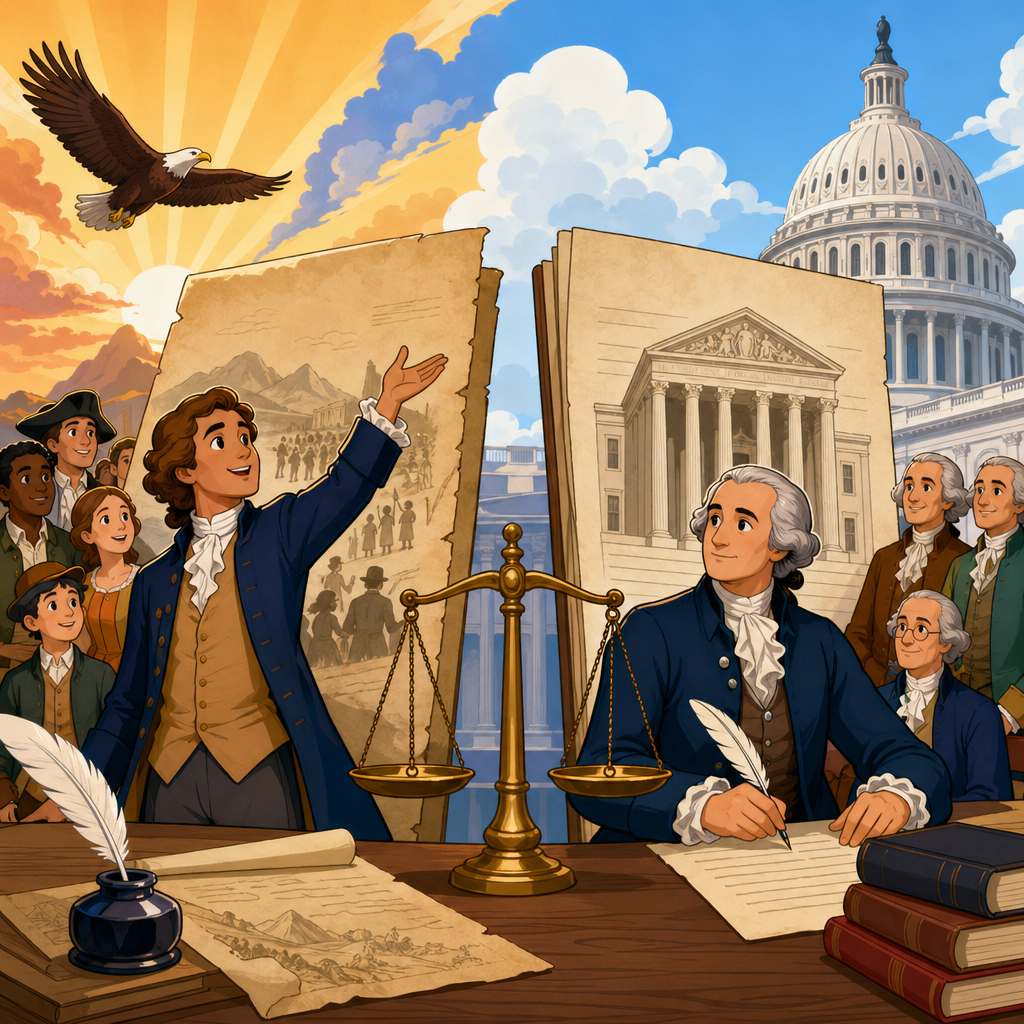
The Declaration of Independence and the Constitution are the two founding texts most often paired in AP Government and Politics, yet they do different jobs: one announces principles, the other builds a governing system. Students often blur them together because both emerged from the Revolutionary era and both shaped the United States permanently. In practice, though, the Declaration explains why the colonies separated from Britain, while the Constitution explains how power would be organized after independence. Understanding the difference between ideals and institutions is essential for mastering American political development, constitutional interpretation, civil liberties debates, and the logic behind later reforms.
The Declaration of Independence, adopted on July 4, 1776, is primarily a statement of political philosophy and a formal justification for revolution. Drafted chiefly by Thomas Jefferson and edited by the Second Continental Congress, it argues that legitimate government rests on consent and that people possess natural rights, including “Life, Liberty and the pursuit of Happiness.” The Constitution, written in 1787 and ratified in 1788, is a legal framework for national government. It establishes Congress, the presidency, the federal judiciary, federalism, the amendment process, and the relationship between national and state power. If the Declaration answers the question “Why should a people govern themselves?” the Constitution answers “How should that self-government actually work?”
This comparison matters because many recurring AP Government questions turn on the tension between aspiration and design. The United States celebrates equality and liberty as founding ideals, but it governs through procedures, offices, elections, courts, and compromises. I have seen students improve quickly when they stop treating the founding documents as interchangeable and begin reading each one for its actual purpose, audience, and legal force. That distinction clarifies later topics such as the Bill of Rights, judicial review, civil rights movements, the expansion of suffrage, and disputes over executive power. It also helps explain why Americans still quote the Declaration in moral arguments, while courts and public officials rely on the Constitution in legal arguments.
Different Purposes at the Founding
The Declaration and the Constitution emerged from related but distinct political crises. In 1776, colonial leaders needed to unify support for independence, persuade undecided Americans, and signal legitimacy to foreign powers such as France. The Declaration served all three functions. Its long list of grievances against King George III was not decorative; it was evidence intended to show that the British government had violated the colonists’ rights and broken the political relationship. The document therefore works like an indictment combined with a philosophical manifesto.
By contrast, the Constitution came after independence had already been won and after the Articles of Confederation had exposed serious weaknesses. The national government lacked reliable taxing authority, interstate disputes were difficult to manage, and collective action was often slow. Events such as Shays’ Rebellion in 1786–1787 convinced many leaders that the existing system could not maintain order or support national survival. The Constitution’s purpose was not to justify rebellion but to solve governance problems. It was designed to create a stronger national structure without recreating the centralized tyranny Americans associated with monarchy and parliamentary overreach.
That distinction between justification and construction is the clearest starting point for any comparison. The Declaration is outward facing and argumentative. The Constitution is inward facing and operational. One declares independence from an existing regime; the other allocates powers inside a new regime. When teachers ask which document has direct legal authority today, the answer is the Constitution. When they ask which document expresses the nation’s foundational creed, the answer is usually the Declaration.
Ideas in the Declaration: Natural Rights, Equality, and Consent
The Declaration’s most enduring contribution is its language of universal principles. Jefferson drew heavily from Enlightenment thought, especially John Locke’s theory that people possess natural rights and that governments exist to secure them. The phrase “all men are created equal” did not describe social reality in 1776; slavery, disenfranchisement, and legal inequality were widespread. Its importance lies in setting a standard against which future generations could judge American institutions. Frederick Douglass, Abraham Lincoln, Elizabeth Cady Stanton, Martin Luther King Jr., and many others treated the Declaration as a promissory statement that the nation had not yet fully honored.
Consent of the governed is another central idea. In the Declaration, political legitimacy comes from the people rather than hereditary rule. That claim rejected monarchy and implied that government can be altered when it becomes destructive of rights. This is the core revolutionary principle: sovereignty originates below, not above. In AP Government terms, the Declaration introduces popular sovereignty in moral and philosophical language before the Constitution embeds it institutionally through elections and ratification.
The Declaration also contains a right of revolution, but students should understand the nuance. It does not encourage constant upheaval. Jefferson writes that prudence counsels against changing governments for “light and transient causes.” Only a long train of abuses justifies revolution. That careful phrasing matters because it shows the founders were not endorsing instability; they were defending resistance to sustained tyranny. The document therefore balances liberty with political seriousness.
Institutions in the Constitution: Structure, Power, and Limits
The Constitution is fundamentally about architecture. It begins with popular authority in the preamble, then translates theory into institutions. Article I creates Congress, Article II creates the presidency, and Article III creates the judiciary. The framers separated powers because they believed concentrated power threatened liberty. They also used checks and balances so that each branch could restrain the others. Congress passes laws, but the president can veto them. The president appoints judges and officials, but the Senate confirms many appointments. Courts interpret laws, but judges themselves are appointed through political institutions.
Federalism is another essential constitutional design feature. The Constitution divides authority between national and state governments. This addressed a real founding dilemma: Americans wanted national capacity for defense, commerce, and diplomacy, yet they remained attached to state autonomy. The Supremacy Clause, Necessary and Proper Clause, and Commerce Clause all strengthened national authority, while the Tenth Amendment later reinforced that powers not delegated to the United States are reserved to the states or the people. Much of American politics since 1789 has involved contesting where that line should be drawn.
The Constitution also includes mechanisms for stability and adaptation. Terms of office, regular elections, and enumerated powers create predictability. Article V allows amendment, though deliberately through a demanding process. That design has allowed change without repeated constitutional collapse. The addition of the Bill of Rights in 1791, the Reconstruction Amendments after the Civil War, and later amendments expanding democratic participation show how institutions can evolve while remaining within a constitutional framework.
How the Two Documents Compare
The easiest way to compare the Declaration of Independence and the Constitution is to look at their role, audience, and authority side by side.
| Feature | Declaration of Independence | Constitution |
|---|---|---|
| Primary purpose | Justify separation from Britain | Create a national government |
| Date | 1776 | 1787, ratified 1788 |
| Main focus | Rights, equality, consent, grievances | Institutions, powers, procedures, limits |
| Legal force today | Symbolic and philosophical | Supreme law of the land |
| Key language | Natural rights and revolution | Separation of powers and federalism |
| Typical modern use | Moral argument and civic ideals | Litigation, legislation, governance |
For exam purposes, remember that the Declaration does not establish the three branches, create the electoral system, or define judicial power. Those are constitutional functions. Likewise, the Constitution does not prominently proclaim natural rights in the Declaration’s style, although rights language enters more directly through the Bill of Rights and later amendments. The documents are connected, but they are not duplicates.
Tensions, Contradictions, and Historical Change
The most important historical insight is that American ideals and American institutions did not fully align at the founding. The Declaration’s equality claim coexisted with slavery, limited suffrage, and the exclusion of women from formal political participation. The original Constitution reflected compromise rather than pure principle. It counted enslaved persons through the Three-Fifths Compromise for representation, protected the continuation of the international slave trade until 1808, and contained no initial bill of rights. These are not minor details; they show that institutions often lag behind declared ideals.
At the same time, the language of the Declaration became a powerful tool for reformers pressing institutions to change. Lincoln repeatedly treated the Declaration as the moral anchor of the republic, especially in debates over slavery’s expansion. In the Gettysburg Address, he described the nation as “conceived in Liberty, and dedicated to the proposition that all men are created equal,” linking the Civil War to the unresolved promise of 1776. After the war, the Thirteenth, Fourteenth, and Fifteenth Amendments moved constitutional institutions closer to the Declaration’s equality principle, though enforcement remained inconsistent for generations.
The same pattern continued in women’s rights and civil rights movements. The Seneca Falls Declaration of Sentiments in 1848 deliberately echoed Jefferson’s wording. In the twentieth century, civil rights leaders invoked both documents: the Declaration for moral legitimacy and the Constitution, especially the Equal Protection Clause, for legal remedies. That dual strategy remains common. Activists appeal to founding ideals to persuade the public, then rely on constitutional mechanisms to produce enforceable change.
Why This Comparison Matters in AP Government and Politics
In AP Government and Politics, this topic is a hub because it connects to foundational documents, American political culture, institutions of national government, civil rights, and political ideology. A strong answer on an exam usually identifies the Declaration as a source of political philosophy and the Constitution as a source of governing authority. It then explains how later amendments, court decisions, and social movements narrowed the gap between the two.
Students should also be ready for common misconceptions. First, the Declaration is not legally binding in the same way as the Constitution. Courts do not treat it as an operative statute or constitutional text. Second, the Constitution did not emerge in a vacuum; it was influenced by fears rooted in the Revolutionary experience, including executive abuse, taxation disputes, and arbitrary power. Third, the Bill of Rights is part of the constitutional system, not part of the Declaration. Keeping those categories clear improves both multiple-choice accuracy and free-response precision.
As a sub-pillar hub for miscellaneous AP Government topics, this comparison opens doors to related articles on the Articles of Confederation, Federalist and Anti-Federalist debates, the Bill of Rights, constitutional amendments, landmark Supreme Court cases, civil liberties, civil rights, and democratic participation. Read those topics with one guiding question in mind: is the issue primarily about national ideals, institutional design, or the friction between them?
The Declaration of Independence and the Constitution are best understood as complementary rather than competing texts. The Declaration states the nation’s moral purpose: human equality, natural rights, government by consent, and the legitimacy of resistance to tyranny. The Constitution supplies the machinery: representative institutions, separated powers, federalism, lawmaking procedures, and rules for change. One gives the United States its creed; the other gives it a system.
Their relationship explains much of American history. When institutions fail to reflect professed ideals, citizens, movements, and leaders invoke the Declaration’s principles to demand reform. When those demands are translated into lasting policy, amendments, court decisions, and legislation, they operate through the Constitution. That is why both documents remain central in classrooms, courtrooms, political speeches, and civic memory. They answer different questions, but together they define the American experiment.
For AP Government and Politics, remember the simplest formula: the Declaration tells you why the United States claimed the right to exist, and the Constitution tells you how the United States governs. Master that distinction, then trace how later developments tried to bring institutions closer to ideals. If you are building your understanding of this miscellaneous subtopic, use this article as your starting point and continue to connected topics that show how founding principles became living government.
Frequently Asked Questions
What is the main difference between the Declaration of Independence and the Constitution?
The simplest way to understand the difference is this: the Declaration of Independence explains why the American colonies chose to break from Britain, while the Constitution explains how the new United States government would actually work. The Declaration, adopted in 1776, is a statement of political philosophy and justification. It argues that people have natural rights, that governments derive their power from the consent of the governed, and that the colonies were justified in separating from a king who had violated those principles. The Constitution, written in 1787 and ratified in 1788, is a framework for governing. It establishes the legislative, executive, and judicial branches, divides powers between national and state governments, and creates the procedures and institutions needed to make law and resolve disputes.
That difference is why these two documents are often described as representing “ideals and institutions.” The Declaration is centered on ideals such as liberty, equality, and popular sovereignty. The Constitution is centered on institutions such as Congress, the presidency, the courts, federalism, and checks and balances. Both are foundational, but they operate at different levels. One is a statement of principles and national purpose; the other is a practical blueprint for political order. Students in AP Government often connect them because both helped define the United States, but they should not be treated as interchangeable documents.
Why is the Declaration of Independence considered a statement of ideals rather than a plan for government?
The Declaration is considered a statement of ideals because its primary purpose was to justify independence and articulate the principles behind that decision, not to create a functioning system of government. Thomas Jefferson and the other founders used the document to explain to both domestic and international audiences that the colonies were not rebelling randomly or selfishly. Instead, they claimed to be acting according to universal political principles: that all people possess certain unalienable rights, that governments are created to protect those rights, and that when a government becomes destructive of those ends, the people may alter or abolish it.
Although the Declaration has immense political and moral importance, it does not establish branches of government, define official powers, create courts, provide election rules, or describe how laws should be passed. In other words, it offers a philosophy of legitimate government, but not the machinery of government itself. That is why it has such enduring influence in American political culture. Its language has been repeatedly invoked by reformers, abolitionists, suffragists, civil rights leaders, and others seeking to hold the United States accountable to its founding promises. The Declaration’s power lies less in legal structure and more in moral aspiration. It sets out what government ought to respect, even though it does not specify exactly how a government should be organized to do so.
How does the Constitution turn founding ideals into actual institutions?
The Constitution takes broad revolutionary principles and translates them into a workable governing system. If the Declaration says that government must rest on the consent of the governed and exist to protect liberty, the Constitution asks a harder question: what kind of institutional design can preserve liberty without collapsing into disorder or concentrating power too heavily in one place? The founders answered that question by creating a republic with separated powers, checks and balances, federalism, and regular elections. These mechanisms were meant to channel political conflict through law rather than force.
For example, instead of placing all authority in a single body, the Constitution divides power among Congress, the president, and the federal courts. Congress makes laws, the president enforces them, and the judiciary interprets them. This structure reflects a deep suspicion of concentrated power. At the same time, the Constitution divides authority between the national government and the states, creating federalism. It also builds in amendment procedures so the system can change over time without requiring revolution. Later additions, especially the Bill of Rights, further connected constitutional institutions to core liberties by limiting government action in areas such as speech, religion, due process, and criminal justice. In that sense, the Constitution does not replace founding ideals; it operationalizes them through durable political institutions.
Why do students and readers often confuse the Declaration and the Constitution?
People often confuse the two documents because they are closely linked in American memory and are both treated as founding texts from the Revolutionary era. In classrooms, museums, and public discourse, they are frequently discussed together, and both are associated with the birth of the United States. That makes it easy to blur their separate roles. The language of freedom and rights found in the Declaration also shapes how Americans think about the Constitution, while the Constitution’s legal authority can make people assume that all famous founding language came from it. As a result, students sometimes incorrectly attribute phrases or purposes from one document to the other.
Another reason for the confusion is that both documents helped answer the same broad historical problem: how the colonies became a new nation. But they answered different parts of that problem at different times. The Declaration announced independence in 1776 and set out the justification for separation from Britain. The Constitution came later, after the weaknesses of the Articles of Confederation became clear, and focused on building a stronger national government. Understanding the sequence helps. First came the argument for independence and self-government; later came the design of a more effective political system. When seen in that order, the distinction becomes much clearer: the Declaration explains the nation’s principles of legitimacy, and the Constitution establishes the institutions through which those principles would be pursued.
Which document has greater legal force today: the Declaration of Independence or the Constitution?
The Constitution has far greater direct legal force today because it is the supreme law of the land. It creates the structure of the federal government, allocates powers, limits government action, and serves as the basis for judicial review and constitutional interpretation. Courts rely on the Constitution, its amendments, statutes, and precedents when deciding cases. The Declaration of Independence, by contrast, is not a governing charter in the same legal sense. It does not function as an operative legal code for allocating authority or resolving most constitutional disputes.
That said, it would be a mistake to say the Declaration is unimportant in law and politics. Its influence is enormous, but it is typically moral, philosophical, and interpretive rather than directly enforceable. The Declaration’s principles have shaped constitutional arguments about equality, rights, and legitimate government. Its ideas have informed political movements and helped frame national debates about whether American institutions are living up to their founding commitments. So if the question is which document governs public institutions on a daily basis, the answer is the Constitution. If the question is which document supplies the deepest statement of American political ideals, the Declaration remains indispensable. Together, they help explain not only how the United States is governed, but also what those institutions are supposed to serve.