
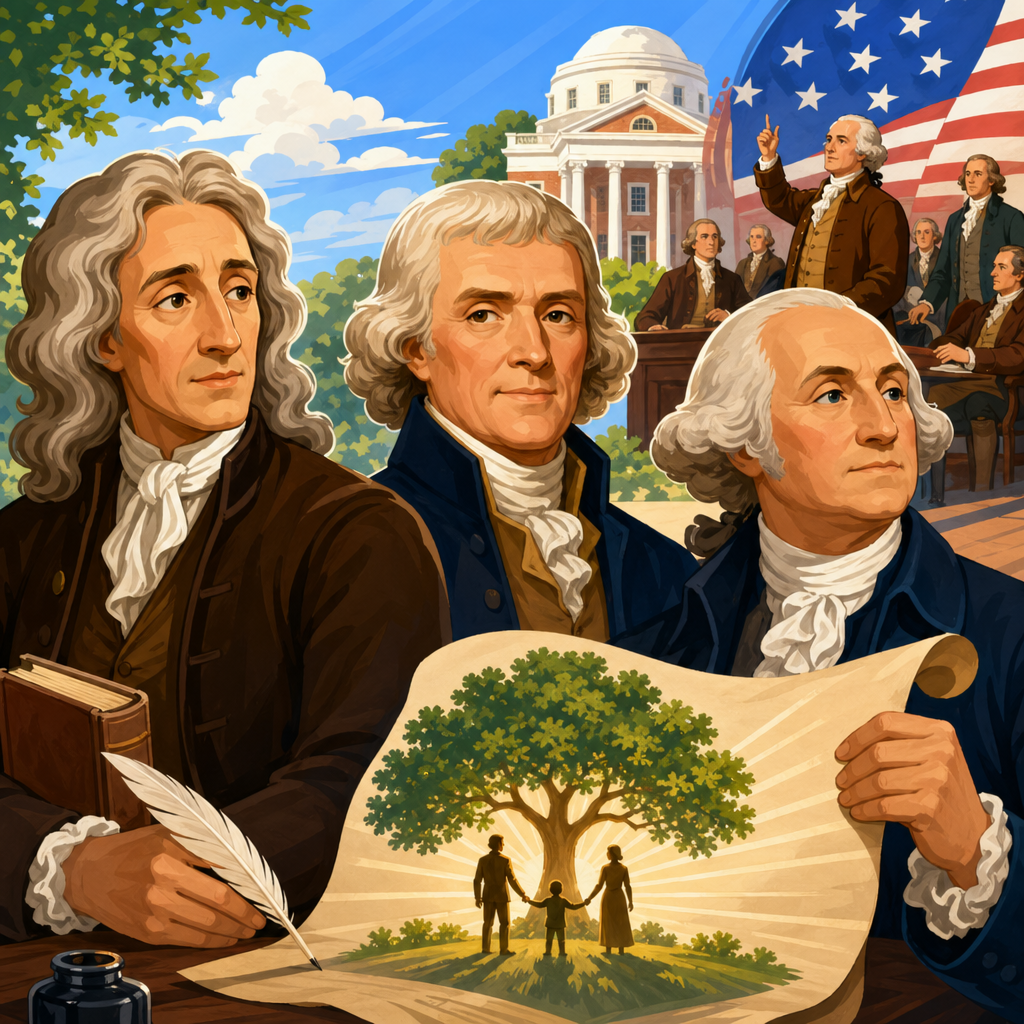
Natural rights theory sits at the center of American government because it explains why government exists, what limits its power, and when citizens may rightly resist it. In AP Government and Politics, students encounter the idea repeatedly: in the Declaration of Independence, in debates over constitutional design, in struggles over voting and equality, and in modern arguments about liberty. The basic claim is straightforward. Human beings possess certain rights by nature, not because a ruler grants them. Government is legitimate only when it protects those rights through laws made with consent. When I teach this topic, I begin there, because the rest of the founding era makes far more sense once that core principle is clear.
Natural rights theory is most closely associated with John Locke, the seventeenth-century English philosopher whose political writings shaped American revolutionary thought. Locke argued that people in a state of nature are free and equal, with rights to life, liberty, and property. They form governments through a social compact to secure those rights more effectively. Thomas Jefferson adapted that language in the Declaration, famously writing that all men are created equal and endowed with unalienable rights, including life, liberty, and the pursuit of happiness. That sentence did not create American ideals from nothing. It distilled a larger intellectual tradition into a political justification for independence.
This matters because the American founding was not only a break from Britain; it was an argument about the source of political authority. If rights come from government, then government may redefine or remove them at will. If rights preexist government, then constitutions, courts, and elected officials are judged by whether they protect what people already possess. That distinction still shapes disputes over free speech, religious liberty, due process, privacy, gun rights, and equal protection. Natural rights theory also explains tensions in American history. The nation proclaimed equality while tolerating slavery, excluding women from full citizenship, and limiting political participation. Understanding the theory helps students see both the promise of the founding and its profound contradictions.
As a hub within AP Government and Politics, this topic connects political philosophy to constitutional structure, civil rights, civil liberties, and democratic citizenship. It links the Declaration to the Constitution, the Bill of Rights, Federalist and Anti-Federalist debates, abolitionism, Reconstruction, and modern Supreme Court doctrine. The most useful way to study it is not as a dead philosophical idea but as a living standard Americans have used to justify revolution, reform, and legal change. Natural rights theory gave the founding generation a language of legitimacy. It also gave later generations a language to expose the ways the United States failed to live up to its own principles.
John Locke and the foundations of natural rights theory
Locke’s Second Treatise of Government provided the clearest framework the American founders drew upon. Writing in the aftermath of English political conflict, Locke rejected the idea that kings rule by divine right. He argued that legitimate government begins with free and equal individuals. In the state of nature, people are not without moral rules; they are governed by natural law, which teaches that no one ought to harm another in life, health, liberty, or possessions. Rights are therefore inherent. They are not permissions from a monarch. That premise was revolutionary because it placed the individual before the state in moral importance.
Locke also explained why government is necessary. Even if people have rights in the state of nature, enforcement is insecure. Individuals may be biased in their own cases, and conflicts can escalate. To solve that problem, people consent to establish government as an impartial authority. But the powers they grant are limited. Government exists to secure rights, not absorb them. If rulers become destructive of those ends, violate trust, or govern without consent, the people retain a right of revolution. This was not an abstract speculation for Americans in the 1760s and 1770s. It became the intellectual backbone of colonial resistance to taxation without representation, arbitrary administration, and military coercion.
Locke’s emphasis on property deserves special attention because it influenced American constitutional thinking deeply. For Locke, property included not only land and goods but also a person’s ownership in his own labor. By mixing labor with nature, individuals acquire property claims. The founders did not all interpret this identically, but they widely accepted that secure property was tied to liberty and independence. James Madison later wrote that government is instituted to protect property of every sort, including opinions and faculties. In practice, however, property rights in early America often benefited white male holders far more than others. That gap between principle and reality is one of the central themes students should track throughout this subtopic.
Jefferson, the Declaration of Independence, and the American adaptation
Jefferson did not simply copy Locke, but he clearly worked within Lockean assumptions. The Declaration opens with a universal claim: when a people dissolves political bonds, it should explain its reasons according to the laws of nature and of nature’s God. It then states that all men are created equal and endowed with unalienable rights. Jefferson’s substitution of the pursuit of happiness for property has been debated for generations. In my experience, the most defensible reading is that he broadened the idea of human flourishing without abandoning the importance of property. Happiness in eighteenth-century political thought referred not to pleasure but to well-ordered liberty, virtue, security, and the conditions for a good life.
The Declaration also translates natural rights theory into a test for government legitimacy. Governments derive their just powers from the consent of the governed. That phrase matters as much as the rights language. Consent does not require unanimous approval of every law, but it does require a political system grounded in representation rather than hereditary command. The long list of grievances against King George III is therefore more than rhetoric. It functions like evidence in a legal brief, showing repeated injuries and usurpations that prove tyranny. For AP Government students, this is a key point: the Declaration is not merely inspirational writing. It is a structured argument rooted in political theory.
Jefferson’s words quickly escaped the moment of independence and became a permanent standard. Abolitionists used the Declaration to attack slavery. Frederick Douglass exposed the hypocrisy of celebrating liberty in a slaveholding republic. Abraham Lincoln treated the Declaration as the moral foundation of the nation, arguing that the Constitution should be read in light of the principle that all are created equal. Women’s rights advocates at Seneca Falls modeled the Declaration in the Declaration of Sentiments. Modern movements for civil rights and equal dignity have done the same. That enduring power explains why this document matters beyond AP Government exams: it frames the American promise in language broad enough to challenge American injustice.
From philosophy to institutions: the Constitution and limited government
The Constitution does not repeat the Declaration’s natural rights language, yet it was designed in response to the same concerns about power, consent, and security. After independence, the Articles of Confederation created a weak national government that struggled to raise revenue, regulate commerce, and maintain order. The framers in 1787 sought a stronger structure, but they remained wary of concentrated authority. Their solution was constitutional design: separation of powers, checks and balances, federalism, and regular elections. These mechanisms are easier to understand when seen as institutional answers to a natural rights problem. If rights are prior to government, government must be both strong enough to protect them and restrained enough not to violate them.
Madison’s Federalist No. 10 and No. 51 are especially important here. He did not rely on the assumption that people or leaders would always be virtuous. Instead, he built a system around the reality of faction and ambition. A large republic would make oppressive majorities harder to form, while constitutional checks would pit power against power. This was a practical extension of the founding commitment to liberty. The Constitution’s framers knew that declarations of rights alone were insufficient. Institutions, incentives, and enforcement mechanisms matter. That is why AP Government students should connect natural rights theory not only to ideals but also to structure. Political philosophy shaped institutional engineering.
| Founding idea | Core meaning | Constitutional expression | Example in practice |
|---|---|---|---|
| Natural rights | Rights exist before government | Bill of Rights and due process limits | Protection for speech and religion against federal power |
| Consent of the governed | Legitimacy comes from the people | Elections and republican government | House members chosen directly by voters |
| Limited government | Power must be restrained by law | Enumerated powers and checks and balances | Congress passes laws, but courts review constitutionality |
| Right of resistance | People may oppose destructive rule | Amendment process and political accountability | Peaceful reform through elections, protest, and constitutional change |
The Bill of Rights, ratified in 1791, made the connection even clearer. Anti-Federalists had argued that the original Constitution lacked explicit protections for individual liberty. Federalists responded that the national government had only delegated powers, but political reality favored a bill of rights. The first ten amendments limit government in areas central to natural rights thought: speech, religion, press, assembly, due process, jury trial, security in person and property, and protection against cruel punishment. The Ninth Amendment is particularly revealing because it warns that listing some rights should not deny others retained by the people. That language reflects the founding assumption that rights are not exhausted by governmental text.
The contradictions of the founding and the expansion of rights
No serious study of natural rights theory in American government can ignore the founding era’s failures. The same political generation that declared universal equality tolerated human bondage on a vast scale. Enslaved people were denied the very rights the Declaration proclaimed. Native nations were treated as obstacles to expansion rather than equal communities with their own claims. Women were excluded from voting and from most formal political power. Property qualifications limited participation in many states. These were not minor inconsistencies. They exposed how often natural rights language was applied selectively, with race, sex, and status determining who counted fully within the political community.
Yet the theory itself became a tool for criticism and reform. That is one reason it remained so important. Abolitionists argued that slavery violated natural law and the Declaration’s first principles. The Reconstruction Amendments transformed that claim into constitutional text. The Thirteenth Amendment ended slavery, the Fourteenth established birthright citizenship and equal protection, and the Fifteenth prohibited racial discrimination in voting. Later reforms extended the promise further: the Nineteenth Amendment recognized women’s suffrage, the Twenty-Fourth attacked poll taxes in federal elections, and the Voting Rights Act of 1965 confronted racial disenfranchisement. In constitutional litigation, equal protection and substantive liberty claims often carry forward the same basic insistence that government must respect inherent human freedom and dignity.
Supreme Court doctrine reflects both the strength and complexity of this legacy. In cases involving marriage, parental rights, bodily autonomy, and intimate association, the Court has sometimes grounded liberty in rights so fundamental that government may not infringe them without extraordinary justification. In other contexts, such as economic regulation, the Court has been more deferential. That unevenness shows a central challenge of natural rights thinking in constitutional law: judges must decide which liberties are fundamental and how to identify them. Original meaning, history and tradition, ordered liberty, and evolving understandings have all been used as interpretive methods. Students should understand that natural rights theory remains influential, but always contested in application.
Why natural rights theory still matters in AP Government and civic life
Natural rights theory still matters because it gives Americans a durable standard for evaluating public power. It reminds citizens that majority rule is not enough by itself. Democratic decisions are legitimate only within limits that protect freedom, equality before the law, and human dignity. That is why debates over campus speech, religious exemptions, criminal procedure, surveillance, abortion, gun regulation, and voting access often sound like arguments from the founding era, even when the facts are modern. The language changes, but the basic question remains: what may government do to persons who possess rights independent of official approval?
For AP Government and Politics, this topic is a hub because it ties together foundational documents, institutions, court cases, and social movements. If students grasp Locke’s account of natural rights, Jefferson’s adaptation in the Declaration, and the Constitution’s structural safeguards, they can better analyze nearly every major unit in the course. They can also read American history with clearer eyes. The founding established a powerful principle, but not a finished democracy. Each generation has had to argue over who is included, which rights are fundamental, and how liberty can coexist with order and equality. Start with the Declaration, read Locke carefully, connect ideas to institutions, and trace how later Americans used those founding claims to demand a more faithful republic.
Frequently Asked Questions
What is natural rights theory, and why is it so important in American government?
Natural rights theory is the idea that human beings possess certain basic rights simply by being human. These rights do not come from kings, legislatures, courts, or constitutions. Instead, they exist prior to government and set moral limits on what government may do. In the American political tradition, this idea became foundational because it offered an answer to three essential questions: why government is created, what government is supposed to protect, and when government loses its legitimacy.
In the American founding era, natural rights theory helped justify independence from Britain. If people have rights by nature, then government is not an end in itself. Its purpose is to secure life, liberty, and related rights, not to rule for its own sake. That logic appears clearly in the Declaration of Independence, which argues that governments are instituted to secure rights and derive “their just powers from the consent of the governed.” This is a direct statement of natural rights reasoning. Government is legitimate because it serves the people’s rights, not because power is inherited or divinely granted.
This theory remains important in American government because it shaped the country’s constitutional culture even beyond the Declaration. It influenced debates over limited government, due process, religious liberty, equality before the law, and the boundaries of state power. It also helps explain why Americans often speak of rights as something the government must respect rather than something it generously provides. In classrooms, court decisions, and political arguments, natural rights theory continues to matter because it connects American institutions to a larger moral claim: individuals possess a dignity and freedom that government must recognize and protect.
How did John Locke influence Thomas Jefferson and the Declaration of Independence?
John Locke was one of the most important philosophical influences on the American founding, and his impact on Thomas Jefferson is especially visible in the Declaration of Independence. Locke argued that people in a state of nature are free and equal, and that they possess natural rights that government must protect. He also maintained that legitimate government rests on consent and that when rulers violate rights consistently, the people may alter or abolish that government. These core ideas became central to the American case for independence.
Jefferson did not simply copy Locke, but he drew heavily from Lockean principles. Locke famously described the fundamental natural rights as “life, liberty, and property.” Jefferson adapted that formulation into “life, liberty, and the pursuit of happiness.” That change has been discussed for generations, but the underlying structure is unmistakably Lockean. Jefferson preserved the larger philosophical point that rights belong to individuals by nature and that government exists to secure them. The Declaration then moves from principle to accusation by listing ways the British crown had violated those rights and thereby undermined its own legitimacy.
Locke’s influence also appears in the Declaration’s political logic. The document does not present independence as mere rebellion or as a struggle for power. It frames separation from Britain as a justified response to repeated abuses. That argument mirrors Locke’s view that people are not bound to submit indefinitely to a government that destroys the ends for which it was created. In that sense, Locke supplied the moral grammar of the Declaration, while Jefferson translated it into a powerful statement of American political identity. For AP Government and Politics, this connection is crucial because it shows that the Declaration is not just a historical announcement. It is also a philosophical argument about rights, legitimacy, and resistance.
What does natural rights theory say about the purpose and limits of government?
Natural rights theory teaches that government is created to protect preexisting rights, not to create them from nothing. That distinction is essential. If rights come before government, then political authority is limited by moral boundaries. Government may make laws, enforce order, and promote the common good, but it cannot rightfully abolish the very rights it exists to secure. In the American tradition, this idea supports the broader principle of limited government, meaning government has real powers but not unlimited ones.
This way of thinking shaped the founding generation’s concern with constitutional design. If power can threaten liberty, then power must be structured and restrained. That is one reason American government developed features such as separation of powers, checks and balances, federalism, and written guarantees of rights. While the Constitution itself does not read like a philosophical treatise on natural rights, it reflects the assumption that government must be controlled because individuals possess liberties that are not supposed to be casually overridden. The Bill of Rights further reinforces this by placing explicit limits on government action in areas such as speech, religion, due process, and criminal procedure.
Natural rights theory also explains why consent matters. A government that claims unlimited authority over people’s lives contradicts the idea that individuals are naturally free. For that reason, constitutional democracy is tied to the belief that legitimate power must come from the governed and remain accountable to them. In practice, this does not mean every law someone dislikes is automatically illegitimate. Rather, it means that government must operate under lawful, constitutional, and moral constraints. In American political thought, the enduring lesson is that rights are not a gift from the state. They are the reason the state exists and the standard by which it is judged.
When does natural rights theory say citizens may resist or change their government?
Natural rights theory does not treat resistance as a casual option or a license for disorder. Instead, it holds that people may resist or replace a government when that government persistently violates the rights it was created to protect. This is a serious and demanding standard. Thinkers like Locke argued that government is formed by consent for the purpose of securing rights. If rulers become destructive of those ends, they undermine their own claim to obedience. Resistance, then, is justified not because citizens are impatient or unhappy, but because the government has broken the basic compact that gives it legitimacy.
The Declaration of Independence expresses this point carefully. It says that prudence suggests governments long established should not be changed for light and transient causes. That line is important because it shows the founders were not endorsing constant rebellion. Instead, they argued that a long train of abuses and usurpations could demonstrate a design to reduce a people under despotism. Only then would revolution become justified. In other words, natural rights theory recognizes both political stability and the moral right of resistance, but it places resistance in the context of sustained injustice rather than temporary frustration.
In modern American government, this principle is usually understood through constitutional means rather than revolution. Citizens resist unjust power by voting, protesting, petitioning, litigating, organizing, and pursuing reform through institutions. The deeper natural-rights idea remains the same: government is accountable to the people because it exists for their rights. That principle has inspired abolitionism, women’s rights activism, civil rights movements, and later struggles for equal citizenship. Each of those movements, in different ways, appealed to the belief that the nation’s laws and institutions should live up to the promise that rights belong to persons by nature and not by political favor.
How has natural rights theory shaped later debates about equality, voting, and liberty in the United States?
Natural rights theory has had a lasting influence far beyond the founding era because it provides a language for criticizing injustice within American society itself. Once a nation declares that all people possess rights by nature, it creates a standard that later generations can use to challenge exclusions and inequalities. This is one reason the theory has been so powerful in debates over slavery, citizenship, suffrage, equal protection, and civil liberties. The same principles used to justify independence could also be turned inward to ask whether the United States was fully honoring its own commitments.
For example, abolitionists argued that slavery was incompatible with the natural-rights claim that human beings are born free and equal in moral worth. Later, advocates for women’s rights used similar reasoning to argue that political exclusion violated basic principles of liberty and consent. Voting-rights movements likewise drew strength from the belief that legitimate government rests on the governed, making arbitrary exclusion from political participation deeply suspect. In each case, natural rights theory served as both a philosophical foundation and a rhetorical force. It reminded Americans that rights should not depend on race, sex, wealth, or social status.
In contemporary politics, natural rights language still shapes debates over freedom of speech, religious liberty, privacy, bodily autonomy, due process, and equal treatment under law. People may disagree strongly about how particular rights should be defined or balanced, but the broader assumption remains influential: individuals possess a sphere of dignity and liberty that government must respect. That is why natural rights theory continues to appear in AP Government and Politics. It is not just an old philosophical doctrine associated with Locke and Jefferson. It is a living framework that helps explain how Americans argue about justice, power, legitimacy, and the meaning of freedom itself.