
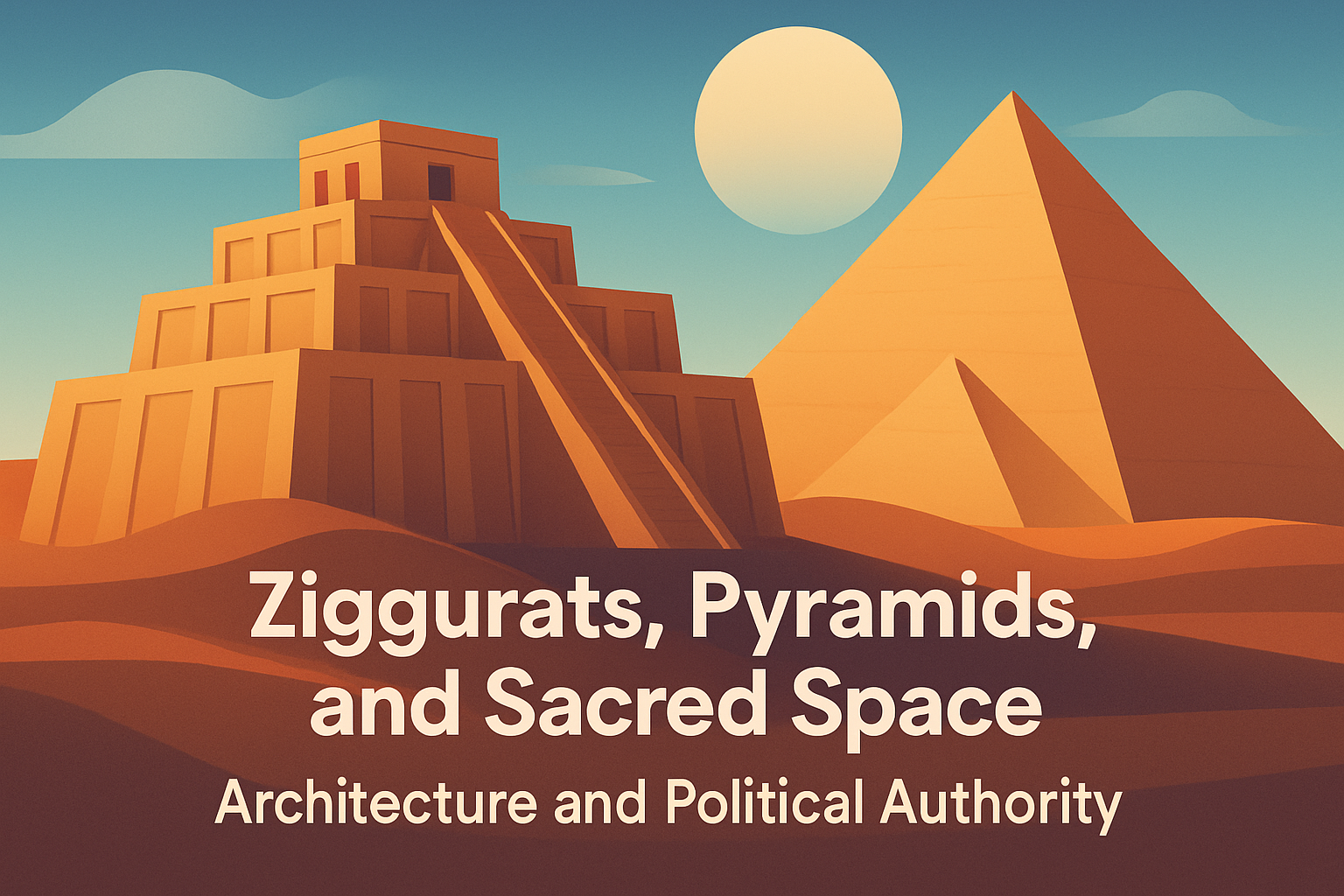
Throughout history, civilizations have constructed monumental architectural structures that serve both religious and political purposes. Among these are ziggurats and pyramids, which stand as testaments to the complex relationship between architecture, sacred spaces, and political authority. Ziggurats, distinct to ancient Mesopotamian cultures, and pyramids, most famously associated with ancient Egypt, are prime examples of how societies have utilized grand structures to assert divine and political power. In this article, we will explore the purpose and significance of these structures through historical context and their ongoing impact on culture and authority.
Defined by their towering forms, ziggurats and pyramids are not just feats of engineering but also embodiments of cultural and religious values. A ziggurat, generally a rectangular stepped tower, functions primarily as a temple complex, believed to connect earth and sky, thus offering access to the divine. On the other hand, a pyramid, often linked with the Egyptian civilization, typically serves as a monumental tomb for pharaohs, symbolizing their lasting power and divine kingship. Together, they illustrate how architecture has historically served as both a sacred space and an emblem of political strength.
Understanding these structures offers insights into ancient civilizations and highlights the enduring link between monumental architecture and authority. Such insights help us appreciate not just the architectural techniques of the past, but also the ways in which cultural and spiritual beliefs can shape the way societies organize, express, and maintain power. As we delve deeper into these ancient wonders, we learn more about the societal values that led to their construction and the legacies they impart to modern architectural and political practices.
The Phenomenon of Ziggurats
The ziggurat, an impressive architectural form, first developed in ancient Mesopotamia around 2100 BCE. These brick-made, tower-like structures, primarily located in the Sumerian, Akkadian, and Babylonian cities, represent some of the era’s most significant architectural achievements. The primary purpose of a ziggurat was to act as a temple that forged a link between humans and their gods, occupying a central place within the city’s religious life.
An exemplary ziggurat is the Ziggurat of Ur, constructed in the 21st century BCE under the rule of King Ur-Nammu. This particular structure was dedicated to the moon god Nanna and showcased the ruler’s devotion to the divine and reinforced his political legitimacy through divine patronage. Ziggurats like Ur’s were believed to be the dwelling places of gods, making them essential pilgrimage sites where priests conducted rituals and citizens offered their prayers and sacrifices.
In essence, the ziggurat served as both a physical and symbolic bridge between the terrestrial and celestial, embodying the convergence of architectural mastery, religious devotion, and political authority.
- Construction Technique: Built with mud bricks, which allowed for large-scale, durable structures.
- Cultural Role: Centers of religious activity and community gathering.
- Political Significance: Exhibited rulers’ divine right or favor, reinforcing their authority.
Pyramids and the Legacy of Kingship
The pyramid, particularly as epitomized by the Great Pyramid of Giza, is one of the most iconic symbols of ancient leadership and sophistication. Constructed during the Fourth Dynasty for Pharaoh Khufu, this structure exemplifies the ancient Egyptians’ sophisticated understanding of mathematics, engineering, and cosmology. The pyramid was more than a tomb; it was a symbolic reminder of the pharaoh’s eternal place in the afterlife and, by extension, his perpetual rule over the land.
The strategic placement and construction of pyramids were deep expressions of Egyptian cosmology, aligning with celestial bodies and thus tying the ruler’s fate directly to the cosmos. The massive labor force required for pyramid construction also represented the pharaoh’s influence, consolidating his power and resource control. Moreover, the grandeur of these pyramids served as powerful deterrents against rebellion, symbolizing the pharaoh’s divine right to rule and capability to command such monumental efforts.
Pharaohs used pyramids to communicate political power and religious piety, creating a legacy that proclaimed their greatness through time, with the pyramids serving as non-ephemeral markers of their reign.
| Feature | Ziggurats | Pyramids |
|---|---|---|
| Primary Function | Religious temple | Royal tomb |
| Cultural Role | Religious ceremonies | Legacy and deterrence |
| Construction Material | Mud bricks | Limestone and granite |
| Examples | Ziggurat of Ur | Great Pyramid of Giza |
Sacred Space and Political Power
The primary role of these architectural feats was architectural: creating sacred spaces linked to political power. While the ziggurats and pyramids served different functions, both exerted considerable influence over their respective societies’ social and political structures. The immaculate construction of these structures required strong centralized control, showcasing the rulers’ authority to mobilize resources, labor, and technical expertise.
Ziggurats and pyramids became central points around which political and religious life revolved. They demonstrated how sacred spaces could be leveraged to bolster a ruler’s status, legitimizing it through associations with the divine. In Mesopotamia, the presence of a ziggurat in a city was synonymous with the city’s political and economic prowess, fostering a stronger community identity and loyalty to the ruling authority. Similarly, in ancient Egypt, pyramids solidified the ruling class’s claim to divine rulership and were instrumental in maintaining the hierarchical structure crucial to sustaining their societal model.
The notion of sacred space intertwined with political power extends beyond practical uses and encapsulates the broader strategy of rulers to enshrine their authority in physical and spiritual landscapes. These monumental structures not only served immediate purposes of governance and religion but broadcasted their civilizations’ ideologies to future generations, securing their place in history.
Architectural Influence on Modern Authority
Though the ziggurats and pyramids were constructed millennia ago, their impact continues to resonate in contemporary architecture and politics. Today’s state buildings, religious centers, and even commercial skyscrapers often carry the tradition of embodying authority and ideology through their design and symbolism. The architecture of power has become a blueprint, borrowed from early examples and adapted to modern contexts, to reinforce control and influence.
In democratic societies, buildings like capitol buildings and national arenas serve a duality reminiscent of ancient structures—hosting processes of governance and symbolizing the state’s values and history. Pyramidal forms have also been integrated into modern architectural design, from cultural centers to museums, reflecting a timeless appreciation for the stability and grandeur these ancient structures conveyed.
This ongoing homage to ziggurats and pyramids in modern architecture speaks volumes about the lasting legacy of these ancient wonders. They reveal the continuous human pursuit to express power, create sacred spaces, and etch authority into permanence through construction, suggesting that the principles behind their initial design have enduring relevance in various cultural landscapes.
Cultural Responsibility and Preservation
In preserving these ancient structures, modern civilization signals its cultural responsibility to honor and understand its past. Ziggurats and pyramids are not just relics but vital threads connecting contemporary society with its historical roots. Many organizations and governmental bodies worldwide are charged with preserving these structures, ensuring they remain intact for future study and appreciation.
The preservation efforts reinforce the importance of understanding cultural and political history to fully appreciate present and future societal dynamics. As new generations arise, these monuments continue to provide invaluable insights into human creativity, ambition, and aspiration. They remind us not only of historical legacy but also of the inherent power of architecture to influence political, spiritual, and cultural consciousness.
Conclusion: Legacies of Power and Sacredness
Ziggurats and pyramids powerfully illustrate the interplay of architecture, sacred space, and political authority across different cultures and epochs. These structures serve dual roles: as monuments of engineering prowess and as profound expressions of cultural values and political strategies. The insights gleaned from studying them emphasize the importance of spiritual connection in governance and how architecture has facilitated this across history.
Today’s architects and political leaders can learn much about the use of monumental structures to signify power and prestige. The legacy of such architecture encourages us to think critically about how we design our spaces, the messages they communicate, and whom they serve. As modern society continues to evolve, the lessons embedded within the stones of ziggurats and pyramids call for a deeper appreciation of the historical symbols of power that shape our current architectural and political landscapes.
As stewards of this rich heritage, individuals and institutions should take an active role in preserving these ancient edifices and applying their lessons to contemporary practices. In doing so, we pay homage to our past and framework our future, bridging history with progress and unifying ages through architecture.
Explore further on how these ancient structures can inspire new developments in architectural ingenuity and remain wary of the innate connection between architecture, symbolism, and authority.
“`htmlFrequently Asked Questions
1. What are ziggurats and pyramids, and how do they differ in construction and purpose?
Ziggurats and pyramids are monumental structures that have significantly marked ancient civilizations, serving not only as indicators of technological advancement but also as representations of cultural beliefs. Ziggurats are great terraced temples constructed primarily in ancient Mesopotamia (modern-day Iraq and Iran). They consist of a series of stacked platforms creating a stepped effect, and each level is accessible via ramps or staircases. Constructed from mud-bricks, they would often feature a shrine or temple at the top, serving as a bridge between earth and the divine. The primary purpose of ziggurats was religious, acting as a dwelling place for the gods and reinforcing the theocratic authority of the priestly class.
Pyramids, meanwhile, are most famously associated with ancient Egypt, although they were also built in different forms by other cultures such as the Maya. The Egyptian pyramids are characterized by their smooth, triangular sides that converge at a single point. Constructed from limestone or granite blocks, they were typically built as tombs for pharaohs and significant leaders, symbolizing the eternal life and divine status of the deceased. The pyramid’s design was symbolic of the rays of the sun and was aligned precisely for astronomical and religious significance, further emphasizing the ruler’s connection to the divine cosmos.
2. How did the construction of these structures demonstrate political authority?
The construction of ziggurats and pyramids reflects an intricate relationship between architecture and political power. In Mesopotamian societies, kings often linked their right to rule with divine approval, which was visually reinforced by ziggurats. These monumental structures dominated the city’s skyline, serving as a constant reminder of the connection between the earthly and divine realms. By being the patron of such grand constructions, rulers cemented their status as intermediaries between the gods and the people, thereby consolidating their political authority and legitimacy.
In Egypt, the pyramids were colossal undertakings demanding immense resources and labor, orchestrated primarily by the pharaoh’s decree. By mobilizing such vast resources, the pharaohs showcased their unmatched power and wealth. The construction of these enormous tombs not only required a sophisticated understanding of mathematics and engineering but also highlighted the centralized efficiency of the pharaoh’s government. Furthermore, aligning these structures with celestial bodies reflected the pharaoh’s divine right to rule, portraying them as gods’ earthly representative, their authority extending into the afterlife.
3. How are sacred space and natural landscapes integrated into the architectural design of ziggurats and pyramids?
In both ziggurats and pyramids, the integration of sacred space within natural landscapes is vital to their architectural and spiritual significance. Ziggurats, typically erected in the flat plains of Mesopotamia, were intentionally placed at the city center and designed to elevate the temple closer to the heavens. The staircases and ramps symbolized ascent, allowing priests to reach the temple atop, where sacred rituals could be conducted in closer proximity to the gods. This elevation not only defined the sacred space but altered the natural landscape to accommodate religious functionality.
Pyramids, particularly in Egypt, were strategically oriented towards cardinal points and were part of a larger complex that included temples and processional ways. They were constructed on the desert’s edge, where the land met the fertile Nile Valley, representing a symbolic threshold between life and the afterlife. The natural landscape influenced their placement, aiming to maximize celestial alignments. The orientation of the pyramids towards certain stars or solstices played a critical role in the pharaoh’s journey to the afterlife, highlighting both spiritual connectivity and architectural ingenuity.
4. What role did religious beliefs play in the construction of these architectural marvels?
Religious beliefs were the cornerstone in the construction of both ziggurats and pyramids, dictating their structure, placement, and function. In Mesopotamia, ziggurats embodied the divine dwelling among humans, where the temple at the zenith was believed to house a god, accessible only to priests or royalty. The multi-layered platform physically reinforced the concept of progression towards holiness, stressing the importance of a harmonious relationship between humans and gods, a central theme in Mesopotamian spirituality.
For the ancient Egyptians, the construction of pyramids was deeply rooted in the culture’s belief in the afterlife and the divine nature of the pharaoh. The pyramids were not merely burial sites but elaborate spiritual machines designed to facilitate the pharaoh’s transformation and ascension to become divine. Every aspect, from its pyramidal shape to the tunnels and chambers within, served a religious purpose aiming to ensure the deceased ruler’s safe passage to the sun god Ra. The emphasis on cardinal alignments and celestial observations underscored a cosmological understanding of life, echoing their veneration of cosmic order as divine will.
5. How have these structures influenced modern conceptions of architecture and authority?
The impact of ziggurats and pyramids extends beyond their historical epoch, influencing contemporary architecture and perceptions of authority. They exemplify how architecture can embody and communicate power, prestige, and spiritual significance. Modern states often use similar monumental structures to project power and stability, a methodology that echoes the ancient practices. Skyscrapers, government buildings, and memorials often harness grand scales and strategic placement to evoke authority, national identity, and collective memory.
Furthermore, the pyramids and ziggurats inspire modern architectural approaches that integrate functionality with symbolism. The emphasis on aligning constructions with natural landscapes and elements continues in sustainable architecture, which respects and integrates the environment in design. The enduring fascination with these ancient landmarks encourages continual exploration into how architecture acts as a mediator between human ambition and the cosmos, influencing aesthetics, cultural identity, and the politics of place in contemporary architectural endeavors.
“`