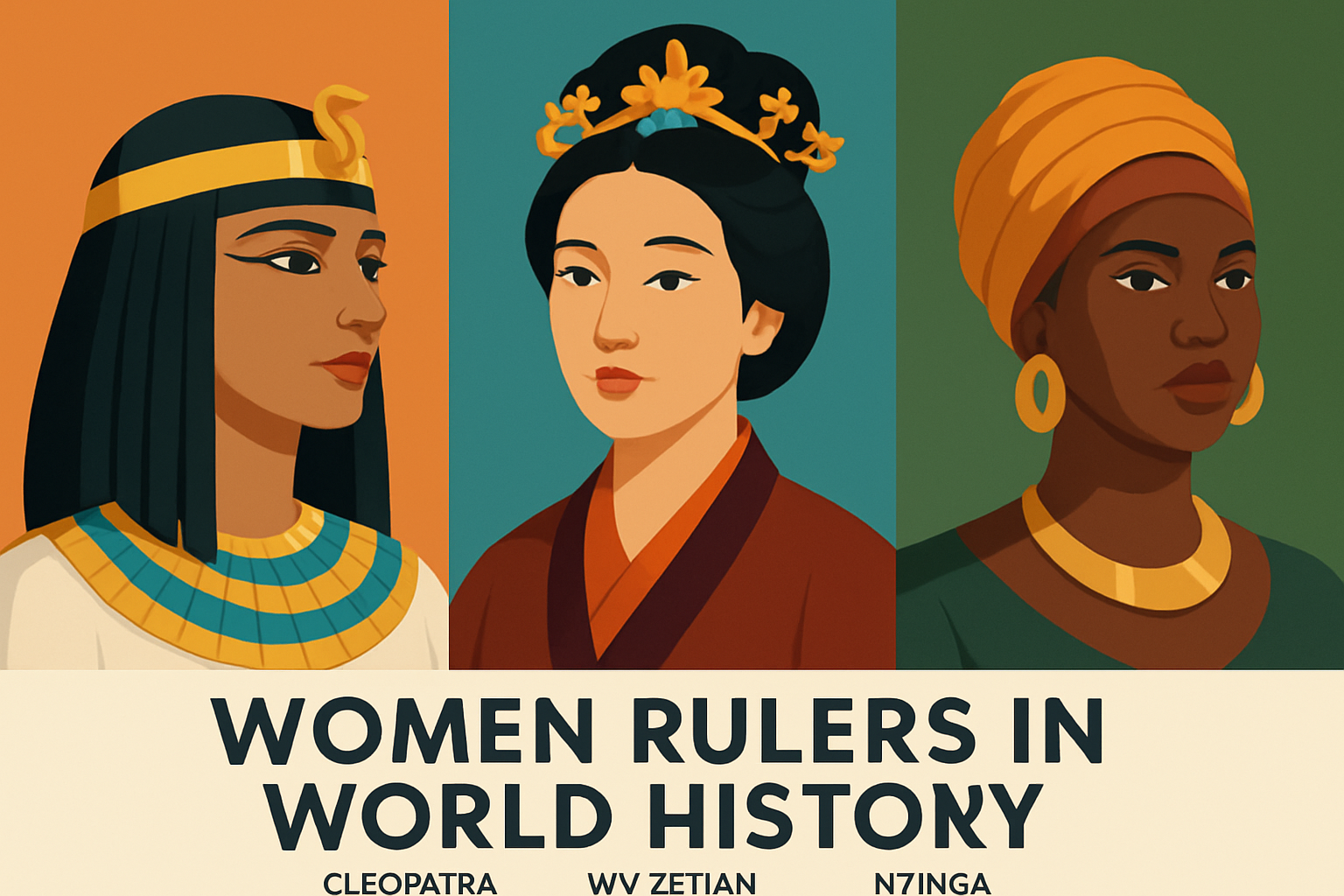
Throughout history, the world has been led primarily by male rulers, but there have also been remarkable women who have defied the norms and taken up the mantle of leadership in their respective regions. These women not only led their people with extraordinary skill and wisdom, but they also left a lasting impact on history that continues to be studied and appreciated today. The stories of Cleopatra, Wu Zetian, and Nzinga are illustrations of such impactful female leadership. By examining these women’s reigns, we gain insight into their unique approaches to governance, as well as their contributions to their cultures and nations. Understanding the accomplishments of these women isn’t merely an appreciation of history; it’s an acknowledgment of their roles in shaping societies and encouraging progress towards gender equality. Their stories matter, as they represent determination, resilience, and the persistent struggle for authority in a male-dominated world.
Cleopatra VII: The Enigmatic Pharaoh of Egypt
Cleopatra VII is arguably one of the most renowned women rulers in world history. Born in 69 BCE, she reigned as the last active pharaoh of the Ptolemaic Kingdom of Egypt. Her charm, intelligence, and political acumen have been both romanticized and vilified throughout Western literature and history. Cleopatra’s role as a female leader during her time was significant in that she managed to maintain Egypt’s independence during a period when the Roman Empire was rapidly expanding.
One of Cleopatra’s most notable strategic alliances was with Julius Caesar. After meeting Caesar in 48 BCE, Cleopatra formed a political and romantic alliance that enabled her to consolidate power and secure Egypt’s sovereignty against potential Roman oppression. She bore Caesar a son, Ptolemy XV Philopator Philometor Caesar, known to history as Caesarion, further securing her political leverage. Additionally, after the assassination of Caesar, Cleopatra aligned herself with Mark Antony, Rome’s influential general, through both political maneuvers and personal romance. This partnership was immortalized by the love story between Cleopatra and Antony, although it ultimately led to their tragic downfall due to the Roman political tides turning against them with the rise of Augustus.
Cleopatra’s reign represented an era where cultural exchanges flourished, evidenced by the fusion of Greek and Egyptian traditions and the thriving of Alexandria as a center of knowledge and learning. Despite the eventual absorption of Egypt into the Roman Empire following her defeat, Cleopatra remains a symbol of powerful female sovereignty and intellectual brilliance.
Wu Zetian: The Only Female Emperor of China
Wu Zetian, known as Empress Wu, was the only woman to ever sit on the throne as an emperor in the history of China. Her ascension from a concubine to the emperor over the Tang Dynasty speaks to her exceptional political shrewdness and determination. Born in 624 CE, Wu Zetian worked her way through the court’s political hierarchy, ultimately ruling first as the empress consort, then regent, and finally, as the emperor of her self-proclaimed Zhou Dynasty from 690 to 705 CE.
Wu Zetian’s reign was marked by significant reforms and a focus on merit over aristocratic lineage, which allowed for a more equitable system within the civil service. She commissioned extensive agricultural projects that contributed to the prosperity and stability of the state. Additionally, Wu Zetian was a patron of Buddhism, influencing cultural and religious landscapes during her time.
To illustrate, during her reign, Wu established a bureau of censors and encouraged the collection of historical works, thus ensuring the documentation and preservation of historical texts and records. These initiatives reflected her desire to consolidate her rule, while also placing an emphasis on intellectual achievement and bureaucratic efficiency. However, her reign was not without controversy; Wu employed ruthless methods to eliminate opposition, cementing her power in a court filled with intrigue and backstabbing.
Wu Zetian’s rule may have been brief, but it was essential in shaping the Tang Dynasty, which continued to be one of China’s most prosperous periods. Her legacy as a female ruler who defied patriarchal constraints serves as an inspiration to women in all walks of life.
Queen Nzinga: The Warrior Queen of Ndongo and Matamba
In the heart of Africa, Queen Nzinga of Ndongo and Matamba arose as a formidable leader against European colonial forces. Nzinga was born in 1583 in the region now known as Angola. Her reign was characterized by her relentless fight against the Portuguese, who were advancing into Central Africa in search of territorial expansion and control over the slave trade.
Nzinga assumed power in 1624 after the passing of her brother, despite fierce opposition and the deeply entrenched male-dominated political structure. Not only did she establish herself as a capable military leader, but she also served as a diplomat who deftly maneuvered alliances with neighboring kingdoms. When faced with the might of Portuguese forces, Nzinga orchestrated alliances with the Dutch and even converted strategically to Christianity, adopting the name Dona Ana de Sousa, in a calculated move to bolster her alliances.
Her strategic leadership and warfare tactics served as an emblem of resistance against colonialism. Nzinga’s precise military tactics and political ingenuity enabled her to hold her kingdom together for decades, a remarkable feat given the era’s geopolitical pressures. Her legacy as a revolutionary leader continues to inspire anti-colonial movements across Africa and beyond.
Through oral traditions and documented encounters with the Portuguese, Nzinga’s story endures as a potent symbol of resilience and the struggle for autonomy in the face of overwhelming external pressures.
- Cleopatra: Strategic partnerships with Julius Caesar and Mark Antony.
- Wu Zetian: Implemented significant reforms, fostering economic growth and cultural prosperity.
- Nzinga: Prowess in military strategy and diplomacy against colonial powers.
Conclusion: The Legacy of Women Rulers
Women like Cleopatra, Wu Zetian, and Nzinga were not mere footnotes in history; they were pivotal to the shaping of their respective civilizations and periods. Each of these women defied societal norms and established themselves as influential monarchs in male-dominated societies. They embraced the responsibility of leadership and demonstrated their capability to impact political, economic, and cultural landscapes.
The legacy of these women rulers serves as both an inspiration and a call to action. Their stories remind us of the importance of challenging gender stereotypes and breaking down barriers to leadership opportunities for women across societies today. As history unfolded, the narratives of Cleopatra, Wu Zetian, and Nzinga reveal the potential and strength that women inherently have, urging us to recognize and cultivate female leadership in our modern world.
By understanding the contributions and struggles of these women, we can appreciate the rich tapestry of world history and continue advocating for equality and recognition of women’s roles in shaping our global narrative. Reflect on their stories, share their legacies, and foster dialogues that encourage inclusivity and appreciation for diverse leadership styles.
Frequently Asked Questions
1. Who was Cleopatra, and what was her significance in world history?
Cleopatra VII Philopator, known simply as Cleopatra, was the last active ruler of the Ptolemaic Kingdom of Egypt. She reigned from 51 BC until her death in 30 BC. Cleopatra is one of the most famous female rulers in history, known for her intelligence, political acumen, and charismatic leadership. Her significance lies in her ability to maintain Egypt’s independence during a time of Roman expansion. Cleopatra was fluent in several languages, including Egyptian and Greek, and was known to be an astute diplomat. She formed key alliances with powerful Roman figures like Julius Caesar and Mark Antony, which were both personal and political in nature. Despite the eventual annexation of Egypt by Rome, Cleopatra’s legacy endures as a symbol of female power and ingenuity. Her story has inspired countless works of art, literature, and film over the centuries, illustrating her lasting impact on world culture.
2. What is known about Wu Zetian’s rise to power in China?
Wu Zetian was the only female emperor in the history of China, ruling as the emperor of the Tang Dynasty from 690 to 705 AD. Her ascent to power was unprecedented and marked by strategic maneuvering within the royal court. Initially a concubine of Emperor Taizong, Wu Zetian’s intelligence and ambition saw her rising through the ranks to become empress consort to Emperor Gaozong. Following Gaozong’s death, she effectively ruled as the power behind the throne during her sons’ reigns. In 690, she boldly declared herself the founder of the Zhou Dynasty, thereby solidifying her position as the official ruler of China. Her reign is noted for significant administrative reforms, promotion of talented officials based on merit rather than aristocratic birth, and the expansion of Buddhism. Despite historical attempts to vilify her as ruthless, modern scholarship acknowledges Wu Zetian’s effective governance and contributions to Chinese history.
3. Who was Queen Nzinga, and how did she impact Angola’s history?
Queen Nzinga Mbande was a 17th-century queen of the Ndongo and Matamba Kingdoms in what is now present-day Angola. Her reign lasted from 1624 to 1663, and she is renowned for her fierce resistance against Portuguese colonialism in Central Africa. As a savvy and resourceful leader, Nzinga employed a mix of diplomacy, military tactics, and alliances to fight against Portuguese encroachments and the slave trade. Her legendary negotiation skills were evident during a famous diplomatic encounter where she boldly refused to kneel before the Portuguese governor, signifying her demand for equal status. Nzinga’s ability to forge alliances with rival African kingdoms and adopt European military technologies made her a formidable opponent. Her leadership not only delayed Portuguese domination in the region but also made her a symbol of resistance and empowerment that continues to inspire movements for freedom and equality across Africa and the world today.
4. What were the challenges faced by these women rulers, and how did they overcome them?
Each of these women faced significant challenges rooted in the gender norms and political climates of their times. Cleopatra, Wu Zetian, and Nzinga navigated patriarchal societies where women’s leadership was not the norm. Cleopatra faced external pressures from Rome and internal challenges from within her own family and court. She used her intelligence, strategic alliances, and her magnetic personality to maintain her power. Wu Zetian faced opposition from Confucian scholars and officials who were skeptical of female leadership. She overcame these challenges through pragmatic reforms, consolidating power, and demonstrating administrative competence. Nzinga contended with colonial ambitions and internal factionalism; her resilience, strategic alliances, and adaptability allowed her to maintain her sovereignty for decades. Each woman’s ability to adapt, leverage their unique skills, and challenge societal norms was key to their overcoming these hurdles.
5. What is the legacy of these female rulers in contemporary society?
The legacies of Cleopatra, Wu Zetian, and Nzinga endure as powerful symbols of women’s leadership and empowerment. Cleopatra remains an icon associated with beauty and intelligence, often highlighting the role of female leaders in ancient history. Her story serves as a cultural touchstone, inspiring generations to explore powerful women’s narratives. Wu Zetian’s rule exemplifies women’s capabilities in governance and has sparked interest and admiration in modern China and beyond as a symbol of female empowerment. Meanwhile, Nzinga is celebrated as a warrior queen and national hero in Angola. Her resistance against oppression is revered, and her legacy is a source of national pride. These women’s stories inspire ongoing discussions about gender, leadership, and the breaking of societal barriers, encouraging contemporary movements for gender equality and justice worldwide.