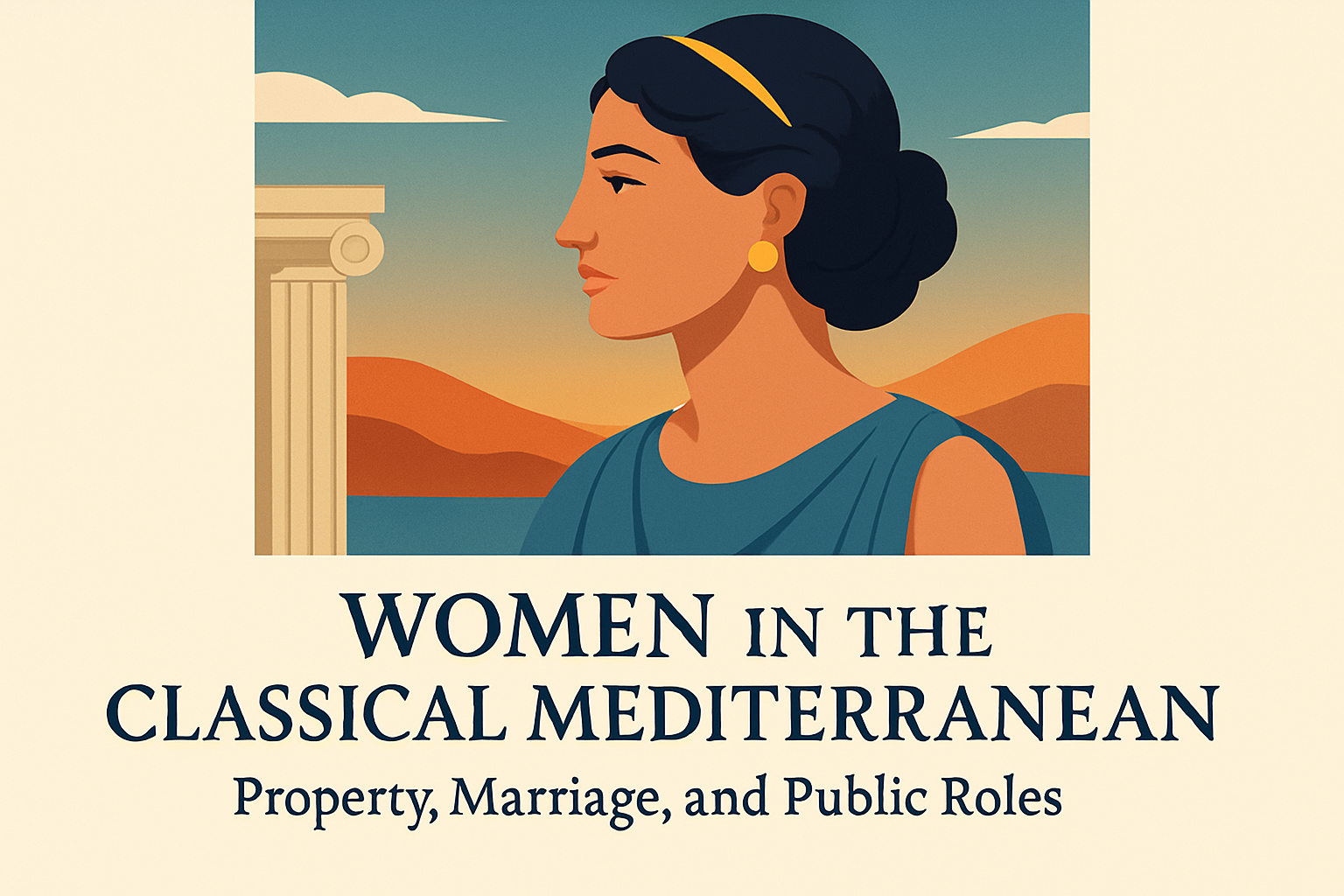
The classical Mediterranean world was a vibrant tapestry woven by various cultures, including the Greeks, Romans, and Egyptians. Women in this region during this era played complex roles, their lives shaped by social norms and laws governing property, marriage, and public participation. Understanding their place in history is crucial to comprehending how cultural and legal perceptions impact women today. Key terms such as ‘property rights’, ‘patriarchy’, and ‘citizenship’ must be defined to fully appreciate the societal structures that influenced women’s lives during this time. Property rights were the legal rights held by individuals to acquire, possess, and manage property; patriarchy denotes a social system where men hold primary power; and citizenship refers to the status of a person recognized under the custom or law of a sovereign state. The exploration of these aspects from a historical perspective provides insight into the evolution of gender roles and helps highlight the immense progress made over centuries while recognizing how much further society has to advance for gender equality.
Property Rights of Women
In the classical Mediterranean, property rights for women varied considerably between Greek, Roman, and Egyptian societies. The legal frameworks within these civilizations determined the extent to which women could own, inherit, and control property. In Greece, the society was largely patriarchal, and women’s property rights were significantly limited. Athenian women, for example, were under the guardianship of a male relative and had very restricted control over property. In contrast, Spartan women had more rights and were known to own a substantial portion of land, as inheritance laws there favored women to some extent. Spartan women could inherit family property, which provided them a level of economic independence uncommon in other Greek city-states.
The case of Roman women showcases a different legal structure. The Romans devised legal categories like “sui iuris”, meaning woman of her own law, allowing some women autonomy over their property, although these were rare exceptions often among the wealthier classes. By the late Republic and early Empire, Roman women of sufficient means managed their estates and economic endeavors independently to some degree. This circumstance arose partly due to the Roman institution of “manus,” a form of marriage that essentially placed a woman under her husband’s control, evolving to allow women, especially widows, to manage their affairs.
In Egypt, the situation was unique, with women enjoying considerable rights compared to their Greek and Roman contemporaries. Egyptian women could acquire and dispose of property, manage estates, and even engage in legal transactions. A famous example is the contracts written by women during the Ptolemaic period where women would engage in property transactions, underscoring a more equitable legal system. This ability to manage property significantly impacted their social standing and economic clout.
- Greek – Limited rights, with major variations (e.g., Spartan women).
- Roman – Intermediate, with progressive changes over time.
- Egyptian – Relatively advanced rights, allowing legal economic independence.
Marriage Practices and Their Impact on Women
Marriage in the classical Mediterranean can be seen as both a personal union and an economic arrangement. For Greek women, marriage was often arranged by the father, and a dowry was provided to ensure the daughter’s future. This dowry was essentially women’s leverage in a marriage, representing their economic interest that would sometimes revert back to the family in case of a divorce. Athenian marriage laws required women to remain under male guardianship, reflecting the patriarchal structure of the society.
Romans viewed marriage as a bond not only between individuals but families too, impacting women’s social and familial roles. Roman women entering “cum manu” marriages experienced a shift in allegiance from their birth family to their husband’s family. However, “sine manu” marriages became more prevalent, allowing women to remain under the legal control of their birth family. This distinction provided women more autonomy over their property and personal legal matters.
The Egyptian marriage contract clearly outlined the rights and responsibilities of each party, resembling more a legal agreement than in Greek and Roman traditions. These contracts often included provisions for the woman’s ownership of property within the marriage, illustrating a societal structure that respected the individual rights of women within domestic settings. Notably, the Ptolemaic period produced substantial documentation of women leveraging these contracts to safeguard their interests.
As these practices evolved, they influenced social dynamics and women’s roles in public and private spheres. Distinctions in how these cultures approached marriage underscore the cultural variances in women’s autonomy and societal contribution.
Public Roles and Civic Participation
The scope of women’s public roles in the classical Mediterranean was largely dictated by cultural norms and legal structures. Greek women, especially in Athens, had little to no public role. They were largely excluded from political life and were expected to focus on domestic duties. Exceptions existed, such as priestesses, who participated in religious ceremonies, yet this was not the norm and didn’t offer any political power, although it provided social standing and religious influence.
Roman women saw a slightly different reality, with some degree of influence in public spaces, albeit informal. These women managed familial wealth, influenced social and political scenes through their relationships, and sponsored public works, indirectly shaping civic life. Around the late Republic era, elite Roman women like Livia Drusilla, Augustus’ wife, exerted considerable informal power and influence, maneuvering within the constraints imposed by societal expectations.
In Egypt, particularly during the Ptolemaic period, women participated more overtly in public life relative to their Greek or Roman counterparts. They served not only as priestesses but also engaged in business and were documented as having legal authority in administrative roles. The prevalence of women in these roles was intertwined with the cultural and religious acceptance embedded within Egyptian society.
| Region | Role | Example |
|---|---|---|
| Greek | Domestic and religious roles | Priestesses like the Pythia of Delphi |
| Roman | Informal public influence | Livia Drusilla’s political maneuvering |
| Egypt | Public and religious authority | Women in Ptolemaic administrative roles |
Key Takeaways and Conclusion
Exploring the roles of women in the classical Mediterranean offers valuable lessons on the intersection of gender, law, and culture. Greek women’s property and political roles were severely restricted except in notable exceptions like Sparta. Roman women saw a gradual shift in marital and property rights, contributing to enhanced personal autonomy over time. Conversely, Egyptian women enjoyed substantial rights, allowing them to participate actively in economic and legal matters. These diverse paradigms showcase the varying degrees of female autonomy across the Mediterranean, highlighting how cultural context shapes gender dynamics.
Understanding this history underscores the progress and challenges in the ongoing quest for gender equality. As modern society continues to challenge patriarchal systems and advocate for gender inclusivity, examining these historical frameworks provides critical insight into the foundations of current societal structures. The history of women in the classical Mediterranean exemplifies the resilience and influence of women even within restrictive confines, serving as an inspiration for further advocacy and reform in pursuit of equality. Embrace this knowledge as a catalyst for further exploration and advocacy for women’s rights globally, understanding that the quest is both historical and contemporary, pressing forward into future advancements.
Frequently Asked Questions
1. What were the property rights of women in the classical Mediterranean world?
Understanding property rights for women in the classical Mediterranean is a fascinating delve into historical gender dynamics. In ancient Greece, women’s property rights were quite limited. Typically, women could own and inherit property, but they did so under the supervision of a male guardian, usually a father, brother, or husband. Upon marriage, control over a woman’s dowry often transferred to her husband, though it would revert to her family in cases of divorce or her husband’s death.
In contrast, Roman women enjoyed comparatively more freedom in property matters. They could own, inherit, and manage their property independently, especially after the enactment of laws like the Lex Voconia, which addressed women’s inheritance rights. Roman laws, particularly during the later Republic and Imperial periods, afforded women rights to enter contracts and manage estates. However, societal norms often imposed significant constraints, suggesting that legal rights did not always translate into practical empowerment.
Egyptian women in antiquity, particularly during the Ptolemaic and Roman periods, also had remarkable property rights compared to their counterparts elsewhere. They could engage in financial transactions, own land, and take legal action independently. This autonomy traces back to earlier Pharaonic traditions where women could even rule as pharaohs, breaking many traditional gender barriers found in other contemporary cultures.
2. How was marriage structured for women, and what role did it play in their lives in the classical Mediterranean?
Marriage in the classical Mediterranean was both a personal and social institution with immense implications on women’s lives. In ancient Greece, marriage was primarily a means to secure alliances and ensure legitimate offspring. Athenian women, for example, typically married in their early teens, often to significantly older men. The marriage contract would usually include a dowry essential for the economic stability of the household. The primary role of a Greek wife was to manage the domestic realm, including overseeing household slaves, producing textiles, and raising children. Her public visibility was limited, with an emphasis on modesty and discretion.
In Roman society, marriage was slightly more flexible. Roman women often married in their late teens to early twenties, and marriage contracts—while important—allowed for more property autonomy than in Greece. Marriages could be arranged or based on mutual consent, and women had the legal option of divorce. The Roman matron held an influential role in the family, often participating in social events and public activities, reflecting the relatively liberal Roman attitudes towards public life.
In Egypt, particularly during the Hellenistic and Roman periods, marriage agreements were well-documented with elaborate contracts detailing property and personal rights. Egyptian women often possessed significant economic clout due to the dowries and gifts from their marriages. Furthermore, women could divorce and remarry, similar to Roman practices, though societal expectations still favored marital longevity.
3. What public roles could women engage in across different societies of the classical Mediterranean, and how did these differ?
The public roles of women varied tremendously across the classical Mediterranean, influenced by cultural, legal, and social structures. In Athens, women were largely confined to domestic spaces, with limited public roles. Despite this, some women, notably priestesses of significant religious cults, held influential positions. Religion provided a rare avenue for public presence, albeit in a strictly controlled environment.
In contrast, Roman women participated more actively in public life. Although not allowed formal political roles or to vote, wealthy Roman women could exert influence through social networks, patronage, and participating in societal events. The Vestal Virgins held a unique public role, playing critical religious functions that were deeply respected throughout the empire. Roman elite women also sometimes wielded unofficial political power through their relationships with the male ruling elite.
Egyptian women, particularly under the Ptolemaic and Roman dominions, had pronounced public roles, especially in religious functions. Some even ascended to significant political power, with queens like Cleopatra VII wielding control over state affairs. Overall, while the public roles of women were broader in some societies than others, religious involvement often stood as a common pathway to greater societal prominence.
4. How did cultural perceptions of patriarchy impact women in the classical Mediterranean, and what can we learn from them today?
Patriarchy deeply permeated every societal level in the classical Mediterranean, dictating women’s roles, legal abilities, and social expectations. The entrenched belief that men were the rightful leaders and women primarily caretakers and progenitors underpinned many cultural practices. In Greek city-states like Athens, democratic principles applied exclusively to free male citizens, sidelining women from political processes entirely. This male-dominance ideology also reinforced strict societal norms around female propriety and virtue, shaping familial and social dynamics.
Roman society mirrored these patriarchal guidelines to a lesser extent, allowing for somewhat greater female influence in property and family matters, though formal political roles remained elusive. However, powerful figures like Livia Drusilla and Agrippina the Younger illustrate how women could navigate within patriarchal systems to wield power indirectly.
Learning from these historical contexts allows us to see how deeply ingrained gender biases are and how, despite constraints, women find ways to exercise agency. The push for gender equality today reflects ongoing efforts to dismantle the legal and social remnants of such gender-biased systems. Studying these historical precedents offers insights into current gender dynamics and highlights the importance of creating inclusive structures where both men and women can flourish equally.
5. How did citizenship laws in the classical Mediterranean affect women’s social status and legal rights?
Citizenship laws were crucial in defining women’s social status, often amplifying their disenfranchisement in classical Mediterranean societies. In ancient Athens, citizenship was tightly linked to notions of patrimony and legitimacy, meaning only children born from a citizen father and a legally wedded citizen mother could inherit full citizenship rights. For Athenian women, this placed weight on marital fidelity and managing family properties to ensure legitimate heirs, reinforcing their subordinate status despite their crucial role in citizen production.
Although Roman citizenship laws granted women some legal rights regarding property and family, they were generally excluded from formal participation in politics. Their status often hinged on their relationship to male citizens; however, modifications to Roman laws did provide more freedom and legal standing, such as the right to own property and initiate divorce. Despite these improvements, women’s citizenship was informal, prioritizing the patriarch’s role in public representation.
In Egypt, particularly under the Ptolemaic dynasty, citizenship was not rigidly defined as in Greece and Rome. The blending of Greek and local traditions allowed various degrees of autonomy and legal rights for women irrespective of their marital status. These flexible attitudes underscore a more intricate interplay between gender and citizenship, which presents a stark contrast to the rigid structures employed elsewhere.