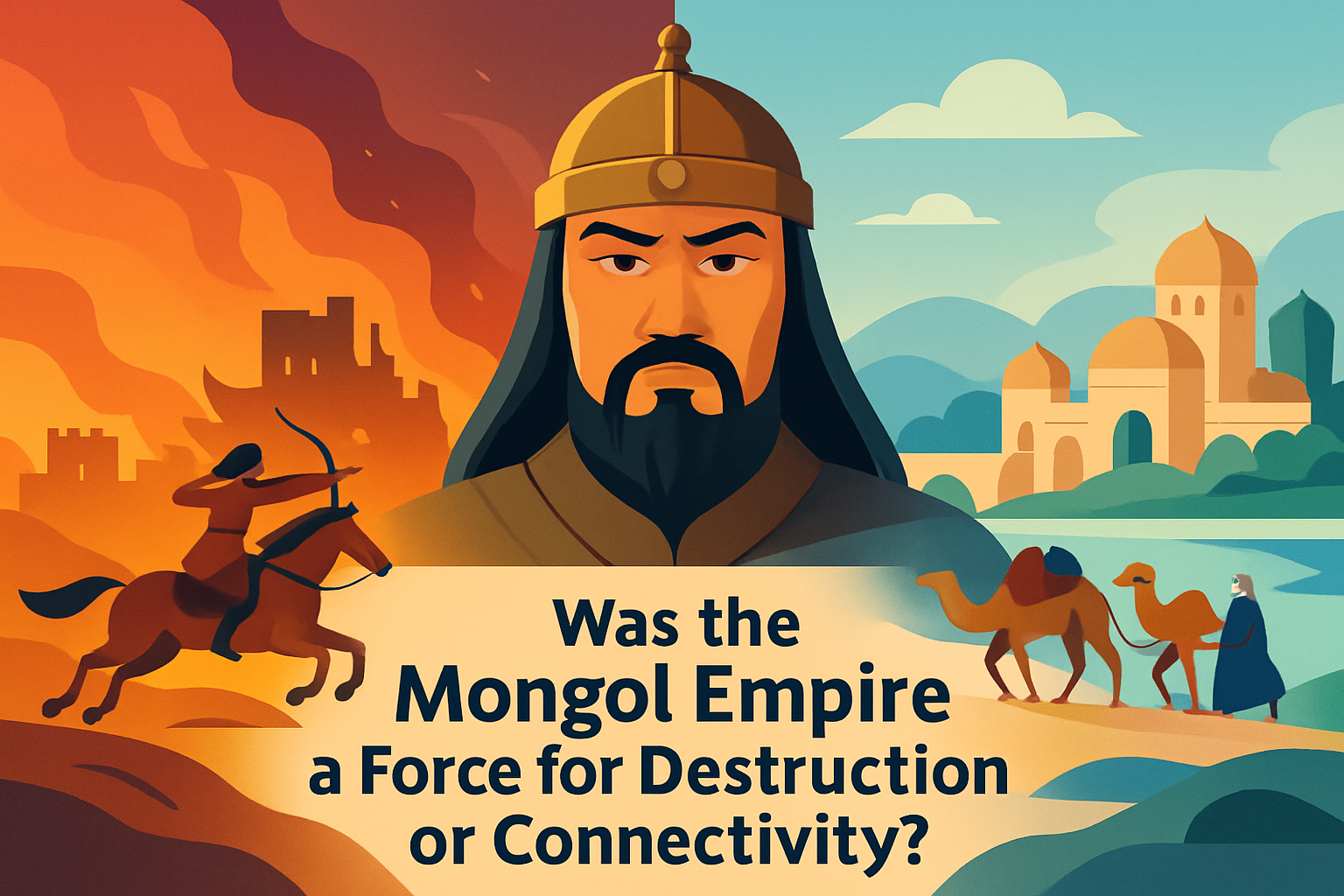
Introduction to the Mongol Empire’s Dual Legacy
The Mongol Empire, which emerged in the 13th century, stands as one of the largest contiguous empires in human history. Known for its expansive reach from East Asia to Europe, the empire evokes contrasting perspectives: it is seen both as a destructive force and as a catalyst for unprecedented global connectivity. Understanding the Mongol Empire’s dual legacy is vital, as it influenced the modern world in multifaceted ways, including trade, cultural exchange, and warfare.
Key terms integral to this topic include “destruction,” which refers to their widespread conquests and the bloody tactics employed, and “connectivity,” which highlights the empire’s role in facilitating trade routes and cultural exchanges across its vast territories. The Mongol Empire matters because its legacy is a microcosm of the complex interplay between conquest and connection, offering insights into how empires can simultaneously bring devastation and foster development.
By examining the Mongol Empire, we can better understand how historical narratives are shaped by the dual forces of destruction and connectivity. This understanding allows us to appreciate how such forces have continued to play a role in global geopolitics, cultural syncretism, and economic interdependence, thus making the study of this empire relevant today.
The Force of Destruction: Mongol Conquests and Their Impact
One of the most widely recognized aspects of the Mongol Empire is its military conquests, which were often marked by dramatic devastation. Under the leadership of Genghis Khan and his successors, the Mongols employed ruthless strategies to expand their territory rapidly. Their use of psychological warfare, skilled cavalry tactics, and siege warfare led to the fall of several key cities, such as Beijing, Baghdad, and Kiev. These invasions resulted not only in the destruction of infrastructure but also in the loss of countless lives, leading many historians to label the Mongols as a force for destruction.
An example of their destructive impact is the Siege of Baghdad in 1258, which marked the end of the Islamic Golden Age. The Mongols’ brutal sacking of the city led to a massive death toll and the obliteration of libraries and cultural treasures, effectively causing a significant cultural and scientific loss for the Islamic world.
Yet it’s important to note how these acts of destruction were paradoxically accompanied by strategic efforts to incorporate subdued regions into their empire, thereby fostering a certain level of stability and order in the long term. By imposing strict military and administrative control, the Mongols managed to secure trade routes and enforce laws, albeit through initially violent means.
Connectivity Through Trade: The Silk Road Revitalized
While the Mongols are often remembered for their destructive campaigns, they also played a pivotal role in enhancing connectivity across Eurasia. The Mongol Empire revitalized the Silk Road by ensuring peace and security across its territories, which spurred trade between East and West. Mongol rule facilitated the movement of goods—such as silk, spices, and precious metals—and people, including merchants, scholars, and diplomats.
| Trade Goods | From East to West | From West to East |
|---|---|---|
| Silk | ✔ | ✔ |
| Spices | ✔ | — |
| Precious Metals | — | ✔ |
| Textiles | — | ✔ |
Notably, the Mongol postal system, known as the Yam, facilitated communication across vast distances, allowing information to travel swiftly across the empire. The integration of various cultures and the movement of diverse peoples contributed to the exchange of technologies, ideas, and scientific knowledge.
One real-world example of this connectivity is the journey of Marco Polo, an Italian merchant whose travels along the Silk Road under Mongol protection led to a significant cultural and commercial exchange and subsequently inspired European exploration.
Cultural Exchange and Syncretism Under Mongol Rule
The Mongol Empire’s vast expanse not only enabled trade but also fostered significant cultural exchanges. The Mongols employed a policy of cultural tolerance and patronage, often allowing scholars, artists, and religious figures from captured regions to move freely and interact. This policy led to increased cultural syncretism, where elements from different cultures blended to create new traditions.
For instance, Persian and Chinese influences merged under Mongol rule, influencing art and architectural styles in many parts of their empire. The Persian artistic and engineering skills enriched Chinese culture, and conversely, Chinese innovations in ceramics and government organization influenced Persian societies.
Moreover, religious tolerance under the Mongols allowed Christian, Buddhist, and Islamic communities to flourish and interact. This openness led to the exchange of religious ideas and practices, an exchange which had lasting impacts on the religious landscape of Asia and Europe.
Perhaps the most prominent example of cultural exchange is the work of the Ilkhanate in Persia, where the conversion of Mongol rulers to Islam led to the spread of Islamic culture and learning in the region.
Administrative Reforms: A System of Governance
The Mongol Empire not only connected distant lands through trade and culture but also introduced significant administrative reforms that facilitated efficient governance across its vast territories. These reforms were crucial for maintaining control and stability within the empire.
One key reform was the introduction of a meritocratic system to select and promote officials, regardless of their ethnic or social background, thus ensuring that the most capable individuals governed effectively. This system encouraged loyalty to the Mongol rulers and reduced internal conflicts based on ethnicity or tribal affiliations.
Another important reform was the codification of laws, known as the “Yassa,” which standardized legal procedures across the empire. This legal uniformity ensured fairness and justice in the administration of far-flung regions and contributed to the smooth functioning of trade and communication.
A real-world manifestation of the Mongols’ systematic approach to governance was evident in their capital, Karakorum, which became a multicultural hub with distinct influences from various parts of the empire, reflecting the diversity and inclusivity of Mongol administrative practices.
Conclusion: The Mongol Empire’s Lasting Influence
The Mongol Empire’s dual legacy of destruction and connectivity offers a complex narrative that has had a profound impact on the world. Through their conquests, the Mongols undoubtedly wreaked havoc on numerous civilizations, altering the course of history through violence and devastation. However, they simultaneously facilitated an unprecedented degree of connectivity that fostered trade, cultural exchanges, and administrative innovation.
The key takeaway from this historical examination is that while the Mongol Empire initially exerted destructive power, it also served as a conduit for advancements in trade, technology, and governance that have had lasting effects on global civilization. Understanding the multifaceted impact of the Mongol Empire enables us to appreciate the nuances of history, where empires can act as both destructors and connectors.
As a reader, consider how these historical dynamics relate to present-day global interactions, where forces of destruction and connectivity continue to shape our world. Reflect on how lessons from the Mongol Empire’s dual legacy can inform contemporary policies and strategies for fostering peaceful, interconnected global communities.
Frequently Asked Questions
Was the Mongol Empire primarily a force of destruction?
The Mongol Empire is often remembered for its swift and decisive conquests, which indeed involved a significant degree of destruction. Under the leadership of Genghis Khan and his successors, the Mongol military campaigns were marked by fierce and sometimes ruthless tactics. Cities that resisted Mongol invasions were often razed to the ground, and populations faced dire consequences. Noteworthy examples include the sack of cities like Baghdad in 1258, which resulted in massive loss of life and destruction of cultural heritage. However, it is essential to understand that these acts were part of a broader military strategy designed to establish control over vast territories. While these campaigns were destructive, they were not senseless; they were highly effective in creating an empire that spanned from the Pacific Ocean to Eastern Europe, laying foundations for a new global network.
How did the Mongol Empire contribute to global connectivity?
Beyond its reputation for destruction, the Mongol Empire played a crucial role in fostering global connectivity during the 13th and 14th centuries. Once the initial phase of conquest concluded, the empire established an era of relative peace and stability known as the Pax Mongolica. This period allowed for the unprecedented movement of people, goods, and ideas across the vast Eurasian landscape. The Mongols developed sophisticated systems for trade and communication, including the famous Silk Road network. They established postal stations and protected trade routes, facilitating the exchange of luxury goods, technologies, philosophies, and cultural practices across diverse regions. This fusion of ideas and knowledge significantly influenced the societies within Mongol-controlled areas, effectively bridging East and West in a way that had never been achieved before.
Did the Mongol Empire promote any cultural exchanges?
Absolutely. The Mongol Empire was a melting pot of cultures, and its leaders were often keen to learn from the diverse peoples they ruled over. For instance, the court of Kublai Khan, who ruled as the emperor of the Yuan dynasty in China, was a hub for scholars, artists, and travelers from different parts of the world, including the celebrated Venetian merchant Marco Polo. The Mongols valued skilled individuals regardless of their ethnic backgrounds, integrating artisans, craftsmen, and intellectuals into their societal framework. This openness fostered profound cultural exchanges, leading to advancements in various fields such as astronomy, medicine, and art. The hybrid cultures that emerged from these interactions enriched the Mongols’ own practices and influenced the regions they governed long after their direct rule ended.
What impact did the Mongol Empire have on trade?
The Mongol Empire significantly boosted trade across its territories. By establishing and securing the Silk Road, trade between the East and West flourished. The Mongols implemented policies that encouraged trade by ensuring the safety of merchants and offering protection against banditry along trade routes. Their empire-wide currency systems and legal codes provided a stable economic environment conducive to commerce. Goods such as silk, spices, textiles, and precious metals were exchanged, alongside ideas and technologies, which gave rise to urban centers of commerce and innovation. The connectivity established under Mongol rule not only benefitted economic trade but also laid the groundwork for the future development of cities throughout Asia and Europe.
How does the legacy of the Mongol Empire continue to influence the modern world?
The Mongol Empire’s dual legacy of destruction and connectivity continues to have implications today. Its ability to unite a substantial portion of the Eurasian continent set precedents for global trade and communication networks that are fundamental in the modern era. The idea of connecting distant markets and cultures can be traced back to the practices established during the Mongol era. Additionally, the exchange of goods and knowledge during the Pax Mongolica contributed to the development of the Renaissance in Europe. Today, scholars study the Mongol Empire to understand the complexities of empire-building, cultural integration, and globalization, recognizing it as a significant turning point in world history that helped shape the intersectionality of cultures and economies. Its enduring narrative reminds us of the dual capacity for empires to both destroy and create, offering lessons on the power dynamics that drive historical change.