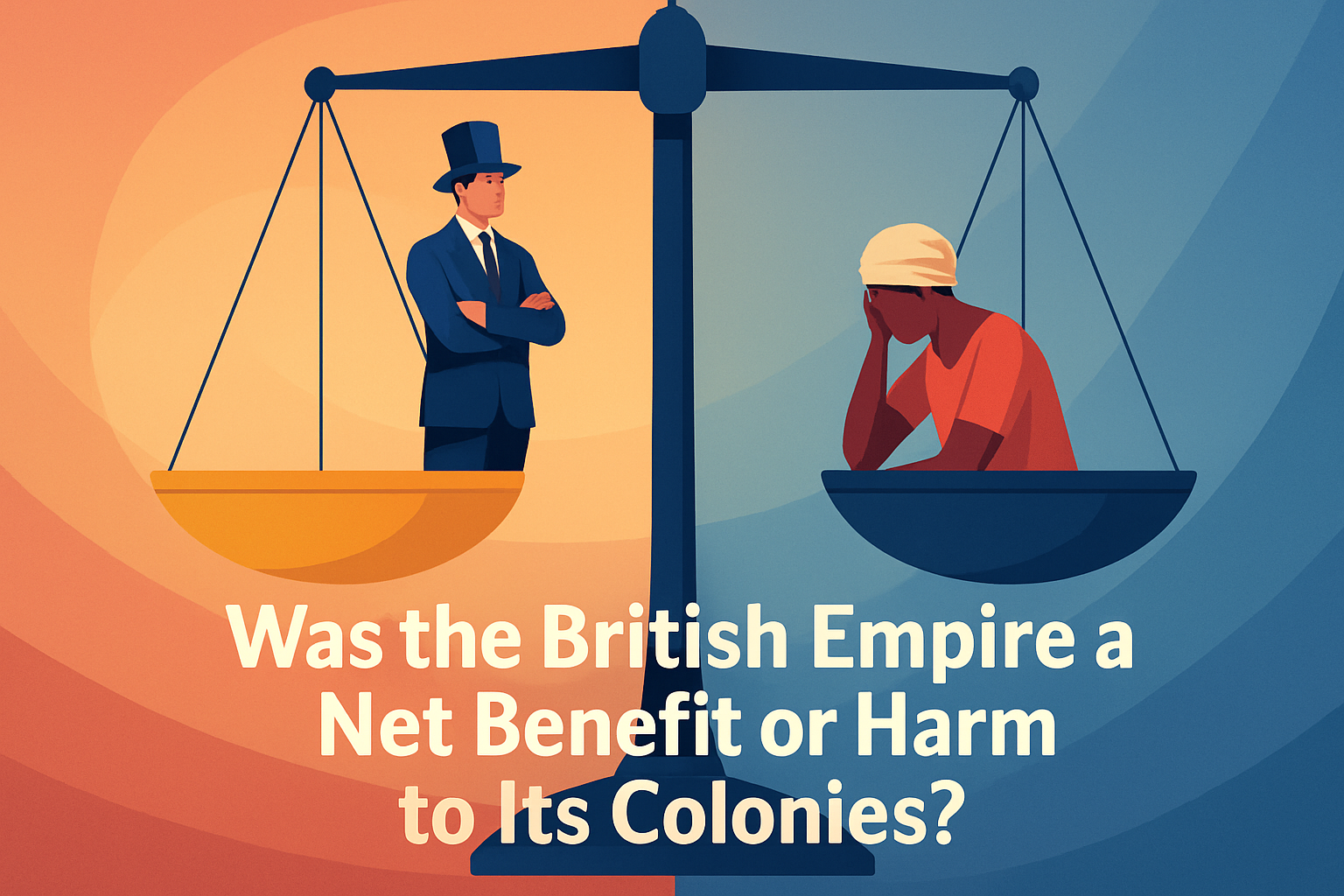
Few historical topics are as contentious and wide-ranging as the legacy of the British Empire. At its height, the British Empire was the largest empire in history, covering vast territories across continents, including Asia, Africa, the Americas, and Oceania. The influence of the British Empire is still felt today through language, culture, political systems, and economic structures. While it undeniably transformed these regions, the question remains: was the British Empire ultimately a net benefit or harm to its colonies?
Understanding the impact of the British Empire requires a nuanced view of history. Definitions of “benefit” and “harm” vary depending on historical perspective, cultural context, and the specific colony in question. For some, benefits are measured in terms of modernization, infrastructure, education, and global integration. For others, harm is more important, focusing on exploitation, cultural erosion, and inequality. This article aims to explore these dualities, helping readers to form their own informed opinion about the legacy of British colonialism.
The significance of examining the British Empire’s impacts extends beyond academic curiosity. It informs modern discussions about reparative justice and the decolonization movement, which advocate for addressing historical wrongs to foster equitable futures. As former colonies navigate their postcolonial identities and legacies, understanding this complex past is pivotal in shaping their national narratives and policies.
Economic Legacies of the British Empire
The economic impact of British colonialism is one of the most debated aspects. Many argue that the empire helped to lay down the foundations for modern economic systems, while others point to how extraction economies impoverished local populations.
One shining example often cited as an economic success is India. During British rule, infrastructure such as railways, telegraph lines, and ports were developed substantially. By the time of India’s independence in 1947, the country had over 40,000 miles of railways, facilitating domestic and international trade. Proponents argue that these developments helped India integrate into the global economy, laying groundwork for its current boom.
However, this came at a significant cost. The British economic policy in India was primarily extractive. It favored cash crop cultivation over subsistence farming, which made local economies vulnerable to international price fluctuations and famines. The infamous Bengal Famine of 1943, which resulted in millions of deaths, is often linked to colonial economic policies prioritizing military supplies in wartime over local food needs.
Socio-Political Transformation and Governance
The British Empire introduced Western governance structures, legal systems, and political institutions in their colonies. In many places, this was hailed as a step towards modernity and democracy. As colonies gained independence, several adopted British parliamentary systems which continue to this day.
For example, Australia’s governance system is heavily based on British legal principles and parliamentary democracy, which has contributed to its political stability and robust institutions. As a part of the British Commonwealth, Australia maintains ties that foster political and economic cooperation.
Yet, the imposition of British governance often disregarded existing political and social structures, leading to long-term socio-political disruptions. In many African colonies, borders were arbitrarily drawn without regard to ethnic and cultural divisions, sparking conflicts that linger today. Nigeria, for instance, faced significant post-independence strife due to ethnic tensions inflamed, in part, by colonial boundary decisions.
Cultural Impact and Identity
The cultural implications of British colonialism are profound, characterized by both assimilation and cultural suppression. On one side, the spread of the English language has become a unifying medium for international communication, contributing to globalized culture and commerce.
English became the lingua franca in many former colonies, enabling them to participate more fully in global conversations. Nigeria, with over 500 local languages, uses English as its official language to ensure effective governance and global engagement.
Conversely, colonial policies often suppressed local languages and traditions, leading to the erosion of cultural identities. Many native traditions were marginalized or deemed inferior, a situation reflected in Australian Aboriginal communities where languages and customs are endangered due to past assimilation policies.
Health and Education Systems
In many colonies, the British introduced modern medical practices and built educational institutions, which may be seen as long-lasting benefits. In countries like India, renowned institutions like the Indian Institutes of Technology have their roots in the colonial education system styled after British universities.
Medical advancements were also significant, with the establishment of hospitals and introduction of modern medicine, notably reducing mortality from diseases such as smallpox and cholera. Such developments laid the groundwork for improved public health systems.
However, these developments often skewed pre-existing local practices and knowledge. Traditional forms of healing and education were sidelined, with Western approaches dominating practices. The intent behind educational systems was also questioned, as they were often designed to create an administrative class to serve colonial aims rather than truly empower the population.
| Aspect | Perceived Benefits | Perceived Harms |
|---|---|---|
| Economy | Infrastructure, global trade integration | Extraction policies, economic vulnerability |
| Politics | Democratic institutions, legal frameworks | Ethnic conflicts, loss of traditional authority |
| Culture | Cultural exchange, lingua franca | Cultural erosion, identity crisis |
| Health/Education | Medical advancements, educational institutions | Marginalization of traditional practices |
Resource Exploitation and Environmental Impact
The resource extraction policies of the British Empire profoundly impacted environmental and ecological landscapes. British industries fueled by resources extracted from colonies left lasting environmental footprints. For instance, in regions like West Africa, intensive monoculture practices led to deforestation and soil degradation, impacting local agriculture long after independence.
Fiji offers an illustrative case where the sugarcane plantations, introduced by British entrepreneurs, drastically altered the ecology and economic structure. The introduction of Girmitiyas (indentured laborers) from India to work on these plantations not only changed the demographic profile of the islands but had lingering effects on race relations and environmental conservation efforts.
While the Empire brought technological advances like railways and mining techniques, it often did so without consideration for environmental sustainability or indigenous ecological knowledge, causing irrevocable changes to the landscape.
Summary and Reflection
Understanding the British Empire’s impacts involves balancing perceived benefits against undeniable harms. While the empire facilitated developments in infrastructure, governance, and global connectivity, it often did so through exploitative means, significant cultural disruption, and environmental degradation. The narrative of the British Empire varies widely across regions, reflecting diverse experiences and perspectives.
For modern readers, dissecting this complex legacy offers valuable insights into contemporary global relations and social justice issues. It encourages a dialogue on how to rectify historical wrongs and advances calls for equitable economic and cultural policies in affected regions. A critical examination of colonial histories not only informs past understanding but shapes how the world addresses ongoing inequality and fosters inclusive global development.
The call to action is not to simplify this historical narrative but to embrace its complexity as a path to understanding and reconciling with it. By educating ourselves about the nuanced legacies of colonial empires, we are better equipped to engage in meaningful discourse and take informed actions towards a more equitable future.
Frequently Asked Questions
1. How did the British Empire impact the economies of its colonies?
The British Empire had a profound and lasting impact on the economies of its colonies, both positive and negative. On the positive side, the British often introduced new technologies and infrastructure, including railways, telegraphs, and ports, which facilitated trade and communication. They also established legal and administrative systems that could provide a framework for economic development. However, these developments were often designed primarily to serve British interests, focusing on extracting resources and opening up new markets for British goods rather than developing a diversified local economy.
The economic policies imposed by the British emphasized cash crop cultivation, mining, and resource extraction. This focus often disrupted local economies and led to a dependency on fluctuating global markets. Profits from colonial economies were frequently repatriated to Britain, limiting local reinvestment and stunting long-term economic growth. Moreover, traditional industries and crafts sometimes faced competition from British goods, leading to their decline. Overall, while there were moments of economic growth under British rule, many colonies emerged with economies that were structurally imbalanced and heavily reliant on the former colonial power even after gaining independence.
2. Did the British Empire contribute to the development of governance and political systems in its colonies?
The British Empire did contribute to the development of governance and political systems in many of its colonies, but the nature and effectiveness of these contributions varied widely. British colonization introduced concepts such as the rule of law, representative institutions, and bureaucratic governance, which influenced political developments in some regions. India, for example, saw the establishment of the Indian Civil Service, which was modeled on British administrative practices and remains a key part of the modern Indian government.
However, the political systems imposed by the British were often designed to maintain control and limit effective local self-government. Colonies were typically ruled through a combination of direct British administration and collaboration with local elites. Representative institutions, where they were introduced, often had limited powers and were not always representative of local populations. Moreover, the arbitrary drawing of borders and favoritism towards certain groups exacerbated ethnic, religious, and social tensions that lingered long after the end of British rule. Thus, while the British Empire did lay some of the groundwork for modern political systems, it also left a legacy of political instability and division in many former colonies.
3. How did British imperial rule affect the cultural landscape of its colonies?
British imperial rule had a significant and lasting impact on the cultural landscapes of its colonies. One of the most visible influences is the widespread use of the English language, which remains a global lingua franca and an official language in many former colonies. British colonial education systems propagated English literature, history, and values, which continue to be a part of many former colonies’ educational curricula.
Cultural exchanges did occur, with colonial subjects influencing British culture and vice versa. However, British rule also often entailed efforts to suppress or undermine local traditions, religions, and languages in favor of Western ones, leading to a loss of cultural heritage and identity in some cases. The construction of cultural institutions like museums, libraries, and universities introduced Western ideas of knowledge and culture that sometimes overshadowed local ones. While these institutions contributed to education and cultural exchange, they were also used to promote British culture as superior. Overall, while British rule introduced a global cultural dimension, it often did so at the cost of local culture and identity.
4. Did the British Empire improve healthcare and education in its colonies?
In terms of healthcare and education, the British Empire did introduce some advancements that benefited the colonies, but these were often unevenly distributed and primarily served British interests and the urban elite. The British established hospitals, medical schools, and public health initiatives, introducing modern medical practices that helped combat local diseases and improve overall health outcomes in some regions. However, these facilities were often inadequately funded and accessible only to a small fraction of the population, particularly in rural areas.
In education, the British influence led to the establishment of Western-style schools and universities, which educated a generation of colonial subjects. Higher education opportunities were expanded, with some colonies seeing the foundation of prestigious universities that continue to exist today. However, education systems were primarily designed to create a local administrative workforce to serve colonial needs rather than to empower local populations. Indigenous education systems were often neglected or dismantled, and the majority of the population had limited access to education beyond basic levels. While these introductions laid groundwork for future development, the benefits were compromised by inequality and lack of widespread access.
5. Was the British Empire’s impact on its colonies’ social structures ultimately positive or negative?
The impact of the British Empire on the social structures of its colonies was significant, resulting in both positive and negative changes. The introduction of Western social hierarchies and norms often disrupted traditional societies, leading to the decline of indigenous social institutions and altering gender roles, family structures, and community dynamics. British colonial policies sometimes reinforced existing social stratifications by collaborating with local elites to govern, thus entrenching hierarchies and societal divisions.
On the positive side, British rule also led to some social advancements, such as the abolition of practices deemed inhumane by the British, including slavery in some regions and certain oppressive local traditions. Increased urbanization and the development of new social classes brought about by industrialization and trade opened up new opportunities for social mobility for some individuals. However, these benefits were often unevenly distributed, with the majority of the population continuing to face systemic inequalities, discrimination, and limited access to resources. The imposition of British social norms and values often clashed with indigenous cultures, creating tensions and lasting cultural disruptions. The legacy of British social policies remains complex, with both positive contributions and negative consequences that continue to influence former colonies.