
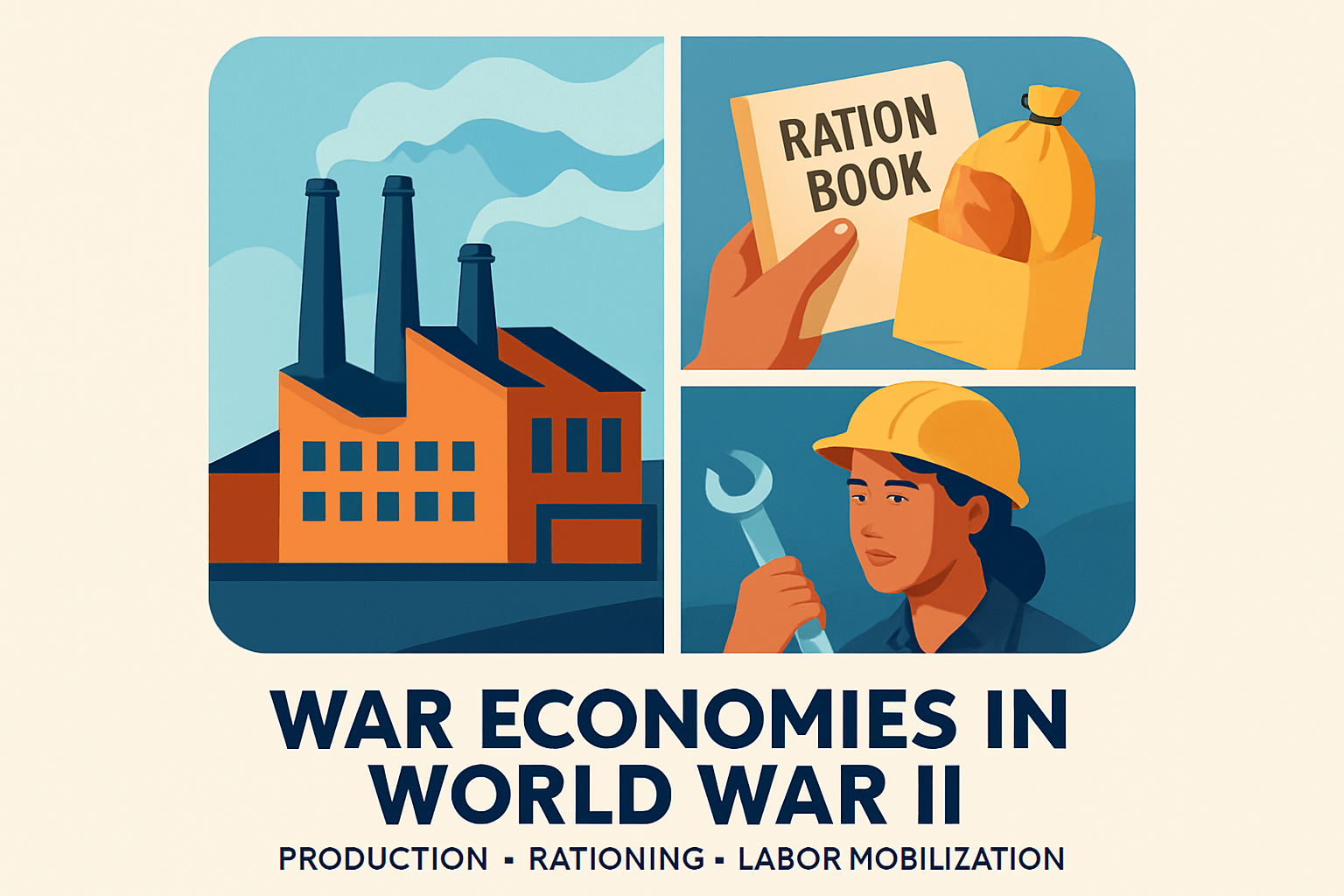
War economies in World War II transformed entire societies by redirecting industry, labor, finance, and daily consumption toward military victory. A war economy is an economic system in which the state coordinates production priorities, allocates scarce materials, controls prices, and mobilizes workers to sustain armed conflict. In World War II, this meant factories stopped making peacetime consumer goods and began producing tanks, aircraft, rifles, ships, trucks, and ammunition at unprecedented scale. It also meant civilians accepted ration books, shortages, wage controls, longer working hours, and government planning that reached into households as well as heavy industry.
Having studied wartime production systems closely, I have found that three forces explain why some nations converted faster and performed better than others: production management, rationing discipline, and labor mobilization. These forces were tightly linked. A country could not flood the front with aircraft if aluminum, rubber, steel, and fuel were still being used freely in civilian markets. It could not keep munitions plants running if workers were untrained, underfed, or drafted into the army without replacement. It could not maintain morale if rationing appeared unfair or black markets expanded. The war economy was therefore not just about manufacturing output; it was about administering scarcity without breaking social order.
The major combatants approached this challenge differently. The United States relied on massive industrial capacity, federal contracting, and coordination through agencies such as the War Production Board. Britain combined centralized controls with detailed rationing systems and a long experience of blockade management. Nazi Germany pursued rearmament before 1939 but only shifted to fuller mobilization later, especially under Albert Speer after 1942. The Soviet Union used extreme central planning, factory relocation, and brutal labor discipline to outlast invasion and rebuild output east of the Urals. Japan mobilized industry too, but resource shortages, shipping losses, and limited industrial depth constrained results.
This subject matters because World War II was won not only on battlefields but also in mines, shipyards, rail networks, farms, and kitchens. Production rationing and labor mobilization determined how many weapons reached the front, how long civilians tolerated deprivation, and whether governments could sustain total war. Understanding these systems explains why the Allies eventually overwhelmed the Axis with material superiority, why women and colonial workers became essential to wartime labor forces, and why postwar states emerged with stronger administrative capacity. It also helps modern readers see the enduring lesson of wartime economics: logistics, organization, and fair allocation often decide outcomes as much as strategy or courage.
Production Conversion and State Control
The first task of a World War II war economy was conversion: turning peacetime industry into military industry fast enough to matter. In the United States, automobile plants that had produced cars for civilian buyers began manufacturing tanks, aircraft engines, jeeps, and bombers. Ford’s Willow Run plant became a symbol of mass production applied to war, assembling B-24 Liberator bombers on a moving line. General Motors, Chrysler, and other firms operated under government contracts that specified output, schedules, and material priorities. This was not laissez-faire capitalism in wartime clothing. It was a managed system in which the federal government used procurement, priorities, and financing to direct private industry toward military goals.
Britain had to act even earlier because it faced direct threat and severe import constraints. The Ministry of Aircraft Production, created in 1940, coordinated design, subcontracting, and output in a sector central to survival during the Battle of Britain. Factories were dispersed to reduce bombing risk, and shadow factories expanded capacity beyond established firms. Civilian construction and nonessential manufacturing were curtailed so machine tools, skilled engineers, and raw materials could be concentrated in strategic sectors. In practical terms, war production depended on thousands of administrative decisions: which factory received steel first, which rail lines carried coal, which machine tools were reassigned, and which product lines were cancelled.
Germany demonstrates the cost of delayed full mobilization. Hitler’s regime rearmed heavily in the 1930s, but consumer considerations, service rivalries, and overlapping bureaucracies limited efficient concentration. After military setbacks and the death of Fritz Todt, Albert Speer rationalized procurement from 1942 onward, simplifying designs, standardizing components, and concentrating production. German armaments output rose sharply even under Allied bombing, showing how much slack had existed. Yet efficiency gains could not overcome structural shortages of oil, aluminum, rubber, transport capacity, and secure industrial geography. Production policy improved, but strategic conditions deteriorated faster.
Rationing: Managing Scarcity on the Home Front
Rationing in World War II was the organized distribution of scarce consumer goods to ensure military needs came first while preserving civilian health and morale. Governments rationed food, clothing, fuel, tires, gasoline, soap, and other essentials because unrestricted market demand would have produced inflation, hoarding, and politically damaging inequality. Britain’s system is often cited as the most comprehensive. Bacon, butter, sugar, meat, tea, and eggs were rationed, and families used coupons tied to official allowances. The policy was restrictive, but it was also designed around nutrition. Officials such as nutritionist Jack Drummond shaped food policy so limited diets still delivered basic caloric and vitamin needs, which helped Britain avoid the social breakdown that unchecked shortages could cause.
In the United States, rationing was broad but generally less severe than in Britain because domestic resources were larger. The Office of Price Administration administered coupons for sugar, meat, processed foods, gasoline, and shoes, while also imposing price ceilings to restrain inflation. Gasoline rationing was partly about conserving tires, since natural rubber supplies had been cut by Japanese conquests in Southeast Asia. This is a useful reminder that wartime shortages were interconnected. A shortage of rubber could reduce civilian driving, affect freight logistics, and force massive synthetic rubber programs, all at once. Rationing therefore worked best when tied to wider production strategy rather than treated as a stand-alone policy.
| Country | Main Rationed Goods | Administrative Goal | Key Challenge |
|---|---|---|---|
| Britain | Meat, sugar, butter, tea, clothing, fuel | Protect nutrition and equalize access | Import dependence under submarine threat |
| United States | Gasoline, sugar, meat, shoes, processed foods | Control inflation and redirect materials | Balancing abundance with military demand |
| Germany | Food, clothing, fuel, consumer goods | Sustain war effort and civilian order | Blockade pressure and shrinking resources |
| Soviet Union | Bread, food staples, clothing, fuel | Prioritize army and industrial workers | Devastation from invasion and dislocation |
Rationing always created tradeoffs. Done well, it promoted fairness and military efficiency. Done poorly, it expanded black markets and undermined trust. Germany and occupied Europe saw chronic shortages, substitution goods, and extensive illegal trading, especially as the war turned against the Axis. In the Soviet Union, rationing was highly unequal, with heavy industrial workers and soldiers often receiving priority over others. That hierarchy reflected military necessity but came at immense social cost. The central lesson is clear: rationing was never simply about reducing consumption. It was about deciding who would bear deprivation, in what order, and according to what standard of legitimacy.
Labor Mobilization: Women, Conscription, and Coercion
No war economy could function without workers, and World War II created labor shortages almost everywhere by drawing millions of men into military service. Governments responded by mobilizing women, older workers, teenagers, migrants, colonial labor, and, in some regimes, forced laborers. In the United States, the image of “Rosie the Riveter” captured a real structural shift. Women entered aircraft plants, shipyards, and ordnance factories in large numbers, taking roles once coded as male industrial work. By 1945, about one in four married women worked outside the home in the United States, and female employment in manufacturing rose dramatically. Training programs, workplace redesign, and propaganda all helped normalize this transition, though wage inequality and occupational segregation persisted.
Britain went even further in formal labor direction. The National Service Acts enabled the state to conscript not only soldiers but also labor, assigning women to factories, transport, agriculture, and civil defense. The Women’s Land Army addressed farm labor shortages by sending women into agricultural work essential to domestic food production. This mattered because U-boat warfare threatened imports, making domestic farming part of national defense. From an economic perspective, Britain treated labor as a strategic resource to be allocated, not merely recruited. That approach improved utilization but also required careful management of morale, housing, childcare, and transport.
The Soviet Union mobilized labor under harsher conditions than any other major Allied power. German invasion destroyed industrial regions, displaced millions, and forced entire factories to be dismantled and moved east. Workers, including many women and adolescents, endured extreme hours, poor housing, and strict discipline to restore output in the Urals, Siberia, and Central Asia. The achievement was enormous: Soviet factories produced vast quantities of tanks, artillery, and ammunition despite catastrophic early losses. But this was not an efficient labor market in the modern sense. It was emergency mobilization under authoritarian command, where absenteeism could be punished and human endurance substituted for comfort or choice.
Nazi Germany also relied heavily on labor mobilization, but increasingly through coercion. As German men entered the armed forces, labor deficits were filled with prisoners of war, civilians deported from occupied territories, and concentration camp inmates. By 1944, millions of foreign and forced laborers worked in the German economy. This expanded output in the short term, yet coercion carried serious limits. Forced workers were less productive, more likely to resist, and costly to police. In my assessment, Germany’s dependence on coercion is a crucial reason its labor mobilization never matched Allied resilience. A system built on terror can extract effort, but it struggles to generate initiative, skill retention, and stable morale.
Output, Logistics, and Why the Allies Won the Economic War
War production figures do not tell the whole story, but they reveal the scale of Allied advantage. The United States produced roughly 300,000 military aircraft during the war, along with tens of thousands of tanks, huge merchant fleets, and vast volumes of trucks and ammunition. Liberty ships, built in standardized designs, demonstrated how production engineering and modular methods could compress build times dramatically. The Soviet Union, meanwhile, produced highly effective armored vehicles such as the T-34 in enormous numbers, aided by design simplification and concentration on a smaller set of proven models. Britain sustained major aircraft and naval output while surviving blockade and bombing. These were not isolated industrial feats; they were the visible result of integrated war economies.
Logistics made output meaningful. A tank built but not fueled, transported, repaired, or supplied with ammunition was just stranded capital. This is where Allied economic organization outclassed the Axis. American industry supplied not only U.S. forces but also allies through Lend-Lease, sending trucks, locomotives, food, machine tools, aluminum, and fuel across global routes. Soviet offensives depended heavily on American trucks and rail materials even while Soviet factories supplied the weapons. Britain functioned as an armed logistics hub, coordinating shipping, convoy protection, and imperial resource flows. The economic war was therefore cumulative: high output strengthened logistics, and reliable logistics made high output operationally decisive.
The Axis powers could not solve their resource problems. Germany lacked adequate oil and was increasingly crippled by attacks on synthetic fuel plants and transport networks. Japan faced acute shortages of fuel, steel, and shipping after submarine warfare severed imperial supply lines. Even when factories remained standing, inputs often did not arrive in time. Strategic bombing alone did not win the war, but when combined with blockade, battlefield losses, and resource deprivation, it strained Axis economies beyond recovery. The final lesson is straightforward. World War II war economies succeeded when governments converted industry quickly, rationed fairly enough to preserve legitimacy, and mobilized labor at scale without destroying productivity. For anyone studying military history, economic policy, or state capacity, this is the essential insight: industrial organization and social discipline were weapons. Explore them closely, and the logic of Allied victory becomes far clearer.
Frequently Asked Questions
What is a war economy, and how did it function during World War II?
A war economy is a system in which governments redirect national resources toward military needs during a major conflict. In World War II, this meant the state took a much larger role in deciding what factories produced, how raw materials were allocated, where labor was needed, and which goods civilians could still buy. Instead of allowing markets alone to determine production, governments set priorities for steel, coal, oil, rubber, aluminum, food, transportation, and labor so that armies, navies, and air forces could be supplied on a massive scale. The goal was simple but enormous in practice: turn the entire productive capacity of a nation into an engine of war.
In practical terms, war economies transformed daily life as much as they transformed industry. Automobile plants switched to tanks and aircraft engines, consumer appliance manufacturers turned to munitions and communications equipment, and shipyards expanded rapidly to build cargo vessels and warships. Governments also imposed rationing, price controls, and centralized planning boards to prevent shortages, inflation, and competition between civilian and military sectors. Citizens experienced this through coupon books, restrictions on gasoline and meat, shortages of familiar household goods, and heavy pressure to save, work longer hours, and accept changes in consumption habits. World War II demonstrated that victory depended not only on battlefield strategy, but also on the ability to organize production, labor, and resources more efficiently than the enemy.
Why was rationing so important in World War II, and what items were commonly rationed?
Rationing was essential because wartime demand dramatically exceeded normal peacetime supply. Military forces required enormous quantities of food, fuel, metals, textiles, and rubber, leaving fewer goods available for civilians. At the same time, shipping disruptions, submarine warfare, territorial losses, and the diversion of industrial output to weapons made shortages more severe. Without rationing, wealthier consumers might have bought up scarce supplies, prices could have surged, and critical materials needed for military production might have been wasted on nonessential use. Governments used rationing to distribute limited goods more fairly while ensuring that armed forces and defense industries received top priority.
Commonly rationed items included gasoline, meat, butter, sugar, coffee, shoes, tires, and clothing, though the exact list varied by country. In some places, bicycles, soap, coal, and household fuel were also tightly controlled. Ration books and coupons became a routine part of everyday life, and people had to plan meals, travel, and purchases around their allotments. Rationing also encouraged repair, reuse, gardening, and substitution, with civilians urged to “make do and mend” rather than expect abundant consumer choice. Beyond economics, rationing had a psychological and political function: it reinforced the idea that everyone, including civilians at home, was participating in the war effort through sacrifice and discipline.
How did labor mobilization change the workforce during World War II?
Labor mobilization was one of the most far-reaching social transformations of the war. As millions of men entered military service, governments and industries faced urgent labor shortages in factories, mines, transportation systems, farms, and shipyards. To meet demand, states recruited workers on an unprecedented scale, expanded technical training, and shifted people across regions and sectors into defense work. The result was not just a larger workforce, but a reorganized one, with long hours, strict production targets, and a new emphasis on efficiency, standardization, and mass output.
Women entered industrial employment in far greater numbers, especially in countries such as the United States, the United Kingdom, and the Soviet Union, where they worked in aircraft assembly, munitions plants, transport, clerical administration, agriculture, and heavy industry. Colonial subjects, migrants, and minority populations were also drawn into wartime labor systems, though often under unequal conditions and discriminatory pay structures. In many countries, governments regulated wages, restricted job switching, and classified certain occupations as essential, making labor a strategic resource to be directed much like raw materials. In authoritarian regimes, labor mobilization could also include coercive and forced labor on a vast scale, showing that wartime productivity was sometimes built not only on patriotic participation, but also on compulsion and exploitation.
How did governments coordinate production and convert civilian industry into military production?
Governments coordinated wartime production through planning agencies, procurement systems, industrial directives, and direct partnerships with private firms. Rather than waiting for businesses to adapt on their own, the state identified strategic priorities and steered contracts, machine tools, transportation access, and raw materials toward industries considered most essential. This process is often called industrial conversion. Factories that had once produced refrigerators, automobiles, radios, and typewriters were redesigned to manufacture bombers, trucks, artillery shells, radar equipment, and engines. Conversion required more than changing assembly lines; it involved retraining workers, redesigning logistics, standardizing parts, expanding power supplies, and solving bottlenecks in steel, rubber, fuel, and skilled labor.
To make this possible, governments often created boards or ministries that coordinated contracts and balanced competing demands across the economy. They used production quotas, procurement guarantees, tax incentives, and cost controls to push output higher while trying to prevent waste and inflation. Scientific management, mass production techniques, and standardization became crucial because military needs were measured in staggering volumes. In the most successful war economies, industrial coordination allowed factories to produce weapons faster, cheaper, and in more uniform models, which simplified training, repairs, and supply. This administrative side of the war was less visible than combat, but it was absolutely decisive: armies could only fight if the economic system behind them delivered a continuous stream of equipment, fuel, food, and replacement parts.
What were the long-term effects of World War II war economies on society and postwar development?
The long-term effects were profound because wartime economic mobilization changed institutions, expectations, and social structures well beyond 1945. First, the war greatly expanded state capacity. Governments learned how to manage budgets on a huge scale, coordinate industry, collect data, regulate prices, and direct labor. Even after the war ended, many countries retained stronger central administrations, broader welfare responsibilities, and a closer relationship between government, science, and industry. Wartime research and manufacturing also accelerated technological change in aviation, electronics, chemicals, computing, medicine, and logistics, laying foundations for postwar economic growth.
Second, war economies reshaped social life and labor markets. The wartime entry of women into industrial and administrative work did not erase older inequalities, but it altered public expectations about gender and employment. Labor unions gained influence in some countries, while workers emerged from the war with stronger claims to social security, housing, education, and healthcare. At the same time, the burdens of mobilization exposed deep inequalities, including racial discrimination, colonial exploitation, and the use of forced labor. Postwar societies therefore inherited both the achievements and contradictions of wartime organization. In many places, the experience of shared sacrifice helped legitimize reconstruction programs and expanded public services, while the industrial infrastructure built for war was later redirected toward peacetime prosperity. In that sense, World War II war economies did not simply win the war; they helped shape the political and economic order of the postwar world.