
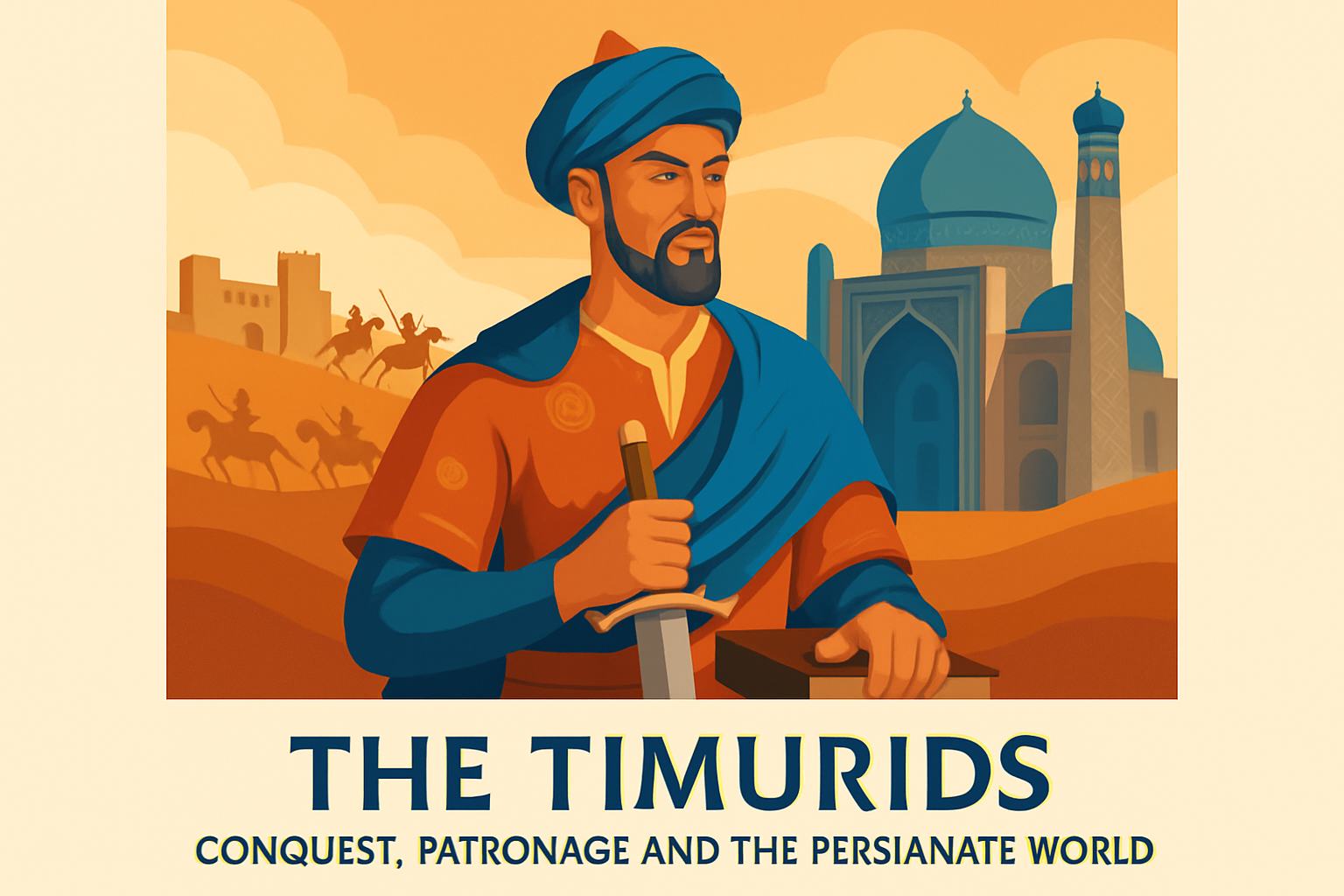
The Timurids transformed Eurasian history by coupling brutal conquest with extraordinary cultural patronage, creating a Persianate world that stretched from Transoxiana to India and left durable marks on politics, art, language, and memory. The term “Timurids” refers to the dynasty founded by Timur, known in the West as Tamerlane, whose campaigns in the late fourteenth century forged an empire across Central Asia, Iran, Iraq, and parts of Anatolia and India. “Persianate world” describes societies where Persian language, literary norms, courtly etiquette, and administrative habits shaped elite culture beyond ethnic Persia itself. I have worked extensively with Timurid chronicles, architectural programs, and manuscript traditions, and the pattern is unmistakable: military devastation and refined statecraft advanced together. That tension matters because the Timurids helped define how power was represented across the Islamic East, influencing the Ottomans, Safavids, Uzbeks, and especially the Mughals. Anyone studying empire, Islamic art, Persian literature, or Central Asian history eventually encounters the Timurid synthesis of violence, legitimacy, and cosmopolitan patronage.
Timur’s rise cannot be understood through simple labels such as “Mongol” or “Persian” alone. He emerged in Transoxiana after the fragmentation of the Chaghatayid realm, drawing legitimacy from Turco-Mongol steppe traditions while ruling increasingly sedentary, urban populations tied to Persian bureaucratic culture. Because he was not a direct descendant of Chinggis Khan, he could not claim full Chinggisid sovereignty, so he married into that lineage and governed through puppet khans while exercising actual authority as amir. This distinction is crucial: Timurid rulership rested on military charisma, redistribution of booty, and claims to restore order, but it also depended on scribes, scholars, jurists, architects, and revenue officials steeped in Persian and Islamic norms. The dynasty mattered not merely because it won battles, but because it institutionalized a model of rulership in which nomadic prestige and Persian urban sophistication reinforced one another. That fusion became one of the defining political languages of early modern Asia.
How Timur Built an Empire Through Mobility, Fear, and Legitimacy
Timur built his empire between the 1360s and his death in 1405 through a campaign system based on rapid cavalry movement, alliance management, siegecraft, and exemplary terror. His armies operated across enormous distances, defeating rivals in Khwarazm, Iran, the Golden Horde, the Caucasus, India, Syria, and Anatolia. The sack of Delhi in 1398 and the defeat of Ottoman sultan Bayezid I at Ankara in 1402 are among the most famous examples. Contemporary chroniclers such as Sharaf al-Din Ali Yazdi presented these wars as the reimposition of divinely favored order, but the practical mechanics were stark: rebellious cities were punished, artisans were deported, and wealth was redirected to Samarkand. I have seen this pattern repeatedly in Timurid sources; conquest was not random destruction but calculated extraction. Timur destroyed political competitors while relocating talent, including metalworkers, calligraphers, builders, and textile specialists, to his capital. Samarkand’s splendor therefore rested directly on coerced imperial circulation.
Fear was a deliberate instrument of governance. Timurid campaigns are infamous for mass killings and the construction of towers of skulls, reported in places such as Isfahan and Delhi. Modern historians rightly treat some numbers in medieval chronicles with caution, yet the larger point stands: Timur cultivated a reputation for overwhelming punishment to discourage resistance. At the same time, he sought legitimacy through Islamic patronage, restoration rhetoric, and Chinggisid symbolism. Friday sermons, monumental inscriptions, dynastic marriages, and the sponsorship of religious buildings signaled that conquest was not mere raiding. Timur aimed to appear as a universal sovereign protecting Sunni Islam, disciplining unruly rulers, and reviving proper hierarchy. This dual strategy helps explain his success. Terror alone rarely builds durable authority; it was terror combined with recognizable forms of legitimacy that enabled Timurid rule to survive his death, at least in core regions such as Transoxiana and Khurasan.
Why the Timurids Became a Persianate Dynasty
The Timurids became a Persianate dynasty because Persian offered the most effective language of administration, literature, diplomacy, and urban prestige across much of their empire. Their courts were ethnically mixed and politically rooted in Turco-Mongol traditions, but Persian became the dominant medium for chronicling kingship, composing poetry, issuing refined correspondence, and organizing elite culture. This was not a cosmetic choice. In practice, Persian secretaries, historians, and literati translated conquest into governance. Bureaucratic habits inherited from earlier Iranian and ইসলামicate polities gave Timurid rulers access to tested fiscal and administrative techniques. Persian also linked Samarkand and Herat to major intellectual centers from Tabriz to Shiraz.
Importantly, Persianization did not erase Turkic elements. Courts remained multilingual, and Chaghatay Turkic gained increasing literary prestige, especially under later princes. The most famous example is Mir Ali Shir Nava’i, who championed Chaghatay as a serious literary language while fully participating in Persianate high culture. This shows what “Persianate” actually means: not ethnic Persian dominance, but a shared civilizational framework in which Persian norms structured elite life even when rulers and many subjects spoke other languages. I often explain it to readers this way: the Timurid world resembled a cultural commonwealth. A ruler could prize steppe genealogy, sponsor Turkic verse, commission Arabic religious works, and still operate within a recognizably Persianate court system. That flexibility made the model exportable and explains its later success in Mughal India.
Samarkand and Herat as Centers of Art, Architecture, and Knowledge
Timurid patronage reached its most visible form in architecture and the arts of the book. Samarkand under Timur and Herat under Shah Rukh and Sultan Husayn Bayqara became two of the great capitals of the fifteenth-century Islamic world. The Bibi Khanum Mosque, Gur-e Amir mausoleum, Shah-i Zinda complex, and later the monumental ensembles associated with Ulugh Beg demonstrate a preference for axial planning, lofty pishtaq portals, double domes, glazed tile revetment, and mathematically controlled ornament. These buildings were not simply decorative. They staged sovereignty in urban space, turning architecture into political argument. Imported craftsmen from Iran, Azerbaijan, Syria, and India helped create forms that looked both imperial and transregional.
Herat, especially in the later fifteenth century, became equally important for manuscript painting, calligraphy, historiography, and poetry. The atelier associated with Kamal al-Din Bihzad set standards for composition, color balance, figural narration, and psychological detail that later Safavid and Mughal painters studied closely. Timurid book culture integrated paper production, script mastery, illumination, binding, and textual editing into a single prestige economy. Court libraries were not passive collections; they were production centers where scholars and artists collaborated under princely supervision. The Timurid achievement is clearest when viewed comparatively.
| Center | Primary Strength | Notable Patron | Lasting Influence |
|---|---|---|---|
| Samarkand | Imperial architecture and dynastic display | Timur, Ulugh Beg | Set visual language for Central Asian sovereignty |
| Herat | Manuscript arts, poetry, courtly refinement | Shah Rukh, Husayn Bayqara | Shaped Safavid and Mughal painting and letters |
| Shiraz | Literary continuity and scribal expertise | Timurid governors and local elites | Linked Timurid taste to older Iranian traditions |
Ulugh Beg’s observatory in Samarkand also reminds us that Timurid patronage included science. His Zij-i Sultani astronomical tables, produced with a team of scholars, ranked among the most accurate premodern observations. This was serious institutional science, not ornamental learning. In my experience, that detail changes how readers understand the dynasty: the same court culture that celebrated epic poetry also invested in mathematics, astronomy, and precise measurement.
Religion, Court Culture, and the Management of Authority
Timurid political culture was deeply Islamic, yet it was not reducible to simple piety. Rulers sponsored mosques, madrasas, shrines, Sufi lineages, and scholars of law, but they also used religion to stabilize contested power. The Naqshbandi order became particularly significant in Central Asia, while shrines across Khurasan and Transoxiana benefited from elite support. Patronage of descendants of the Prophet, jurists, and Sufi masters helped Timurid rulers anchor themselves in local moral landscapes. This mattered because conquest elites were often socially thin in newly acquired cities. Endowments, ceremonies, and public works translated military victory into civic legitimacy.
At court, authority was performed through etiquette, gift exchange, banqueting, titulature, and the controlled visibility of the ruler. Women of the dynasty also played consequential roles as patrons, mediators, and founders of religious and charitable institutions. Gawhar Shad, wife of Shah Rukh, is a prime example. Her mosque and madrasa projects in Herat and Mashhad demonstrate that Timurid cultural politics cannot be written as a male story alone. Yet there were clear limits. Succession remained unstable because no fixed rule of primogeniture prevailed. Princes governed appanages, built personal networks, and often fought one another. The brilliance of Timurid court culture existed alongside chronic factionalism, a contradiction that shaped the dynasty’s eventual fragmentation.
From Timurid Iran to Mughal India: The Dynasty’s Long Afterlife
The most consequential Timurid legacy unfolded after the original empire splintered. In Iran and Central Asia, Timurid political forms were gradually overtaken by rival powers, especially the Uzbeks in Transoxiana and the Safavids in Iran. Yet defeat did not erase influence. Timurid models of kingship, urban patronage, manuscript production, and Persian literary culture were absorbed by successor states. The clearest continuation came through Zahir al-Din Muhammad Babur, a Timurid prince who lost Samarkand, seized Kabul, and in 1526 founded the Mughal Empire in North India. Babur’s memoir, the Baburnama, preserves Timurid habits of observation, genealogy, and aesthetic judgment while describing a new imperial setting.
The Mughals carried Timurid and Persianate norms farther than Timur himself ever did. Under Humayun, Akbar, Jahangir, and Shah Jahan, the synthesis of Turco-Mongol lineage, Persian bureaucratic culture, and lavish artistic patronage matured into one of the early modern world’s most powerful imperial systems. Mughal painting drew on Herat precedents; Mughal historiography echoed Timurid chronicle styles; Mughal garden design and ceremonial kingship likewise reveal Timurid inheritance. Even the idea that an empire could legitimize itself through both conquest and curation owes much to Timurid precedent. For that reason, the Timurids are not a dead-end Central Asian dynasty. They are a hinge between the post-Mongol world and the great gunpowder empires that followed.
The Timurids matter because they demonstrate how empires can shape civilization through contradictory forces at once. Timur conquered with exceptional violence, but his dynasty also invested in the institutions, languages, and arts that defined the Persianate world for centuries. Their courts fused Turco-Mongol political traditions with Persian administration, Islamic legitimacy, and urban cultural prestige. Samarkand and Herat became models of imperial capital formation, while figures such as Ulugh Beg, Gawhar Shad, Ali Shir Nava’i, and Bihzad show the range of Timurid achievement beyond warfare alone. The dynasty’s greatest legacy may be methodological: it teaches historians to read conquest and culture together, not separately. Cities were devastated, yet scholars and artisans were gathered; political instability persisted, yet astonishing artistic coherence emerged. That is why the Timurids still command attention in world history, Islamic studies, and art history.
For readers exploring conquest, patronage, and the Persianate world, the essential takeaway is clear. The Timurids did not merely inherit older traditions; they reorganized them into a powerful transregional template that successor empires, especially the Mughals, adapted with lasting success. Understanding the dynasty means understanding how legitimacy is built through language, architecture, scholarship, and controlled memory as much as through armies. If you want to deepen that study, continue with Timurid architecture in Samarkand, Herat manuscript painting, and the Baburnama’s account of dynastic survival. Together, those sources reveal why the Timurid world remains one of the most important laboratories of imperial culture in Eurasian history.
Frequently Asked Questions
Who were the Timurids, and why are they so important in Eurasian history?
The Timurids were the ruling dynasty founded by Timur, the fourteenth-century conqueror often called Tamerlane in Western sources. From his Central Asian base, Timur built a vast empire through a series of military campaigns that reached across Transoxiana, Iran, Iraq, parts of Anatolia, and into India. His conquests were famously violent, and contemporary as well as later chroniclers emphasized both the scale of destruction and the speed with which his armies reshaped the political map. Yet the importance of the Timurids goes far beyond warfare. They created a dynasty that linked Central Asia, the Iranian world, and eventually South Asia in ways that permanently influenced politics, court culture, visual art, architecture, and literary life.
What makes the Timurids especially significant is the combination of military power and cultural ambition. Although Timur himself emerged from a Turco-Mongol political world, the dynasty he founded became one of the great patrons of Persianate civilization. Under Timurid rule, cities such as Samarkand and Herat developed into major centers of scholarship, manuscript production, architecture, poetry, and historical writing. Their courts attracted scholars, artists, calligraphers, theologians, and administrators from across the Islamic world. In that sense, the Timurids were not just empire builders; they were also empire curators, shaping a durable model of kingship and culture that influenced later dynasties, most notably the Mughals in India. Their historical importance lies precisely in this paradox: they were remembered both for devastation and for one of the most brilliant cultural flowerings of the late medieval and early early modern Persianate world.
What does the term “Persianate world” mean in the context of the Timurids?
The phrase “Persianate world” refers to a broad zone of societies in which Persian language, literary forms, courtly values, bureaucratic practices, and artistic conventions carried high prestige, even where Persian was not the everyday spoken language of the majority. It does not mean that all these regions were ethnically Persian or politically united under a single state. Rather, it describes a shared cultural sphere stretching across parts of Central Asia, Iran, Afghanistan, and South Asia, where Persian served as a major language of administration, intellectual exchange, poetry, and elite identity. In the Timurid context, this concept is especially useful because the dynasty ruled over ethnically and linguistically diverse populations while relying heavily on Persianate institutions to organize power and express legitimacy.
Under the Timurids, Persian became a key language of governance, historical writing, and refined literary production. Court historians crafted narratives that linked Timurid rule to older Iranian and Islamic models of sovereignty, while poets and scholars used Persian to articulate ideals of kingship, ethics, beauty, and learning. At the same time, the Persianate world was not static or narrowly ethnic. It absorbed Turkic, Mongol, and Islamic elements and reworked them into new political and cultural forms. The Timurid courts are a classic example of this blending. Their rulers drew on steppe traditions of military authority, Islamic claims to legitimacy, and Persian models of urban court culture all at once. That synthesis helped create a Persianate ecumene that was flexible, portable, and influential far beyond the dynasty’s original homeland.
How did the Timurids combine brutal conquest with extraordinary cultural patronage?
This is one of the defining features of Timurid history. Timur’s campaigns were marked by calculated violence, mass killings, forced migrations, and the destruction of rival urban centers. He used terror as a political tool, intending not only to defeat enemies but to intimidate future opponents and display overwhelming authority. Entire regions were destabilized by his invasions, and the human cost was immense. However, conquest also generated the conditions for a new form of imperial accumulation. Wealth, skilled labor, and artistic talent were transferred from conquered territories to Timurid centers, especially Samarkand. Artisans, architects, metalworkers, calligraphers, and scholars were often relocated and put to work in service of dynastic prestige.
The result was an empire that could be deeply destructive in one setting and intensely creative in another. Timurid rulers and princes sponsored monumental architecture, lavish manuscripts, scientific study, gardens, and sophisticated courtly ceremony. Their patronage was not a contradiction of conquest so much as an extension of it. Victorious rule had to be displayed materially, intellectually, and aesthetically. Great mosques, madrasas, mausoleums, and illustrated books became statements of power, legitimacy, and universal ambition. By the fifteenth century, especially under rulers and patrons such as Shahrukh, Ulugh Beg, and the cultural elites of Herat, Timurid lands witnessed a remarkable flourishing of art and learning. So the dynasty’s legacy cannot be understood through warfare alone; its cultural achievements were inseparable from the imperial structures built by conquest, even when those structures rested on violence.
What were the major cultural achievements of the Timurid era?
The Timurid era is widely regarded as one of the high points of Persianate and Islamic artistic culture. In architecture, the dynasty became famous for monumental building projects distinguished by grand scale, geometric planning, soaring domes, and dazzling tilework in blues and turquoises. Samarkand in particular was transformed into an imperial showcase, while Herat later emerged as an equally important center of refined urban culture. Timurid patronage also elevated manuscript production to exceptional levels. Illustrated histories, epics, and poetic collections were copied in elegant scripts and enriched with sophisticated miniature painting. These manuscripts were not simply books; they were luxury objects that reflected elite taste, political ideology, and technical mastery.
The dynasty also made major contributions to literature, historiography, and science. Persian poetry thrived, and courts sponsored writers who preserved, adapted, and expanded classical traditions. At the same time, Chagatai Turkic gained prominence as a literary language in certain Timurid circles, showing that Timurid culture was multilingual even as it remained deeply Persianate in orientation. Historical writing also flourished, producing chronicles that shaped how the dynasty and its predecessors would be remembered. In science and scholarship, the most celebrated example is Ulugh Beg, the Timurid prince and astronomer who supported major observational work and built an important observatory in Samarkand. Altogether, Timurid achievements mattered not only because they were impressive in their own time, but because they established aesthetic and intellectual models that later courts, especially the Mughal court, would inherit and adapt.
How did the Timurid legacy shape later states such as the Mughals in India?
The Timurid legacy had a profound afterlife, especially in South Asia. The Mughal dynasty, founded by Babur in the early sixteenth century, explicitly claimed Timurid descent and treated that connection as a source of prestige and legitimacy. Babur inherited not just a genealogical claim, but a political and cultural inheritance rooted in Central Asian kingship, Persianate courtly ideals, and the memory of Timur as a world conqueror. Even though the Mughal Empire developed under very different conditions in India, its ruling culture carried unmistakable Timurid features: dynastic self-consciousness, love of gardens and planned urban spaces, patronage of Persian literature, refined manuscript arts, and a vision of monarchy that fused military authority with cultural magnificence.
More broadly, the Timurids helped transmit and intensify the Persianate norms that would become central to many Islamic courts across Asia. Persian remained an elite language of administration and literary expression in Mughal India for centuries. Artistic practices associated with Timurid ateliers influenced Mughal painting, book arts, architecture, and ceremonial life. The idea that a powerful ruler should also be a patron of scholars, poets, and builders was deeply embedded in the Timurid model and became fundamental to later imperial self-fashioning. Even beyond direct dynastic descent, the Timurid example shaped political memory. They were remembered as both fearsome conquerors and makers of civilization, and that dual image continued to influence how later rulers imagined empire. In this sense, the Timurid legacy did not end with the fragmentation of their original domains; it lived on through institutions, aesthetics, language, and imperial ideals across the wider Persianate world.