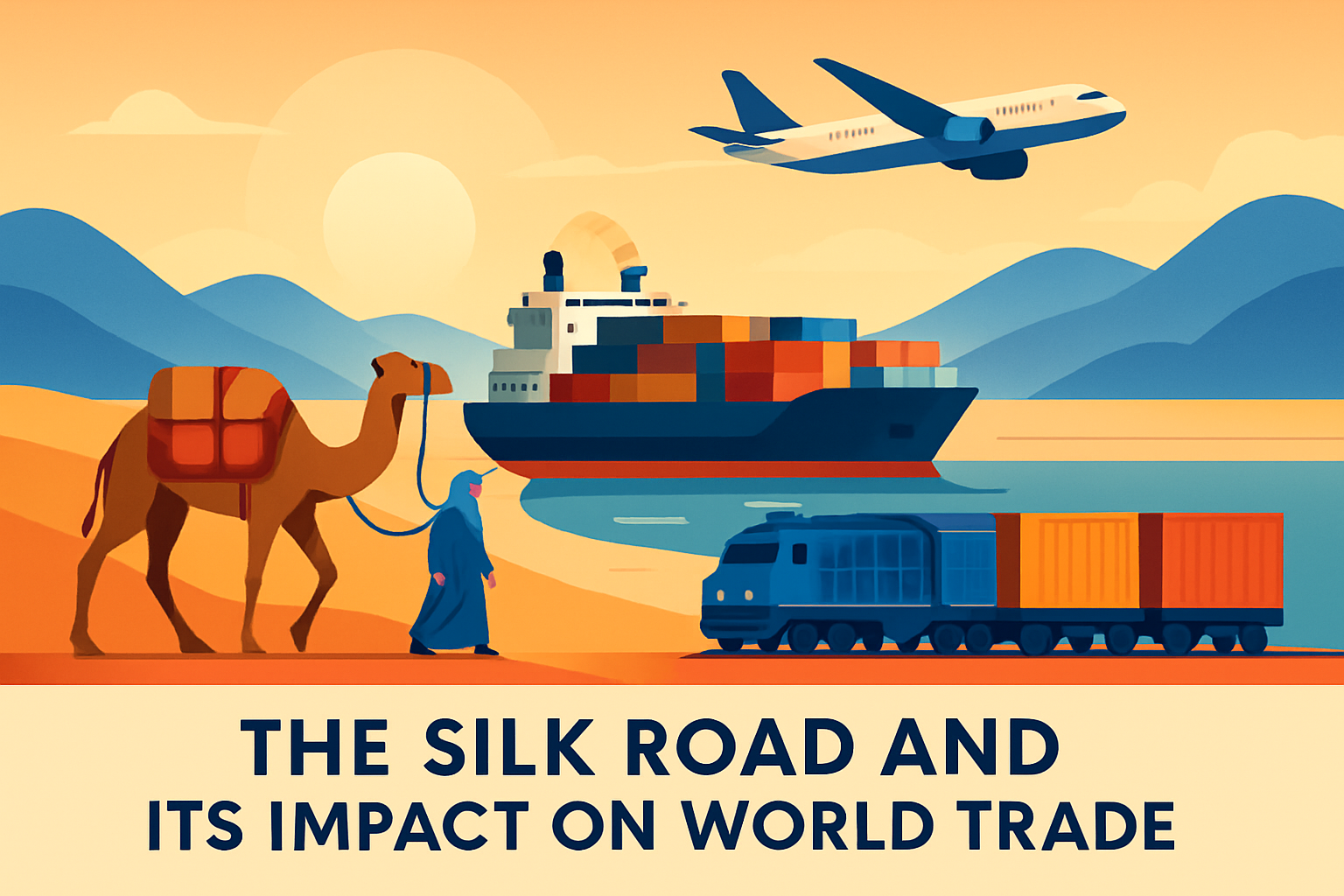
The Silk Road, a term often synonymous with ancient trade and cultural exchange routes, holds a significant place in world history for its role in connecting the East and West. Originating during the Han Dynasty (207 BCE to 220 CE) in China, it extended for over 4,000 miles across Asia, reaching as far west as Europe. The Silk Road was not a single road but a web of interconnected trade routes that facilitated the exchange of goods, ideas, religion, and technology across numerous civilizations. This ancient network of trading pathways revolutionized commerce, fostering economic and cultural ties between distant lands. By creating avenues for silk, spices, and other luxury goods, the Silk Road played a fundamental role in establishing early globalization, impacting economies and societies. Understanding the Silk Road is crucial not only to appreciate the history of international trade but also to gauge its lasting influence on cultural integration and economic practices, which continue to resonate in modern global trade dynamics.
The Cultural and Economic Landscape of the Silk Road
The Silk Road was a major conduit for cultural and economic exchange, influencing the regions it connected for centuries. Culturally, the Silk Road was not just about goods; it was a tapestry of interconnected civilizations, each contributing unique aspects of their cultures to a shared human experience. Religious ideas, such as Buddhism, Zoroastrianism, and later Islam and Christianity, traveled along these paths, shaping societies along the way. Artistic influences and scientific knowledge were exchanged, enriching each region.
Economically, the Silk Road was a catalyst for the development of cities, facilitating urbanization and wealth accumulation. Key cities like Samarkand and Bukhara in Central Asia emerged as vibrant trade hubs. These cities became melting pots of diverse cultures, facilitating not only trade but also the exchange of ideas and technological innovations that would fuel further economic growth.
Trade Goods and Their Impact
Numerous goods traveled the Silk Road, with silk being the most famous. Originating in China, silk was highly coveted in the West. However, the trade routes carried far more than silk. Spices, precious stones, ceramics, incense, and other goods traversed the vast distances, each impacting the economies of the regions they touched. Chinese porcelain was another highly prized item that spread through these routes, affecting European tastes and ceramics production for centuries.
- Silk: Luxurious fabric that became a symbol of status.
- Spices: Essential in cuisine and as preservatives, driving the spice trade.
- Ceramics: Advanced techniques spread, influencing European craftsmanship.
- Precious Metals and Stones: Bridges of wealth between civilizations.
This exchange of goods had a profound impact. For instance, Roman society was greatly influenced by silk from China. Its introduction into Roman attire and decor signified an elevation of sartorial elegance, affecting social dynamics and economy within the empire. Meanwhile, spices imported from India through Central Asia were valuable not only for enhancing food but also for medicinal purposes, underpinning a robust trade network around these items.
The Spread of Ideas and Religion
While the Silk Road is often associated with trade, it was equally influential in the spread of ideas and religion. Buddhism spread from India into Central Asia, China, and beyond, often facilitated by traders and monks traveling the route. The transmission of religious texts and the establishment of monasteries along the Silk Road played a critical role in disseminating Buddhist teachings.
Significant in this context was the historic journey of the Chinese monk Xuanzang in the 7th century, who traveled to India in search of sacred texts. His journey not only reinforced religious ties between these regions but also contributed to linguistic and cultural exchange. Xuanzang’s travels highlighted the Silk Road’s role as a vector of religious and cultural diffusion, resulting in a rich tapestry of shared spiritual and philosophical contexts.
Technological and Scientific Exchanges
Scientific and technological knowledge also flowed along the Silk Road, profoundly impacting the development of various civilizations. Paper, invented in China, made its way westward, revolutionizing record-keeping, literature, and administration across the Silk Road. Similarly, technologies such as printing, gunpowder, and weaving techniques were shared, reshaping industries in the process.
The concept of the astrolabe, crucial for navigation, spread from the Islamic world along the routes. This facilitated advancements in navigation that later played a crucial role during the Age of Exploration. Furthermore, medicinal knowledge, such as herbal remedies and surgical techniques, traversed these routes, enhancing the medical practices across different regions.
Modern Implications and Lessons from the Silk Road
In contemporary times, the concept of the Silk Road has been revived through initiatives like China’s Belt and Road Initiative (BRI), aiming to recreate similar trade connections and economic collaboration among a myriad of countries spanning Asia, Africa, and Europe. This modern embodiment of the Silk Road retains the spirit of enhancing trade relationships but also addresses infrastructure and geopolitical dynamics.
| Traditional Silk Road | Modern Belt and Road Initiative |
|---|---|
| Silk, spices, and luxury goods | Energy resources, infrastructure projects |
| Cultural and religious exchange | Information technology and economic partnerships |
| Ancient trade routes with natural landscapes | Advanced railways, ports, and digital connectivity |
This revival acknowledges the Silk Road’s historical significance while embracing current global trade’s complexities. It offers lessons on the benefits and challenges of interdependence among nations. The Silk Road’s legacy reminds us of the potential for peace and prosperity when diverse cultures engage in mutual exchange.
Conclusion: The Enduring Legacy of the Silk Road
The Silk Road’s legacy is its testament to the enduring power of human connection and exchange. Through its network of trade routes, it facilitated the movement of goods, cultures, religions, ideas, technologies, and peoples, impacting civilizations in profound ways. It laid the groundwork for modern trade and cross-cultural interactions and remains a powerful symbol of the potential for human endeavor to overcome distance and difference in pursuit of mutual benefit.
Understanding the Silk Road is integral to comprehending the evolution of international commerce and cultural exchange, providing insights into shaping contemporary global relations. As we seek to navigate a future interconnected world, the Silk Road serves as a historical example of how collaboration and exchange can lead to mutual growth and progress.
The enduring lesson is clear: Embracing diversity and fostering connections through trade and dialogue can lead to shared prosperity, emphasizing the importance of building on this ancient foundation for a more connected and cooperative global community. Encourage others to explore the rich history of the Silk Road and consider incorporating its lessons of exchange and collaboration into today’s globalized world.
Frequently Asked Questions
1. What exactly was the Silk Road, and why is it so important in world history?
The term “Silk Road” refers to a historical network of trade routes that spanned from China to Europe, around 4,000 miles. Its importance stems from its role as a major conduit for economic, cultural, political, and technological exchanges that profoundly influenced the world. Originating during the Han Dynasty, it wasn’t just a single road but a complex web of overland and maritime paths. These trade routes facilitated the movement of goods such as silk from China, spices from India, gold and silver, glassware, and countless other items. But it was more than just silk; the road served as a melting pot for ideas, religions like Buddhism and Islam, technologies, and even innovations like paper and gunpowder from the East that eventually impacted the West. Its influence was monumental in creating interconnectedness across continents, altering economies, and igniting the creativity that fueled cultural revolutions. By linking diverse cultures, the Silk Road sowed the seeds for globalization as we know it today.
2. How did the Silk Road impact trade and commerce in the ancient world?
The impact of the Silk Road on trade and commerce was transformative, as it opened new markets and facilitated the exchange of not only luxury goods but also everyday commodities. Economically, it revolutionized trade, making it possible for merchants to transport goods across thousands of miles. This led to the thriving of caravan cities—bustling hubs of activity like Samarkand and Bukhara—where merchants from different lands traded wares, amassed fortunes, and exchanged knowledge. The sheer breadth of goods that moved along the Silk Road was staggering, from silk to silver, and ceramics to camels. The introduction of currency and credit further enabled trade across such vast distances. The mantling of taxation and tariffs along the routes also gave rise to powerful empires that benefitted from the prosperity brought by commerce. Moreover, trade along the Silk Road led to a blending of culinary, artistic, and architectural influences that shaped societies. It essentially laid the groundwork for a commercial ecosystem that enhanced intercontinental connections.
3. In what ways did the Silk Road influence cultural exchange and religious diffusion?
The Silk Road was a catalyst for cultural exchange and religious diffusion on an unprecedented scale. As traders moved along these routes, they brought more than just goods; they carried stories, culture, traditions, and beliefs. The influence of the Silk Road in spreading religions is perhaps one of its most enduring legacies. Buddhism, for example, traveled from India to China and further along to Korea and Japan, largely through missionary monks and traders who used the road. Similarly, Zoroastrianism moved from Persia, while Islam spread not just to Central Asia but as far as Southeast Asia and Africa. Cultural practices mingled as well, leading to innovation in arts and crafts, to the blending of musical traditions, and to the enriched cuisines that borrowed spices and recipes from diverse regions. The very notion of trade routes as conduits for knowledge and ideas helped establish a shared human heritage, contributing to a sense of connected human history. The Silk Road became a platform for a kaleidoscope of exchanges that laid the foundation for the cultural richness and complexity we see across regions today.
4. What technological and intellectual advancements spread through the Silk Road?
The Silk Road’s role in the dissemination of technology and knowledge was monumental. It was through this trade network that many of the world’s most transformative innovations traveled. The East-West exchange saw technologies like papermaking and printing methods move westward, altering written communication and its accessibility along the way. The introduction of gunpowder from China revolutionized warfare in Europe and the Middle East. Agricultural innovations such as new crop varieties and irrigation techniques also traveled these routes, spurring agricultural productivity in distant lands. Likewise, medicines, alchemical processes, and navigational advancements found their way across the Silk Road, influencing medical, chemical, and maritime technology. Intellectually, the Silk Road facilitated the spread of mathematical concepts from India, including the use of zero, impacting future European developments in mathematics. Philosophies, scientific knowledge, and artistic techniques exchanged through traveler encounters enriched civilizations. The network operated much like a vast open book filled with collective wisdom shared among its numerous participants, contributing impressively to the progress of humanity.
5. What led to the decline of the Silk Road, and what was its lasting legacy?
The decline of the Silk Road was gradual and multi-faceted, with several interrelated factors contributing to its dwindling use. Geographic and political challenges such as the development of more direct maritime trade routes, especially those pioneered during the age of discovery, steered global trade away from the overland routes. The rise of powerful empires that controlled large swathes of the road, such as the Mongol Empire, acted initially as a unifying force but later fragmented to contribute to instability and decline. The advent of the Ottoman Empire further diminished its importance by controlling key crossroads and fostering alternate routes. However, the most profound impact came from the Black Death in the 14th century, which erased significant populations and disrupted established trade networks across Asia and Europe. Despite its decline, the legacy of the Silk Road endures in its historical role as a linkage of continents that laid a relational and economic framework still evident in global trade today. Modern-day initiatives like China’s Belt and Road show the enduring influence of these ancient paths in ambitions to recreate the global connectiveness they once fostered, illustrating their timeless relevance.