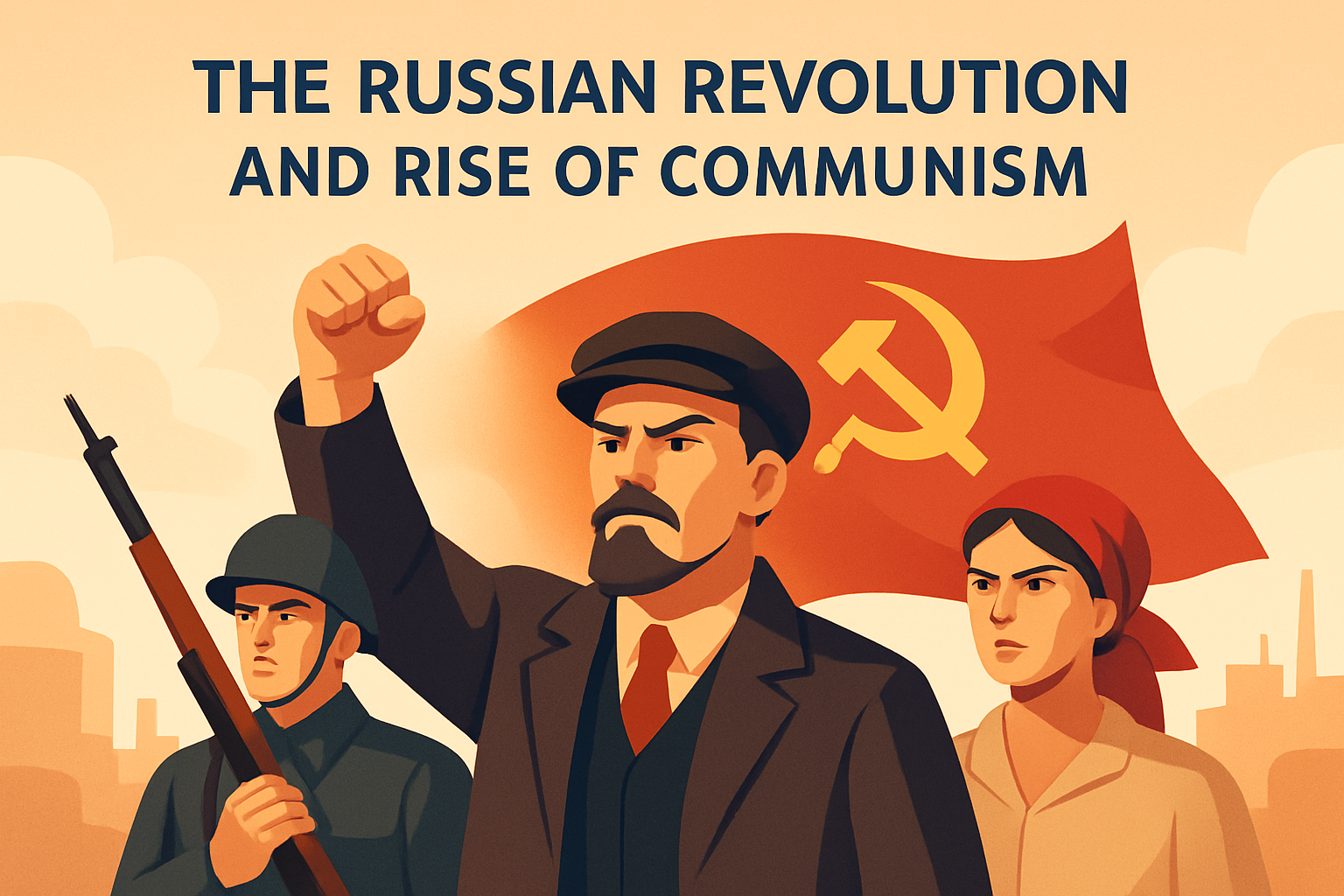
The Russian Revolution marks a monumental event in the 20th century, altering the socio-political landscape of not just Russia but the entire world. The essence of this revolution hinged on overthrowing Tsarist autocracy and establishing a society based on the principles of communism. Understanding the Russian Revolution requires delving into its socio-economic roots, key developments, and eventual outcomes. This revolutionary period holds enormous significance because it illustrates the power of collective human will in societal transformation, provides lessons on governance and policy failures, and has had a lasting influence on global politics. It is essential to understand these dynamics to appreciate modern socio-political systems and the historical foundation of communism. This article will explore the intricacies of the Russian Revolution, its causes, influential figures, and its profound impact on world history.
The Socio-Economic Conditions Leading to Revolution
The Russian Revolution of 1917 did not emerge in a vacuum; it was preceded by decades of social unrest and economic discontent. Russia, under Tsar Nicholas II, was an absolute monarchy plagued by inefficiency, corruption, and drastic social inequalities. The majority of Russians were peasants living in squalor, subjected to feudalistic conditions despite the monumental changes elsewhere in the world due to industrialization. Urban workers, who were growing in number, lived similarly miserable lives, working long hours under poor conditions for meager wages.
Industrialization in Russia occurred rapidly but inefficiently. The few industrial centers that arose were overburdened with workers, creating labor disputes and heightening class tensions. The discontent was further exacerbated by Russia’s involvement in World War I, which strained the economy, led to significant casualties, and deepened public dissatisfaction with the Tsarist regime.
The February Revolution: The End of Tsardom
The culmination of years of social turmoil occurred in February 1917, when the first revolution erupted. This revolution was surprisingly spontaneous, initially sparked by protests driven by food shortages and mounting public frustration. The unrest quickly spread, leading to widespread strikes by workers and demonstrations throughout Petrograd.
A critical factor in the success of this revolution was the massive desertion of Russian soldiers, who sided with the protestors. This mutiny represented a colossal crack in the Tsarist foundation, making it insurmountable for Tsar Nicholas II to maintain control. As a result, he abdicated the throne on March 2, 1917, ending centuries of Romanov rule and transferring power to the Provisional Government. It was thought that this government would pave the way for a fairer democratic society. However, the Provisional Government failed to address critical reforms or withdraw from the unpopular war, leading to continuous societal unrest.
The October Revolution: The Birth of Bolshevik Russia
Discontent with the Provisional Government’s inability to initiate significant reformations opened the door for the Bolsheviks, led by Vladimir Lenin, to rise in popularity and influence. Lenin promised “peace, land, and bread,” resonating deeply with war-weary soldiers, frustrated workers, and impoverished peasants. Adhering to Marxist ideology, the Bolsheviks sought to kindle a classless societal system.
In October 1917, with key Bolshevik figures such as Leon Trotsky orchestrating efforts, the Bolsheviks successfully disrupted the Provisional Government, capturing the Winter Palace in Petrograd with minimal violence. The Bolsheviks declared the establishment of a Soviet government and withdrew from World War I, negotiating peace with Germany in the Treaty of Brest-Litovsk. This maneuver assured the Bolsheviks an initial wave of support, although later geopolitical and socio-economic challenges quickly emerged.
| Key Events of 1917 | Description |
|---|---|
| February 1917 | Mass protests against the Tsar lead to his abdication and formation of the Provisional Government. |
| October 1917 | The Bolsheviks overthrow the Provisional Government, leading to the establishment of Soviet Russia. |
The Russian Civil War: Solidifying Soviet Control
Though the Bolsheviks had gained control, their governance was immediately challenged, leading to a bloody civil war (1917-1922) between the Red Army (Bolshevik forces) and the White Army (anti-Bolshevik factions, covering monarchists, capitalists, and moderate socialists). This war produced widespread devastation, further impoverishing the Russian people and causing millions of deaths from battle and famine.
The Bolsheviks, however, were successful in unifying their support through propaganda, the promise of land reforms, and the implementation of War Communism, a policy that nationalized businesses and requisitioned surplus grain to support the army and urban workers. A significant advantage was the Red Army’s centralized command and determination to defend the nascent Soviet state against multiple enemies.
By 1922, Lenin and the Bolsheviks emerged victorious, solidifying their control over the newly formed Union of Soviet Socialist Republics (USSR). This marked the establishment of a single-party state under communist principles, drastically contrasting with its Tsarist predecessor.
Impact on the Global Stage
The Russian Revolution marked a pivotal juncture in world history due to its implications far beyond Russia’s borders. The rise of communism challenged capitalist ideologies and prompted political and ideological struggles worldwide. The Bolshevik model inspired numerous revolutions and liberation movements globally, contributing to the spread of communist parties and ideologies across Europe, Asia, Africa, and Latin America.
A notable example is China, where the Russian Revolution provided a model for the Chinese Communist Party, leading eventually to the Chinese revolution of 1949. The spread of communism ignited the Cold War, a geopolitical and ideological standoff primarily between the United States and the Soviet Union, profoundly influencing global politics, economy, and conflicts for decades.
The Legacy of the Russian Revolution
The legacy of the Russian Revolution is multifaceted. It demonstrated the potential for revolutionary socialism, laying the groundwork for Marxist policies and literature to flourish. The revolution’s success suggested that a different socio-economic order was not only possible but could offer solutions to the deep socio-economic divides apparent worldwide. It set the stage for nationalized industries, planned economies, and the welfare state concepts that various governments would experiment with throughout the 20th century.
The Bolsheviks, through their eventual transition to the Stalinist regime, showcased the potential dangers of a centralized autocracy masquerading as a people’s government. This contributed to the portrayal and perception of communism as tyrannical, influencing public policies and governance today. Ironically, while the revolution sought equality, it unveiled the potential for totalitarian regimes to exploit revolutionary rhetoric for personal or party gain.
Concluding Remarks: Lessons and Implications
The Russian Revolution not only reshaped Russia but reverberated globally, redefining political ideologies and reshaping geopolitical alignments. It stands as a historical case of the power dynamics between the proletariat and those in power, offering critical lessons for modern governance and social justice movements. The transition from Tsarist rule to communism illustrates the profound societal shifts possible through collective willingness to challenge established norms.
For today’s reader, the Russian Revolution encourages reflection on contemporary socio-political inequalities and the imperative need for systematic reforms that ensure equity and justice. It highlights the risks of disconnection between policymakers and the public’s grievances. As a call-to-action, analyzing this period urges us to actively engage with our governance systems, demanding transparency and accountability.
The revolution’s legacy underscores democracy’s value and the vigilance required to safeguard freedoms in any system. Understanding its components fortifies our grasp of history’s role in shaping our contemporary world, urging constant reflection and informed action to better our societies.
In closing, while the revolution provides extensive historical insight, its enduring message compels us to practice awareness, engagement, and critical analysis within our modern socio-political ecosystems.
Frequently Asked Questions
1. What were the main causes of the Russian Revolution?
The Russian Revolution was primarily fueled by a mix of socioeconomic issues, political discontent, and significant military failures. Let’s dive deeper into these:
Socio-economic issues: Russia in the early 20th century was largely agrarian with a significant portion of its population living as peasants in poverty. The country had been slow to industrialize compared to Western Europe, and the peasants often faced food shortages and subsequent uprisings due to harsh living conditions and limited rights. Coupled with a growing class of industrial workers in urban areas, there was significant unrest.
Political discontent: The autocratic rule under Tsar Nicholas II was widely criticized. He failed to implement meaningful political reforms that many in the middle and working classes sought. The severe restrictions on political freedoms and failure of the Duma (a legislative assembly) to effectively challenge the Tsar’s power led to increased opposition.
Military failures: The horrors and pressures of World War I exacerbated internal tensions. Russia suffered severe military defeats, which demoralized soldiers and destabilized the country even further. Heavy losses at the front lines, along with dire conditions at home, made support for the Tsar plummet, ultimately acting as a spark that ignited the revolution.
2. Who were the key figures in the Russian Revolution?
Several pivotal figures played critical roles in the Russian Revolution, shaping its course and outcomes:
Vladimir Lenin: As the leader of the Bolshevik Party, Lenin was instrumental in the October Revolution, which ultimately brought the Bolsheviks to power. His beliefs and charismatic leadership were central to the revolution’s success.
Leon Trotsky: A key organizer and leader of the Bolshevik military efforts, Trotsky played a vital role in the planning and execution of the October Revolution. As a gifted orator and strategist, he helped the Bolsheviks consolidate power during the civil war.
Nicholas II: The last Tsar of Russia, his inability to address the needs of the Russian populace effectively led to the collapse of the Romanov dynasty. His abdication marked the end of centuries-old monarchy.
Alexandra Kollontai: An influential Bolshevik, Kollontai was a staunch advocate for women’s rights and worked towards social reforms, especially involving the rights and roles of women in society.
3. How did the Bolsheviks manage to seize power during the Russian Revolution?
The Bolsheviks’ successful seizure of power can be attributed to strategic planning, tactical foresight, and effective utilization of prevalent discontent. Here’s how they did it:
Tactical alliances and propaganda: The Bolsheviks promised “peace, land, and bread,” which resonated with war-weary soldiers, land-hungry peasants, and urban workers alike. Their message aligned with the immediate demands of various social groups, increasing their support base.
Exploiting war fatigue: The ongoing failures in World War I left the Russian military and population exhausted. Lenin and the Bolsheviks condemned the war and promised to withdraw, gaining substantial support from demoralized soldiers and civilians alike.
Control over critical infrastructure: The Bolsheviks took strategic control of communication and transportation networks, such as telegraph offices and railway stations. This move prevented the provisional government from organizing a coherent defense and allowed the Bolsheviks to coordinate operations effectively.
Influence within soviets: The Bolsheviks gained influential positions within the soviets (workers’ councils), which enabled them to leverage the collective voices of discontented workers and soldiers. This grassroots support was key in legitimizing their coup as a popular uprising.
4. What were the immediate effects of the October Revolution on Russian society?
The October Revolution had profound and immediate impacts that reshaped Russian society and governance:
Dissolution of the provisional government: Once in power, the Bolsheviks dissolved the provisional government, effectively ending any attempt to establish a liberal democratic regime. This liquidation marked the beginning of one-party Bolshevik rule.
Land redistributions: The Bolsheviks issued decrees that redistributed land to the peasantry, seizing it from private landowners and the former aristocracy. This move aimed at placating the peasant majority and consolidating their support.
Peace negotiations: Efforts to exit World War I succeeded with the Treaty of Brest-Litovsk, albeit at the cost of substantial territorial concessions to Germany. This decision divided Russian sentiment, offering respite from war but also stirring nationalist affront.
Societal upheaval: The sweeping social changes instigated widespread economic disarray and triggered a multifaceted civil war. The country split between the ‘Reds’ (Bolsheviks and allies) and ‘Whites’ (anti-Bolshevik forces), leading to a prolonged period of conflict, hardship, and reconstruction.
5. How did the Russian Revolution pave the way for the rise of communism globally?
The Russian Revolution not only altered Russia but inspired and influenced socialist movements worldwide, setting the stage for the rise of communism globally in several ways:
Ideological beacon: The Bolsheviks, under Lenin, established the Soviet Union as the world’s first worker and peasant state premised on Marxist principles. This provided a tangible model for global communists, positioning the USSR as an ideological leader.
Comintern and international solidarity: The Bolsheviks initiated the Communist International (Comintern) to foster global communist movements by spreading revolutionary ideas and supporting socialist uprisings abroad. The USSR effectively became a hub for international revolutionary efforts.
Class and anti-imperialist movements: The Russian Revolution sparked enthusiasm among oppressed classes worldwide and invigorated anti-imperialist struggles. Seeing a proletariat overthrow an autocratic regime inspired similar movements in Europe, Asia, Africa, and Latin America.
World War II and aftereffects: The USSR emerged as a superpower post-World War II, often expanding its influence across Eastern Europe and other parts of the world. During the Cold War, the ideological battle between capitalism and communism reached unprecedented heights, further cementing communism’s role on the global stage.