Introduction to Geopolitical Influence in the Developing World
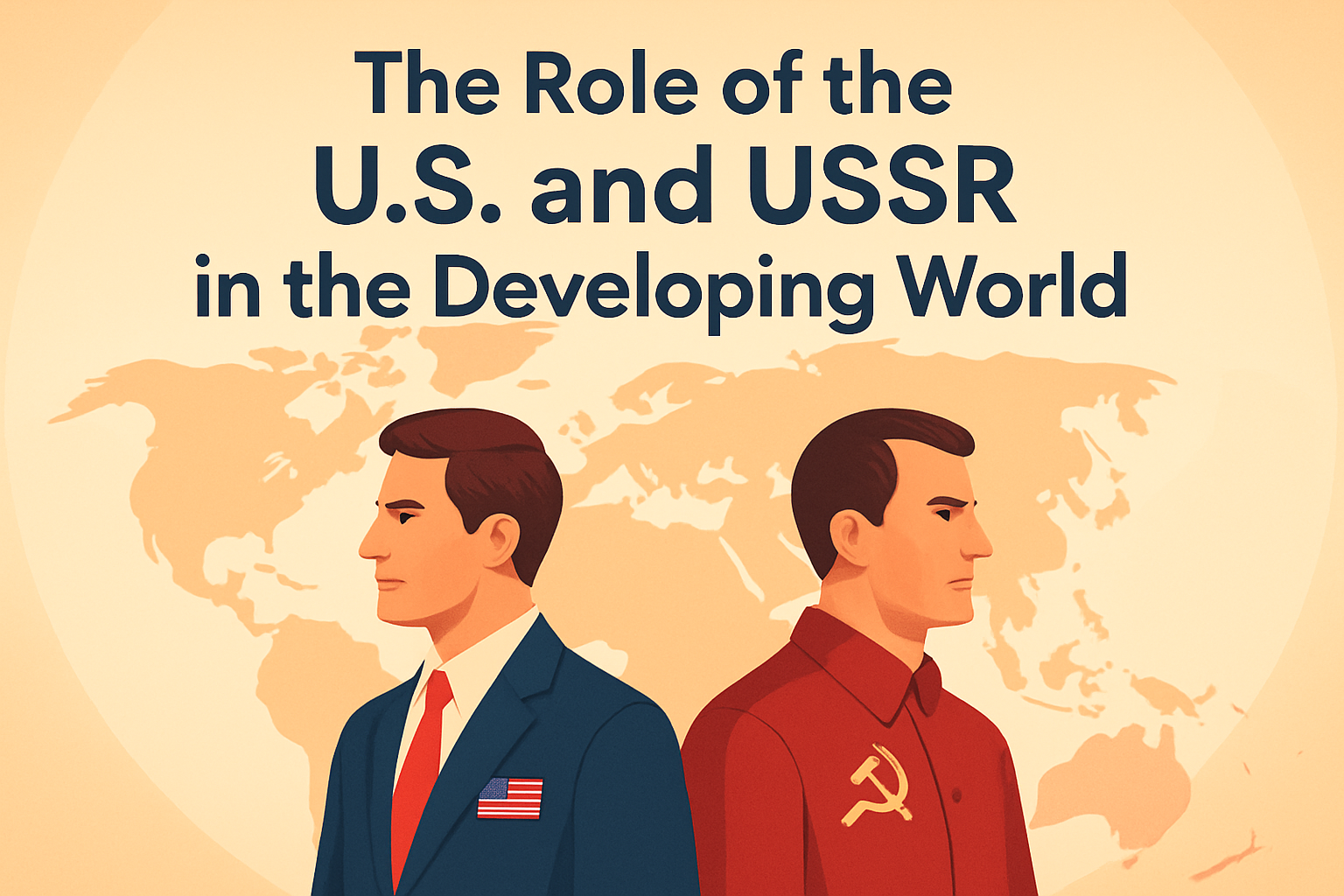
The mid-20th century was a defining period in global history, with two superpowers—the United States (U.S.) and the Union of Soviet Socialist Republics (USSR)—vying for ideological and political dominance on the world stage. This tug-of-war played out significantly in the developing world, which refers to nations with less industrialization and lower living standards compared to more developed countries. These two juggernauts left an indelible mark on these regions, intervening in political affairs, influencing economic structures, and introducing military aid. The impact of these interactions continues to shape the political, social, and economic landscapes of many countries today.
Understanding the role of the U.S. and USSR in these developing regions is crucial for appreciating the intricacies of current international relations. These superpowers wielded considerable influence during the Cold War era (1947-1991), a period of geopolitical tension characterized predominantly by the ideological battle between capitalism, championed by the U.S., and communism, promoted by the USSR. By investigating the nature of superpower interventions, economic strategies, and cultural influence, we can better comprehend the historical context that shapes the present-day dynamics between developed and developing nations.
Political Influence and the Fight for Ideological Supremacy
The geopolitical rivalry between the U.S. and USSR was primarily a struggle for political and ideological supremacy, focusing significantly on the developing world, where many nations were gaining sovereignty after the collapse of colonial empires. The superpowers employed different strategies to win allies, support regimes aligned with their interests, or destabilize those leaning towards the opposition’s ideology.
The United States often opted for interventions that supported pro-capitalist regimes, providing financial and military aid to safeguard their interests. An illustrative case is the U.S. intervention in Vietnam during the 1960s and 1970s. The American government got involved extensively to prevent the spread of communism in Southeast Asia, based on the domino theory, which suggested that the fall of Vietnam to communism would lead to a cascade of similar events throughout the region. This conflict, however, resulted in devastating consequences for Vietnam, highlighting the indelible scars left by superpower conflict on developing countries.
Conversely, the Soviet Union extended its sphere of influence by aligning with socialist-leaning liberation movements and governments. In Africa, the USSR intervened in countries like Angola and Mozambique, offering military support and economic aid to governments espousing socialist ideals. Their involvement in Angola during the Angolan Civil War (1975-2002) is a notable example. The Soviet support of the Popular Movement for the Liberation of Angola (MPLA) against U.S.-backed factions underscored their vested interest in promoting global socialism.
Economic Strategies: Aid, Trade, and Growth
The economic dimension of U.S. and Soviet involvement in developing countries was characterized by aid programs and trade agreements designed to secure loyalty and advance their respective ideological models. The economic interventions varied significantly, with each superpower adopting a distinct approach tailored to increase influence and foster dependency on their economic systems.
The United States implemented strategic economic aid plans, like the Marshall Plan (though initially limited to Europe), and similar programs in Asia, Africa, and Latin America under the auspices of modernization theory, which postulated that economic development would lead to political stability and democracy. A prominent example is the Alliance for Progress, launched in 1961, which aimed to establish economic cooperation between the U.S. and Latin America by providing $20 billion in aid for socioeconomic development over a ten-year period. Although the results were mixed, it demonstrated the U.S.’s commitment to curbing the spread of communism by promoting capitalism through financial assistance.
The Soviet Union employed a different economic approach by fostering socialist economies through trade agreements and direct financial assistance. An example can be seen in Cuba, where the Soviets provided substantial economic support after the Cuban Revolution, primarily through favorable trade terms and subsidies. The U.S. embargo against Cuba further cemented economic ties between Cuba and the USSR, as Cuba relied heavily on Soviet aid to sustain its economy and continue pursuing a socialist model.
| Country | U.S. Support | USSR Support |
|---|---|---|
| Vietnam | Military Intervention | Anti-American Ideals |
| Angola | Support of Anti-communist Factions | Support of MPLA Government |
| Cuba | Economic Embargo | Economic Aid and Trade Agreements |
Cultural Exchange and Influence
Besides political and economic maneuverings, both the U.S. and USSR engaged in cultural diplomacy to extend their influence and export their respective ideologies. Cultural exchanges, media broadcasts, and educational programs became vehicles for each superpower to promote its values and way of life.
The U.S. leveraged its cultural products, using television, films, and radio broadcasts to disseminate American ideals and culture. The Voice of America was instrumental in broadcasting American news, culture, and propaganda across the globe, illustrating the soft power tactics employed to win hearts and minds. Through initiatives such as the Fulbright Program, the U.S. also facilitated educational exchanges to promote mutual understanding and encourage students from developing countries to experience America’s capitalist society.
The USSR, by contrast, highlighted its achievements in science, technology, and sports to demonstrate the superiority of socialism. They organized cultural events, exhibitions, and sent educational delegations to showcase these triumphs. Soviet publications, translated into multiple languages, were circulated in developing nations, aimed at projecting the benefits of socialist society. The USSR’s emphasis on education and technical training was apparent in programs designed to educate students from developing countries in Soviet universities.
Military Interventions and Proxy Wars
The Cold War period was riddled with numerous conflicts in which the U.S. and USSR either supported opposing sides or became directly involved as part of their broader strategies to maintain influence over developing regions. These interventions often escalated into proxy wars, wherein both superpowers facilitated conflicts through indirect means without engaging each other head-on.
The U.S. involvement in Nicaragua during the 1980s provides a clear example of such a proxy war. The U.S. provided support to the Contras, a rebel group opposing the socialist Sandinista government, through funding and military aid. The ensuing conflict not only caused significant turmoil in Nicaragua but also stirred political controversy domestically within the United States.
Similarly, the Soviet Union’s invasion of Afghanistan in 1979 marked another pivotal military intervention in its pursuit to uphold a socialist regime against mujahideen rebels, who were backed by the U.S. and other Western allies. This decade-long conflict drained Soviet resources and significantly contributed to the eventual dissolution of the USSR. The U.S.’s proxy support in Afghanistan illustrates how both superpowers engaged in indirect military engagements to challenge each other while avoiding direct confrontation, further destabilizing developing countries caught in the crossfire.
Conclusion: The Lasting Legacy of Superpower Involvement
In conclusion, the involvement of the U.S. and USSR in the developing world during the Cold War era has left lasting footprints that continue to influence global geopolitics today. Through political alliances, economic strategies, cultural exchanges, and military interventions, both superpowers shaped the trajectories of numerous nations, leaving behind a legacy of conflict, development, and ideological transformation. The profound impact of these interactions serves as a reminder of the delicate nature of international relations and the importance of understanding past influences to navigate future challenges.
For policymakers, scholars, and citizens interested in international affairs, the lessons learned from these historical interventions highlight the significance of diplomatic engagement, inclusive development strategies, and cultural exchanges as peaceful means of diplomacy. By acknowledging and addressing the past influence of superpowers in the developing world, we can work toward a more balanced and cooperative international community.
Reflecting on the role of the U.S. and USSR provides valuable insights that encourage us to explore new approaches to fostering global cooperation, reducing conflict, and implementing sustainable development practices. Readers are invited to delve deeper into the historical experiences of countries affected by superpower intervention to better grasp the complexities of today’s global landscape and envision solutions that advocate for peace, prosperity, and shared progress.
Frequently Asked Questions
1. Why were the U.S. and USSR so interested in the developing world during the mid-20th century?
The mid-20th century was characterized by the Cold War, a geopolitical rivalry between the U.S. and the USSR. Both superpowers sought to expand their influence globally, and the developing world was a significant arena for this competition. Strategically, these regions held economic, political, and military importance. By aligning with developing nations, both the U.S. and the USSR could secure valuable resources, establish or bolster military bases, and spread their respective ideologies—capitalism and democracy versus communism and state control.
Moreover, during this era, many countries in Asia, Africa, and Latin America gained independence from colonial powers. The newly independent nations often lacked strong political institutions and economic stability, making them susceptible to external influence. The U.S. and USSR viewed these countries as potential allies that could tip the global balance of power. Ideologically, the U.S. was concerned about the spread of communism; likewise, the USSR sought to propagate its socialist ideals. For both, winning the hearts and minds of the developing world was essential to asserting global dominance.
2. How did economic aid play a role in the U.S. and USSR’s strategies in the developing world?
Economic aid became a critical tool used by both the U.S. and USSR to solidify their influence in the developing world. The U.S. utilized programs like the Marshall Plan in Europe, adapted for non-European countries through agencies like the U.S. Agency for International Development (USAID). By providing financial assistance, the U.S. encouraged economic development in a manner that aligned with capitalism and democratic governance. This aid often came with strings attached, such as requirements to purchase American goods or adopt certain economic policies.
The USSR, on the other hand, offered aid to burgeoning socialist states and sympathetic governments, typically focusing on state-owned enterprises and large infrastructure projects. This method aimed to prove the superiority of socialism by promoting its economic model as a viable alternative to capitalism. The Soviet Union invested in heavy industrial projects, agricultural collectivization efforts, and military assistance to further entrench its influence.
For both superpowers, economic aid was not purely altruistic; it was a strategic move to create loyal allies and ensure that these nations remained aligned with their benefactor’s ideological and political agendas.
3. What was the impact of military interventions by the U.S. and USSR in the developing world?
Military intervention by the U.S. and USSR in the developing world had profound and diverse impacts. For the U.S., a notable example was the Vietnam War, where the aim was to prevent the spread of communism in Southeast Asia. The U.S. engaged in extensive military campaigns, leading to a significant loss of life, economic cost, and eventually, a controversial withdrawal that influenced American foreign policy for years to come.
Similarly, the Soviet invasion of Afghanistan in 1979 was a pivotal military intervention where the USSR sought to support a pro-Soviet government amidst a growing insurgent threat. This invasion led to a decade-long conflict that drained Soviet resources and contributed to global criticism and isolation. The war in Afghanistan played a substantial role in the eventual dissolution of the Soviet Union.
Both powers faced challenges such as locally growing resistance and international condemnation, which demonstrated the limitations of military power in achieving long-term political goals. The interventions often led to instability, leaving lasting scars on local populations and further complicating U.S.-USSR relations.
4. How did cultural diplomacy feature into U.S. and USSR foreign policy in the developing world?
Cultural diplomacy was an integral aspect of U.S. and USSR strategies to win global support. The U.S. engaged in cultural exchanges, educational programs, and media initiatives to showcase American culture and values. Institutions like the Fulbright Program sponsored students and educators from developing countries to study in the U.S., hoping to cultivate positive perceptions and an appreciation for democratic ideals.
The USSR also engaged in robust cultural diplomacy efforts. It promoted the successes of Soviet art, music, science, and sports as evidence of the benefits of the socialist system. The USSR hosted students from developing nations, offering scholarships to study in Russian universities. Events like state-run exhibitions and broadcasting efforts sought to disseminate Soviet cultural achievements.
Both superpowers understood that cultural diplomacy could subtly influence public opinion and create goodwill, which was just as important as political and military strategies in securing alliances and advancing their interests in the developing world.
5. In what ways did the competition between the U.S. and USSR in the developing world impact the local political landscapes?
The geopolitical tug-of-war between the U.S. and USSR in the developing world deeply impacted local political landscapes in multifaceted ways. The competition often resulted in heightened political tension, with both superpowers supporting competing factions or governments. This support could destabilize nations with existing internal conflicts or create new ones, as seen with the civil wars in several African countries during the Cold War era.
In some instances, local leaders exploited Cold War tensions to acquire economic and military aid, often playing one superpower off against the other to gain some leverage. However, this external backing often came at a high price, with some governments undermined by becoming overly dependent on their superpower sponsors.
Additionally, the ideological battle influenced governance systems in the developing world, with some countries adopting socialist models aligned with the USSR, while others transitioned towards democratic and capitalist frameworks inspired by the U.S. These choices often set the political direction for decades, influencing their developmental trajectories long after the Cold War ended.