
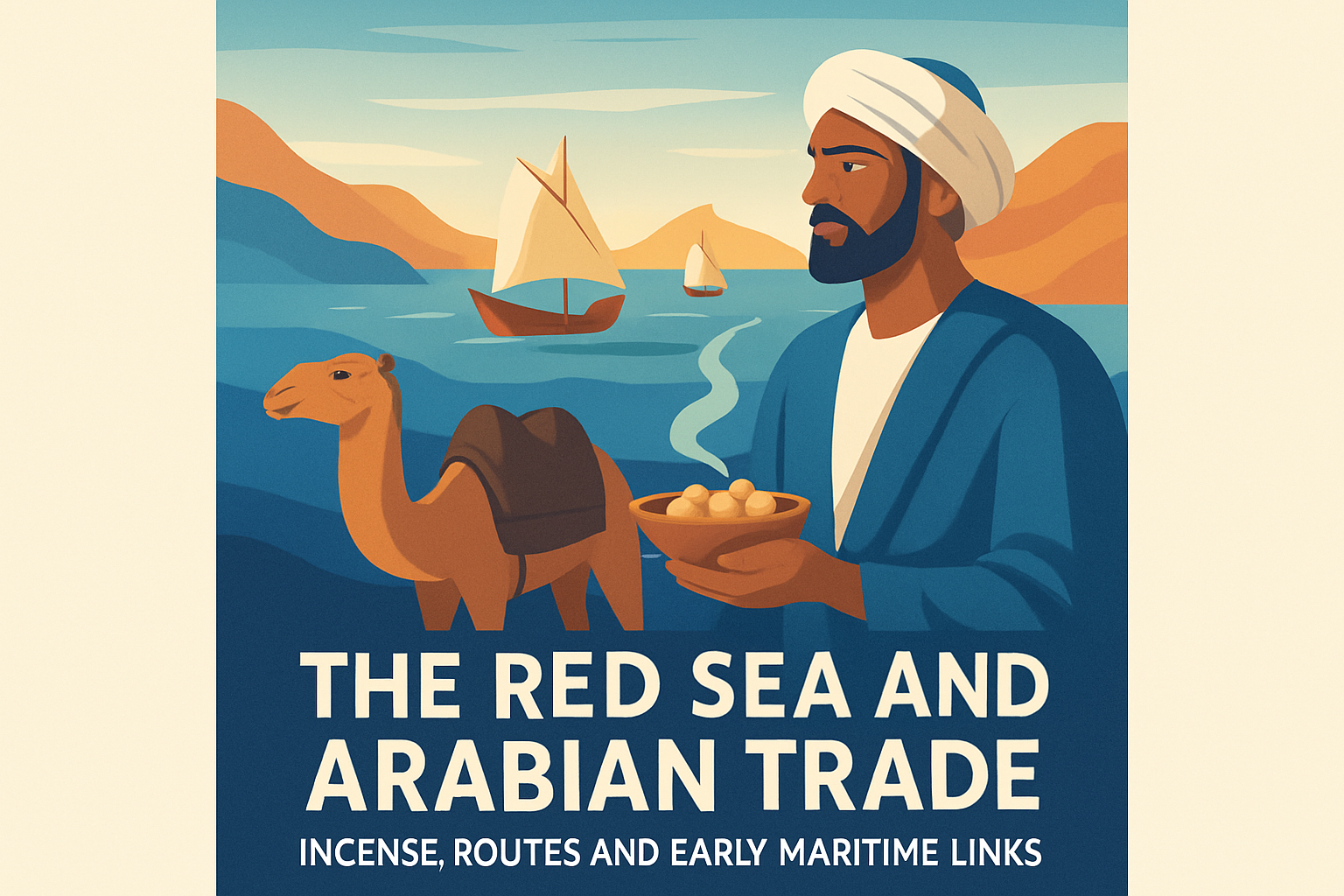
The Red Sea has served as a crucial maritime corridor linking various civilizations and formed an integral part of ancient Arabian trade. This connection, often referred to as the Incense Route, played a significant role in ancient commerce and cultural exchange. This topic is vital because understanding these early trade networks gives us insights into how economies, cultures, and societies were interconnected long before the modern era. The emphasis will be on the Red Sea and the Arabian Peninsula, exploring how the trade of incense among other commodities formed the backbone of early commerce and maritime activities.
Key terms in this discussion include the Incense Route, which was a network of major trading pathways that connected the Arabian Peninsula with the civilizations of Africa, Europe, and the Far East. This pathway facilitated the movement of goods like frankincense and myrrh from what is now Oman, Yemen, and Somalia, across the Arabian desert, and into booming markets of the ancient world. Maritime links refer to the sea routes that were supplemented by these land trades, primarily leveraging the navigable environments provided by the Red Sea.
By delving into these early trade routes, one can better appreciate how regions that are now part of modern Saudi Arabia, Yemen, Egypt, and elsewhere, contributed significantly to economic development. Furthermore, the subject helps highlight the historical importance of trade in shaping socio-economic structures and cultural dynamics in ancient times, and why this maritime connection mattered so greatly.
Understanding the Incense Route: A Backbone of Ancient Trade
Spanning vast stretches across arid and semi-arid landscapes, the Incense Route was far more than just a trading path. It represented a complex web of socio-economic exchanges and interactions among different peoples. Arabian traders, often referred to as the Nabataeans, were adept at navigating both the harsh desert terrains and the bustling markets of the Mediterranean, establishing a flourishing trade network.
The most traded commodities were frankincense and myrrh, aromatic resins used for religious, medicinal, and personal purposes. These commodities were highly prized in areas such as Egypt, where they were used in embalming rites, and in Rome, where demand was nearly insatiable. The trade hubs were Yathrib (now Medina), Petra, and Gaza, which served as key stopping points along the route.
- Frankincense: Harvested primarily in the Dhofar region (modern-day Oman), this resin was one of the most significant exports.
- Myrrh: Originating similarly from the Arabian Peninsula, this resin was used extensively across both Northern Africa and the Mediterranean.
- Other Commodities: Besides incense, traders carried spices, precious stones, metals, and textiles, enriching the offerings of the route.
This network was crucial for the exchange of goods and ideas, eventually leading to the spread of cultures and technologies across continents. The caravanserais along the trade route acted as early forms of inns and marketplaces, facilitating interactions between traders, and the exchange of not just goods, but also cultural practices and knowledge.
Red Sea: The Maritime Pulse of Arabian Trade
The Red Sea served as a vital highway for early maritime commerce. Its strategic position as a natural waterway connecting the Indian Ocean with the Mediterranean was unparalleled. Ships laden with goods from as far away as the coasts of Africa and India traversed its calm surface, ushering an era where maritime trade became increasingly significant.
Not only did the Red Sea provide a quicker and potentially safer mode of transport when compared to desert caravans, but it also allowed for the bulk transportation of a diverse range of goods. Trade goods from the east, particularly textiles, spices, and gemstones from India, found their way to Roman markets by this passage. Conversely, Roman and Greek manufactured goods were exported back along the same routes.
The city of Alexandria emerged as a pivotal maritime hub, with its harbor constantly bustling with ships. Alexandria’s role as a center of trade meant that it became a melting pot of cultures, ideas, and innovations.
| Port | Commodity |
|---|---|
| Alexandria | Textiles, Spices |
| Aden | Incense, Precious Stones |
| Sophon | Metals, Grain |
The strategic importance of the Red Sea can also be seen through the presence of numerous trading and administrative cities along its coast, such as Adulis (in present-day Eritrea), which connected the sub-Saharan and coastal African trade routes to the rest of the world.
Early Maritime Links and Their Impact on Civilization
Maritime trade via the Red Sea transformed not just the economies but also the very cultural fabric of the societies that engaged in it. Given the vast distances and diverse cultures involved, the exchange facilitated by these maritime links spurred cultural diffusion.
The influence of these trade connections is evident in archaeological findings, such as the discovery of Roman coins in India and Chinese silk in Egyptian tombs. These artifacts are testaments to the far-reaching impacts of ancient maritime trade. Cultures along these routes integrated foreign elements into their practices, languages, and even religions.
A notable implementation was the widespread dissemination of Hellenistic culture, due to the conduit among Egyptian, Greek, and beyond. Similarly, the Red Sea routes played a part in the gradual spread of early Christianity and later Islam as trading centers often became hotspots for intellectual and spiritual exchange.
The political ramifications of these connections were significant. Control over these lucrative routes often meant immense power and wealth, resulting in the rise and fall of empires. The Ptolemaic Kingdom of Egypt, for instance, invested heavily in the development of its Red Sea ports, while also constructing extensive road networks linking these ports to the interior and thus cementing its position in the ancient world economy.
The Decline and Transformation of Ancient Arabian Trade Networks
Though these trade networks were thriving for centuries, changes in political power, technological advancements, and newer trade routes eventually led to their decline. The rise of the Islamic Empire redefined trading dynamics, while new overland routes continued to offer alternate paths for commodities trading.
During the late Roman Empire and into the Byzantine period, trade over the Red Sea began to wane as the Mediterranean regained its prominence. The need for new, shorter routes resulted in a search for alternate paths, which eventually led to the infamous spice routes around the Cape of Good Hope.
In addition, the development of the silk and spice routes further east began to draw the focus of major trading powers, leading the Incense Route and its maritime branches to lose their substantial commercial momentum by the medieval period.
Nevertheless, the influence of these early networks persists, not only in the form and infrastructure that survived but also in the rich blend of cultures and communities that thrived long after their commercial heyday ended. It set a precedent for future trade routes and has been a continuous source of insight for historians studying the evolution of global trade and cultural exchanges.
Conclusion: Lessons from the Red Sea and Arabian Trade Networks
The Red Sea and Arabian trade networks exemplified an era where trade was the catalyst for incredible cultural exchange and economic prosperity. This exploration of the Incense Route and its maritime connections underscores the significance of historical trade networks, offering compelling insights into their roles in shaping the ancient world’s socio-economic landscapes.
For modern readers and historians, these lessons illuminate the intrinsic value of connectivity and collaboration across different cultures, reminding us of the power of trade as a facilitator of diplomacy and cultural integration. They also set a unique precedent for understanding globalization, a concept that has roots planted firmly in the legacy of these early trade routes.
As a call-to-action, perfect your understanding of ancient trade relations by visiting historical sites, reading further on the subject, or exploring museum exhibitions dedicated to this rich, intricate history. These actions can deepen your appreciation for how interconnected our world has always been, a realization that continues to resonate in our contemporary, globalized economy.
Frequently Asked Questions
1. What was the significance of the Incense Routes in Arabian trade?
The Incense Routes were ancient trade pathways that played a critical role in facilitating commerce across the Arabian Peninsula and beyond. These routes connected the aromatic rich regions of southern Arabia to the Mediterranean markets. The most notable products traded were frankincense and myrrh, which were highly valued for their use in religious ceremonies, perfumes, and medicines. The Incense Routes were not just about trade in goods; they also facilitated cultural exchanges, as traders from different societies interacted and shared customs, beliefs, and technologies.
Moreover, the Incense Routes contributed significantly to the economic prosperity of various kingdoms in Arabia, such as the Sabaeans and the Nabataeans. These societies grew wealthy by controlling and taxing the trade that passed through their lands. The economic boost from incense trade enabled these kingdoms to wield considerable influence in areas of politics and culture, both regionally and internationally. Therefore, the Incense Routes were a linchpin in the commerce of ancient Arabia, which advanced not only economic aspects but also enriched its cultural and societal landscapes.
2. How did the Red Sea function as a trade corridor in ancient times?
The Red Sea was a pivotal maritime corridor that linked the Arabian Peninsula with Africa, the Indian Subcontinent, and the Mediterranean world. As one of the most strategic waterways in ancient trade, it allowed for the movement of goods, ideas, and people with relative ease compared to overland routes.
The Red Sea offered merchants a maritime alternative to the arduous land routes across the deserts of Arabia. Ships departing from ports such as Muza (in modern Yemen) or Leuke Kome (near present-day Al-Wajh, Saudi Arabia) would navigate the sea, taking advantage of seasonal monsoon winds, to reach bustling trading hubs like Alexandria or ports in the Horn of Africa. Goods exchanged included spice, silk, textiles, ivory, precious stones, and metals.
This maritime network enabled traders to circumvent geographic barriers, reducing the time and risk associated with transporting goods. Consequently, the Red Sea helped integrate diverse economies by facilitating long-distance trade, thereby contributing to the prosperity of ancient civilizations. It played a critical role in sustaining and expanding trade networks that connected different parts of the known world.
3. What impact did the trade routes have on the civilizations along the Red Sea and Arabian Peninsula?
The trade routes traversing the Red Sea and Arabian Peninsula had a profound impact on the civilizations settled along these paths. Economically, these routes contributed to the wealth and development of several powerful kingdoms. Many of these societies became intermediaries in the trade of luxury items, and this afforded them substantial revenues. For instance, the Kingdom of Axum (now part of modern-day Ethiopia) emerged as a major commercial hub due to its strategic location along the Red Sea.
Socially and culturally, trade routes fostered a complex interplay of diverse cultures. As merchants and travelers moved across these regions, they brought with them languages, religious beliefs, art, and innovations, which enriched the local cultures. This interchange gave rise to vibrant multicultural societies within port cities and trading towns. Additionally, religious exchange was prominent, as Judaism, Christianity, and, later, Islam, spread along these trade corridors, influencing the spiritual lives of many communities.
In summary, the trade routes significantly shaped the economic prosperity, cultural development, and religious landscapes of ancient civilizations located along the Red Sea and the Arabian Peninsula. They were instrumental in creating thriving, interconnected societies long before modern globalization.
4. What were some challenges faced by traders along these routes?
Traders navigating the Incense Routes and the Red Sea corridor encountered numerous challenges. Firstly, the harsh and arid deserts of the Arabian Peninsula posed significant difficulties for land caravans. Extreme temperatures, scarce water supplies, and inhospitable terrain meant that logistical planning was crucial to ensure the safety and success of trade expeditions.
Additionally, maritime traders had to contend with the unpredictable nature of the Red Sea itself. Although the monsoon winds were beneficial for navigating, they could also be perilous if not timed correctly. The presence of coral reefs and a rugged, often poorly-mapped coastline added further navigational challenges, making seafaring potentially dangerous.
Furthermore, political instability and the constant threat of piracy or raids by local tribes and competing kingdoms added an element of risk. These external threats could disrupt trade routes and lead to losses in valuable cargo or even threaten lives. Traders often had to establish alliances or pay tributes to local rulers and tribes to secure safe passage. Despite these challenges, the lucrative nature of the trade ensured that these routes remained active for centuries, as merchants braved these risks seeking fortune and profit.
5. How did these early trade networks contribute to globalization?
Early trade networks like the Incense Routes and the Red Sea maritime links were pivotal precursors to globalization. They facilitated a wide distribution of goods and ideas across vast distances, which was instrumental in binding different regions and cultures into interconnected systems. Through trade, a wide array of products—ranging from Arabian incense to Indian spices and East African ivory—were distributed globally, bringing remote societies into contact with one another.
This era of proto-globalization meant that technological advances, such as navigation tools and techniques, disseminated across regions, fostering innovation and development. As goods and materials moved freely, so too did cultural and religious ideas, making these trade networks conduits for a rich exchange of knowledge and traditions.
The interactions that arose from trading activities helped set the stage for more structured forms of international trade that would develop in subsequent centuries. These early networks exemplify how commerce can integrate distinct regions, creating a foundation for more complex forms of global economic and cultural exchanges.The lessons learned from how these ancient networks operated continue to inform modern understandings of trade and globalization, highlighting the enduring power of commerce in shaping human history