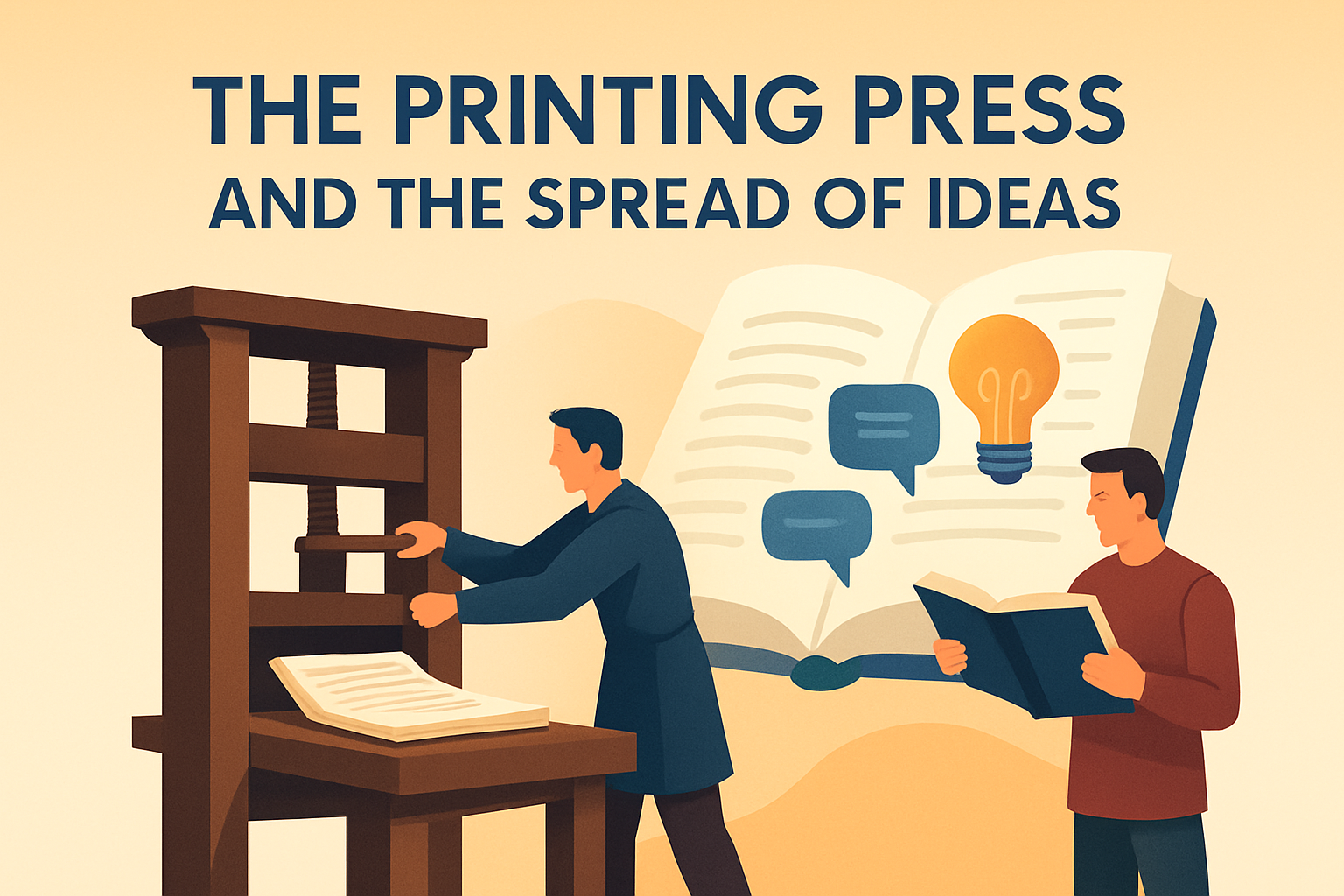
The invention of the printing press marked a turning point in human history, revolutionizing the way ideas were disseminated and transforming societies worldwide. This groundbreaking technology emerged in the mid-15th century and is attributed to Johannes Gutenberg, who developed the first movable type printing system in Europe. The significance of the printing press cannot be overstated as it democratized knowledge, fostering an unprecedented spread of ideas that laid the foundation for the modern world. Understanding the impact of the printing press illuminates how technological advancements can reshape cultures, influence economies, and drive intellectual progress.
The primary function of the printing press was to reproduce written materials more efficiently and in larger quantities than was previously possible with hand copying. Before its invention, producing books and documents was labor-intensive and time-consuming, limiting access to information to a small number of elite individuals. Gutenberg’s press dramatically reduced the cost and effort required to produce reading materials, making them more accessible to the general population. The resulting information boom catalyzed significant cultural and intellectual movements, including the Renaissance and the Reformation, and permanently altered the trajectory of human history.
The Technological Revolution of Printing
Gutenberg’s invention revolutionized the production of books by introducing movable type, a system that used individual, reusable letters and symbols made from metal. This technology allowed printers to assemble entire pages of text by arranging these movable types into a frame. Once arranged, the frame would be inked, and paper pressed against it, creating an inked impression of the text. This process was significantly faster than the earlier method of hand-copying manuscripts and could be repeated multiple times to produce many copies of the same document.
Gutenberg’s most famous print work, the Gutenberg Bible, illustrates the power of this technology. Completed in around 1455, this Latin translation of the Bible was not only the first major book printed using movable type but also represented a high standard of typography and binding that was unrivaled at the time. The ability to replicate texts quickly and efficiently led to an explosion in the production and dissemination of literature, enabling new ideas to spread quickly and broadly.
Impact on Religion and the Reformation
The printing press played a pivotal role in the Protestant Reformation by facilitating the rapid spread of Martin Luther’s ideas. In 1517, Luther famously nailed his Ninety-Five Theses to the door of the Castle Church in Wittenberg, sparking debates over the practices of the Catholic Church. The ability to print multiple copies of his theses, as well as his subsequent writings, enabled his critiques of the Church to reach a wide audience across Europe.
With the printing press, reformers could challenge the Catholic Church’s monopoly on religious texts, providing the laity with access to the Bible and religious writings in their native languages. This newfound accessibility empowered individuals to interpret religious texts independently, weakening the Church’s control over religious doctrine and governance.
The Printing Press and the Renaissance
The Renaissance, a period of renewed cultural and intellectual interest in classical antiquity, owes much of its development to the proliferation of printed materials. As the printing press disseminated classical texts and contemporary scholarly works throughout Europe, it facilitated an exchange of ideas that transcended geographical boundaries. Intellectual figures like Erasmus, Montaigne, and Machiavelli were able to publish their works and reach audiences far beyond their immediate locales, catalyzing a cross-pollination of ideas that defined the Renaissance.
The sharing of artistic techniques, scientific discoveries, and philosophical treatises during this period was not only faster but also more widespread than ever before. The press enabled artists and scientists, such as Leonardo da Vinci and Galileo Galilei, to distribute their findings and insights, fostering a collective growth in knowledge and understanding.
Development of Mass Communication
The printing press laid the foundations for mass communication, transforming the way societies socialize and convey information. With the advent of newspapers and other periodicals, there was a shift in how people accessed news and information, moving away from oral tradition and fragmented accounts to more coherent narratives delivered on a large scale. The ability to print newspapers regularly allowed people to stay informed about local and global events, creating a more interconnected world.
One notable example is “The Relation,” recognized as the first newspaper, published in Strasbourg in 1605. Such publications became central to informing the public, shaping public opinion, and even influencing political actions. They allowed for the spread of new ideas and discussions on governance, laying the groundwork for democratic practices.
Educational Transformation
The printing press significantly impacted education, democratizing access to knowledge and learning. Prior to its invention, education was limited to a privileged few who could afford handwritten manuscripts. By making books more accessible and affordable, the press played a crucial role in increasing literacy rates and fostering a more informed population.
The increased availability of textbooks and educational materials revolutionized teaching and learning methodologies. Educational institutions were able to expand their curricula and offer a broader range of subjects. Furthermore, students could now access knowledge independently, an essential step towards self-directed learning.
- Increased availability of textbooks
- Higher literacy rates
- Expansion of educational subjects
- Rise of self-directed learning
Economic Impact and the Growth of the Book Trade
The introduction of the printing press also had significant economic implications, contributing to the growth of the book trade. As demand for printed materials increased, bookshops and printing companies emerged as flourishing businesses. The book trade expanded rapidly, with new markets opening up as literacy spread. This growth in commerce also led to the development of copyright laws as a means to protect intellectual property and ensure fair compensation for authors and publishers.
In evaluating the economic impact of the printing press, it is crucial to consider how it affected professional industries. The need for literate workers to manage, edit, and distribute publications created new job opportunities and stimulated economic growth. Thus, the printing press not only transformed the world of ideas but also stimulated an emerging economy around these ideas.
Social and Political Implications
The social and political ramifications of the printing press were vast. By providing individuals with direct access to new ideas and information, it empowered them to question authority and seek their own truths. This democratization of knowledge contributed to the rise of individualism and skepticism of traditional power structures, marking an ideological shift towards modernity.
The scientific revolution, driven in part by the printing press, challenged established doctrines and provoked debates that reshaped the political landscape. Revolutionary ideas such as those from the Enlightenment philosophers, like John Locke and Voltaire, spread through print, challenging existing political systems and inspiring movements for independence and democracy.
| Impact Area | Key Changes |
|---|---|
| Religion | Breakdown of the Catholic Church’s monopoly on knowledge; spread of Reformation ideas |
| Education | Increased literacy and educational opportunities |
| Economy | Growth of the book trade and new job opportunities |
| Politics | Spread of revolutionary ideas that questioned traditional authority |
Cultural Exchange and Globalization
The printing press also played a crucial role in cultural exchange and the early stages of globalization. It fostered the dissemination of not only European but also non-European knowledge, as works from other cultures were translated and published. This exchange was bidirectional, influencing and reshaping societies across the globe. European colonial powers used print to spread their languages and cultures, while simultaneously exposing European readers to new ways of life through travel literature and translations of Eastern religious and philosophical texts.
Real-World Example: The printing of Marco Polo’s travels introduced Europeans to the wonders of Asia, fueling interest in exploration and trade. This curiosity and the subsequent sharing of knowledge laid the groundwork for the Age of Exploration and expanded global interactions, leading to the interconnected world we know today.
Conclusion
The printing press fundamentally altered the framework of society, impacting every aspect of life from religion and politics to economics and education. By facilitating the rapid spread of ideas, it empowered individuals with knowledge previously confined to a select few. This helped to inspire cultural movements such as the Renaissance and Reformation, which reshaped the intellectual and spiritual landscape of Europe and beyond.
The lessons learned from the printing press underscore the profound impact technological advancements can have on society. Just as the printing press democratized access to knowledge, today’s digital technologies continue to redefine how we communicate, learn, and engage with the world. As we navigate the complexities of the modern digital age, understanding the powerful role of the printing press can inspire us to thoughtfully harness new technologies for the collective advancement of society.
Call to Action: In our increasingly connected world, continue to value and support access to information for all. Advocate for literacy, invest in education, and champion the responsible dissemination of knowledge to foster a more informed and equitable global community.
Frequently Asked Questions
1. What was the printing press and who invented it?
The printing press was a revolutionary invention that changed the course of history by allowing for the mass production of books and other written materials. It was first developed in the mid-15th century by Johannes Gutenberg, a German blacksmith, goldsmith, printer, and publisher. Prior to the invention of the printing press, books were painstakingly hand-copied, a slow and expensive process that kept knowledge confined to the elite. Gutenberg’s major contribution was the development of a movable type system, which allowed for the fast and efficient reproduction of texts. This system used individual letters and symbols cast in metal, which could be rearranged to form words and sentences, making it possible to print multiple copies of a single document quickly and with relatively low costs. The printing press not only made literature and scientific texts more accessible but also contributed to the spread of new ideas and the democratization of knowledge, impacting social structures and laying crucial groundwork for the modern knowledge economy.
2. How did the printing press contribute to the spread of ideas during the Renaissance?
The printing press played a pivotal role in the dissemination of ideas during the Renaissance, a cultural movement that spanned the 14th to the 17th centuries. During this time, there was a revival of interest in the classical knowledge of Greece and Rome, coupled with innovative ideas in art, science, politics, and philosophy. The printing press facilitated the rapid spread of these ideas by making books more widely available and affordable. Renaissance humanists, such as Erasmus and Petrarch, who emphasized the value of pursuing personal intellectual development and societal improvement, were among the first to benefit from the new technology. Books, pamphlets, and essays could now be reproduced on a scale never before possible, allowing for an unprecedented exchange of information across Europe. The printing press also promoted literacy as more individuals sought to gain access to the wealth of information now available in print. Its impact can be seen in critical developments of the period, such as the Protestant Reformation, where printed works like Martin Luther’s 95 Theses challenged the Catholic Church’s doctrines and reached a wide audience quickly. Overall, the printing press was instrumental in amplifying and distributing the transformative ideas of the Renaissance, leading to intellectual growth and cultural change.
3. In what ways did the printing press affect the Reformation?
The printing press was a catalyst for the Protestant Reformation, which was a significant religious movement of the 16th century that aimed to reform certain practices and beliefs of the Catholic Church. Before the invention of the printing press, reformist ideas were primarily spread by word of mouth or handwritten documents, which limited their reach and impact. With the advent of Gutenberg’s press, reformers found an effective way to distribute their critiques and teachings to a broader audience. Martin Luther, one of the central figures of the Reformation, famously nailed his 95 Theses to the door of the Wittenberg Castle Church in 1517. His theses, which criticized the Church’s practice of selling indulgences and called for a return to Scripture as the sole authority, were quickly printed and disseminated across Europe. The efficiency of the printing press allowed for Luther’s and other reformers’ writings, such as pamphlets, translations of the Bible, and sermons, to circulate widely, gaining support among the general populace, scholars, and other clergy. This widespread dissemination of reformation literature helped to foster a new religious consciousness and encouraged critical debate about religious practices and ideologies. The printing press thus amplified reformist messages, significantly contributing to the success and expansion of the Reformation movement, leading to the formation of new Protestant denominations.
4. How did the printing press influence education and literacy?
The advent of the printing press had a profound influence on education and literacy. Before its invention, books were scarce, expensive, and usually only available to the wealthy or to religious institutions. The laborious process of hand-copying manuscripts meant that few books existed, and those that did were often written in Latin, a language not accessible to the average person. With the printing press, books could be produced en masse at a fraction of the cost, making them more available to the general public and facilitating the rise of vernacular languages in written texts. This democratization of knowledge contributed to a significant rise in literacy rates as education became more accessible. Schools and universities benefited greatly from having more abundant learning materials, which helped standardize curricula and enhance educational methods. The increased availability of printed materials encouraged independent learning and critical thinking, shaping a more informed citizenry. Over time, the spread of educational materials fostered an environment where new ideas could flourish, contributing to major intellectual breakthroughs like the Scientific Revolution and Enlightenment. In essence, the printing press not only made knowledge more accessible but also fostered a more educated and literate society.
5. What is the lasting impact of the printing press on modern society?
The legacy of the printing press is vast and enduring, shaping numerous aspects of modern society. One of its most significant impacts is the democratization of knowledge, making information accessible to a broader audience and empowering individuals to think critically and independently. This democratization paved the way for today’s connected, information-driven world, where digital technology plays a similar role in information dissemination. The mass production of books, newspapers, and periodicals through the centuries has facilitated widespread education and literacy, which are essential components of modern democratic societies. Additionally, the printing press laid the groundwork for the principle of freedom of the press, which is a cornerstone of many democratic institutions worldwide today. It also introduced the concept of intellectual property and copyrights, which are crucial in protecting the works and innovations of authors and creators. The array of printed materials has fostered cultural exchanges, scientific collaboration, and global communication that continue to define our globalized world. Moreover, the impact of the printing press can be seen in the evolution of languages, literature, and even political movements, all of which have contributed to the diverse and complex fabric of contemporary society. In short, the printing press revolutionized how we share and receive information and continues to influence the way we interact with the world around us.