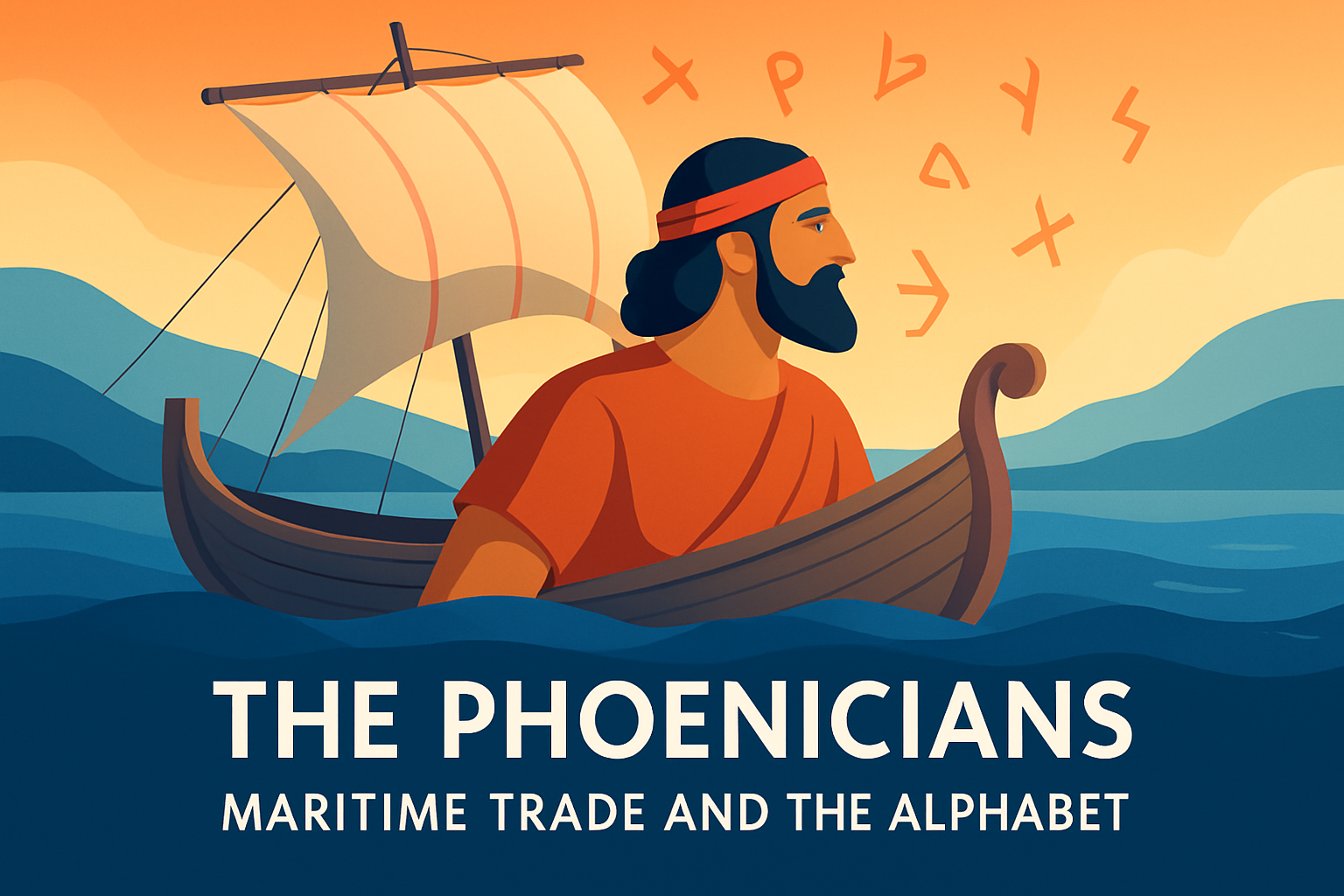
Introduction to the Phoenicians
The Phoenicians were an ancient civilization known for their prowess in maritime trade and the development of one of the most influential alphabets in history. Originating in the region of modern-day Lebanon, this Semitic-speaking people extended their influence across the Mediterranean Sea from approximately 1550 BCE to 300 BCE. As master mariners and shrewd merchants, they established expansive trade networks that were pivotal in the exchange of goods and cultures among various ancient societies. The Phoenicians’ development and dissemination of the alphabet also left a lasting legacy, significantly shaping the cultures of the Mediterranean and providing a foundation for modern alphabets, including the Greek and Latin scripts.
The importance of understanding the achievements and influence of the Phoenicians lies in their substantial contributions to the evolution of commerce, navigation, and communication. By mastering the art of sea travel and creating efficient trade routes, they facilitated the spread of goods and ideas across vast distances, fostering connections between distant regions. Their alphabet simplified written communication and became the precursor to many of today’s writing systems. Consequently, the Phoenicians played a critical role in the development of ancient societies and have left an indelible mark on world history.
The Role of Maritime Trade in Phoenician Society
Maritime trade was the lifeblood of Phoenician society, and it formed the backbone of their economy and cultural exchange. The strategic location of their city-states along the eastern coast of the Mediterranean facilitated their emergence as dominant seafarers. Cities like Tyre, Sidon, and Byblos became bustling centers of commerce, from which the Phoenicians set sail to trade with Egypt, Greece, Cyprus, North Africa, and beyond. Their expertise in shipbuilding and navigation allowed them to transport a plethora of goods, including timber, glass, and Tyrian purple dye—an exceptionally rare and highly-valued dye extracted from murex snails.
Prominent Trading Commodities
Phoenician trade was distinguished by several key commodities, which were crucial to their economic prosperity and international influence:
- Timber: The cedar trees of Lebanon were in high demand in the ancient world, particularly by the Egyptians, who used the wood for building ships and monumental structures.
- Glass: The Phoenicians are credited with the invention and widespread use of glassblowing, which allowed them to create a variety of glass products that were traded throughout the Mediterranean.
- Tyrian Purple: Known as the “Purple People” due to their dye, the Phoenicians monopolized the trade of this luxury item, a marker of wealth and power among the elite.
Beyond these goods, the Phoenicians also traded metals, textiles, pottery, and foodstuffs, bridging the economic and cultural worlds of the East and West. Their trading ventures were not only lucrative but also facilitated the introduction and exchange of technological and cultural advances among the civilizations they contacted.
The bustling trade activities conducted by the Phoenicians can be illustrated through their establishment of numerous colonies, with Carthage being one of the most renowned. Carthage, located in modern-day Tunisia, became a major power in the Mediterranean, furthering Phoenician trade networks and cultural influence. These colonies acted as important trading posts and hubs that extended the reach of Phoenician commerce across the sea.
The Development of the Phoenician Alphabet
The Phoenicians’ introduction of the alphabet marked a significant advancement in the realm of written communication. Prior to the Phoenician alphabet, writing systems such as cuneiform and hieroglyphics were intricate and required extensive training to master. The Phoenician writing system was revolutionary because it simplified writing by using a set of 22 characters, each representing a single consonant. This innovation laid the groundwork for more accessible and efficient written communication, as it could be learned and used by a broader range of people.
The Phoenician alphabet’s simplicity and adaptability enabled it to be adopted and adapted by other cultures, most notably by the Greeks. Greek adaptation of this alphabet introduced vowels, making it even more versatile. The legacy of this adaptation can be evidenced in the subsequent development of the Latin alphabet, which is considered the ancestor of many modern alphabets used today.
An example of the significance of the Phoenician alphabet can be seen in its impact on Greek culture. The Greeks embraced this new writing system for its simplicity, contributing to the recording of literature, philosophy, and other aspects of Greek civilization. This crucial development facilitated the wider dissemination of knowledge and cultural heritage in the ancient world, profoundly influencing Western civilization.
The Influence of Phoenician Cultural and Technological Innovations
The Phoenicians’ contributions extended beyond trade and the alphabet, encompassing significant cultural and technological innovations. Their maritime prowess, combined with their expertise in navigation, enabled them to venture beyond the familiar territories, mapping unknown regions of the Mediterranean. They were among the first to use the North Star for navigation, a technique that would be vital for future generations of seafarers.
Additionally, the Phoenicians established complex trade networks and logistical operations, fostering economic interdependence among regions. These networks augmented their cultural footprint and facilitated the dispersion of Phoenician customs, artistic styles, and religious beliefs.
The following table illustrates the scope of Phoenician influence through their major colonies and the modern-day countries in which they are located:
| Phoenician Colony | Modern-Day Country |
|---|---|
| Carthage | Tunisia |
| Gades (Cádiz) | Spain |
| Byblos | Lebanon |
| Sardinia | Italy |
| Carthago Nova (Cartagena) | Spain |
These strategically positioned colonies facilitated not only trade but also cultural exchange and the spread of Phoenician technologies. Through these settlements, Phoenician innovations permeated neighboring societies, further entrenching their legacy.
Summary and Conclusion
The Phoenicians, through their maritime trade expertise and innovation of the alphabet, left an indelible mark on the ancient world and modern society. Their adeptness in exploiting their geographic position allowed them to dominate trade across the Mediterranean, while their pioneering alphabet revolutionized communication. By facilitating cultural exchange and laying the groundwork for modern writing systems, the Phoenicians significantly contributed to the cultural and technological development of numerous civilizations.
Understanding the Phoenician influence reminds us of the importance of innovation and cultural exchange. The global networks initiated by their trade routes continue to resonate today in our interconnected world. Therefore, we are encouraged to appreciate and learn from the past, fostering cooperation and communication across modern boundaries.
To further explore the fascinating history and influence of the Phoenicians, consider visiting historical sites of ancient Phoenician cities or engaging with scholarly works dedicated to their study. By delving deeper into their world, we gain not only an understanding of their achievements but also insights into the dynamics of trade, communication, and cultural exchange that remain pertinent in our modern world.
Frequently Asked Questions
1. Who were the Phoenicians and where were they located?
The Phoenicians were an ancient civilization famed for their expertise in maritime trade and the development of a significant alphabet. They were a Semitic-speaking people who originated in the geographical area that is now modern-day Lebanon. This civilization became prominent around 1550 BCE and continued to influence to about 300 BCE. Strategically positioned on the eastern Mediterranean coast, the Phoenicians capitalized on their unique location to create successful trade networks that spanned across the Mediterranean Sea. The coastal cities of Tyre, Sidon, and Byblos were among the most notable Phoenician cities, each playing a crucial role in the economic and cultural interactions of the era.
2. What made the Phoenicians so successful at maritime trade?
The Phoenicians’ success in maritime trade can be attributed to several key factors. Firstly, their geographic position on the Mediterranean coast provided them with excellent access to the sea, enabling them to establish extensive trade routes. They were incredibly skilled shipbuilders and navigators, using cedar wood from nearby forests to construct durable and efficient fleets capable of long sea voyages. The Phoenicians were adept at reading wind patterns and currents, which allowed them to navigate more efficiently across vast distances. Importantly, they were not only traders but also colonizers, establishing settlements and trade outposts at strategic points along their routes, like Carthage in North Africa. These served as hubs for trading networks that reached as far afield as Britain for tin and the Western coast of Africa for gold and ivory. Their ability to trade high-value goods, such as Tyrian purple dye, glass, and metalwork, allowed them to amass wealth and influence across the Mediterranean region.
3. How did the Phoenician alphabet develop, and why was it so influential?
The Phoenician alphabet, developed around 1050 BCE, dramatically transformed written communication. This was one of the first alphabets to employ letters to represent sounds, rather than using complex pictograms or ideograms as previous systems like Egyptian hieroglyphs and Sumerian cuneiform had done. Comprising 22 characters, the Phoenician alphabet was relatively simple and easy to learn. This simplicity helped it spread rapidly along with their trade networks. As merchants and traders required record-keeping systems that were fast and practical, the efficiency and adaptability of the Phoenician alphabet made it ideal. Its design laid the groundwork for many subsequent alphabets, including Greek and Latin, which directly influenced the development of European languages. The adoption and adaptation of the Phoenician alphabet by other cultures radically enhanced literacy and record-keeping capacities, thereby shaping much of the world’s linguistic history.
4. What goods did the Phoenicians trade, and why were they in demand?
The Phoenicians were renowned for trading a variety of high-demand luxury goods. Among the most famous was Tyrian purple dye, a vibrant and lasting color made from the murex shellfish, so expensive that it was primarily worn by royalty or very wealthy individuals. They also traded fine glassware—a skill they mastered over generations—woodwork and furniture from cedar trees, and intricately worked metal items. Moreover, they were adept in handling bulkier goods such as textiles, wine, and olive oil. The unique quality and craftsmanship of Phoenician products contributed heavily to their desirability and facilitated the spread of Phoenician culture and material influence around the Mediterranean. As intermediaries, Phoenician traders also played a critical role in the exchange of cultural practices and technologies between the various civilizations they connected.
5. Why did Phoenician civilization decline?
Several factors contributed to the decline of the Phoenician civilization. By the 1st millennium BCE, they encountered significant external pressures, including invasions from powerful neighboring empires. The Neo-Assyrians and then the Babylonians, and eventually the Persians, asserted dominance over Phoenician cities, reducing their independence and economic control. Furthermore, the rise of powerful Greek city-states and the Roman Republic introduced new maritime competitors into the Mediterranean, significantly challenging Phoenician trade routes and commercial dominance. The conquests of Alexander the Great finally toppled the independent city-states, marking the end of Phoenician autonomy. By 300 BCE, after centuries of adaptation and integration into Persian and later Hellenistic political spheres, the distinct Phoenician identity began to dissipate as it was absorbed into the broader tapestry of Mediterranean cultures.