
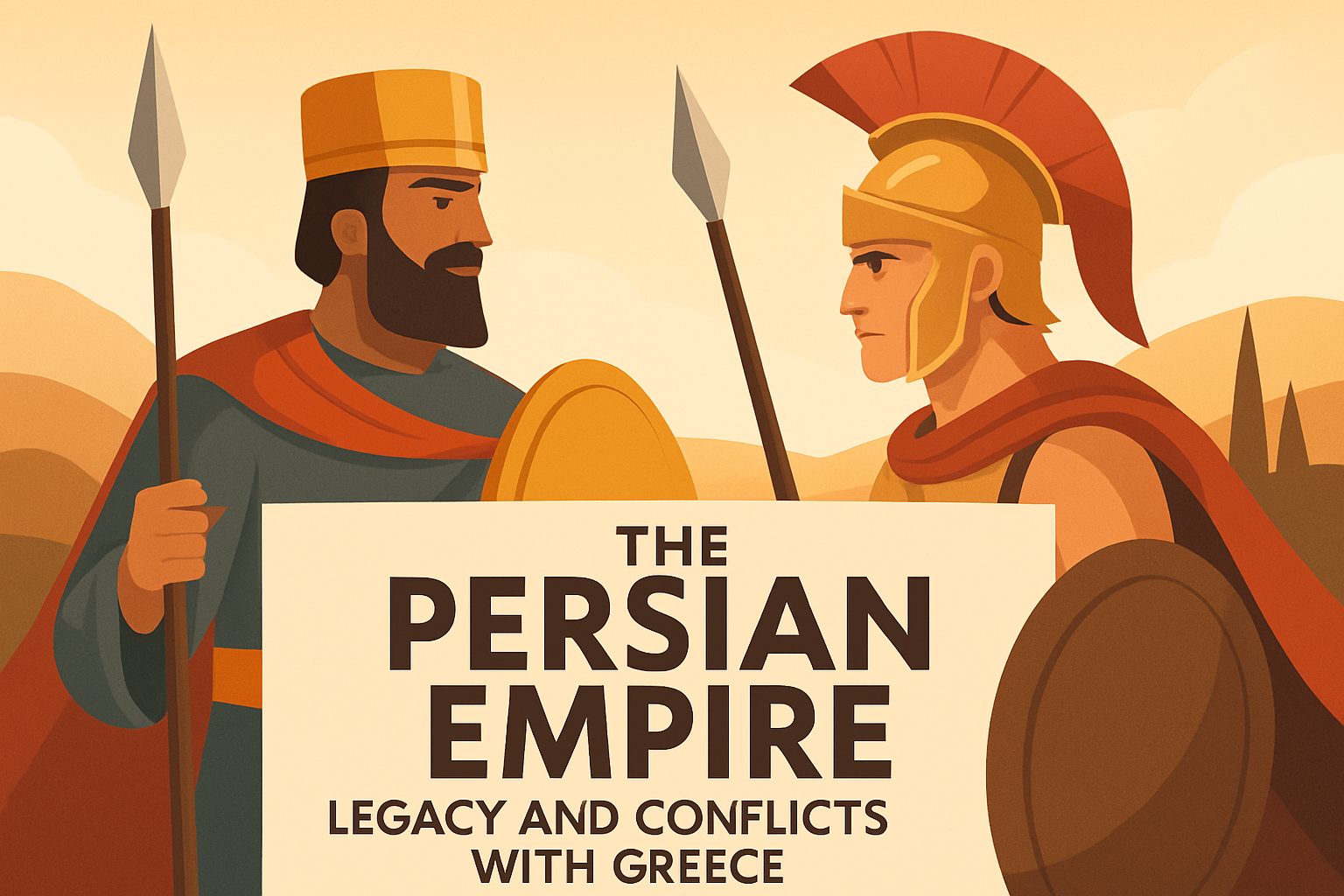
The Persian Empire, one of history’s most significant and powerful empires, has left an indelible mark on the world. Originating from ancient Persia, the empire’s vast expanse at its height stretched from the Indus Valley in the east to Egypt and Greece in the west. Its influence and legacy are profound, affecting governance, culture, and military tactics that continue to ripple through history to the present day. Understanding the Persian Empire is not just an exercise in historical curiosity; it is a journey into the origins of modern civilization. This empire, characterized by its innovative administration, tolerance of diverse cultures, and infrastructural projects like the Royal Road, also proved to be a formidable adversary in one of the ancient world’s most famous rivalries—the conflicts with ancient Greece. The Greco-Persian Wars exemplified a test of power and influence, painting a vivid picture of ancient geopolitics that still intrigues historians and enthusiasts alike.
The Rise of the Persian Empire and Its Governance Model
The roots of the Persian Empire reach deep into ancient history, originating from a small kingdom situated within present-day Iran. It was under the ambitious leadership of Cyrus the Great in the sixth century BCE that the empire began its ascent. Cyrus the Great was not only a military genius but also an astute administrator. His approach to governance was revolutionary for its time: he allowed conquered peoples to retain their customs and religions, fostering loyalty and stability within the vast territories of the empire.
Governance under the Persian Empire involved a sophisticated system of satrapies, or provinces, each overseen by a governor, known as a satrap. This system decentralized administration, making governance more adaptable and efficient. This structure is vividly illustrated in Herodotus’ historical accounts, where he highlights the empire’s capacity to manage diverse cultures across wide geographical areas. The benevolent rule of Cyrus and subsequent emperors like Darius the Great transformed Persia into an economic and cultural powerhouse. This approach resonates even today, as modern governments seek to balance central authority with regional autonomy.
Military Might and Infrastructure: The Backbone of Persian Power
Consolidating such a vast empire required more than just administrative acumen; it demanded unparalleled military strength. The Persian army, also known as the Immortals due to their constant number of ten thousand, stood as a symbol of this military might. They were renowned for their discipline and skill, comparable to modern elite military units.
The empire’s infrastructure, particularly the Royal Road, played an indispensable role in maintaining its existence and efficacy. Spanning over 1,500 miles, the Royal Road enabled quick communication and troop movements across the empire. This network not only facilitated trade but also strengthened political cohesion. The significance of such infrastructure can be seen in today’s global reliance on efficient transportation networks like highways and air routes.
Conflict with Greece: Prelude to the Greco-Persian Wars
The encounter between Persia and Greece is a classic tale of East meeting West, with profound implications for both regions. The Persian Wars began due to Persia’s attempts to incorporate Greek city-states within its empire, starting with the Ionian Revolt where many Greek cities in Asia Minor rose against Persian rule. Persia’s initial victories in these attempts were temporary as mainland Greece, led by Athens and Sparta, posed a formidable challenge.
To better understand these conflicts, consider the key battles that defined the era:
- Battle of Marathon (490 BCE): A landmark Persian defeat where the Greek forces utilized their hoplite tactics to great effect.
- Battle of Thermopylae (480 BCE): Although a Persian victory, the valiant stand of the 300 Spartans epitomized Greek resilience.
- Battle of Salamis (480 BCE): A pivotal naval battle that showcased Greek naval ingenuity, leading to a decisive Persian defeat.
The Greco-Persian Wars were not just about military might; they were also competitions of ideologies—democracy versus autocracy, freedom versus subjugation. These conflicts left enduring legends, inspiring countless works of art and literature, and laid the groundwork for the flourishing of Greek culture, which has profoundly influenced Western civilization.
Cultural Exchanges and Esteems: The Broader Impact
Despite the conflicts, the Persian and Greek worlds were not purely adversarial; there was significant cultural exchange. Persians admired Greek art and philosophy, while the Greeks were influenced by Persian innovations in administration and organization. This cross-pollination enriched both cultures, leading to advancements in science, philosophy, and the arts.
Notably, the Persian Empire’s emphasis on infrastructure influenced Greek engineering, evident when examining structures like the Parthenon in Athens. The blending of Persian and Greek elements foreshadowed the later Hellenistic era following Alexander the Great’s conquests, illustrating the persistent exchange of ideas and culture. This shared history demonstrates the benefits of cultural interaction, laying a model for today’s globalized world where diverse exchanges fuel progress and innovation.
The Decline and Continuing Influence of the Persian Empire
While the Persian Empire eventually succumbed to external forces, most notably Alexander the Great in the 4th century BCE, its impact did not wane with its political decline. The administrative genius of the Persians influenced successive empires, including the Roman Empire, which borrowed heavily from Persian ideas of governance and road systems.
Recent archaeological findings continue to shed light on the sophisticated nature of Persian urban planning, emphasizing their progressive approach to empire-building. The concept of a diverse, tolerant empire inspired many future states, establishing a legacy that underscores the profound adaptability and resilience of a well-structured governance system.
Conclusion
The Persian Empire’s story is one of innovation, power, and intercultural exchange. From its rise under Cyrus the Great to its enduring influence, the empire offers profound lessons in leadership, strategy, and cultural integration. Its conflicts with Greece, far from being mere battles of power, were crucial chapters in the struggle between contrasting systems of governance and ways of life. These encounters ultimately fostered significant progress and enriched both Persian and Greek societies—a testament to how competition can lead to mutual growth.
Reflecting on the Persian Empire’s legacy invites us to consider the importance of effective governance, the benefits of strategic infrastructure, and the value of cultural exchange. By learning from history, we can engage more thoughtfully with the complexities of modern global interactions and governance. To delve deeper into this rich historical narrative, consider engaging with resources on Persian history, or exploring related historical novels and documentaries that bring this pivotal era to life.
Frequently Asked Questions
1. What made the Persian Empire one of history’s most significant empires?
The Persian Empire, often referred to as the Achaemenid Empire, is hailed as one of history’s most significant empires due to its unprecedented size, cultural diversity, and innovative governance. Founded by Cyrus the Great in the 6th century BCE, it expanded rapidly, at its zenith covering a massive geographical area from the Indus Valley in the east to the shores of the Mediterranean Sea in the west, including Egypt and parts of Greece. This vast empire was characterized by its sophisticated system of administration, with a centralized government led by a powerful monarch and efficient provincial governance through local satraps or governors. The Persians were pioneers in human rights, famously known for the Cyrus Cylinder, considered the first charter of human rights. Their respect for the cultures and religions of the conquered lands played a pivotal role in maintaining relative peace and stability across its territories. Additionally, the construction of the Royal Road facilitated trade and communication across the empire, further strengthening its cohesion and economic prosperity.
2. How did the governance system of the Persian Empire influence modern states?
The Persian Empire’s governance system was revolutionary for its time and laid the groundwork for future models of statecraft. The empire was divided into provinces, known as satrapies, which were governed by satraps or governors who were often of local origin. This system allowed for local autonomy, which helped to maintain order and reduce the likelihood of insurrections. The King’s envoys or ‘eyes and ears of the king’ ensured that the central authority remained informed about the happenings in different provinces, introducing an early form of audit and accountability in governance. Moreover, the standardization of currency and development of infrastructure, such as roads and postal systems, mirrored practices adopted by modern states for economic stability and efficient administration. Elements of this administrative framework are seen today in federal systems of governance where states or provinces enjoy a degree of autonomy but remain under the central government’s jurisdiction. The influence of the Persian model is apparent in its ideals of centralized authority harmonized with local governance, a balance that continues to inform political structures around the world.
3. What were the cultural achievements and influences of the Persian Empire?
The Persian Empire’s cultural contributions are vast and continue to have a significant impact. Architecturally, the empire is renowned for the grandeur of its royal palaces and cities, such as Persepolis, which exemplified the blend of various cultural influences under its rule. The empire also championed literature, with works such as those by Zoroastrian priests providing insights into one of the world’s oldest practiced religions, Zoroastrianism. Art flourished under the Persian Empire; intricate carvings, metalwork, and stunning reliefs told stories of kings and gods, serving as both aesthetic and cultural expressions of power. Language played a crucial role in the administration of this vast empire, with Old Persian becoming a lingua franca across its territories; the alphabet developed for the royal inscriptions influenced later scripts in the region. The Persian Empire’s emphasis on tolerance and cultural diversity, its encouragement of arts and sciences, and its development of infrastructure set benchmarks for civilizations that followed, underlining its enduring legacy over the centuries.
4. What were the causes and consequences of the conflicts between the Persian Empire and Greece?
The conflicts between the Persian Empire and Greece, known as the Greco-Persian Wars, were fueled by a combination of political, economic, and cultural factors. The initial cause was the Persian Empire’s expansionist policies, which brought it into direct conflict with the independent Greek city-states, leading to tensions escalating into full-blown wars. The Ionian Revolt (499–493 BCE) ignited the initial conflict, as Greek city-states in Ionia, under Persian control, rebelled with Athens’ support. This rebellion prompted Darius I of Persia to launch punitive expeditions against Greece, culminating in pivotal battles such as Marathon and, in Xerxes’ reign, Thermopylae and Salamis. The consequences of these conflicts were profound. They marked a halt to Persia’s westward expansion and allowed the nascent democracy of Athens to grow in influence, ushering in the Golden Age of Greece. Culturally, these wars highlighted the distinction between the Persian autocratic monarchy and Greek city-state democracy, influencing Western political thought. The Greek victories, celebrated in art and literature, fostered a sense of unity among the often-disparate Greek states. The wars set a precedent for future East-West conflicts and highlighted the strategic importance of naval warfare in the classical world. The legacy of these conflicts endured, shaping both Eastern and Western histories in fundamental ways.
5. How did the Persian Empire’s military tactics and innovations affect warfare in ancient times?
The Persian Empire was a powerhouse of military innovation, employing strategies and technologies that had a lasting impact on warfare. The empire’s armies were known for their diversity and adaptability; they integrated soldiers from various regions, bringing different weapons and combat strategies to the battlefield. This amalgamation of forces allowed the Persians to employ a wide array of tactics suitable for various terrains and opponents. The Immortals, an elite infantry unit, exemplified disciplined warfare and presented an ever-present threat due to their constant number; whenever a soldier fell, another took his place immediately. The use of cavalry was another hallmark of Persian military prowess, providing mobility and flexibility. Their innovations weren’t confined to land; the Persians also developed impressive naval capabilities, constructing a formidable fleet that played a key role in their attempts to subdue Greece. Utilization of resourcefulness in logistics, such as the Royal Road aiding swift troop movement, highlighted the empire’s strategic foresight. The combination of these strategies, rooted in depth and adaptability, influenced subsequent empires, imparting lessons on the significance of diversified forces, logistical excellence, and the need for adaptable tactics in warfare. These tactical doctrines have resonated throughout the ages, influencing military strategies up to the modern day.