
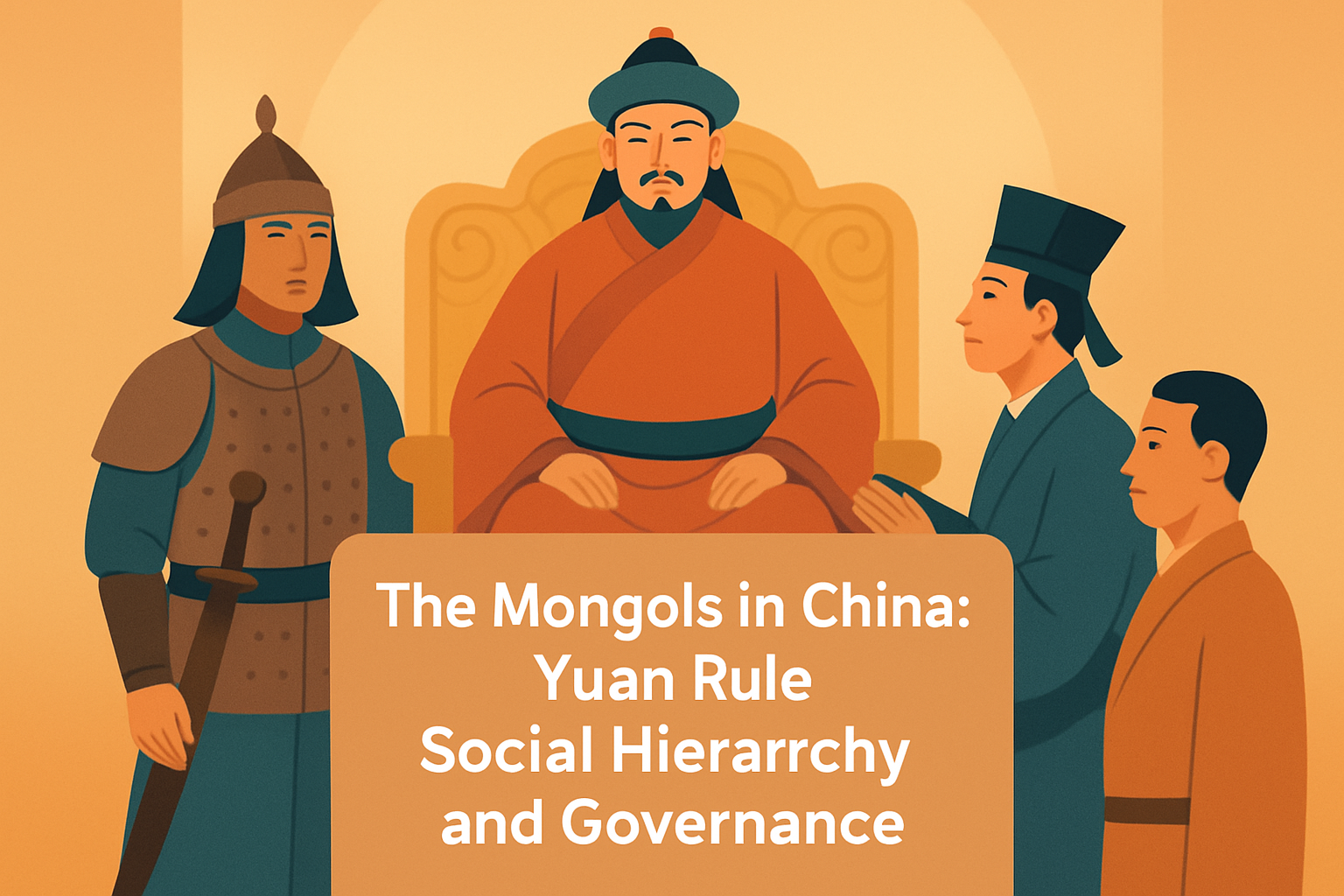
The Mongols in China transformed East Asia by creating the Yuan dynasty, a regime that combined steppe traditions with Chinese imperial institutions while ruling a vast, diverse population through a carefully ranked social hierarchy and an adaptive system of governance. In practical terms, “Yuan rule” refers to the period from 1271 to 1368 when Kublai Khan and his successors governed China as part of the broader Mongol imperial world. “Social hierarchy” describes the officially recognized ranking of peoples under Yuan administration, while “governance” covers the methods, offices, laws, taxes, military structures, and political strategies used to hold power. This topic matters because the Yuan dynasty was not simply a foreign conquest regime imposed from above; it was a major experiment in multiethnic rule, administrative integration, and imperial management that shaped later Chinese statecraft. When I have worked through Yuan documents, legal summaries, and later historical compilations, the same pattern appears repeatedly: Mongol rulers did not replace Chinese government wholesale, nor did they fully assimilate into it. Instead, they built a hybrid order that preserved Mongol privilege, used Central and West Asian intermediaries, and selectively employed Chinese administrative practices to govern an enormous agrarian empire.
Understanding how the Mongols ruled China helps answer several common questions directly. Why did the Yuan dynasty classify people by ethnic and political background? Because the conquest had been won by a minority elite that needed a reliable structure of loyalty, taxation, and officeholding. How was the state actually run? Through a central secretariat, regional administrations, military garrisons, fiscal agencies, and a court that balanced Mongol aristocratic interests against the realities of governing sedentary farming populations. Why did this system matter historically? Because it showed both the strengths and limits of conquest empires. The Yuan expanded communications, patronized trade, and connected China more tightly to Eurasia, yet their unequal social order and heavy fiscal demands also deepened resentment. To understand Yuan rule clearly, it is necessary to examine both the hierarchy that organized society and the institutions that sustained power.
Conquest, Dynasty Building, and the Logic of Mongol Rule
The Mongol presence in China began with campaigns under Chinggis Khan and his successors, but the decisive architect of dynasty building was Kublai Khan. After defeating the Southern Song in 1279, he claimed the Mandate of Heaven and formally presented his government as a Chinese dynasty, the Yuan. This move was not cosmetic. It gave the Mongols access to the language of legitimacy familiar to Chinese elites while allowing them to maintain their own imperial identity. In my reading of the period, this dual strategy was central to Yuan success: they ruled as khans to the Mongol world and as emperors to China.
Kublai understood that conquering territory was easier than administering it. Northern China had already experienced non-Han regimes such as the Liao, Jin, and Western Xia, so the Yuan inherited precedents for mixed rule. Yet the scale was new. The Mongols had to govern densely populated agricultural regions, major cities, river systems, and entrenched local elites. They therefore retained many Chinese institutions, including ministries, tax registers, and provincial frameworks, but they staffed and supervised them in ways that protected Mongol supremacy. This was a pragmatic imperial formula rather than a contradiction.
The capital at Dadu, present-day Beijing, symbolized this synthesis. Built as an imperial center, it connected steppe mobility with sedentary administration. Court politics, tribute, grain supply, military deployment, and paper currency all converged there. The Yuan court also remained linked to the broader Mongol ecumene, meaning China was governed not as an isolated civilization but as one region within a vast transcontinental empire. That wider context explains why so many foreign officials, merchants, and specialists appeared in Yuan service. The dynasty’s governmental choices reflected the priorities of conquest, security, and imperial integration.
The Yuan Social Hierarchy: Who Ranked Above Whom and Why
The most famous feature of Yuan social organization was its ranked classification of subject peoples. Although historians debate the exact flexibility of these categories, the broad structure is clear. Mongols stood at the top. Below them were the semuren, a broad label often translated as “various categories” and used for peoples from Central and West Asia, including many Muslims, Uighurs, and other non-Han groups who had entered Mongol service. Next came northern Chinese, often called hanren in Yuan usage, a category that included people from former Jin territories and other groups conquered earlier. At the bottom were southern Chinese, often called nanren or manzi, largely the population of the former Southern Song.
This hierarchy was political before it was cultural. It did not simply measure civilization, wealth, or education. It reflected the sequence of conquest and the perceived reliability of different populations. Mongols occupied the ruling stratum because they were the conquerors and military core of the empire. Semuren often received favorable treatment because many had served the Mongols before or during the conquest of China and were seen as useful intermediaries without deep roots in Chinese elite networks. Northern Chinese were treated somewhat better than southerners because they had been under non-Song rule longer and were incorporated into Mongol systems earlier. Southern Chinese, conquered last and associated with the defeated Song, faced the greatest suspicion.
| Rank | Group | Typical Political Status Under Yuan Rule |
|---|---|---|
| 1 | Mongols | Highest privilege; military and top political authority; legal and administrative advantages |
| 2 | Semuren | Favored foreign and inner Asian service groups; strong access to administrative and fiscal roles |
| 3 | Hanren | Northern Chinese and earlier conquered populations; some officeholding but fewer protections and less trust |
| 4 | Nanren | Southern Chinese from former Song territories; lowest standing in many appointments and legal settings |
The hierarchy affected taxation, officeholding, judicial treatment, and access to power. It did not mean every Mongol was rich or every southerner was powerless, but it structured opportunity. In the administration I have studied, elite confidence mattered as much as formal law. A semuren tax official or financial administrator could wield enormous influence because the court trusted him more than a local Chinese notable. Likewise, a highly educated southern scholar might find his advancement blocked by political suspicion. The system was designed to prevent the rapid reconsolidation of Chinese literati dominance.
At the same time, social ranking under the Yuan was not absolutely rigid. Wealth, patronage, service, and local conditions all shaped outcomes. Some Chinese elites served effectively, and some Mongols lacked real influence beyond status. Even so, the hierarchy sent a consistent message: the dynasty was multiethnic, but not egalitarian. Order depended on differentiated privilege, and that fact became one of the central sources of Yuan strength and eventual weakness.
Government Institutions: How the Yuan State Actually Worked
The Yuan government functioned through a blend of Mongol imperial oversight and inherited Chinese bureaucratic structures. At the center stood the Secretariat, or Zhongshu Sheng, which handled major civil administration. Traditional Chinese ministries continued to exist in modified form, but central authority was often concentrated more directly around the court than in some earlier dynasties. There were also specialized agencies for military affairs, censorship, Buddhist and Tibetan affairs, and palace administration. The emperor and his close circle retained strong discretionary power, which meant institutions could be effective but also unstable when factional conflict grew.
One of the Yuan dynasty’s most important administrative legacies was the development of provinces, or xing sheng, often translated as branch secretariats. Earlier dynasties had regional administrations, but the Yuan gave provincial governance a more durable shape that influenced the Ming and Qing. These provinces helped extend central control across a huge territory by coordinating taxation, judicial oversight, grain transport, and military logistics. This mattered because the Yuan realm included frontier zones, river valleys, and commercially dense regions requiring different styles of administration. Provincial government was therefore not a minor convenience; it was a structural solution to ruling at scale.
The military remained fundamental. Mongol rule in China never lost its conquest character, and garrisons were stationed strategically to deter rebellion and secure communications. Mongol and allied troops enjoyed privileges, but they also imposed costs on the population through provisioning demands. Civil officials could administer tax and law, but military force guaranteed compliance. In this sense, Yuan governance rested on a classic conquest-imperial balance: bureaucracy collected resources, while military power protected the hierarchy that made extraction possible.
The court also relied on a diverse service elite. Uighur scribes, Persian financial experts, Tibetan Buddhist clerics, Mongol princes, and Chinese clerks all played roles. This diversity was a strength because it widened the dynasty’s pool of talent and linked China to Eurasian systems of trade and information. It was also a source of tension, since competing traditions of law, religion, and administration coexisted under one imperial roof. Yuan governance worked best when the center could coordinate these groups without allowing any one bloc to dominate completely.
Law, Taxation, Examinations, and Daily Administration
Yuan governance became tangible to ordinary people through law, taxes, labor obligations, and access to office. The legal order combined Mongol custom, imperial decrees, and Chinese administrative law. In practice, this meant judicial outcomes could vary by social rank and political context. The Mongols often insisted on preserving privileges for their own people, especially in matters involving status and punishment. This unequal legal structure helped maintain elite cohesion, but it undermined the dynasty’s claim to impartial rule.
Taxation was one of the state’s greatest challenges. China’s agrarian wealth funded the dynasty, yet efficient extraction required accurate registers, stable transport, and disciplined officials. The Yuan taxed land, households, commerce, and labor in ways that varied by region. Grain shipments to the capital were especially important, and the Grand Canal remained a crucial artery. When administration functioned well, revenue sustained the court, army, and public works. When it failed, corruption, overassessment, and local hardship increased quickly. In several late Yuan crises, fiscal pressure amplified political discontent.
The civil service examination system reveals the dynasty’s complicated relationship with Chinese elite culture. Early Yuan rulers limited or suspended the examinations because they distrusted the old literati pathway into government and preferred appointments based on conquest loyalty or practical service. In 1315 the exams were restored, but on a restricted basis and with quotas that reflected ethnic hierarchy. This gave educated Chinese men some route into office, yet it did not erase the privileged status of Mongols and semuren. The restoration was therefore significant but not fully transformative. It showed that the Yuan needed Confucian administrative skills, even if they would not yield political supremacy to Confucian officials.
Paper currency, especially the chao, is another practical example of Yuan governance. The dynasty promoted paper money more aggressively than many predecessors, using state authority to support circulation across a broad commercial world. This policy could facilitate exchange and tax collection, particularly in a large empire with active long-distance trade. However, excessive issuance and declining confidence contributed to inflationary problems in later years. Here again, the Yuan displayed both innovation and fragility: they were willing to govern ambitiously, but state capacity did not always match policy design.
Religion, Commerce, and the Limits of Mongol Power in China
The Yuan state governed not only through offices and armies but also through religion, trade, and imperial patronage. Mongol rulers were notably open to multiple religious traditions. Tibetan Buddhism gained exceptional court influence, especially through the patron-priest relationship between the khan and Tibetan clerics. Muslims served in financial and scientific roles. Nestorian Christians and Daoists also appeared in the empire’s social landscape. Confucianism remained important for local administration and elite culture, even when it lacked exclusive political authority. This pluralism was not modern tolerance in an abstract sense; it was an imperial strategy that allowed the court to draw legitimacy and expertise from many communities.
Commerce flourished under the Pax Mongolica, the broader period of relative security across much of Eurasia created by Mongol rule. Merchants, envoys, and travelers moved more readily between China, Central Asia, Persia, and beyond. The career of Marco Polo is often overstated in popular memory, but his account reflects a real phenomenon: Yuan China was integrated into a transregional world of exchange. Goods such as silk, porcelain, horses, medicines, and precious materials circulated through protected routes and state-backed networks. The Mongols valued merchants more highly than many earlier agrarian elites had, partly because trade supported imperial revenue and long-distance coordination.
Yet the same features that gave the Yuan reach also revealed its limits. Court favoritism toward foreign specialists could deepen resentment among Chinese elites. Heavy military expenditures, environmental stress, Yellow River flooding, and local famines exposed the weaknesses of administration. Rebellions such as those associated with the Red Turbans did not emerge from one cause alone; they grew from an interaction of social exclusion, fiscal breakdown, and declining confidence in the dynasty’s right to rule. By the fourteenth century, the hybrid system that had once been adaptive looked to many subjects like a structure of unequal privilege unable to provide order.
The fall of the Yuan in 1368 to the Ming did not erase its importance. In my view, one of the clearest historical lessons is that the Yuan failed not because it borrowed too little from Chinese governance or too much from Mongol practice, but because hybrid empires must constantly convert conquest into consent. The Yuan could command, classify, and extract, but over time it struggled to persuade enough of its subjects that the hierarchy served a just and stable political order.
Conclusion
The Mongols in China ruled through a distinct combination of military conquest, ethnic ranking, administrative adaptation, and imperial pragmatism. The Yuan social hierarchy placed Mongols first, semuren second, northern Chinese third, and southern Chinese fourth, shaping law, appointments, and daily life across the empire. Their governance relied on a strong court, central and provincial institutions, garrisons, tax systems, selective use of examinations, and a multiethnic service elite. These arrangements helped the dynasty govern a vast realm and connect China to wider Eurasian networks of commerce, religion, and diplomacy.
The central benefit of studying Yuan rule is clarity about how conquest states actually function. They endure not by force alone, but by building institutions that translate military victory into regular administration. The Yuan succeeded impressively in some areas, especially provincial organization and transregional integration, yet their unequal hierarchy, fiscal strain, and unstable legitimacy limited long-term durability. For anyone studying Chinese history, empire, or comparative governance, the Yuan offers a precise case of how diversity can be managed effectively for a time without ever becoming politically equal.
If you want to understand later Ming and Qing institutions, frontier policy, or the long history of state formation in East Asia, start with the Yuan dynasty and trace how its innovations and failures shaped what came next.
Frequently Asked Questions
What was the social hierarchy under the Yuan dynasty, and why did it matter so much?
The Yuan dynasty organized society through a formal ranking system that reflected Mongol priorities as conquerors ruling a large and culturally diverse empire. At the top were the Mongols themselves, who enjoyed the greatest political privilege, military authority, and access to high office. Below them were various non-Han groups often called “Semuren,” a broad category that included Central Asians, West Asians, and other peoples from across the Mongol Empire who were often trusted for administrative and financial roles. Next came the people of northern China, who had lived for generations under earlier conquest dynasties and were generally treated differently from the population of the former Southern Song. At the bottom were the inhabitants of southern China, who made up a large share of the population but were often viewed by Yuan rulers as the least politically reliable because they had been conquered last.
This hierarchy mattered because it shaped real opportunities in government, taxation, legal treatment, and social mobility. Access to office, judicial outcomes, and even punishments could differ depending on where a person stood in the official order. The system helped the Mongol rulers preserve their dominance by preventing the majority Han Chinese population from fully controlling the state. At the same time, it allowed the dynasty to recruit talent from across Eurasia, bringing in administrators, merchants, and specialists from many regions. In practice, this meant Yuan society was not simply “Chinese” in a conventional dynastic sense; it was an imperial society built to secure conquest rule. The hierarchy was therefore both a political strategy and a social reality, one that deeply influenced daily life, elite competition, and the long-term legitimacy of Yuan government.
How did the Mongols govern China while still preserving their own steppe traditions?
Yuan governance worked because the Mongols did not attempt to erase Chinese imperial institutions outright, nor did they rule China exactly as they ruled the steppe. Instead, they blended methods. Kublai Khan adopted the dynastic name “Yuan,” established a capital at Dadu, and made use of long-standing Chinese tools of rule such as provincial administration, taxation systems, court bureaucracies, and written legal procedures. These were essential for governing an enormous agrarian population, managing grain revenues, and maintaining state authority over densely settled regions. Chinese political forms offered an administrative framework sophisticated enough to sustain a major empire.
At the same time, the Mongols preserved distinct features of Inner Asian rule. The ruling house remained tied to the wider Mongol imperial tradition, military power remained central, and personal loyalty to the khan and aristocracy still mattered greatly. Key positions were often held by Mongols or trusted non-Han elites, and the court retained a cosmopolitan, imperial character shaped by the larger Mongol world. The Yuan state also relied on institutions and practices that reflected conquest politics, including the strategic distribution of offices and privileges among different ethnic and regional groups. In this sense, Yuan government was adaptive rather than purely assimilated. It used Chinese institutional strength to rule effectively, while preserving Mongol political supremacy and steppe-derived understandings of power. That combination explains both the dynasty’s administrative reach and its persistent tensions with many of its Chinese subjects.
Did the Yuan dynasty use the traditional Chinese civil service examination system?
The Yuan dynasty did use the civil service examination system, but not in a straightforward or continuous way. In the early years of Mongol rule, the exams were suspended for long periods because the new rulers did not fully trust the established scholar-official elite and did not want traditional Confucian pathways to dominate state service. From the Mongol perspective, relying too heavily on the old examination system could have empowered the very literati class that had served previous Chinese dynasties and that might challenge conquest rule. As a result, appointments often depended more on ethnic status, patronage, military background, or the needs of the court than on examination success alone.
When the examinations were later restored, they operated within the Yuan social hierarchy rather than replacing it. Different quotas and expectations applied to different groups, and the system did not produce the same kind of scholar-bureaucratic order seen under dynasties such as the Song or Ming. Still, the restoration mattered. It showed that the Mongol court recognized the practical value of Confucian-trained officials for managing law, taxation, records, and local governance. The exams also gave educated Chinese elites at least some route into public service, even if that route was narrower and more politically constrained than before. So the best way to understand Yuan policy is that the examinations were a useful administrative tool, but never the unquestioned foundation of government. Under the Yuan, bureaucratic recruitment remained shaped by conquest priorities as much as by classical learning.
How did Yuan rule affect everyday life for different groups in China?
Everyday life under the Yuan dynasty varied significantly depending on one’s place in the empire’s social and administrative order. For Mongol elites, the dynasty offered privileged access to office, legal advantages, and material rewards tied to their status as conquerors. For Central and West Asian administrators, merchants, and specialists, Yuan rule could open remarkable opportunities because the Mongol Empire connected China to wider Eurasian networks of trade, diplomacy, and expertise. These groups often benefited from the dynasty’s trust in outsiders who were seen as less tied to entrenched Chinese local interests.
For many Chinese subjects, however, life under Yuan rule could be more restrictive and uneven. The social hierarchy affected appointments, taxation burdens, and legal treatment, and many people in the former Southern Song territories felt especially disadvantaged. Local communities still farmed, traded, married, worshipped, and participated in regional society much as before, but they did so under a regime that openly marked some populations as politically less favored than others. At the same time, the Yuan period was not defined only by repression. It also saw expanded long-distance commerce, increased movement of people and ideas, and the circulation of technologies, artistic forms, and religious influences across Eurasia. In daily life, then, Yuan rule could mean both hardship and opportunity: discrimination in official structures on one hand, and participation in a more interconnected imperial world on the other. That complexity is essential to understanding the period.
Why did the Yuan dynasty ultimately lose support and fall in 1368?
The Yuan dynasty fell for a combination of political, social, economic, and environmental reasons rather than a single dramatic cause. One major problem was legitimacy. Because the dynasty remained associated with conquest rule and maintained a formal hierarchy that privileged Mongols and other non-Han groups, it struggled to win durable support from broad sections of the Chinese elite and population. Many literati served the dynasty, but others remained skeptical of a government that did not fully embrace the moral and political ideals associated with earlier Chinese rule. This weakness became more serious when the court faced internal disputes, succession problems, and factional conflict among elites.
Material pressures made matters worse. The later Yuan period saw fiscal strain, corruption, regional instability, and serious natural disasters, including floods linked to the Yellow River system. These crises damaged agriculture, disrupted transport, and increased popular suffering. The government had difficulty responding effectively, and confidence in its ability to govern weakened. Rebellions grew, most famously those associated with the Red Turban movement, which drew strength from social unrest, millenarian beliefs, and anti-Yuan sentiment. As central authority faltered, regional military leaders gained influence, and one of them, Zhu Yuanzhang, eventually founded the Ming dynasty after taking the Yuan capital in 1368. The fall of the Yuan was therefore not simply a military defeat; it was the collapse of a conquest regime whose social order, administrative tensions, and crisis management failures eroded its base of support over time.