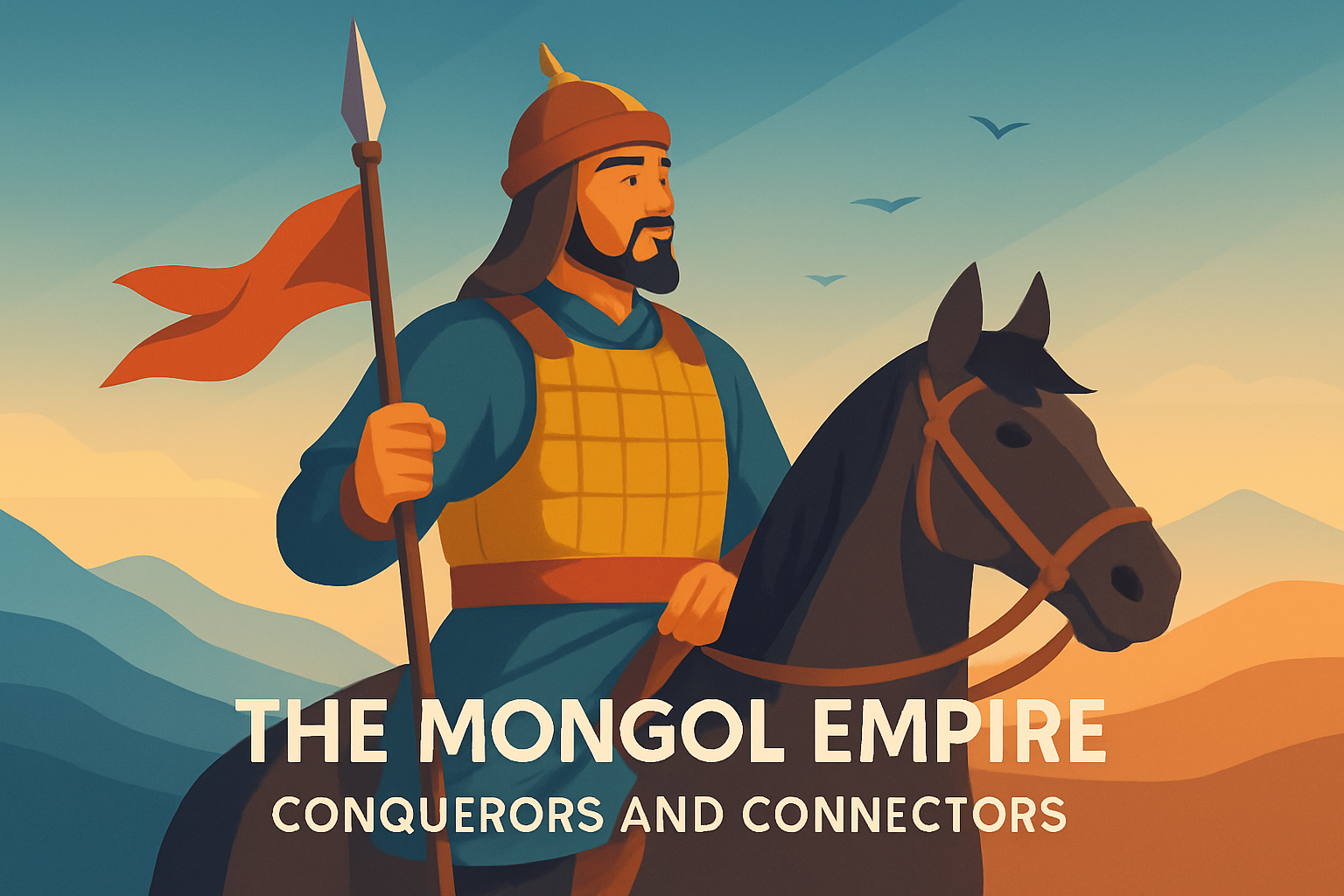
Introduction to the Mongol Empire
The Mongol Empire stands as one of the most remarkable examples of human ingenuity in history. It is often remembered as a fearsome force that swept through regions with impressive speed and ruthlessness, crumbling established empires in its path. Established in the early 13th century by the formidable Genghis Khan, the Mongol Empire eventually spanned from Europe to Asia, creating a vast dominion that surpassed any other in terms of contiguous land area. Understanding the Mongol Empire is significant due to its profound influence on the cultural, political, and economic development across Eurasia. Not merely conquerors, the Mongols also acted as connectors between distant lands, facilitating trade, exchanging knowledge, and integrating diverse cultures. This dual role of conqueror and connector illuminates the intricate dynamic between warfare and cultural symbiosis.
The Formation and Expansion of the Mongol Empire
The Mongol Empire’s rise was largely orchestrated by Genghis Khan, a brilliant strategist and leader, who united various nomadic tribes of the Asian steppes under his rule. Through a combination of military brilliance and the use of psychological warfare, he expanded the empire’s reach. By employing innovations such as the composite bow and superior cavalry tactics, the Mongols defeated larger armies with remarkable efficiency.
One prominent example of the Mongol military’s prowess was the conquest of the Khwarezmian Empire, which spanned modern-day Iran and Central Asia. The Mongolian forces implemented a strategic combination of espionage, rapid attacks, and brutal reprisals, swiftly bringing the region under Mongol control. This expansion not only secured valuable trade routes but also served as a testament to their formidable influence during this period.
The Mongols as Facilitators of Trade
While often portrayed as ruthless conquerors, the Mongols also recognized the importance of commerce and cultivated it actively. The Pax Mongolica, or Mongolian Peace, facilitated by their rule, enabled unprecedented trade and cultural exchanges across the Silk Road. By maintaining law and order and protecting trade routes, they significantly reduced crime and piracy, allowing safer passage for merchants and travelers.
An outstanding demonstration of this role was the flourishing trade between the East and the West. Goods such as silk, spices, and precious metals moved freely across the expansive territories. The Mongol Empire connected the great cities of the medieval world, including Beijing, Baghdad, and Constantinople, creating a web of economic and cultural connections. This period fostered an accelerated exchange of technologies and ideas, which would later play a crucial role in European development.
Cultural Exchange and Integration
The vast Mongol Empire, with its diverse population, was a melting pot of cultures, religions, and philosophies. The Mongol leadership often adopted policies of religious tolerance and employed scholars from various cultures, thereby promoting cultural integration. This environment allowed people of different backgrounds to coexist and learn from one another.
For instance, Marco Polo, the Venetian merchant and explorer, spent years in the court of Kublai Khan, Genghis Khan’s grandson. His detailed accounts of the wealth and sophistication of the Mongol court introduced Europe to the wonders of the East, sparking the imagination of generations and encouraging exploration and trade. The Mongol Empire, therefore, served as a bridge of knowledge, linking Eastern and Western civilizations.
The Mongol Administration and Legal Reforms
Beyond military conquests, the Mongols implemented efficient administrative reforms that contributed significantly to their governance. Genghis Khan established a legal code known as the “Yassa,” which enforced law and order throughout the empire. This code aimed to unify the diverse cultures under Mongol rule and set the foundation for a stable governance system.
The Mongol administration was characterized by a meritocratic approach, where officials were chosen based on ability rather than nobility. This practice not only attracted talented individuals from all corners of the empire but also minimized corruption and encouraged innovation. The inclusive nature of the Mongol administration is evident in their selection of foreign experts, such as Persian administrators and Chinese engineers, to manage and develop different regions of the empire.
Impact on Modern World
The legacy of the Mongol Empire extends into modern times, with its influences seen in various aspects of contemporary society. The Mongols’ facilitation of trade paved the way for the Age of Exploration and globalization. Their advancements in communication, such as the postal relay system, laid the groundwork for modern logistical networks.
The empire also served as a model for centralized administration and law, influencing subsequent empires and states. The principles of meritocracy and legal standards introduced during this era can be observed in current governance practices around the world, highlighting the Mongol Empire’s lasting impact.
Mongolian Military Strategies and Innovations
Mongolian military strategies were renowned for their complexity and effectiveness, combining traditional nomadic tactics with innovative approaches. The Mongol army was organized into units known as “tumens,” each composed of 10,000 warriors equipped for both rapid movements and prolonged engagements. Superior mobility allowed the Mongols to execute strategies such as feigned retreats and encirclements.
Technological innovations such as the composite bow, which could be used effectively while riding horseback, granted them a significant advantage over their adversaries. This military prowess can be exemplified by the Siege of Baghdad in 1258, where the Mongols used sophisticated siege technologies and coordination to capture one of the most defensively fortified cities at the time, forever altering the course of Islamic and regional history.
- Unification Strategies: Genghis Khan’s unification of the Mongol tribes from 1206 created a stable base for expansion.
- Military Innovation: Emphasis on the use of mounted archers and rapid mobility were key factors in successful campaigns.
- Administrative Reforms: Adoption of effective legal and administrative measures such as the “Yassa” for governance.
Conclusion and Key Takeaways
The Mongol Empire, from the fierce conquests initiated by Genghis Khan to the vast cultural and economic networks they fostered, offers a multifaceted legacy. It was more than a vast empire of conquest; it was a unifying force that reshaped the world through its promotion of trade, cultural integration, and innovative administrative practices.
The Mongols’ dual role as conquerors and connectors illuminates essential lessons about the balance between power and diplomacy. Their story highlights the importance of recognizing diversity and the potential for peaceful coexistence and mutual benefit across cultural divides.
To appreciate the full scope of the Mongol Empire is to understand not just the intricacies of historical conquest but the enduring nature of connectivity and cooperation, providing a blueprint for modern global interactions. Reflecting on these lessons encourages the further exploration of history’s influence on our current world, inspiring curiosity and understanding of our shared heritage.
We invite you to delve deeper into the study of empires and their impacts on our world, enhancing your knowledge and perspective in our interconnected global society.
Frequently Asked Questions
What made the Mongol Empire such a formidable force during its expansion?
The Mongol Empire’s strength and rapid expansion can be credited to several key factors that transformed a group of nomadic tribes into a powerful empire. A significant factor was the exceptional military strategies and leadership of Genghis Khan, the founding leader of the Empire. He was a brilliant tactician who understood the power of speed, surprise, and psychological warfare. The Mongol armies were known for their mobility, utilizing skilled horsemen and expert archers to great effect. This adaptability underpinned the Mongol military strategies, allowing them to cover vast distances quickly and outmaneuver enemies.
Furthermore, the Mongols employed effective methods of governance and communication, maintaining a highly organized leadership structure that ensured efficient command over their troops. Genghis Khan also promoted unity among the diverse tribes, creating a sense of shared purpose. Besides, their reputation for ruthlessness helped instill fear, often leading to quick surrenders by enemy territories, thus expanding their empire with fewer resources unnecessarily expended on prolonged battles.
How did the Mongol Empire impact trade and cultural exchange across Eurasia?
The Mongol Empire significantly influenced trade and cultural exchange across its vast territories by establishing the renowned Pax Mongolica, or ‘Mongol Peace’. This was a period of stability and law across the conquered regions, fostering safer and more reliable trade routes. The Mongols revitalized the Silk Road, previously plagued by banditry and conflict, thus facilitating the movement of goods, ideas, religions, and cultures over great distances.
Traders, scholars, and travelers, like the famous Marco Polo, were encouraged to traverse through the empire, bringing with them technology, knowledge, and cultural practices. In doing so, the Mongols inadvertently connected isolated civilizations and encouraged an unprecedented flow of exchange. Innovations such as paper currency, gunpowder, and new agricultural practices spread to far corners of the realm, greatly impacting the social and economic landscapes of numerous regions.
What role did religion play in the governance of the Mongol Empire?
The Mongol Empire was notably tolerant of various religions, which played a strategic role in their governance. Genghis Khan and his successors understood the benefits of religious inclusivity as a means to unify the vast and culturally diverse territories under their control. They adopted a pragmatic approach, allowing freedom of worship to avoid alienating conquered populations and to prevent uprisings.
Various religious leaders were often granted tax exemptions and protection, facilitating the Mongol rulers in gaining favor and maintaining stability across their empire. This policy of religious tolerance not only quelled potential unrest but also enriched the empire with a profusion of philosophical ideas and cultural practices. These contributed to the empire’s administration by enhancing diplomacy and social harmony, further cementing the Mongols’ rule across their extensive dominion.
What led to the decline of the Mongol Empire despite its early success?
Several factors contributed to the decline of the Mongol Empire after its impressive expansion. The vastness of the territory and the diversity within it posed significant challenges in administering such a large domain. The logistical difficulties of managing communication and governance across great distances often resulted in fragmentation and inefficiencies.
Over time, the unity once fostered by Genghis Khan began to disintegrate, with successive leaders finding it increasingly difficult to maintain control and cohesion among the disparate regions. Additionally, the Empire eventually split into several smaller khanates, as the territories were divided among Genghis Khan’s descendants, each seeking autonomy and often clashing with one another. Such internal strife weakened the centralized power and made them vulnerable to external pressures.
Additionally, the Mongol Empire’s reliance on trade also proved to be a vulnerability. As rival empires and emerging nations sought to disrupt the trade routes, the economic prosperity that had fueled the Mongol state started to dwindle. As these factors compounded, the Mongol Empire—despite its innovative governance and earlier dominance—gradually lost its grip and eventually retreated into history.
Who was Genghis Khan and how did he manage to unify the Mongol tribes?
Genghis Khan, originally named Temujin, was a visionary leader who rose from humble beginnings to create one of the greatest empires in history. Born around 1162 in the harsh terrains of modern-day Mongolia, he faced numerous adversities during his youth, including family betrayals and battles against rival tribes. However, these hardships shaped him into a resilient and ambitious leader.
He managed to unify the fractured Mongol tribes through a combination of strategic alliances and military conquests, employing unique tactics and embodying strong leadership qualities. Genghis Khan’s charisma and reputation for rewarding loyalty and skill, regardless of birth or background, earned him the respect of various tribes. He implemented a merit-based system within his military, which engendered loyalty and fostered a sense of shared identity among his followers.
Furthermore, Genghis Khan codified laws, known as the Yassa, which helped to establish order and governance across his growing domain. His astute understanding of human and tribal dynamics allowed him to consolidate power effectively and unify the Mongol tribes. His legacy was not only a vast empire but also a cultural and political foundation that influenced subsequent generations and leaders long after his death in 1227.