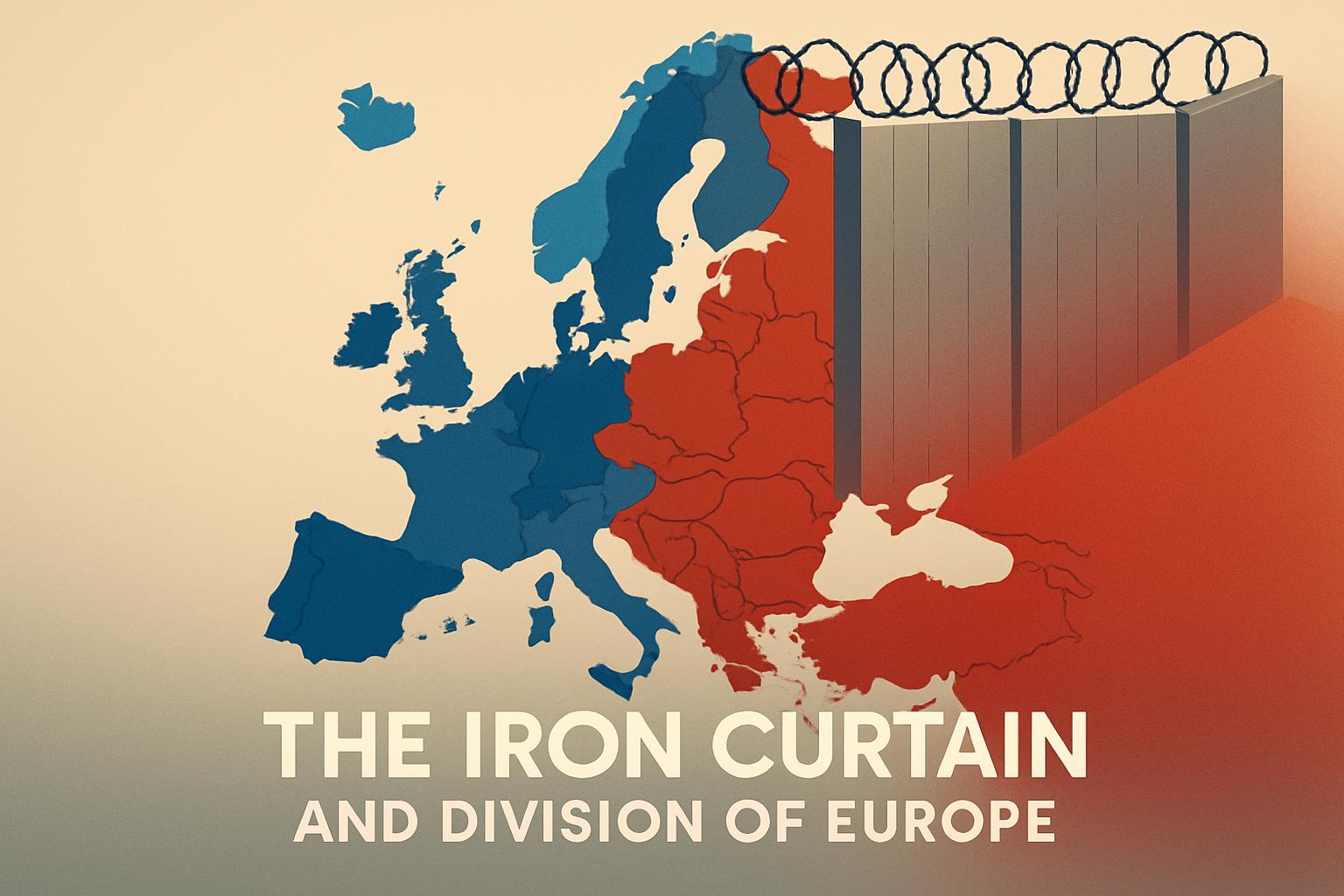
Introduction to The Iron Curtain and Its Significance
The term “Iron Curtain” is a metaphorical description coined by Winston Churchill to describe the political, military, and ideological barrier that isolated the Soviet-controlled countries of Eastern Europe from the rest of the continent during the Cold War. This division was pivotal in shaping the geopolitical landscape of Europe post-World War II and embedding a secular division that reshaped global politics, economies, and societies. Understanding the Iron Curtain is crucial for grasping how it influenced current international relations and the ever-complex European dynamics that exist today.
The Iron Curtain symbolized the ideological conflict and physical boundary dividing Europe into two separate areas from the end of World War II in 1945 until the end of the Cold War in 1991. On one side of the Curtain were the countries that were members of the Warsaw Pact and considered to be influenced by the Soviet Union. On the other side were the countries that were NATO members or aligned with the United States. The significance of this division lies in its ability to create two opposing blocs that practiced different political systems, economic structures, and social ideologies.
This geographical separation was more than just a political division; it embodied the broader conflict of the Cold War—a confrontation between communist and capitalist ideologies. The Iron Curtain influenced how countries interacted on international platforms and created a persistent backdrop of tension that impacted strategies for security, diplomacy, and even cultural exchanges. Consequently, this divide has left a lasting legacy that impacts socio-economic and political realities in modern Europe.
Formation of the Iron Curtain
The formation of the Iron Curtain began in the immediate aftermath of World War II, at a time when Europe was left devastated and in need of reconstruction. As the Allied powers sought to rebuild the continent, ideological differences emerged between the Soviet Union and the Western powers, particularly the United States and the United Kingdom. The Yalta and Potsdam Conferences shaped much of Europe’s post-war framework, yet they also highlighted stark ideological rifts.
To tighten its influence in Eastern Europe and prevent the spread of capitalism, the Soviet Union established communist governments in Albania, Poland, Hungary, Czechoslovakia, Romania, and Bulgaria, creating a buffer zone around its western borders. This control was solidified through political, military, and economic means, effectively establishing the Iron Curtain.
An example of how this division materialized is through the Berlin Wall, constructed in 1961. Although the wall physically divided East and West Berlin, it became a potent symbol of the broader separation between the Eastern bloc and the West. The Berlin Wall stood as a testament to the broader Iron Curtain concept, highlighting how ideologies translated into physical and political barriers.
Political Implications and the Cold War
Politically, the Iron Curtain was significant because it institutionalized the geopolitical division that led to the Cold War. This period was marked by intense rivalry between the United States and the Soviet Union, as well as a consistent military and political standoff between the two ideological blocs. The spread of “Iron Curtain” countries presented direct challenges to the spread of democracy and free-market economies.
To counter the spread of communism, Western Europe, under the leadership of the United States, implemented policies like the Truman Doctrine and initiated alliances such as the North Atlantic Treaty Organization (NATO) in 1949. This forged a sense of unity and collective defense against perceived Soviet aggression, while the Eastern bloc consolidated their forces under the Warsaw Pact a few years later.
- NATO: A military alliance of Western countries formed in 1949 to counter the Soviet threat.
- Warsaw Pact: Established in 1955 as a counterbalance to NATO, consisting of Soviet-satellite states.
- Truman Doctrine: U.S. policy to contain Soviet influence globally, marking the start of American Cold War strategy.
This ideological battleground influenced global affairs, encouraging several proxy wars such as the Korean and Vietnam Wars, pushing the world to the brink of nuclear conflict during crises like the Cuban Missile Crisis. The Iron Curtain was at the heart of these conflicts, anchored by differing visions of governance and human rights.
Economic and Social Impact
The Iron Curtain not only divided Europe politically but also economically and socially, leading to stark contrasts between the East and West in terms of economic development and social freedoms. In the West, countries focused on rebuilding with aid from the Marshall Plan, which stimulated significant economic growth and prosperity. This contrasted with the East’s centrally planned economies, which often resulted in inefficiencies and shortages.
An excellent illustration of the economic dichotomy was seen in Germany, where West Germany experienced an economic miracle (“Wirtschaftswunder”), rapidly rebuilding and becoming an industrial powerhouse, while East Germany struggled with stagnated economic growth and limited consumer availability. The Berlin Wall, again, served not only as a physical barrier but a symbolic economic one, dividing two different social realities.
Socially, this divide also fostered considerable differences in lifestyle. Western nations enjoyed more freedoms, vibrant cultures, and democratic governance, while Eastern bloc countries were controlled by restrictive regimes with limited freedoms. This led to a myriad of escape attempts, with people risking their lives to flee the East for the freedoms promised in the West, especially seen in events such as the Hungarian Revolution of 1956.
Dissolution of the Iron Curtain
The Iron Curtain began to dissolve in the late 1980s, primarily due to internal and external pressures on the Soviet Union and Eastern bloc countries. Economic hardship, nationalistic movements, and demands for more significant freedoms pushed these countries towards change. The policies of Soviet leader Mikhail Gorbachev, such as Glasnost (openness) and Perestroika (restructuring), played a decisive role in the opening of the Iron Curtain.
Significant milestones in the dissolution of the Iron Curtain include the peaceful negotiations in Poland that allowed for greater political participation and the fall of the Berlin Wall in 1989, which was one of the most iconic moments in modern history. The reunification of Germany and the subsequent collapse of communist regimes across Eastern Europe swiftly followed and epitomized the end of an era characterized by division.
| Key Events Leading to the Fall of the Iron Curtain |
|---|
| 1989 – Fall of the Berlin Wall |
| 1989 – Round Table Talks in Poland |
| 1990 – German Reunification |
| 1991 – Dissolution of the Soviet Union |
The marked shift allowed for the end of decades-long animosity and the chance for Europe to pursue greater integration and collective security, ultimately contributing to the expansion of the European Union and NATO in the 1990s and beyond.
Modern Day Legacy of the Iron Curtain
The legacy of the Iron Curtain persists even today, manifesting in the continued political and economic reconstruction efforts across Eastern Europe. The transition from centrally planned economies to free-market systems was, and in some cases, still is, challenging. Issues like corruption, inequality, and political instability pose significant challenges to these nations even decades after the curtain’s fall.
Moreover, the Iron Curtain’s historical context plays a role in modern tensions between Russia and Western Europe. The echoes of the past are seen in the strategic posturing and political discourse between NATO and Russia, with former Eastern bloc countries often caught in geopolitical crossfires as they navigate between historical allegiances and aspirations for integration with European and global communities.
An example of this lingering legacy is reflected in the ongoing Ukraine-Russia conflict, where historical ties, national identity issues, and foreign influence overlap, highlighting the complicated aftermath of the Iron Curtain’s division.
Conclusion and Future Implications
The Iron Curtain, as both a concept and a historical reality, was a defining feature of post-World War II Europe. It was an emblem of ideological struggle and division that left a profound impact on political alignments, economic policies, and social landscapes. Understanding its history and implications provides insight into many contemporary issues facing Europe and highlights the ongoing effects of past divisions on present-day geopolitics.
Ultimately, the dissolution of the Iron Curtain has paved the way for greater European integration and cooperation, offering opportunities for reconciliation and unity across a historically divided continent. The lessons learned from this era encourage continuous dialogue, diplomacy, and collaboration to maintain peace and stability.
As the world continues to experience geopolitical shifts, the Iron Curtain serves as a reminder of the importance of pursuing common ground and building bridges in diverse political landscapes. Let us take positive steps in understanding and learning from this past, fostering collaboration to address and resolve present challenges effectively.
Frequently Asked Questions
1. What exactly was the Iron Curtain, and why was it significant?
The Iron Curtain was a term famously coined by Winston Churchill during a speech in 1946 to describe the division between Western Europe and the Soviet-controlled Eastern Europe after World War II. It’s important to understand that this “curtain” wasn’t a physical barrier, like the Berlin Wall, but rather a symbolic one. The Iron Curtain represented the ideological conflict and physical boundary dividing Europe into two distinct areas of political influence and economic control. Western Europe was largely capitalist and democratic, supported by the United States and its allies, while Eastern Europe was dominated by the Soviet Union and followed communist principles. This division was significant not only because it created two opposing military alliances, NATO and the Warsaw Pact but also because it marked the beginning of the Cold War, a period of intensified rivalry and nuclear arms race. This ideological divide influenced global politics, economics, and even culture for over four decades, impacting societies on both sides of the curtain.
2. Why did the Iron Curtain lead to such division in Europe?
The reasons behind the division in Europe due to the Iron Curtain are rooted in the outcomes of World War II and the conflicting ideologies of the major world powers. At the end of the war, the USSR and the Western Allies had differing visions for Europe’s future. The Soviet Union sought to expand its influence and secure its borders by creating a buffer of communist states in Eastern Europe. In contrast, the Western powers, including the United States and Britain, aimed to promote democracy and open markets. This fundamental clash of interests and the historical events that followed led to the deep-set division embodied by the Iron Curtain. Countries in Eastern Europe, like Poland, Hungary, and Czechoslovakia, fell under the direct or indirect control of the USSR, establishing one-party states with central economies. Meanwhile, Western Europe pursued recovery through aid programs like the Marshall Plan, fostering rapid economic growth. This split resulted in not only political and military tensions but also upheaval in social and cultural arenas, with both sides vying for ideological supremacy.
3. How did the Iron Curtain affect ordinary people’s lives in divided Europe?
The Iron Curtain had a profound impact on the day-to-day lives of people in both Eastern and Western Europe. For those living behind the Iron Curtain in Eastern Europe, daily life was characterized by restricted freedoms, limited political rights, controlled media, and often harsh state surveillance. Economies were centrally planned, leading to shortages and inefficiencies. Because of aggressive censorship policies, access to information was limited, affecting people’s understanding of the world beyond their borders. Conversely, Western Europeans experienced politically and economically freer societies, enjoying higher standards of living, access to diverse media, and generally more personal freedom. However, the constant threat of nuclear war loomed large for all Europeans, Western and Eastern alike, as the Cold War tensions escalated. Hence, the Iron Curtain didn’t just separate nations but profoundly divided people’s experiences, opportunities, and perceptions based on which side they were on.
4. What were the long-term effects of the Iron Curtain on Europe?
The long-term effects of the Iron Curtain were both vast and nuanced, shaping modern Europe in many ways. Politically, the end of the Cold War and the fall of the Iron Curtain led to the reunification of Germany and the subsequent enlargement of the European Union as ex-Eastern Bloc countries transitioned to democracy and market economies. These changes brought about economic cooperation and political stability previously unimaginable in the region. Despite significant progress, disparities remain evident today. Economically, the legacy of decades of communist rule still affects many Eastern European nations, which generally lag behind their Western counterparts in terms of GDP per capita and living standards. Socially, the Iron Curtain cultivated diverse cultural perspectives and identities that continue to influence Europeans’ views on issues like democracy, governance, and international relations. The ideological battle emboldened by the Iron Curtain has left enduring scars and sometimes unspoken divisions which modern Europe continues to navigate and heal from.
5. Why was the fall of the Iron Curtain so important, and how did it happen?
The fall of the Iron Curtain symbolized the end of the Cold War and was a pivotal moment for global history, signaling a new era of collaboration and peace in Europe. Its fall was marked by the various democratic revolutions sweeping across Eastern European countries in the late 1980s, most notably the fall of the Berlin Wall in 1989. The collapse happened due to several converging factors. Politically, Soviet leader Mikhail Gorbachev’s policies of glasnost (opening) and perestroika (restructuring) fostered an environment where political reform seemed possible and even necessary. Economically, the failing economic systems within Eastern Bloc countries made change more pressing, as these economies could no longer sustain themselves under central planning. Social movements demanding greater freedom and prosperity gained momentum across Eastern Europe, fueled by a populace tired of oppression and economic hardship. The collaborative efforts of Eastern European reformers, paired with the declining Soviet influence, facilitated the dismantling of the Iron Curtain, leading to political transformations and economic integrations that have shaped today’s Europe. The fall demonstrated the power of grassroots movements and ideological shifts in altering the course of history, significantly impacting international relations globally.