
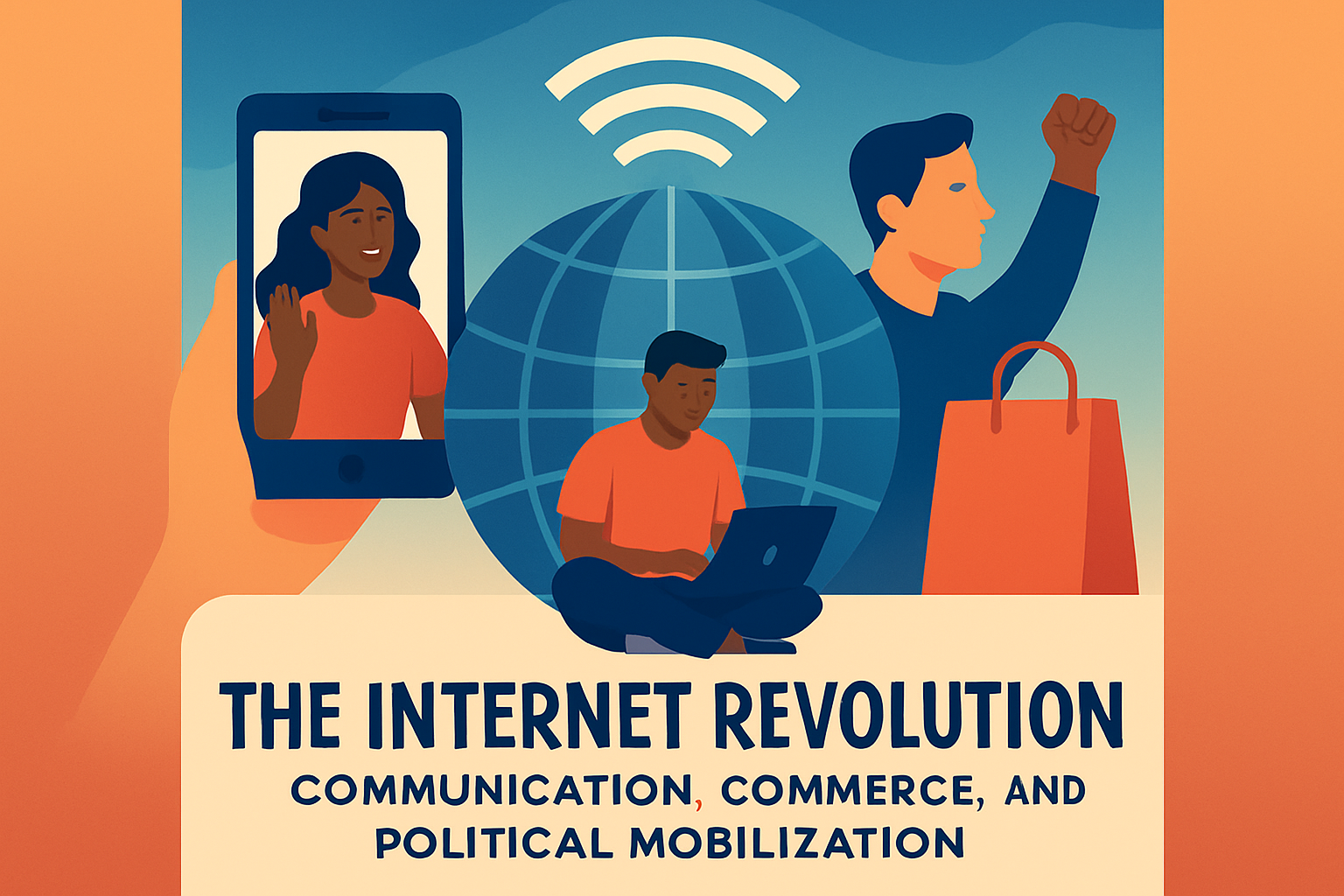
The internet revolution reshaped daily life by changing how people communicate, buy and sell, organize politically, learn about health, and respond to environmental challenges. In practical terms, the internet is the global network of interconnected computers and devices that allows digital information to move instantly across borders. That definition sounds technical, but its effects are concrete: families maintain constant contact through messaging apps, small businesses reach national markets through e-commerce platforms, activists coordinate protests through social networks, clinicians monitor patients through connected tools, and researchers share climate data in real time. Over two decades of working with digital publishing, online campaigns, and technology adoption have made one point unmistakable: the internet is not a separate sphere from society. It is now part of the infrastructure of society itself.
Understanding this transformation matters because communication, commerce, and political mobilization increasingly influence one another. A rumor on a social platform can affect public health behavior within hours. A payment system outage can halt online retail and delay medicine deliveries. A viral video documenting pollution can trigger regulation, investor pressure, and citizen action. For readers exploring Environment, Health & Technology under the broader Contemporary topic, this hub article provides the essential map. It defines the main systems, explains how they work in plain language, and highlights the opportunities and risks that shape modern life. The core idea is simple: the internet revolution created unprecedented access, speed, and scale, but every benefit comes with governance, equity, and reliability questions that institutions and citizens must answer carefully.
How the Internet Rewired Communication
Communication was the first major domain transformed by the internet, and the shift was not just from letters to email. It was a move from one-to-one and one-to-many broadcast models toward many-to-many, always-on interaction. Email lowered the cost of written communication. SMS and messaging applications such as WhatsApp, Signal, and Telegram made instant conversation routine. Video platforms and tools like Zoom, Microsoft Teams, and Google Meet normalized face-to-face interaction across distance. Social networks compressed publishing and distribution into a single action: one post could reach friends, journalists, employers, or millions of strangers at once.
This matters because speed changes behavior. In newsroom workflows I have managed, the interval between an event and public awareness shrank from hours to minutes. During natural disasters, that speed can save lives when local agencies push evacuation notices through mobile alerts and social feeds. During disease outbreaks, public health agencies use dashboards, live briefings, and platform partnerships to spread guidance. The same infrastructure also enables misinformation. False claims about vaccines, wildfire causes, or contaminated water often spread faster than corrections because platforms reward novelty, emotion, and engagement. Effective communication online therefore requires media literacy, source verification, and clear institutional messaging.
The internet also changed language itself. Memes, short video, and emoji became communicative tools with social and political meaning. Communities form around niche interests or local concerns, allowing people with rare diseases, environmental justice grievances, or technical expertise to find one another quickly. That connectivity is often beneficial. Patients compare treatment experiences, farmers share drought strategies, and neighborhood groups coordinate responses to storms. Yet communication abundance can produce fragmentation. Algorithmic feeds personalize information, creating separate realities where users receive different facts, different priorities, and different emotional cues. When communication systems become fragmented, social trust weakens, and public problem-solving becomes harder.
Commerce in the Age of Platforms, Payments, and Data
The internet revolution transformed commerce by reducing transaction friction. A business no longer needs expensive physical storefronts in every market to sell nationally or globally. Through platforms such as Amazon, Shopify, Etsy, Alibaba, Mercado Libre, and local marketplace apps, merchants can list products, process payments, manage logistics, and advertise to targeted audiences from a single dashboard. Consumers benefit from convenience, price comparison, subscription services, and near-instant access to digital goods. Businesses gain customer data, direct feedback, and lower barriers to entry. I have seen small firms double revenue after improving search visibility, streamlining checkout, and connecting inventory systems to online storefronts.
Behind that convenience is a sophisticated stack of technologies: cloud computing, content delivery networks, payment gateways, fraud detection systems, recommendation engines, and customer relationship management software. Digital payments are central. Services such as PayPal, Stripe, Apple Pay, and UPI in India have made online purchasing ordinary. UPI in particular demonstrates how public digital infrastructure can scale commerce; it processes billions of transactions monthly and has accelerated peer-to-peer and merchant payments across income levels. Logistics networks then turn online orders into physical delivery, using route optimization, warehouse automation, and demand forecasting. Commerce today is therefore not just about websites. It is an ecosystem of software, finance, transportation, and data governance.
The tradeoffs are significant. Platform dependence can squeeze smaller sellers through rising fees, shifting search rankings, and limited access to customer relationships. Data collection raises privacy and competition concerns, especially when dominant firms combine search behavior, location, browsing, and purchase histories. Cybersecurity is another core issue. Ransomware, credential theft, and supply-chain attacks can interrupt payments or expose customer data at scale. Regulators have responded with consumer protection rules, privacy laws such as the GDPR, and antitrust scrutiny of gatekeeper platforms. Healthy digital commerce needs more than innovation; it requires transparency, secure architecture, interoperable systems, and fair market conditions.
Political Mobilization, Civic Participation, and Democratic Risk
Political mobilization changed dramatically once the internet gave ordinary citizens publishing power, fundraising capacity, and coordination tools. Campaigns now use email lists, micro-donations, livestreams, volunteer platforms, and social targeting to mobilize supporters. Grassroots movements rely on hashtags, encrypted chats, shared documents, and location-based alerts to organize demonstrations, monitor elections, and document abuse. The Arab Spring, Black Lives Matter, climate strikes inspired by youth activists, and mutual-aid networks during crises all showed how online systems can convert attention into action. In campaigns I have observed closely, digital tools shortened the path from awareness to participation: a person could see an issue, donate, register, attend, and recruit others within minutes.
That empowerment does not guarantee democratic health. The same tools support disinformation operations, harassment campaigns, voter suppression messaging, and foreign influence efforts. Recommendation systems can amplify polarizing content because outrage often drives more engagement than context. Bots and coordinated inauthentic accounts can manufacture the appearance of consensus. Deepfakes and synthetic audio increase the burden of verification. Election administrators, civil society groups, and platforms now devote substantial resources to content moderation, fact-checking partnerships, cybersecurity hardening, and rapid response teams, yet enforcement remains inconsistent and politically contested.
| Area | Main Internet Benefit | Primary Risk | Practical Response |
|---|---|---|---|
| Communication | Instant global reach | Misinformation spread | Source verification and trusted alerts |
| Commerce | Low-friction transactions | Data exposure and platform dependency | Security controls and market oversight |
| Politics | Rapid civic mobilization | Manipulation and polarization | Transparency, moderation, and digital literacy |
| Health | Telemedicine and information access | False medical claims | Clinical standards and evidence-based guidance |
| Environment | Real-time monitoring and coordination | Energy use and electronic waste | Efficient infrastructure and circular design |
Political mobilization online is strongest when digital activity connects to offline institutions. Petitions alone rarely create durable change, but petitions linked to legal strategy, local organizing, media outreach, and policy negotiation often do. The internet lowers coordination costs; it does not eliminate the need for leadership, coalition building, or credible demands. Effective civic use of technology depends on transparency in political advertising, resilient election infrastructure, independent journalism, and public trust in procedures. When those supports are weak, online mobilization can become volatile rather than constructive.
Health Technology, Public Information, and Digital Care
Health is one of the most consequential areas shaped by the internet revolution. Patients now search symptoms, access laboratory results through portals, book appointments online, attend telehealth consultations, and use wearable devices that track heart rate, sleep, activity, blood oxygen, and glucose trends. During the COVID-19 pandemic, telemedicine moved from optional convenience to essential infrastructure almost overnight. Hospitals expanded virtual triage, primary care practices adopted remote consultations, and public dashboards became central tools for case tracking and risk communication. In my work with digital health content, the biggest challenge has been balancing accessibility with clinical accuracy: people need clear explanations, but medical guidance must remain evidence-based and specific.
The benefits are substantial. Telehealth improves access for rural patients, people with mobility limitations, and workers who cannot easily take time off. Remote monitoring can support chronic disease management by helping clinicians detect changes earlier. Online patient communities reduce isolation and help families navigate treatment decisions. Public health agencies can distribute vaccination guidance, heat alerts, air quality warnings, and outbreak updates at speed. The best digital health systems integrate usability, privacy, and clinical workflow rather than treating technology as a bolt-on feature.
Risks remain serious. Search engines and social platforms expose users to unverified medical claims, supplement scams, and conspiracy narratives. Health data is highly sensitive, making privacy and cybersecurity nonnegotiable. In the United States, HIPAA sets important standards for protected health information, but many wellness apps fall outside strict clinical regulation while still collecting intimate data. Algorithmic tools can also reproduce bias if trained on incomplete or unrepresentative datasets. Good digital health policy therefore requires interoperability standards, informed consent, strong encryption, transparent model evaluation, and clear distinction between medical advice and general information.
Environmental Change, Infrastructure, and the Hidden Cost of Connectivity
The internet is often presented as weightless, but it depends on physical infrastructure with environmental consequences. Data centers consume large amounts of electricity and water for cooling. Telecommunications networks require towers, fiber, semiconductors, and maintenance fleets. Consumer devices depend on mined materials, global shipping, and eventual disposal. According to the International Energy Agency, data centers and transmission networks account for a meaningful share of global electricity demand, even as efficiency gains have moderated growth. That means the digital economy is inseparable from energy systems, supply chains, and environmental regulation.
At the same time, internet-connected technology is essential for environmental management. Satellite imagery, sensor networks, and cloud analytics support wildfire detection, methane monitoring, precision agriculture, flood forecasting, and biodiversity tracking. Utilities use smart grids to balance loads and integrate renewable energy. Cities deploy connected traffic systems to reduce congestion and emissions. Researchers share climate models and open datasets globally, accelerating collaboration. I have worked with organizations that used remote sensing and public dashboards to translate complex environmental data into local action, and the impact is strongest when information is timely, trusted, and geographically specific.
The challenge is to maximize environmental benefit while reducing digital harm. That means renewable-powered data centers, efficient coding, longer device lifecycles, right-to-repair policies, and robust e-waste collection. It also means honesty about rebound effects. Greater efficiency does not automatically lower total energy use if demand expands faster than savings. Sustainable digital transformation requires procurement standards, lifecycle accounting, and public reporting, not just green branding.
What This Contemporary Hub Connects Next
As a hub for Environment, Health & Technology, this article connects several themes that deserve deeper exploration in dedicated pages. One branch examines digital public health, including telemedicine regulation, patient data governance, health misinformation, wearable devices, and AI-assisted diagnostics. Another focuses on environmental technology: climate data systems, renewable energy management, smart cities, electronic waste, and the environmental footprint of cloud computing. A third explores contemporary communication and commerce, from platform economics and cybersecurity to digital labor, creator markets, and supply-chain resilience. The political branch covers online activism, election integrity, digital surveillance, censorship, and the governance of large platforms.
The common thread across all of these topics is institutional design. Technology alone does not determine outcomes. Rules, incentives, standards, business models, and public expectations shape whether internet systems broaden opportunity or deepen inequality. When organizations build transparent processes, secure infrastructure, and accountable governance, digital tools can expand access and improve resilience. When they chase scale without safeguards, the same tools can magnify harm. Readers using this hub should treat each linked topic not as an isolated trend but as part of one contemporary system in which communication, markets, health, and environmental realities continuously interact.
The internet revolution is best understood not as a single invention but as an ongoing restructuring of modern society. It changed communication by making participation immediate, global, and interactive. It changed commerce by connecting discovery, payment, logistics, and data into integrated digital marketplaces. It changed political mobilization by lowering the cost of organizing while increasing the speed of persuasion, conflict, and manipulation. It also transformed health through telemedicine, remote monitoring, and rapid information distribution, and it reshaped environmental management through sensing, modeling, and coordination tools. These benefits are real, measurable, and already embedded in everyday life.
But the central lesson from years of practical digital work is that connectivity is not enough. Systems must be trustworthy, equitable, secure, and sustainable. Citizens need digital literacy. Businesses need responsible data practices. Governments need modern regulation and resilient public infrastructure. Health institutions need evidence-based communication. Environmental planning needs lifecycle thinking and energy accountability. When these conditions are in place, the internet supports better decisions and broader participation. When they are absent, speed and scale can intensify error, exploitation, and distrust.
Use this Contemporary hub as your starting point for understanding how Environment, Health & Technology intersect in the connected age. Explore the related articles, compare the tradeoffs, and follow the evidence behind each issue. The internet revolution is still unfolding, and informed readers are better prepared to shape what comes next.
Frequently Asked Questions
What is the internet revolution, and why is it considered such a major turning point in modern life?
The internet revolution refers to the rapid transformation of society caused by the spread of the global digital network that connects computers, phones, businesses, governments, and institutions in real time. While the internet can be defined technically as a system of interconnected networks that transmit data instantly across long distances, its true importance lies in how deeply it has changed everyday life. It has altered the speed of communication, expanded access to information, reshaped commerce, and created entirely new ways for people to organize socially and politically.
This shift is considered a major turning point because it did not simply improve existing systems; it restructured them. Before widespread internet access, communication was slower, business expansion required more physical infrastructure, and political organizing often depended on local meetings, printed materials, and traditional media coverage. Today, a family can stay in contact across continents through messaging apps and video calls, a small business can sell products nationwide or globally through an online storefront, and a political movement can gain visibility within hours through social platforms and digital campaigns.
The internet revolution also matters because it connects multiple parts of life at once. Education, healthcare, banking, entertainment, environmental monitoring, and civic participation all increasingly rely on digital tools. In that sense, the internet is not just a technology sector development; it is a foundational force that influences how modern societies function, compete, and respond to change.
How has the internet changed communication between individuals, families, and communities?
The internet has fundamentally changed communication by making it faster, cheaper, more continuous, and more interactive than at any other point in history. Individuals no longer have to rely only on letters, landline calls, or scheduled broadcasts to exchange information. Instead, they can send instant messages, hold video conversations, share photos and documents, and participate in online communities from almost anywhere with a connection.
For families, this has created a new kind of daily closeness. Relatives living in different cities or countries can speak face to face through video apps, coordinate routines in group chats, and share milestones in real time. This constant contact has been especially important for migrant families, long-distance relationships, and households balancing work and travel. The emotional effect is significant: communication is no longer limited by geography in the same way it once was.
At the community level, the internet has expanded the idea of what a community can be. People now form connections not only through physical neighborhoods, schools, or workplaces, but also through shared interests, identities, professions, and causes. Local groups can organize events, announce emergencies, raise funds, and distribute information quickly through websites, messaging platforms, and social media. At the same time, this transformation has introduced challenges such as misinformation, online harassment, and information overload. Even so, the overall effect has been to make communication more immediate, participatory, and wide-reaching than traditional systems allowed.
In what ways did the internet revolution transform commerce and opportunities for small businesses?
The internet revolution transformed commerce by removing many of the traditional barriers that once limited who could buy, sell, advertise, and compete. In the past, reaching customers often required a physical storefront, significant advertising budgets, and access to regional distribution channels. Today, businesses of many sizes can create websites, use digital marketplaces, promote products on social platforms, accept online payments, and serve customers far beyond their immediate location.
For small businesses, this change has been especially important. A local craft maker, food producer, consultant, or retailer can now reach national or international audiences without building a large physical presence. Search engines, online reviews, digital ads, and e-commerce platforms have made discovery easier, while shipping networks and payment systems have made transactions more efficient. This has opened new paths for entrepreneurship, reduced entry costs in many industries, and allowed niche businesses to find highly specific customer groups.
The internet has also changed consumer behavior. Buyers can compare prices instantly, read reviews, research brands, and make purchases at any hour. This has increased convenience and competition at the same time. Businesses are now expected to provide responsive customer service, transparent information, and seamless digital experiences. While the online marketplace creates opportunity, it also requires adaptability. Companies must pay attention to cybersecurity, data privacy, algorithm changes, and the pressure of competing in a crowded digital environment. Even with these challenges, the internet has made commerce more dynamic, accessible, and scalable than ever before.
How has the internet influenced political mobilization and public participation?
The internet has had a profound effect on political mobilization by making it easier for people to share information, build networks, coordinate action, and participate in public debate. Political messages that once depended heavily on newspapers, television, radio, and formal campaign structures can now spread through websites, email lists, livestreams, and social media platforms. This has lowered the cost of organizing and given citizens, activists, and grassroots groups more tools to shape public discussion.
One of the most important changes is speed. A petition can gather support quickly, a protest can be organized in hours, and a local issue can gain national attention if it resonates online. Digital tools help movements recruit volunteers, raise donations, publish evidence, and communicate directly with supporters without always relying on gatekeepers in traditional media. This has strengthened civic engagement in many cases and made political participation more accessible to people who were previously excluded from major platforms.
At the same time, the internet’s role in politics is not automatically positive. The same systems that enable mobilization can also spread false information, intensify polarization, and reward emotionally charged content over careful analysis. Political actors can use digital tools to inform and empower the public, but they can also use them to manipulate attention and distort debate. For that reason, understanding the internet’s political impact requires balance. It has expanded democratic participation and public visibility, but it has also made media literacy, platform accountability, and critical thinking more essential than ever.
Beyond communication and commerce, how has the internet affected health, education, and environmental action?
The internet’s influence extends far beyond messaging and online shopping. In health, it has changed how people access information, services, and support. Patients can research symptoms, communicate with providers, book appointments, use telemedicine platforms, and access digital health records. Public health agencies can also distribute urgent updates rapidly during outbreaks or emergencies. Although online health information varies in quality and must be evaluated carefully, the internet has undeniably improved the reach and speed of health communication.
In education, the internet has made learning more flexible and more widely available. Students can take online courses, access digital libraries, watch lectures, collaborate through cloud-based tools, and learn from institutions and experts around the world. Teachers use digital platforms to assign work, track progress, and connect with students outside the classroom. This has expanded educational opportunity, especially for remote learners, working adults, and people seeking specialized training. However, it has also highlighted inequalities in device access, broadband availability, and digital literacy.
In environmental action, the internet has become a powerful tool for awareness, research, and coordination. Scientists and organizations use digital systems to share climate data, map environmental changes, and monitor disasters in real time. Activists use online platforms to organize campaigns, educate the public, and pressure institutions to respond to issues such as pollution, deforestation, and climate change. Communities can receive alerts about fires, floods, heatwaves, and other risks more quickly than in the past. Taken together, these developments show that the internet revolution is not limited to convenience or entertainment. It has become central to how societies care for health, spread knowledge, and respond collectively to global challenges.