
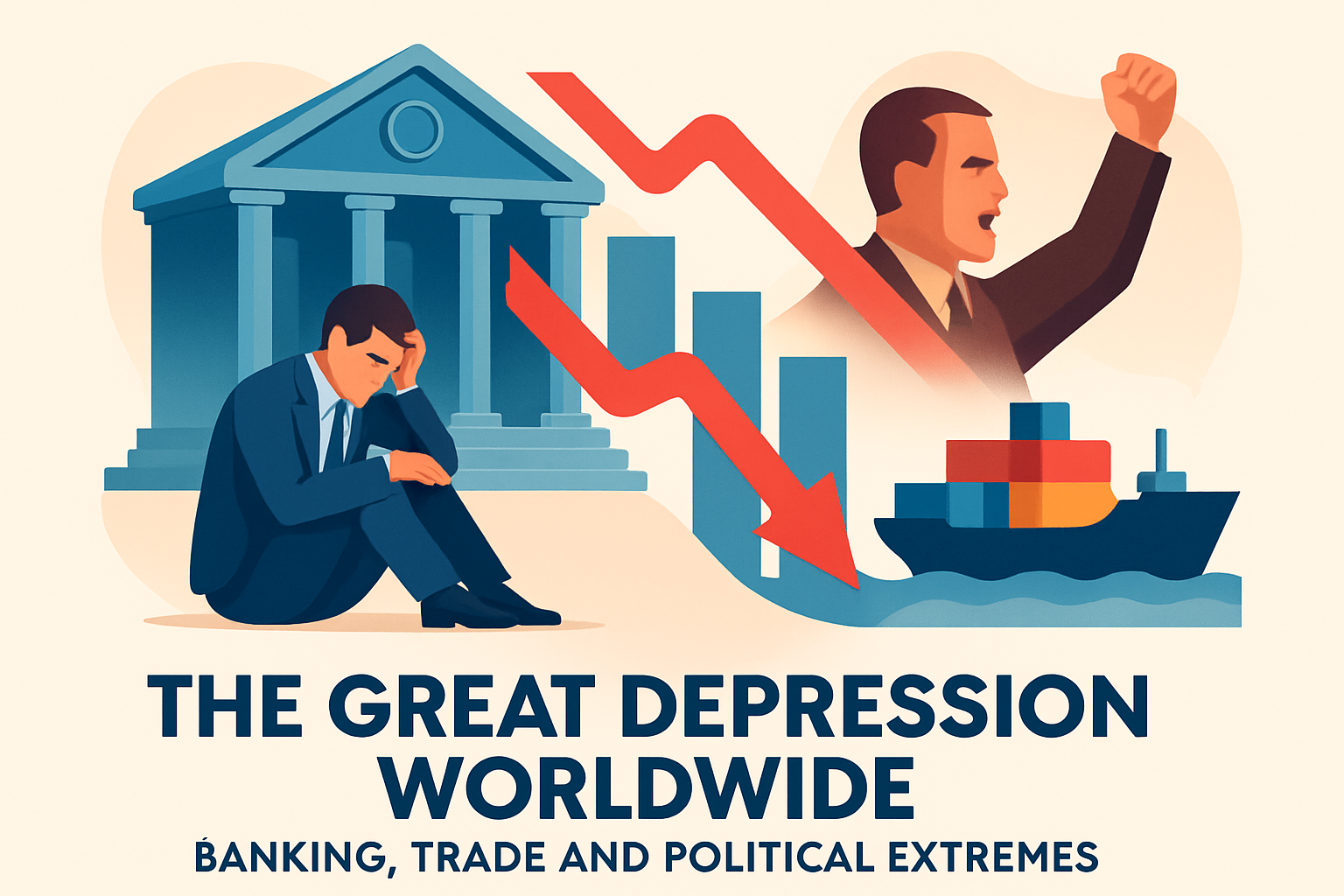
The Great Depression was not a single market crash or one country’s recession; it was a worldwide breakdown in banking, trade, employment, and political stability that reshaped the twentieth century. Historians usually date it from 1929 to the late 1930s, but in practice its timing varied by country, with banking crises, deflation, and collapsing demand hitting some economies earlier, longer, or more violently than others. When I explain this period to students and clients, I start with three linked systems: finance, global commerce, and government legitimacy. Once those three systems failed together, hardship spread fast.
At its core, the Great Depression was a severe and prolonged contraction in economic activity marked by falling output, business failures, mass unemployment, debt distress, and declining prices. Banking crises mattered because banks connected savings to investment and daily commerce. Trade mattered because the interwar economy relied on cross-border flows of goods, capital, and credit. Political extremes mattered because economic desperation weakened confidence in centrist institutions and gave radical movements space to grow. These are not separate stories. They are one integrated global story.
The crisis emerged from structural weaknesses left by the First World War, fragile debt arrangements, speculative excess in the 1920s, and rigid policy frameworks such as the gold standard. After the Wall Street crash of October 1929, governments and central banks often made conditions worse by defending currencies, restricting credit, cutting spending, and raising tariffs. In the United States, bank failures destroyed household savings and reduced lending. In Germany and Austria, financial collapse fed social panic. In Latin America and Asia, export prices dropped sharply, crushing economies tied to commodities such as coffee, wheat, sugar, rubber, and tin.
Understanding the Great Depression worldwide matters for more than historical interest. It explains why modern policymakers care so much about lender-of-last-resort functions, deposit insurance, coordinated stimulus, and avoiding protectionist spirals. It also helps explain how economic shocks can transform politics. The lesson I have seen confirmed repeatedly in comparative economic history is simple: when financial systems fail, trade contracts, and unemployment rises, societies do not remain politically neutral for long. The Depression is therefore essential for understanding both the road to the Second World War and the design of modern economic governance.
How Banking Failures Turned Recession into Global Depression
Banking collapse was one of the main mechanisms that converted a downturn into a worldwide catastrophe. In the late 1920s and early 1930s, banks were less protected than modern institutions. Deposit insurance was generally absent, central bank responses were inconsistent, and regulation was often weak. When confidence fell, depositors rushed to withdraw cash. A bank run was not just a financial event. It destroyed working capital for firms, cut credit for farms and households, and spread fear from one town or nation to another.
In the United States, waves of bank failures between 1930 and 1933 deepened deflation and unemployment. The Federal Reserve, created in 1913, did not act aggressively enough as lender of last resort. Milton Friedman and Anna Schwartz later argued that monetary contraction was decisive, and while historians debate details, the broad point stands: a shrinking money supply intensified the slump. Thousands of banks failed, especially smaller rural institutions. Businesses could not borrow for payroll or inventory. Consumers delayed spending because prices and wages were falling. Debt burdens became harder to carry in real terms.
Europe’s banking system was equally vulnerable. The 1931 collapse of Austria’s Creditanstalt is one of the clearest examples of systemic contagion. Its failure shook confidence across Central Europe and quickly affected Germany and Britain. Germany faced severe pressure because its banks and government depended heavily on short-term foreign loans, many of them from the United States. Once American capital retreated and depositors lost confidence, the financial structure cracked. Banking holidays, capital controls, and emergency decrees followed. Credit evaporated precisely when unemployment and political rage were already rising.
The gold standard intensified these failures. Countries committed to maintaining fixed exchange rates had limited room to expand money supply or lower interest rates. Instead of stabilizing domestic economies, authorities often raised rates to defend gold reserves. That choice protected parity at the expense of employment and output. Barry Eichengreen’s work has shown persuasively that countries leaving gold earlier generally recovered earlier. Britain abandoned gold in 1931 and gained flexibility. The United States left gold in stages under Franklin Roosevelt, helping reflate prices. France stayed on gold longer and suffered deeper stagnation.
| Country | Key Banking or Monetary Shock | Policy Response | Result |
|---|---|---|---|
| United States | Bank runs and failures, 1930 to 1933 | Bank holiday, FDIC creation, leaving gold | Financial stabilization and partial recovery |
| Austria | Creditanstalt collapse in 1931 | Emergency support, international negotiations | Contagion spread across Europe |
| Germany | Foreign loan withdrawal and bank crisis | Controls, bank closures, austerity pressure | Severe contraction and political radicalization |
| Britain | Pressure on sterling and gold reserves | Left gold in 1931, lower rates | Earlier recovery than gold-bloc states |
From direct experience analyzing financial crises, I consider the banking dimension the clearest answer to a common question: why did the Depression become so deep? Because failed banks do not merely reflect a weak economy; they actively break the mechanisms needed for recovery. Savings disappear, trust collapses, and even solvent businesses are starved of credit. That happened on a global scale in the early 1930s.
Why World Trade Collapsed So Dramatically
World trade fell with shocking speed after 1929. The causes included shrinking demand, collapsing commodity prices, reduced credit, exchange instability, and rising protectionism. International commerce depended heavily on trade finance, shipping insurance, and predictable exchange arrangements. Once banks weakened and currencies came under pressure, traders faced higher risk and fewer financing options. Demand also fell because consumers and firms cut purchases everywhere at once. A German factory bought fewer imported materials, a British household bought fewer manufactured goods, and an Argentine ranch exported into a market with lower prices and weaker buyers.
Protectionist policy made a bad situation worse. The most famous example is the United States Smoot-Hawley Tariff Act of 1930, which raised duties on many imports. It did not cause the Depression by itself, but it intensified retaliation and symbolized the retreat from economic cooperation. Canada, European states, and others responded with their own barriers. Imperial preference systems redirected trade within empires rather than through open markets. Countries introduced quotas, licensing rules, and exchange controls. The practical result was fragmentation: instead of one world market, there were competing blocs.
Commodity exporters suffered especially hard because prices for primary goods dropped sharply. Latin American economies that relied on coffee, nitrates, sugar, beef, copper, or wheat saw export earnings collapse. Brazil responded by buying and even destroying coffee stocks to support prices, an extraordinary measure that shows how extreme the imbalance became. In Southeast Asia, producers of rubber and tin faced similar pain. Farmers often increased production to make up for lower prices, which worsened oversupply. That vicious cycle pushed rural debt and poverty higher.
Trade collapse also had a social geography. Port cities, mining districts, plantation zones, and manufacturing regions tied to exports were hit first and often hardest. In my own reading of interwar business archives, one recurring pattern stands out: firms did not fail only because demand was weak; they failed because payment chains broke. Importers could not secure letters of credit, exporters could not predict exchange values, and inventories sat unsold while debts came due. This is why modern crisis managers pay attention not just to tariffs but to the infrastructure of commerce, including banking, insurance, and currency settlement.
Different National Experiences Across the World
The Great Depression was global, but it was not uniform. National outcomes depended on debt levels, export structure, political institutions, and how quickly governments changed policy. The United States suffered a dramatic collapse in output and employment, with unemployment reaching roughly 25 percent at its peak. Roosevelt’s New Deal brought banking reform, public works, agricultural adjustment, and labor changes, but recovery remained incomplete until wartime mobilization. Even so, measures such as the Emergency Banking Act and Social Security permanently changed the state’s role in economic security.
Germany’s experience was economically devastating and politically explosive. The Weimar Republic already carried the burden of war debts, reparations disputes, and social polarization. Chancellor Heinrich Brüning pursued austerity, seeking fiscal credibility under conditions of collapsing demand. That strategy deepened unemployment and misery. By 1932, millions were out of work, and support for anti-system parties surged. The Nazi Party exploited fear, resentment, and class conflict, presenting authoritarian nationalism as a remedy for economic breakdown. The Depression did not mechanically cause Hitler’s rise, but it created the environment in which his movement could become a mass force.
Britain followed a somewhat different path. It faced heavy unemployment in older industrial regions such as coal, steel, and shipbuilding, yet after leaving gold in 1931 it gained monetary flexibility. Lower interest rates supported housing construction and some domestic demand. Recovery was uneven, and regional distress remained severe, but Britain avoided the same degree of political collapse seen in Germany. France, by contrast, experienced a later but persistent slump, partly because it remained tied to gold longer and faced political fragmentation that limited decisive action.
Japan shows another distinctive pattern. Hit by falling silk exports and rural distress, it also moved away from orthodoxy earlier than some European powers. Monetary easing, deficit spending, and military demand contributed to recovery in the early 1930s. Yet that recovery was tied to rising militarism and imperial expansion. In Latin America, the shock encouraged import-substituting industrialization as governments sought to reduce dependence on volatile world markets. In colonies across Africa and Asia, imperial authorities often prioritized revenue and external stability over welfare, leaving producers and workers to absorb the pain.
How Economic Crisis Fed Political Extremes
Political extremism grew during the Depression because economic suffering eroded trust in liberal institutions. When banks failed, jobs disappeared, and governments seemed powerless, voters and activists looked for alternatives outside the democratic center. Extremes took different forms: fascism, authoritarian conservatism, militarism, revolutionary socialism, and populist nationalism. The common thread was the promise of decisive action against paralysis. Economic collapse did not automatically produce dictatorship, but it dramatically widened the audience for parties that rejected compromise.
Germany is the clearest case, but not the only one. In much of Eastern and Southern Europe, parliamentary systems weakened as leaders used emergency powers or backed authoritarian rule. In Spain, economic and social tensions contributed to polarization that culminated in civil war in 1936. In Japan, the Depression strengthened militarists who argued that parliamentary politics and international cooperation had failed. Expansion into Manchuria in 1931 was not simply a strategic act; it was also linked to domestic pressures, resource fears, and the search for national revival through force.
At the same time, the Depression also expanded support for democratic reform in some countries. In the United States, Roosevelt channeled anger into institutional change rather than anti-democratic revolution. In Scandinavia, social democratic parties developed durable bargains around employment, welfare, and agricultural support. These cases matter because they show that economic crisis creates political openings, not predetermined outcomes. The difference often lies in state capacity, leadership, and whether governments can deliver visible relief quickly enough to preserve legitimacy.
One lesson I return to often is that people rarely radicalize over abstract macroeconomic indicators. They radicalize when hardship becomes personal and prolonged: savings vanish, mortgages fail, wages fall, children leave school, and elites appear insulated. The Great Depression made those conditions widespread. That is why political history and economic history cannot be separated here. The path from bank run to extremist vote was not direct in every case, but it was real enough to alter the global balance of power.
Lasting Lessons for Modern Economies
The Great Depression worldwide left a durable institutional legacy. Modern deposit insurance, stronger central banking, countercyclical fiscal policy, and international financial cooperation all reflect lessons drawn from interwar failures. The creation of the Federal Deposit Insurance Corporation in 1933 helped end destructive bank runs in the United States. John Maynard Keynes’s critique of austerity under depression conditions gained lasting influence because governments learned that cutting demand during a slump can intensify collapse. After the Second World War, the Bretton Woods system was designed in part to avoid the disorder of the 1930s.
Another enduring lesson concerns trade. Policymakers now know that protectionist spirals can magnify domestic pain rather than shield economies from it. Open trade alone is not enough, but stable rules, functioning credit channels, and international coordination matter enormously. The 2008 global financial crisis revived many comparisons with the 1930s, and the reason was clear: once banking stress threatens payment systems and confidence, authorities must act rapidly. Aggressive liquidity support, deposit guarantees, and fiscal intervention are not signs of panic; they are tools developed because earlier hesitation proved disastrous.
The Great Depression also warns that economic recovery is never just technical. It is social and political. If people believe that rescue policies protect only banks, wealthy investors, or politically connected firms, legitimacy weakens again. Effective crisis response must therefore combine stabilization with fairness: jobs, income support, debt restructuring, and visible rules that rebuild trust. That is the central benefit of studying the Depression worldwide. It shows how finance, trade, and politics interact under pressure, and why resilient institutions are essential before the next shock arrives. Read related economic history and compare crises carefully, because the patterns remain highly relevant today.
Frequently Asked Questions
What made the Great Depression a worldwide crisis rather than just an American downturn?
The Great Depression became a global crisis because the world economy in the late 1920s was already tightly connected through finance, trade, debt, and currency systems. While the 1929 stock market crash in the United States is the most familiar symbol of the era, it did not by itself create all the damage. The deeper problem was that many countries were linked through fragile banks, international loans, war debts, and the gold standard, which limited governments’ ability to respond flexibly. When credit tightened and confidence collapsed, problems in one country quickly spread to others through falling investment, bank failures, shrinking imports, and sudden withdrawals of foreign capital.
One of the clearest examples was Central Europe, where banks and governments depended heavily on short-term foreign lending. Once lenders became nervous, that money could vanish almost overnight. Banking crises in Austria and Germany then fed wider panic across Europe. At the same time, commodity-exporting countries in Latin America, Africa, and parts of Asia were hit by falling global demand and collapsing prices for goods such as coffee, wheat, sugar, rubber, and metals. So even places far from Wall Street suffered deeply because their incomes depended on international markets that were suddenly contracting.
In practical terms, this was a chain reaction. Banks failed, businesses lost access to credit, factories reduced output, workers lost jobs, households cut spending, and governments saw revenues collapse just when social distress was rising. International trade then fell sharply, which made domestic unemployment even worse. That is why historians describe the Great Depression as a worldwide breakdown in banking, trade, employment, and political stability. It was not one event in one country, but a systemic crisis that exposed how vulnerable the interwar global economy had become.
How did banking failures turn a recession into a much deeper depression?
Banking failures were central because modern economies rely on banks not only to hold savings, but to provide credit, process payments, support businesses, and maintain confidence. When banks began to fail in large numbers, the damage went far beyond depositors losing money. Credit contracted, firms could not borrow to meet payroll or finance inventory, farmers could not refinance debt, and consumers became more cautious. In that environment, even healthy businesses could be dragged down simply because the financial system around them was collapsing.
Deflation made this even more destructive. As prices and wages fell, the real burden of debt rose. That meant households, farms, and firms had to devote a larger share of their shrinking income to repayment. Banks, already weakened by bad loans, then faced more defaults. As fear spread, people rushed to withdraw deposits, causing bank runs that pushed otherwise survivable institutions over the edge. The result was a vicious cycle: bank weakness reduced lending, lower lending reduced production and employment, lower income increased defaults, and more defaults weakened banks further.
The international dimension mattered too. In many countries, especially those trying to defend gold-standard currencies, central banks hesitated to provide aggressive emergency support because they feared losing gold reserves or undermining exchange-rate stability. That choice often deepened the crisis. Countries that stabilized their banks earlier and moved away from rigid monetary constraints generally recovered sooner. In that sense, the banking collapses of the early 1930s were not simply symptoms of the Depression; they were powerful engines that intensified and prolonged it.
Why did world trade collapse so dramatically during the Great Depression?
World trade collapsed because demand, credit, and international cooperation all broke down at the same time. When unemployment rose and incomes fell, consumers bought less and businesses invested less. That alone reduced imports. But the contraction became much sharper because firms could not easily obtain trade financing, banks were failing, and governments increasingly turned inward. Instead of treating trade as part of the solution, many leaders treated foreign competition as a threat to domestic jobs and responded with tariffs, quotas, exchange controls, and preferential trading blocs.
The Smoot-Hawley Tariff in the United States is often cited because it raised duties on many imported goods and encouraged retaliation abroad, but it was only one piece of a much larger protectionist pattern. Across the world, countries tried to shield domestic producers and conserve gold or foreign exchange. Those policies may have seemed politically understandable in the short run, but collectively they shrank global commerce even further. Export-dependent economies suffered especially badly because they could not easily replace lost foreign markets with domestic demand.
For primary-producing regions, the collapse in trade was devastating not just because export volumes fell, but because prices fell as well. A country might sell nearly as much coffee, wheat, or copper as before and still earn far less. That reduced tax revenues, weakened banks, cut government spending capacity, and increased social stress. Trade was therefore not a side issue in the Great Depression. Its collapse transmitted hardship across continents and made recovery much harder, especially for countries dependent on international markets for income, employment, and access to imported goods and capital.
How did the Great Depression contribute to political extremism and the collapse of democracy in some countries?
The Great Depression undermined political systems because it destroyed the everyday foundations of social trust. When millions of people lost jobs, savings, farms, or businesses, many stopped believing that existing parties and institutions could protect them. Economic pain on that scale rarely remains purely economic. It becomes a crisis of legitimacy. Voters begin looking for movements that promise decisive action, national renewal, scapegoats, or a complete break with the status quo. That is one reason the Depression is so closely tied to the rise of political extremism in the 1930s.
Germany is the most consequential case. The Weimar Republic was already fragile, burdened by political polarization, reparations disputes, and memories of inflation and war. When the Depression hit, unemployment soared and parliamentary coalitions proved unable to produce stable solutions. That environment gave the Nazi Party a powerful opening. It offered simple explanations, emotional certainty, and a message that fused economic grievance with nationalism, anti-communism, and racial hatred. The Depression did not make dictatorship inevitable, but it dramatically strengthened anti-democratic forces by discrediting moderate politics.
Elsewhere, the political outcomes varied, which is important to stress. In some countries, the crisis encouraged authoritarian rule, military influence, or radical movements on the right and left. In others, it pushed governments toward welfare reforms, public works, stronger labor protections, and broader state intervention within democratic systems. So the Depression did not produce one universal political result. What it did do almost everywhere was intensify pressures already present in each society. Where institutions were weak and polarization was high, extremism gained ground more easily. Where governments adapted more effectively, democracy had a better chance of surviving the storm.
Did all countries experience the Great Depression in the same way or recover at the same time?
No, and this is one of the most important points for understanding the Depression globally. Historians often date the period from 1929 into the late 1930s, but the severity, timing, and path of recovery differed significantly from country to country. Some economies were hit earliest through financial linkages, others through falling commodity prices, and others through trade contraction. Recovery also depended on each country’s banking stability, political choices, social structure, export profile, and willingness or ability to abandon rigid economic orthodoxies.
Countries tied tightly to the gold standard often suffered longer because they prioritized currency stability and balanced budgets over aggressive monetary expansion and domestic relief. By contrast, countries that left gold earlier often gained more room to lower interest rates, reflate prices, and support employment. Britain, for example, began to recover earlier than some continental economies after leaving gold in 1931. The United States saw especially severe banking collapse before New Deal reforms and monetary changes began to alter conditions. Germany reduced unemployment later in the decade, but under a regime whose recovery strategy was bound up with dictatorship, repression, and rearmament rather than healthy democratic stabilization.
Outside the industrial powers, the experience could look different again. Many Latin American countries suffered sharply from export-price collapse and responded with debt difficulties, political change, and in some cases a turn toward import-substituting industrialization. In colonial territories, hardship was often filtered through imperial trade structures and coercive labor systems. In Japan, the crisis interacted with militarism and expansionist ambitions. So while the Great Depression is a single historical label, it was actually a cluster of overlapping national and regional crises. That is precisely why it matters to study it as a worldwide phenomenon rather than as one story beginning and ending on Wall Street.