
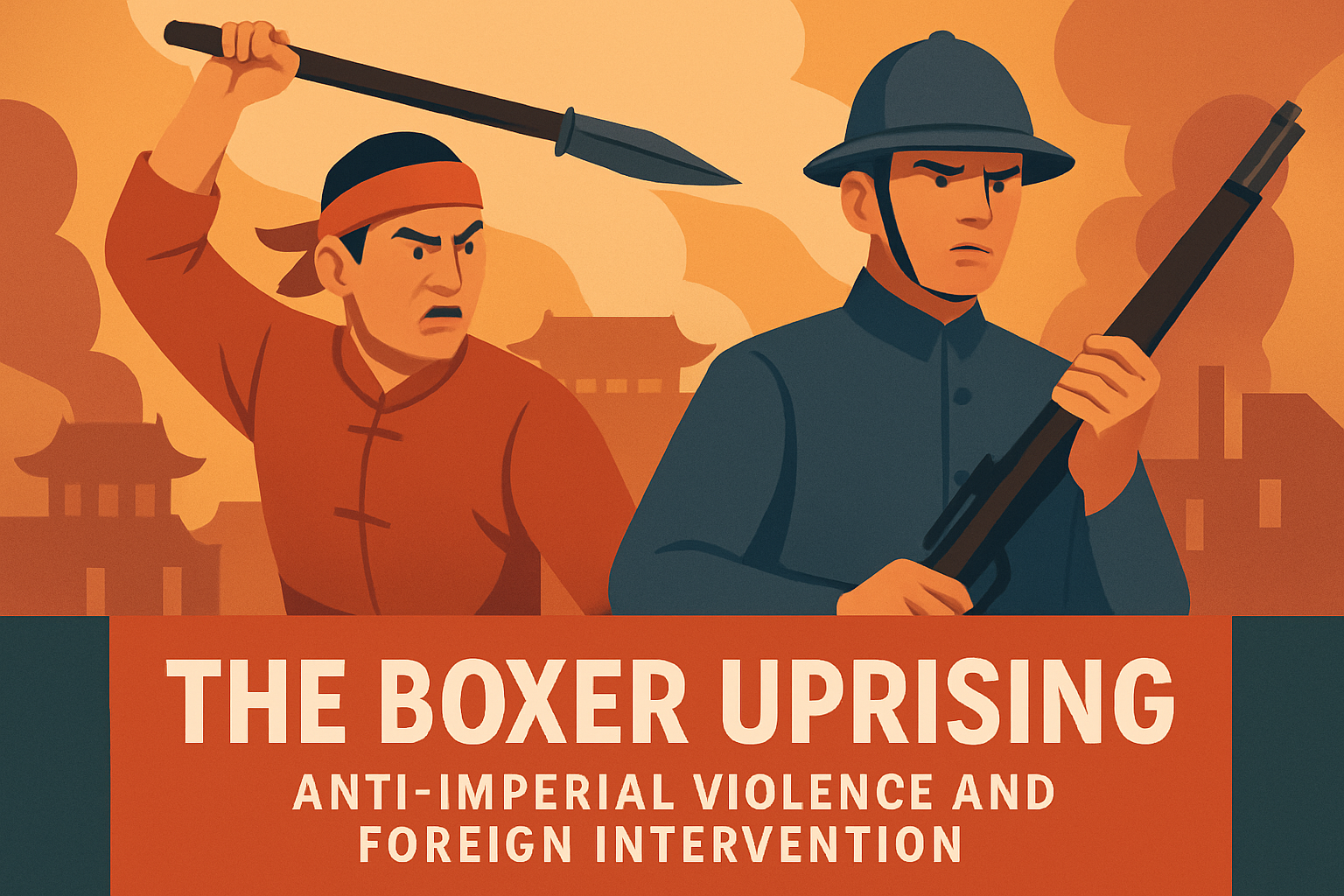
The Boxer Uprising was a violent anti-imperial movement in China that exploded between 1899 and 1901, bringing together rural militias, court politics, foreign intervention, and a crisis that reshaped East Asia. Historians usually define the uprising as a popular rebellion led by the Yihetuan, or “Righteous and Harmonious Fists,” a secretive northern Chinese movement whose members practiced martial rituals, attacked missionaries and Chinese converts, and blamed foreign influence for social and economic collapse. The term “Boxer” came from Western observers who associated their training with boxing drills, but the movement was far more than a martial arts cult. It was a reaction to imperial encroachment, environmental stress, state weakness, and cultural humiliation, all colliding at the end of the Qing dynasty.
Understanding the Boxer Uprising matters because it sits at the crossroads of anti-colonial resistance and catastrophic political miscalculation. In my experience writing about late Qing China, few events are as frequently simplified. Some accounts frame the Boxers only as xenophobic fanatics, while others romanticize them as pure freedom fighters. Neither view is adequate. The uprising was rooted in legitimate anger over foreign domination, unequal treaties, missionary privilege, railway expansion, indemnities, and military defeats. Yet it also unleashed brutal violence against civilians, especially Chinese Christians, and provoked an international military response that deepened China’s subordination.
To understand why the Boxers emerged, it helps to define the wider imperial context. After the Opium Wars and a string of unequal treaties, foreign powers including Britain, France, Germany, Russia, Japan, and the United States gained treaty ports, extraterritorial legal rights, missionary protections, commercial access, and strategic footholds inside China. The Sino-Japanese War of 1894 to 1895 exposed Qing weakness dramatically. Japan’s victory shocked Chinese elites and encouraged the “scramble for concessions,” during which foreign powers leased territory, built rail lines, mined resources, and carved out spheres of influence. For many villagers in Shandong and Zhili, imperialism was not an abstract diplomatic process. It meant land disputes, church-backed lawsuits, market disruption, and visible foreign intrusion into local life.
The Boxer Uprising also matters because it directly influenced modern Chinese nationalism. It revealed the danger of fragmented governance, the inability of the Qing state to control local violence, and the costs of confronting industrial powers without military modernization. It also left a memory of humiliation that later reformers, revolutionaries, and nationalist leaders repeatedly invoked. If you want to understand why anti-imperialism became central to twentieth-century Chinese politics, the Boxer crisis is essential. It shows how foreign intervention could intensify domestic collapse, and how domestic weakness could invite even greater foreign control.
Origins of the Boxer Movement in Northern China
The Boxer movement emerged primarily in Shandong province, where drought, social unrest, and foreign missionary expansion created combustible conditions. I find that the clearest way to explain its rise is to start locally. Villagers faced crop failure, debt, banditry, and declining trust in officials. At the same time, Catholic and Protestant missions expanded under treaty protection, often acquiring land and legal influence. Missionaries themselves were not all identical, and many provided education or medical care, but the structure of missionary privilege changed local power balances. Chinese converts could seek church protection in disputes, which non-converts often saw as unfair interference. These conflicts were not merely religious. They were about authority, taxation, lawsuits, and access to community institutions.
The Yihetuan drew from existing martial arts societies, spirit possession practices, and militia traditions. Their rituals promised invulnerability to bullets and divine protection, ideas that seem irrational from a modern military perspective but made sense within a world shaped by folk religion, performance culture, and desperation. Local leaders used charms, drills, and public ceremonies to build cohesion. Slogans such as “Support the Qing, destroy the foreign” captured the movement’s contradictory political position. The Boxers were anti-foreign, but at first they were not simply anti-dynastic rebels. Many believed they were defending China and even the Qing throne from invasive outsiders.
German activity in Shandong helped radicalize resistance. After the 1897 murder of two German missionaries, Germany seized Jiaozhou Bay and expanded its presence aggressively. This pattern, familiar across imperial history, turned a local incident into territorial occupation. Railway construction and mission growth followed. When local communities watched foreign governments use missionary deaths as pretexts for strategic expansion, suspicion hardened into rage. By 1898 and 1899, Boxer bands were spreading, attacking churches, cutting telegraph lines, and targeting symbols of foreign power.
Why Anti-Foreign Violence Spread So Quickly
Anti-foreign violence spread because several grievances overlapped at once: environmental crisis, economic anxiety, dynastic weakness, and visible legal inequality. In north China, severe drought in 1899 and 1900 devastated agriculture. In rural societies dependent on stable harvests, drought quickly became a political issue. People searched for causes and culprits. Foreign railways, telegraph poles, Christian churches, and mission compounds became easy targets because they symbolized disruptive change. Rumors spread that foreigners desecrated graves, kidnapped children, or disturbed feng shui through construction. Such rumors were false in many cases, but they were powerful because they encoded real fears about local dislocation.
The Qing court’s mixed response accelerated the crisis. Some officials suppressed Boxer groups, especially when violence threatened order. Others saw them as useful auxiliaries against foreigners. Empress Dowager Cixi and conservative court factions gradually moved toward toleration, then support, especially after reform politics fractured the court following the failed Hundred Days’ Reform of 1898. This was a decisive turning point. Once local militants sensed that elements of the state might protect them, recruitment broadened. In practical terms, ambiguity from Beijing functioned like permission.
Chinese Christians suffered heavily because they occupied the fault line between local society and global imperial privilege. Many were ordinary villagers with sincere religious commitments, but during the uprising they were frequently treated as extensions of foreign influence. Boxer attacks on converts were therefore both sectarian and political. This distinction matters. The uprising was not simply a war between China and the West. It was also a civil conflict inside Chinese communities, where loyalty, religion, and local alliances were contested under extreme pressure.
| Factor | How it fueled the Boxer Uprising | Example |
|---|---|---|
| Foreign imperialism | Created resentment through concessions, occupation, and extraterritorial rights | Germany’s seizure of Jiaozhou Bay after 1897 |
| Missionary privilege | Shifted local legal and social power toward protected converts | Church involvement in village disputes in Shandong |
| Environmental stress | Made rural hardship more intense and sharpened scapegoating | North China drought in 1899–1900 |
| Qing weakness | Encouraged militias to believe the state could not restore order alone | Conflicting provincial and court responses to Boxers |
| National humiliation | Turned local anger into anti-imperial politics | Aftermath of the Sino-Japanese War |
The Siege of the Legations and International Response
The best-known episode of the Boxer Uprising was the siege of the foreign legation quarter in Beijing during the summer of 1900. After Boxers entered the capital and anti-foreign violence escalated, diplomats, soldiers, missionaries, and Chinese Christians retreated into the legation district. Qing troops eventually joined the siege, confirming that the conflict had crossed from riot and militia violence into a wider war involving the imperial state. The siege lasted fifty-five days and became a global media event. Newspapers in Europe, the United States, and Japan framed it as a drama of civilization under attack, often erasing the longer history of imperial coercion that had produced the crisis.
Before the siege was lifted, an initial multinational relief expedition under Admiral Seymour failed to reach Beijing. That failure revealed how serious resistance had become. A larger Eight-Nation Alliance then assembled, consisting of Japan, Russia, Britain, the United States, Germany, France, Austria-Hungary, and Italy. In military terms, Japan contributed a substantial and effective force, underscoring its new regional status after victory over Qing China in 1895. The alliance captured Tianjin, marched to Beijing, and relieved the legations in August 1900.
Foreign intervention was not a limited rescue mission. It involved large-scale punitive violence, looting, executions, and reprisals against suspected Boxers and civilians. I think this point is indispensable because older narratives often describe intervention as if it restored order cleanly. It did not. Allied troops committed widespread abuses in Beijing and north China. German Kaiser Wilhelm II’s infamous “Hun speech,” urging ferocious conduct, reflected the revenge mentality shaping the campaign. Russian forces acted brutally in Manchuria. Even where officers tried to impose discipline, occupation warfare generated theft, assault, and indiscriminate punishment. China’s anti-imperial explosion had now produced an even harsher imperial demonstration of force.
The Qing Court, Cixi, and the Politics of Miscalculation
Empress Dowager Cixi remains central to any serious explanation of the Boxer crisis because the court’s decisions transformed a regional uprising into an international disaster. At first, the Qing state vacillated. Senior officials understood that China could not defeat a coalition of industrial powers in open war. Others believed that foreign powers were divided and that Boxer militias could be used strategically. Cixi’s eventual decision in June 1900 to back the anti-foreign struggle and declare war on foreign states was one of the most consequential miscalculations in late imperial Chinese history.
That choice did not arise from ignorance alone. The court had reasons, however flawed, for thinking confrontation might succeed. Foreign powers competed with one another, and provincial officials were not uniformly obedient to Beijing. Anti-foreign sentiment was intense. Boxer crowds appeared numerous and energized. Yet these factors could not compensate for China’s military weakness, logistical fragmentation, and outdated command structure. As I assess the evidence, the Qing leadership confused symbolic mobilization with strategic capacity. They saw mass anger and treated it as combat power.
Not all Qing officials followed the court line fully. Governors such as Li Hongzhang and other provincial leaders in the south pursued a policy often described as “mutual protection,” limiting participation in the anti-foreign war and preserving regional stability. This divergence exposed a fundamental problem in Qing governance: the empire no longer acted as a unified state. Provincial pragmatism helped prevent a broader national collapse, but it also demonstrated that Beijing’s authority was compromised. When the court fled Beijing for Xi’an after the allied advance, the image of imperial sovereignty suffered another devastating blow.
Consequences of the Boxer Protocol
The Boxer Uprising ended formally with the Boxer Protocol of 1901, an agreement that imposed severe terms on Qing China. The protocol required a massive indemnity of 450 million taels of silver, payable with interest over decades, making the total burden far larger in practice. It authorized foreign troops to be stationed along the route from Beijing to the sea, ordered the destruction of forts such as Dagu, punished officials deemed responsible for anti-foreign actions, and expanded foreign security privileges in the capital. In short, the settlement institutionalized the very foreign control that the Boxers had tried to destroy.
The indemnity had long-term consequences for finance and reform. Revenues were redirected to debt service, increasing pressure on taxation and administration. At the same time, the shock of defeat convinced many Qing officials that substantial modernization could no longer be delayed. New policy initiatives after 1901 included military reorganization, educational reform, the abolition of the civil service examination in 1905, and plans for constitutional restructuring. These measures were important, but they came late and under humiliating circumstances. Reform after the Boxer disaster was reactive, not sovereign.
The uprising also changed international perceptions of China. Foreign governments and publics often portrayed the crisis as proof of Chinese barbarism, a deeply racist interpretation that ignored the violence of empire itself. Yet inside China, the lesson many reformers drew was different. They concluded that state weakness invited foreign domination and that cultural outrage without institutional modernization was self-defeating. This insight influenced late Qing constitutionalists, revolutionary movements, and later nationalist narratives under both the Republic and the People’s Republic. The Boxer Uprising became a warning about both imperial predation and reckless resistance.
How Historians Interpret the Boxer Uprising Today
Modern historians interpret the Boxer Uprising through several overlapping lenses: anti-imperial nationalism, rural social protest, religious conflict, and state failure. The strongest scholarship resists one-dimensional explanations. If someone asks, “Were the Boxers patriots or fanatics?” the best answer is that they were both less and more than those labels suggest. They were local actors responding to genuine imperial domination, but their methods included terror, rumor-driven killings, and attacks on vulnerable Chinese neighbors. Their movement expressed patriotism, millenarian belief, and communal violence at the same time.
There is also an important debate about nationalism. The Boxers used proto-national language, but they did not represent a modern centralized nationalist movement in the twentieth-century sense. Their loyalties were shaped by village society, folk religion, and dynastic symbolism as much as by national consciousness. Still, later generations folded the uprising into a broader anti-imperial story because it dramatized resistance to foreign domination vividly. That is why the Boxer Uprising remains politically resonant: it can be remembered as both a tragedy and a defiant refusal to accept colonial subordination.
The clearest takeaway is that anti-imperial violence and foreign intervention fed each other in a destructive cycle. Foreign encroachment generated resentment; resentment produced attacks; attacks invited overwhelming intervention; intervention imposed deeper control. Breaking that cycle required the kind of state capacity, diplomatic leverage, and modernization the Qing lacked. For readers studying Chinese history, global imperialism, or the roots of modern nationalism, the Boxer Uprising offers a precise case study in how local grievance can escalate into world crisis. Read further into the late Qing reforms and the 1911 Revolution, and the full historical significance of the Boxer Uprising becomes unmistakable.
Frequently Asked Questions
What was the Boxer Uprising, and why did it begin?
The Boxer Uprising was a violent anti-imperial movement that erupted in northern China between 1899 and 1901. It was led largely by the Yihetuan, often translated as the “Righteous and Harmonious Fists,” a loose network of rural militant groups whose members blended martial arts, spiritual practices, and anti-foreign activism. The movement emerged during a period of severe strain in late Qing China, when foreign powers had carved out spheres of influence, missionaries operated under special protections, and many Chinese communities felt politically humiliated, economically squeezed, and culturally threatened. In that atmosphere, the Boxers portrayed themselves as defenders of China’s moral order and local society.
The uprising began for several overlapping reasons. Foreign expansion had intensified after China’s defeats in the nineteenth century, especially after the Sino-Japanese War of 1894–1895, which exposed Qing weakness and encouraged imperial competition. Missionary activity also became a major source of tension. Many villagers believed that Christian converts received unfair legal protection from foreign authorities and missionaries, upsetting local power relations and provoking resentment. At the same time, drought, famine, unemployment, and social instability deepened frustration in the countryside. The Boxers channeled these grievances into direct violence, targeting missionaries, Chinese Christians, railways, and symbols of foreign intrusion. In short, the uprising began not from a single cause, but from the explosive combination of imperial pressure, local hardship, religious conflict, and state weakness.
Who were the Boxers, and what did they believe?
The Boxers were not a formal army in the modern sense, but rather a decentralized popular movement rooted mainly in rural northern China. Their followers often came from villages suffering economic insecurity, ecological hardship, and social dislocation. Many practiced ritualized martial exercises, spirit possession, and protective ceremonies that they believed made them invulnerable to bullets and capable of resisting foreign enemies. These beliefs helped create solidarity, courage, and a sense of sacred mission, especially among people who had little confidence in the Qing state’s ability to defend them.
Ideologically, the Boxers combined anti-foreignism, anti-Christian sentiment, and loyalty to a vision of Chinese cultural and moral order. They blamed outsiders for China’s troubles and saw missionaries and Chinese converts as agents of disruption. Railroads, telegraph lines, and churches were not merely physical structures in Boxer eyes; they were visible signs of foreign domination and the erosion of traditional life. Although the movement is sometimes described simply as xenophobic, that label alone is too narrow. The Boxers were responding to real power imbalances created by imperialism, unequal treaties, and foreign legal privileges. Their methods were brutal, but their worldview was shaped by deep fears that China was being dismantled politically, spiritually, and socially. That combination of popular anger, cultural defense, and millenarian belief gave the movement its intensity.
How did the Qing government respond to the Boxer Uprising?
The Qing government’s response was divided, hesitant, and deeply shaped by internal political struggle. At first, many officials viewed the Boxers with suspicion because the movement was disorderly and potentially dangerous to state authority. Some provincial leaders tried to suppress them. Others, however, saw the Boxers as useful allies against foreign encroachment. This split reflected a broader crisis within the Qing court, where officials disagreed over whether China should resist foreign powers militarily or avoid confrontation and preserve what remained of its sovereignty through compromise.
The most dramatic shift came at the imperial court under the influence of Empress Dowager Cixi. As violence escalated and foreign pressure intensified, elements within the Qing leadership moved toward supporting the Boxers rather than crushing them. The court eventually sided with anti-foreign forces, and in 1900 Qing troops and Boxer fighters participated in the siege of the foreign legation quarter in Beijing. That decision transformed a regional uprising into a major international crisis. Still, Qing policy was never fully unified; some governors in southern and central China refused to follow the court into full-scale war with foreign powers. The government’s inconsistent reaction revealed how weakened and fragmented the dynasty had become. In trying to use popular anti-foreign violence for political purposes, the Qing court helped trigger a devastating intervention that further discredited the dynasty and accelerated calls for reform and revolution.
What role did foreign powers play in the conflict and its outcome?
Foreign powers were central to both the causes and the outcome of the Boxer Uprising. Britain, France, Germany, Russia, Japan, the United States, Italy, and Austria-Hungary all had interests in China, ranging from trade and missionary protection to military influence and territorial access. As Boxer attacks spread and foreign diplomats, missionaries, soldiers, and civilians came under threat, these powers coordinated an armed response. The crisis escalated dramatically during the siege of the foreign legations in Beijing, which became the key justification for a large multinational military intervention.
The Eight-Nation Alliance sent troops into China, fought their way to Beijing in 1900, lifted the siege, and imposed harsh reprisals. The intervention involved not only military rescue operations but also looting, executions, collective punishment, and widespread destruction, especially in northern China. In 1901, the Qing government was forced to sign the Boxer Protocol, a punitive settlement that required enormous indemnity payments, allowed foreign troops to be stationed in key areas, and further expanded foreign influence inside China. This outcome was a major humiliation for the Qing dynasty and a stark demonstration of imperial power. At the same time, it intensified Chinese nationalism by convincing many intellectuals, officials, and reformers that the old political order could no longer protect the country. So foreign powers did not merely suppress the uprising; they helped create the conditions for it and then used the crisis to deepen China’s subordination, with long-term consequences for East Asian politics.
Why is the Boxer Uprising historically important?
The Boxer Uprising is historically important because it sits at the intersection of popular resistance, imperial expansion, dynastic decline, and modern nationalism. It was one of the most dramatic anti-foreign explosions of the late nineteenth and early twentieth centuries, showing how deeply imperial intrusion had destabilized Chinese society. The uprising revealed that rural communities were not passive observers of global change; they could become violent political actors when economic pressure, cultural conflict, and foreign domination converged. Even though the Boxers were defeated, their rebellion exposed the intensity of anti-imperial feeling in China and forced both Chinese and foreign observers to confront the social consequences of empire.
Its long-term significance is equally profound. The failure of the Qing state during the uprising further undermined confidence in the dynasty and contributed to the momentum that led to the 1911 Revolution. The Boxer Protocol imposed severe financial and political burdens that weakened the government even more. At the intellectual level, the crisis pushed reformers and revolutionaries to debate how China could survive in a world dominated by imperial powers. Some argued for constitutional reform, others for revolution, modernization, or stronger nationalism. In international terms, the uprising reshaped how global powers approached China and highlighted East Asia as a major arena of imperial rivalry. For historians, the Boxer Uprising remains essential because it was not just a violent episode of rebellion; it was a turning point that illuminated the collapse of the old order and the turbulent birth of modern Chinese politics.