
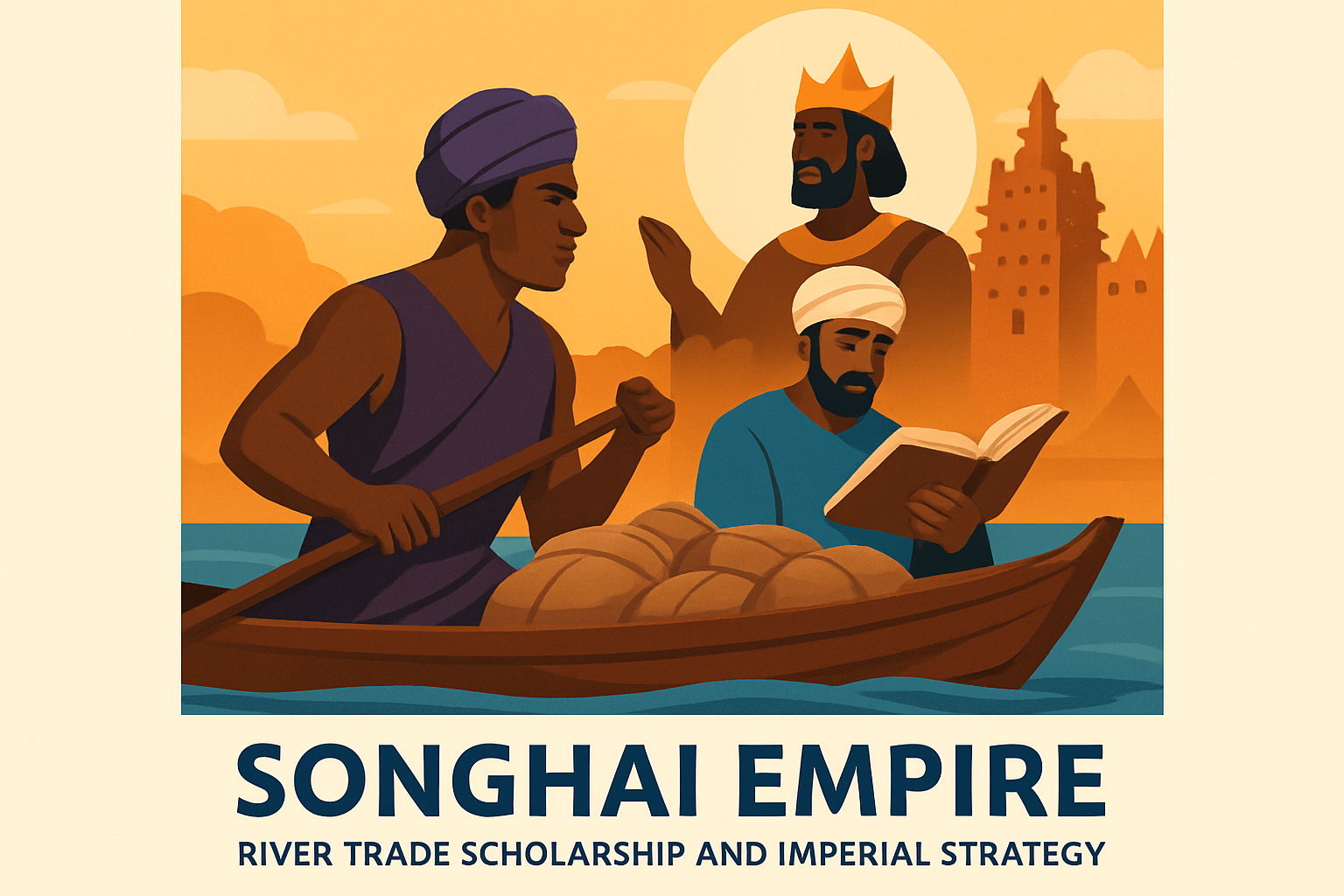
The Songhai Empire emerged along the great bend of the Niger River and became one of the most formidable states in African history by turning geography into power. At its height in the fifteenth and sixteenth centuries, Songhai controlled key commercial corridors across West Africa, governed diverse peoples through a flexible imperial system, and supported centers of Islamic learning that attracted scholars from far beyond the Sahara. The phrase “river trade scholarship and imperial strategy” captures the three foundations that made Songhai exceptional: mastery of transport and exchange on the Niger, investment in intellectual life at cities such as Timbuktu, and deliberate military and administrative policies that allowed rulers to hold an immense territory together.
In practical terms, Songhai was not simply a kingdom that grew larger through conquest. It was a riverine empire. The Niger functioned as a commercial highway, a communication route, and a strategic barrier. Boats moved grain, fish, kola nuts, textiles, slaves, and imported goods between inland markets more efficiently than caravans alone could manage. At the same time, trans-Saharan trade linked Songhai to North Africa, bringing salt, horses, books, metal goods, and religious ideas. From my experience studying premodern trade systems, Songhai stands out because it blended inland water transport with desert caravan commerce better than most empires discussed in standard world history surveys.
Scholarship mattered just as much as commerce. Cities under Songhai rule, especially Timbuktu and Djenné, developed reputations for jurisprudence, theology, grammar, astronomy, and manuscript culture. The Sankore tradition, often simplified in popular writing as a single university, was actually a network of scholars, mosques, teachers, and libraries. This distinction matters because it shows how knowledge circulated through households, patronage ties, and legal institutions rather than through one centralized campus. Islamic learning also strengthened legitimacy. Rulers could present themselves not only as conquerors but as protectors of law, endowers of mosques, and participants in the broader intellectual world of the Muslim Sahel and Maghrib.
Imperial strategy tied these elements together. Songhai rulers, most notably Sunni Ali and Askia Muhammad, understood that revenue, religion, and force had to reinforce one another. Control of river ports supported taxation. Taxation funded armies. Armies protected trade and expanded the empire into productive agricultural zones and commercial towns. Meanwhile, support for judges, scholars, and mosque communities helped transform military success into accepted rule. This article explains how Songhai built power through river trade, how scholarship enhanced prestige and governance, and how imperial strategy enabled the empire to dominate a large portion of West Africa before external pressures and internal fractures weakened it.
River Trade as the Engine of Songhai Power
The Niger River was the empire’s economic backbone. Long before Songhai reached its imperial peak, Gao had already developed as a commercial center because it sat near a major river crossing and connected Sahelian producers with Saharan merchants. When Songhai rulers consolidated authority over stretches of the Niger, they gained more than access to local markets. They acquired leverage over movement itself. In premodern states, whoever controlled choke points, ferries, landing sites, and river towns could influence prices, collect duties, and reward allies. Songhai did exactly that.
River trade was especially effective because it reduced transport costs for bulky goods. Grain, rice from floodplain agriculture, fish from the inland delta, and livestock products could move in larger quantities by boat than by pack animal. That mattered for urban growth. Cities such as Timbuktu and Gao needed dependable food supplies, and the river made concentration of population more feasible. It also supported military logistics. Supplying troops over distance is one of the hardest parts of empire building, and Songhai benefited from the same transport system that enriched merchants.
Trans-Saharan exchange expanded these advantages. Salt from Taghaza remained indispensable in West African markets, while gold from regions farther south moved northward through commercial networks linked to Songhai-controlled towns. Although historians rightly caution against reducing West African history to “gold and salt,” those commodities did structure political competition. States that could secure caravan termini and protect merchant traffic had a decisive fiscal edge. Songhai inherited and extended patterns previously developed by Ghana and Mali, but it did so with greater emphasis on the Niger corridor as an integrated internal artery.
In administrative terms, trade was not left to chance. Officials supervised markets, levied customs, and monitored strategic towns. Based on Arabic chronicles such as the Tarikh al-Sudan and Tarikh al-Fattash, along with archaeological evidence, we can see that commerce depended on political order. Merchants invested where rulers could deter raids, settle disputes, and standardize expectations. Songhai’s success therefore came from governance as much as geography. The empire did not invent the Niger’s commercial value; it institutionalized and militarized it.
Scholarship, Manuscripts, and the Prestige of Timbuktu
Timbuktu became famous because it stood at the intersection of trade and learning. Caravans brought wealth, but they also brought jurists, teachers, students, and books. In the fifteenth and sixteenth centuries, the city housed respected scholars whose work in Maliki law and Islamic theology gave Songhai cultural influence far beyond its borders. When modern readers hear that Timbuktu possessed libraries and manuscript collections, the claim is not romantic exaggeration. Surviving manuscripts and documentary traditions confirm a deep scholarly culture rooted in copying, commentary, debate, and legal practice.
The Sankore, Jinguereber, and Sidi Yahya mosque communities formed the best-known nodes in this intellectual landscape. Yet scholarship in Timbuktu was decentralized. Teachers instructed students in circles, families preserved texts, and judges issued opinions grounded in recognized legal schools. This pattern resembles other Islamic scholarly centers where authority rested less on a single institution than on chains of transmission, mastery of texts, and reputations earned through teaching. I find this especially important when correcting common misconceptions: Timbuktu was not a mythic city of abstract wisdom but a working urban center where literacy served law, commerce, religion, and administration.
Books were valuable trade goods in their own right. Manuscripts could be imported from North Africa or copied locally, and elite demand for them created prestige economies around learning. A ruler who welcomed scholars enhanced both legitimacy and diplomatic standing. Askia Muhammad, in particular, cultivated ties with Islamic scholars and completed the pilgrimage to Mecca, actions that signaled piety while also placing Songhai within wider Muslim political discourse. His consultations with jurists were politically useful because they associated rule with justice and orthodoxy, though local practices and older customs certainly persisted.
Scholarship also had practical consequences. Islamic judges helped regulate inheritance, contracts, debt, and commercial disagreements. In a trading empire, reliable legal norms reduce friction. Merchants are more willing to move goods and extend credit when courts recognize obligations and respected scholars can arbitrate disputes. Timbuktu’s intellectual life therefore should not be separated from economics. It strengthened trust, connected Songhai to transregional networks, and trained literate specialists who could support governance.
Imperial Strategy Under Sunni Ali and Askia Muhammad
Songhai’s rise to imperial status depended on leadership that understood force, mobility, and symbolism. Sunni Ali, who ruled from 1464 to 1492, expanded Songhai through sustained military campaigns that targeted strategic cities and routes. He is often remembered as a formidable cavalry commander and riverine war leader, and that reputation is deserved. Controlling both mounted forces and boats gave him an unusual operational advantage in the Sahel. He used this advantage to seize Timbuktu in 1468 and Djenné in 1473, bringing two major urban centers under Songhai authority.
Sunni Ali’s rule illustrates a classic imperial principle: conquer logistics first, then territory follows. By targeting commercial hubs, he deprived rivals of revenue while integrating valuable populations into his own state. However, chronicles written from scholarly Muslim perspectives portray him ambivalently, sometimes critically, because his policies toward religious elites were not always conciliatory. Historians must read these sources carefully. They reveal tensions between military rulers and urban scholars, but they also show that imperial consolidation was never ideologically simple.
Askia Muhammad, who took power in 1493, shifted the balance toward bureaucratic and religious legitimacy without abandoning expansion. He reorganized provincial administration, appointed governors, and improved the tax system. He also strengthened ties with Muslim scholars and is widely associated with a more explicitly Islamic style of kingship. This was not mere image management. In a large empire containing many ethnic groups, languages, and local traditions, a shared legal and religious framework could help stabilize rule, especially in major towns.
The contrast between Sunni Ali and Askia Muhammad is sometimes exaggerated into warrior versus reformer, but in practice both relied on the same strategic logic: command key routes, dominate productive regions, and turn urban centers into pillars of state capacity. Their methods differed in tone and emphasis. Sunni Ali excelled in conquest and direct coercion. Askia Muhammad deepened administration and ideological legitimacy. Together, their reigns explain why Songhai became the largest empire in West African history before the Moroccan invasion of 1591.
How Songhai Governed a Vast and Diverse Empire
Large empires survive only if they can translate conquest into routine administration. Songhai did this through layered governance rather than rigid centralization. The emperor ruled from Gao, but provincial governors, local chiefs, military commanders, tax officials, and judges all played roles in day-to-day order. This arrangement allowed the state to project authority over great distances without needing to replace every local institution. In my assessment, this flexibility was one of Songhai’s greatest strengths and one of the reasons it expanded so rapidly.
Different regions served different functions. River valleys contributed food and transport. Saharan links generated customs revenue. Urban centers supplied artisans, scholars, and merchants. Frontier zones required military oversight. Songhai’s rulers recognized these differences and governed accordingly. Some communities retained local leaders under imperial supervision, while more strategic areas received closer oversight. This resembles later empires that used indirect rule where practical and direct control where necessary.
Military organization remained central. Cavalry was effective in open Sahelian terrain, but horses were expensive because they had to be maintained in difficult environmental conditions and were vulnerable to disease farther south. River forces mattered as well, especially for communication and campaigns along the Niger. Strategic mobility gave Songhai an edge over rivals who controlled only desert routes or only inland farming zones. The empire’s military geography is impossible to understand without the river.
| Imperial pillar | How Songhai used it | Strategic effect |
|---|---|---|
| Niger River transport | Moved food, troops, and trade goods between Gao, Timbuktu, and other towns | Lowered logistics costs and improved control of internal markets |
| Trans-Saharan trade | Taxed caravans carrying salt, books, textiles, horses, and luxury goods | Generated revenue and linked Songhai to North African networks |
| Urban scholarship | Supported judges, mosques, teachers, and manuscript culture in Timbuktu and Djenné | Increased legitimacy, legal reliability, and diplomatic prestige |
| Provincial administration | Appointed governors and supervised local rulers in conquered regions | Extended imperial reach without constant direct occupation |
| Military mobility | Combined cavalry, infantry, and river craft in campaigns | Enabled rapid conquest and defense of trade corridors |
Taxation and tribute bound these pillars together. States need predictable income, and Songhai drew it from customs duties, agricultural production, subject populations, and control of markets. Yet imperial extraction had limits. If taxes became too heavy or provincial elites felt marginalized, resistance followed. The durability of Songhai therefore depended on balancing coercion with cooperation, a challenge familiar to every large premodern empire.
Decline, Moroccan Invasion, and Enduring Legacy
Songhai’s decline did not occur because trade suddenly disappeared or scholarship lost relevance. The empire weakened through a combination of succession struggles, regional tensions, and external military pressure. After the high point of Askia Muhammad’s reign, internal contests eroded central authority. When dynastic disputes multiply, governors and military leaders begin acting autonomously, which reduces tax flow and weakens frontier defense. This pattern is visible across world history and applies clearly to Songhai.
The decisive shock came from Morocco. Sultan Ahmad al-Mansur sought control over Saharan trade and especially the salt mines of Taghaza, while also pursuing prestige and revenue after costly military campaigns elsewhere. In 1591, a Moroccan force equipped with arquebuses crossed the Sahara and defeated Songhai troops at the Battle of Tondibi. Firearms alone do not explain the outcome, but they mattered psychologically and tactically against forces organized around cavalry and traditional weapons. More important, the invasion exploited an empire already suffering from political fragmentation.
Even after the imperial center collapsed, Songhai’s institutions and cultural achievements did not vanish. Timbuktu remained a scholarly symbol. Manuscript collections endured through family preservation, despite later dispersal and danger. Commercial habits along the Niger continued because rivers outlast regimes. In that sense, Songhai’s legacy is structural as well as historical. It demonstrated that West African states could integrate long-distance trade, urban learning, and imperial administration on a very large scale.
For modern readers, the main lesson is clear. Songhai was powerful not because it possessed one extraordinary resource, but because it aligned economic geography, intellectual authority, and statecraft. River trade created wealth and mobility. Scholarship produced legitimacy and legal order. Imperial strategy converted both into durable, if ultimately vulnerable, power. Understanding Songhai on these terms moves beyond outdated stereotypes and places the empire where it belongs: at the center of serious global history. If you want to deepen that understanding, explore primary chronicles, manuscript research, and comparative studies of Sahelian empires next.
Frequently Asked Questions
What made the Songhai Empire so powerful in West Africa?
The Songhai Empire became powerful because it combined geography, commerce, military organization, and political adaptability in an unusually effective way. Its core territory lay along the great bend of the Niger River, one of the most important transportation and agricultural zones in West Africa. Control of this river system gave Songhai a practical advantage: it could move people, goods, and military forces more efficiently than many rivals. The river supported farming, fishing, and regional exchange, while nearby overland caravan routes connected the empire to Saharan and North African trade networks. In other words, Songhai did not simply occupy a valuable region; it mastered a landscape that linked local production to long-distance commerce.
Its rulers also expanded strategically. Under leaders such as Sunni Ali and Askia Muhammad, Songhai brought major urban and commercial centers under imperial authority, including cities that had long been associated with trans-Saharan trade and Islamic scholarship. This expansion was not just about conquest for its own sake. It was a way of securing customs revenues, regulating trade routes, and preventing rivals from controlling key gateways of wealth and influence. By holding both riverine corridors and desert-facing market towns, Songhai positioned itself at the center of exchange in gold, salt, textiles, kola nuts, and enslaved persons, among other goods.
Just as important, the empire governed a large and diverse population through a flexible system of rule. Rather than trying to erase local authority everywhere, Songhai often incorporated regional elites and allowed varying administrative arrangements across different territories. That flexibility helped the empire manage distance and diversity. Its power, then, rested on more than military strength alone. Songhai was formidable because it turned trade routes into state revenue, geography into logistical advantage, and political strategy into imperial durability.
How did the Niger River shape Songhai’s economy and imperial strategy?
The Niger River was central to nearly every aspect of Songhai’s rise. Economically, it functioned as an artery of movement and exchange. River transport could move bulk goods more reliably and efficiently than many overland alternatives, especially across regions where terrain and climate could make travel difficult. Communities along the Niger produced food, supported fisheries, and participated in local and regional markets, creating a strong internal economic base. That internal base mattered because empires are not sustained by luxury goods alone; they need dependable supplies of grain, labor, and transportation. The Niger helped provide all three.
From an imperial standpoint, the river was also a strategic tool. A state that controlled major stretches of the Niger could coordinate communication, deploy forces, provision garrisons, and maintain closer ties between urban centers and provincial territories. This made the river not just a commercial resource but an instrument of administration and military planning. It allowed Songhai to project authority over a broad zone that linked agricultural communities, trading towns, and scholarly cities. In a region where control of distance often determined political success, river access reduced the costs of empire.
The Niger also connected Songhai to broader trans-Saharan exchange. Goods flowing from forest and savanna regions could move toward major inland centers, where they entered networks that stretched north across the desert. Likewise, salt and other imports from the Sahara and Mediterranean-connected markets could circulate southward. Songhai’s rulers understood that controlling trade was not simply about taxing merchants at isolated points. It was about commanding the routes, crossings, and urban hubs that made exchange possible. That is why the phrase “river trade scholarship and imperial strategy” fits the empire so well: the river supported wealth, wealth supported rule, and rule helped protect the conditions that made both possible.
Why was scholarship so important in the Songhai Empire?
Scholarship was important in Songhai because learning was tied to religion, legitimacy, urban prestige, and international connection. Major cities within the empire, especially Timbuktu and Djenné, became famous as centers of Islamic learning. Scholars taught law, theology, grammar, rhetoric, mathematics, and other subjects within a wider intellectual tradition that linked West Africa to North Africa and the broader Islamic world. These centers were not isolated outposts. They attracted students, jurists, scribes, and teachers from different regions, making the empire part of a vibrant scholarly network that crossed the Sahara.
For rulers, the support of scholarship offered clear political benefits. Islamic scholars could enhance the prestige of a court, contribute to administration, and help frame government in terms recognized across a wide cultural sphere. Under Askia Muhammad in particular, connections to Islamic learning and legal tradition became closely associated with kingship and statecraft. Patronage of scholars, mosques, and educational institutions signaled that imperial authority was not based solely on force. It also rested on moral standing, religious affiliation, and intellectual seriousness. In this way, scholarship reinforced the public image of the state.
At the same time, scholarship had social and cultural significance beyond royal propaganda. Manuscript culture, teaching lineages, and learned debate helped create durable communities of knowledge. These scholarly traditions shaped law, commerce, and everyday religious life. They also challenge outdated assumptions that precolonial African empires were politically impressive but intellectually marginal. Songhai demonstrates the opposite. Its learned centers were internationally respected, and their influence outlasted particular rulers and dynasties. Scholarship mattered because it helped bind local society to wider worlds of thought, while also giving the empire cultural authority that complemented its military and commercial power.
How did Songhai govern such a large and diverse empire?
Songhai governed its empire through a combination of centralized authority and local flexibility. This was essential because the empire included different ecological zones, ethnic communities, commercial interests, and urban traditions. No premodern state could rule such a broad territory effectively through uniform control alone. Songhai’s rulers therefore relied on appointed officials in some areas, military oversight in strategic regions, and cooperation with local elites in others. That mix helped the empire extend power without having to impose the same administrative model everywhere.
Urban centers were particularly important to governance. Cities acted as nodes of taxation, law, trade supervision, and communication. By holding major commercial towns, Songhai could monitor revenue and influence the movement of merchants and goods. Provincial authorities and local leaders often remained significant, but they did so within an imperial framework that expected loyalty, tribute, and political recognition of the ruling power. This system allowed the empire to absorb diverse populations while maintaining enough cohesion to function as a large state.
Military force remained a key part of this structure. Expansion under strong rulers was backed by organized campaigns, and the empire depended on the ability to suppress revolt, protect routes, and deter rivals. But force alone was not sufficient. The most successful imperial systems are those that know when to negotiate, when to incorporate, and when to intervene directly. Songhai’s strength came from this balance. It could be assertive where strategic interests were at stake, especially along trade corridors and in major cities, yet pragmatic in dealing with local realities. That administrative flexibility helps explain how the empire managed to govern such a wide domain during its height.
What led to the decline of the Songhai Empire?
The decline of the Songhai Empire resulted from a combination of internal strain and external pressure rather than a single sudden collapse. Large empires are difficult to maintain, especially when they depend on long-distance communications, military coordination, and continued control of lucrative trade routes. Over time, succession disputes, regional tensions, and the challenges of governing distant territories could weaken central authority. As imperial cohesion frayed, the ability to command loyalty and respond quickly to threats became more fragile.
External invasion played a decisive role in the empire’s downfall. In 1591, forces from Morocco invaded Songhai, motivated in part by the desire to control the wealth of the trans-Saharan trade, including access to gold-producing regions and trade revenues. The Moroccan army possessed firearms, which gave it a significant advantage in key confrontations. Although technology alone does not explain everything, the invasion exposed vulnerabilities in a vast empire already under pressure. The defeat of central Songhai forces disrupted the political order that had held together major cities, trade networks, and provincial relationships.
Even after the empire’s political fragmentation, however, its legacy did not disappear. Commercial life continued in many areas, and centers of scholarship retained cultural importance. The memory of Songhai endured because it had been more than a dynasty of conquerors. It was a sophisticated imperial system built on the interdependence of river trade, learning, and strategic governance. Its decline reminds us that even powerful states can be undone when internal instability intersects with aggressive outside intervention. Its history remains significant precisely because it shows both the remarkable possibilities and the real vulnerabilities of premodern empire.